
Honda Hybrid Mileage Dispute and the Power of Small Claims Court
How a Honda Civic Hybrid mileage dispute in small claims court reshaped views on consumer claims, advertising, and appeals.
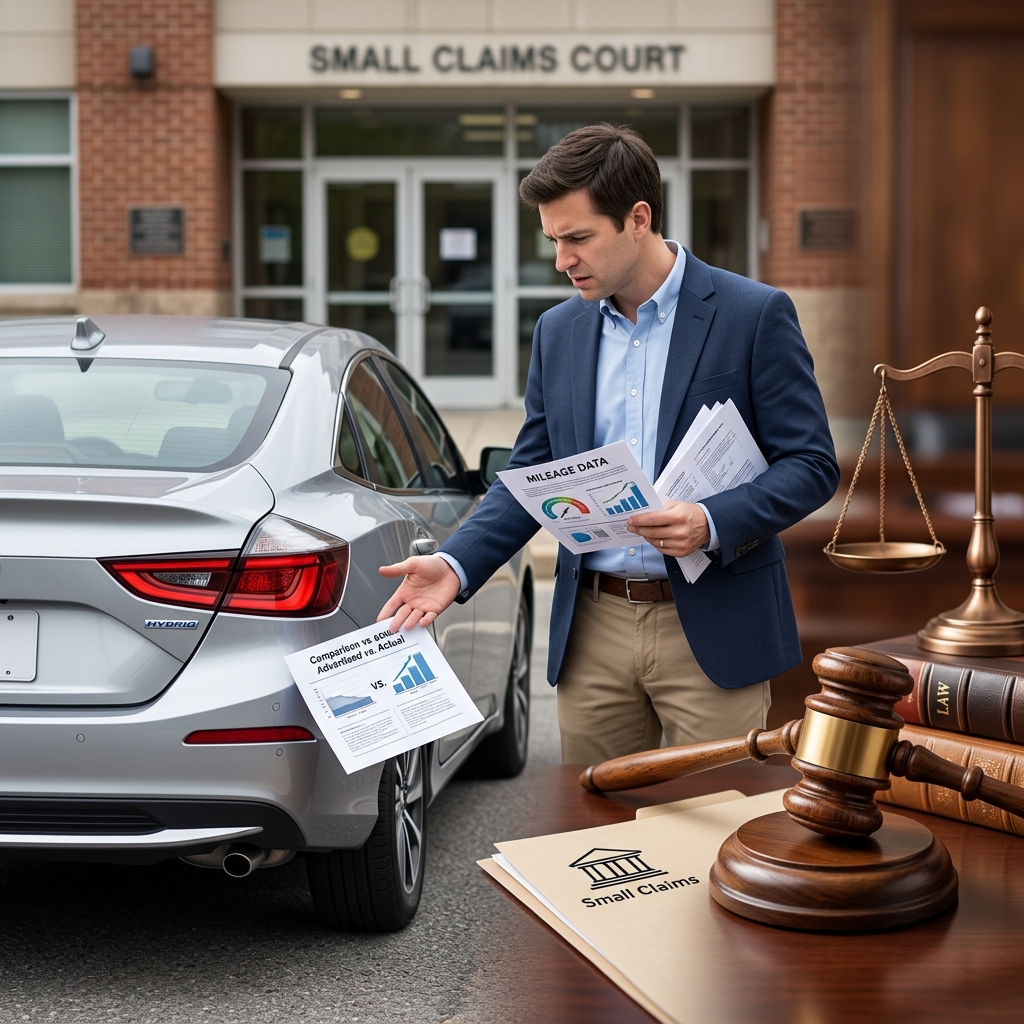
When a California driver claimed her Honda Civic Hybrid did not deliver the fuel economy Honda advertised, she chose a surprising path: small claims court instead of joining a class action. Her case briefly produced a headline-grabbing victory of nearly $10,000, only to be overturned on appeal. The dispute highlighted how carmakers promote fuel economy, how much protection consumers really have, and what small claims courts can and cannot achieve.
Background: The Civic Hybrid Mileage Controversy
The case centered on a 2006 Honda Civic Hybrid purchased in California. The owner argued that Honda had promoted the vehicle as capable of about 50 miles per gallon (mpg), a figure drawn from official Environmental Protection Agency (EPA) fuel economy ratings used in marketing. In real-world driving, however, she said the car’s fuel economy fell far short of those numbers—by around 20 mpg according to some reports.
This mileage gap led her to claim that Honda’s advertising and marketing were misleading. She argued that the company had encouraged consumers to expect significantly better fuel economy than was realistically achievable in typical driving conditions. The dispute did not arise in isolation; owners of various hybrids have long reported differences between window-sticker ratings and everyday performance, especially when driving habits, weather, and terrain differ from standardized test conditions used by regulators.
Why Fuel Economy Ratings Are So Controversial
To understand the controversy, it helps to know how fuel economy ratings are produced. In the United States, the EPA establishes standardized testing procedures for measuring a vehicle’s fuel consumption and then publishes the results as official city, highway, and combined mpg figures. Automakers like Honda must use these EPA numbers on window stickers, but they also often feature them in their advertising.
Several factors commonly contribute to differences between those ratings and real-world fuel economy:
- Driving style – Hard acceleration, high speeds, and frequent braking reduce mpg compared to gentle, steady driving.
- Traffic and terrain – Stop-and-go traffic, steep hills, and rough roads can all lower fuel economy.
- Weather and temperature – Very cold or hot weather can affect engine and battery performance, especially for hybrids.
- Vehicle load – Extra passengers, cargo, or aftermarket accessories add weight and aerodynamic drag.
The EPA itself explains that its ratings are intended as a comparison tool, not a guarantee of the exact mpg any individual driver will see. Ironically, that gap between regulatory intent and consumer expectations became a key issue in the Honda case.
Choosing Small Claims Court Instead of a Class Action
Many Civic Hybrid owners affected by similar mileage concerns had the option to participate in a class action lawsuit. Class actions often lead to broad but relatively small payments or extended warranties for large groups of consumers. Instead, the California owner decided to file in small claims court, seeking roughly $10,000 in damages.
She reportedly viewed the class action settlement as inadequate, offering limited compensation relative to her alleged losses. Small claims court, by contrast, promised:
- No need to hire an attorney (lawyers are often barred from directly representing parties in some small claims systems).
- A faster hearing schedule and simpler procedural rules.
- The potential for a more substantial individual award if the claim succeeded.
This strategy captured public attention. Media outlets reported that her case might encourage other disappointed hybrid owners to pursue small claims remedies rather than accept class action settlements.
The Initial Small Claims Victory
In early 2012, a commissioner of the Los Angeles Superior Court presiding over small claims awarded the plaintiff $9,867, almost the maximum allowed in California small claims at the time. The ruling suggested that the court agreed, at least initially, that Honda’s representations about fuel economy were misleading enough to warrant compensation.
Key arguments reported in coverage included:
- The plaintiff’s claim that Honda’s advertising emphasized high mpg in a way that implied real-world drivers could reasonably expect those numbers.
- Evidence that her own driving experience consistently fell below the advertised ratings.
- Allegations that Honda minimized or failed to clearly disclose the limitations of EPA test-based ratings in real-world conditions.
This outcome made headlines as a rare example of an individual consumer prevailing against a major automaker in small claims court over fuel economy, and it appeared to validate small claims as a viable forum for challenging corporate practices.
Appeal and the Overturning of the Award
Honda exercised its right to appeal the small claims ruling. On appeal, a higher-level judge in the Los Angeles Superior Court reviewed the case and overturned the nearly $10,000 award. Reports indicate that the judge sided with Honda’s arguments, which included reliance on EPA procedures and disclosure practices.
While the detailed reasoning varies among accounts, several themes emerged from coverage of the appeal decision:
- The court recognized that Honda had used the EPA’s official mpg figures, as required by federal law, and that these numbers are not guarantees but standardized comparisons.
- The judge found that evidence did not show Honda had committed actionable fraud or violated legal duties beyond using those official ratings.
- The appeal emphasized that factors such as driving style and conditions could reasonably explain lower mpg and that Honda’s materials did not promise identical performance for every driver.
The reversal demonstrated a critical feature of small claims litigation: even seemingly decisive victories can be short-lived once a case is reviewed by a higher court with broader legal expertise and more formal procedures.
Small Claims Court vs. Class Actions: A Comparison
| Feature | Small Claims Court | Class Action Lawsuit |
|---|---|---|
| Representation | Often self-represented; limited attorney involvement in some jurisdictions | Handled by attorneys representing the class |
| Claim Value | Individual claim, capped by small claims limit | Aggregated claims; individual payout often modest |
| Procedure | Simplified rules, faster hearings | Complex litigation, potentially years |
| Precedent | Limited impact beyond the case | Can create broader legal precedent or industry changes |
| Risk and Reward | Potentially higher award for one person but vulnerable to appeal | Lower individual amounts but more predictable outcomes |
Advertising, Disclosures, and Consumer Expectations
The Honda mileage dispute sits at the intersection of advertising law and consumer perception. Automakers must comply with federal labeling requirements, but they also have wide latitude in how they present those numbers in brochures, online ads, and television spots.
Regulators such as the Federal Trade Commission (FTC) and state attorneys general can pursue companies for deceptive or misleading advertising practices. In general, an advertisement may be considered deceptive if:
- It contains a representation or omission likely to mislead consumers.
- Consumers interpret the message reasonably under the circumstances.
- The misleading message is material, meaning it affects a purchasing decision.
Even when companies use technically accurate data, the overall impression can sometimes be challenged. In the Honda case, the plaintiff argued that the combined effect of Honda’s marketing and window-sticker numbers falsely implied that ordinary drivers could reliably achieve the advertised mpg. The appeal decision suggests the court ultimately found Honda’s reliance on EPA ratings and its disclosures sufficient to avoid liability, but the debate underscores how thin the line can be between persuasive sales language and alleged deception.
Lessons for Consumers Considering Similar Claims
The Honda mileage dispute offers several practical lessons for consumers who believe a product has failed to live up to its advertising:
- Document your experience – Keep detailed records of performance, repairs, and communications with the manufacturer or dealer. In fuel economy disputes, this might include logs of miles driven, gallons refilled, and conditions.
- Understand regulatory baselines – Official ratings (like EPA mpg figures) are comparison tools, not guarantees. Courts may give manufacturers wide legal protection when they rely on those official numbers.
- Evaluate remedies – Weigh the pros and cons of small claims court, class actions, manufacturer goodwill programs, or regulatory complaints. Each route has different potential outcomes, timelines, and costs.
- Consider expert evidence – In more complex disputes, third-party technical assessments, such as independent testing or mechanic reports, can strengthen a legal claim.
- Prepare for appeals – A favorable small claims judgment may be subject to appeal, especially when a large corporate defendant is involved.
Impact on Honda and the Auto Industry
While the appealed judgment eliminated the nearly $10,000 award, the case had reputational and practical impacts. Media coverage drew attention to the discrepancy between advertised and experienced fuel economy for hybrids, putting pressure on automakers to clarify how ratings should be interpreted.
Later years saw regulators refine fuel economy testing procedures and labeling rules to better reflect real-world driving. The EPA, for example, updated its testing protocols and explained more clearly that driving habits, climate, and maintenance can affect mileage, helping to manage expectations and reduce future disputes. Automakers also increased the use of fine-print disclosures and consumer education materials to reduce misunderstandings.
Frequently Asked Questions (FAQs)
Did Honda lose the small claims case?
Initially, Honda lost in small claims court, and the plaintiff was awarded about $9,867 by a Los Angeles Superior Court commissioner. However, Honda appealed, and a higher court later overturned that award.
Why was the small claims award overturned?
On appeal, the judge concluded that Honda had relied on official EPA fuel economy ratings and that these did not legally guarantee identical results for every driver. The judgment found insufficient grounds to hold Honda liable for fraud or deceptive practices under the circumstances.
Can small claims court be used against large companies?
Yes. Individuals routinely file small claims actions against large corporations for issues ranging from defective products to billing disputes. The Honda case shows that small claims can generate significant awards, but such decisions may still be subject to appeal and reversal.
Are advertised mpg numbers guarantees?
No. EPA fuel economy ratings are designed as standardized benchmarks to compare vehicles, not as promises of exact real-world performance. Actual mpg varies with driving conditions, habits, and vehicle maintenance.
What should I do if my car’s mpg is much lower than advertised?
First, check factors like tire pressure, driving style, and maintenance. If the gap remains large, you can contact the dealer or manufacturer, consult technical experts, and consider options such as warranty claims, participating in any class actions, or exploring small claims remedies where appropriate.
References
- Calif. Woman Takes Honda To Small Claims Court Over Hybrid Mileage — NPR / Morning Edition. 2012-01-05. https://www.npr.org/transcripts/144749987
- Woman Wins Small Claims Suit Against Honda Over Mileage — ABC News. 2012-02-01. https://abcnews.go.com/Business/woman-wins-small-claims-suit-honda-mileage/story?id=15493339
- Honda Civic Hybrid Gas Mileage Case Heads To Small Claims Court — Green Car Reports. 2011-12-29. https://www.greencarreports.com/news/1071241_honda-civic-hybrid-gas-mileage-case-heads-to-small-claims-court
- Calif. Woman Takes Honda To Small Claims Court Over Hybrid Mileage — KERA / NPR affiliate report. 2012-01-05. https://www.keranews.org/2012-01-05/calif-woman-takes-honda-to-small-claims-court-over-hybrid-mileage
- Appeals Court Overturns $10K Small Claims Verdict Against Honda for Hybrid Mileage — ABA Journal. 2012-05-22. https://www.abajournal.com/news/article/appeals_court_overturns_10k_small_claims_verdict_against_honda_for_hybrid_m
Similar Articles








Read full bio of Sneha Tete


