
Geo-Tracking and Warrants: Rethinking Phone Location Privacy
How phone location tracking collides with constitutional protections, emerging privacy laws, and the growing market for your movements.
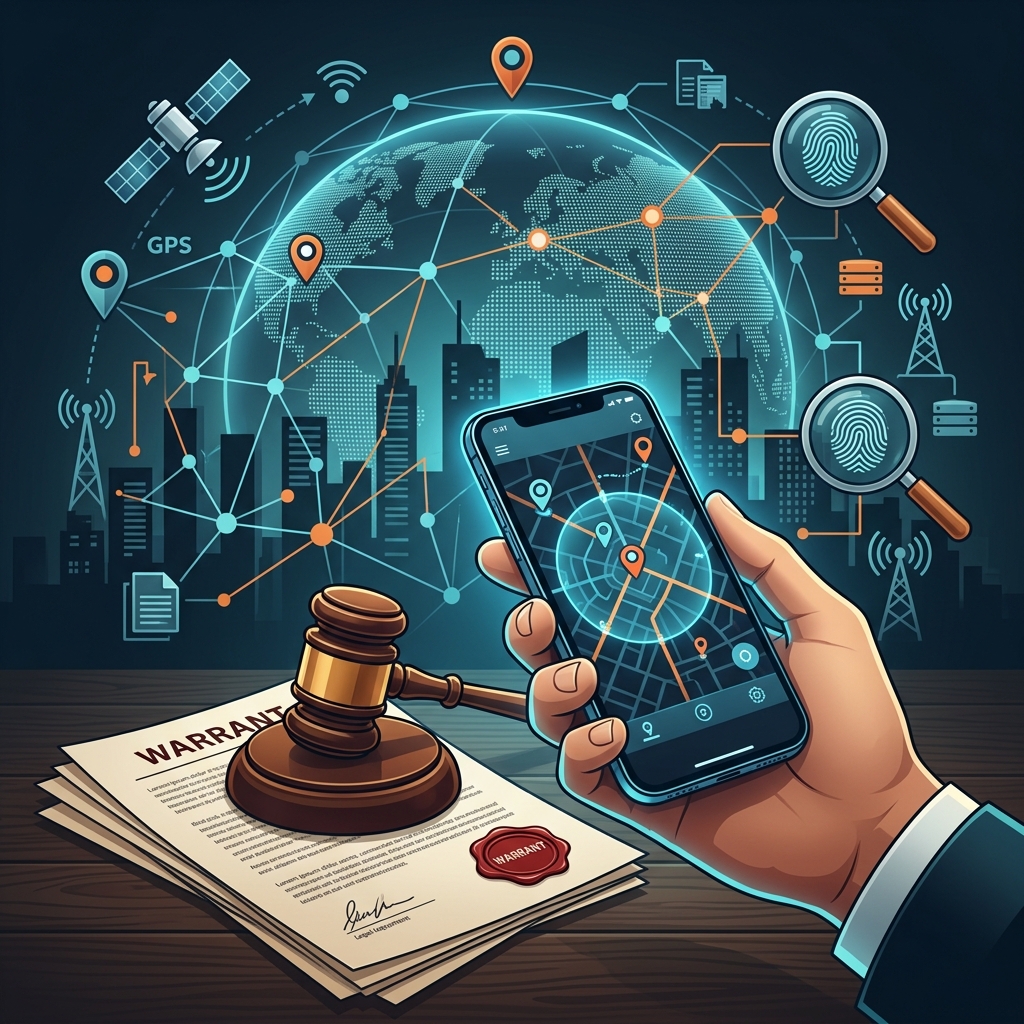
Smartphones constantly generate location data, quietly recording where we live, work, travel, and meet other people. Government agencies and private companies now have unprecedented technical ability to reconstruct a detailed map of our movements. This raises a central question for modern privacy law: should government access to your phone’s location information require a warrant?
This article examines how geo-tracking works, why it is uniquely sensitive, how the law has evolved, and when a warrant is required. It also reviews emerging state-level protections and practical steps individuals can take to better protect their location privacy.
Understanding Phone Location Data
Location data is broadly defined as any information that can be used to determine the past or present position of a device or person, with varying levels of precision. Common sources include:
- GPS signals from satellite networks, usually the most precise location source available on consumer devices.
- Cell tower records, which identify the towers your phone connects to and can be used for triangulation.
- Wi‑Fi network identifiers, which reveal approximate or very precise locations depending on the density of access points.
- Bluetooh beacons and proximity data, increasingly used in retail and public spaces for micro‑location tracking.
- App-based location services, which collect geolocation to provide navigation, social features, targeted ads, or analytics.
Significantly, phones can often be tracked even when standard location services are disabled, because they continue communicating with cell towers and Wi‑Fi networks, and may run background processes or malware that record movement.
Why Location Tracking Is Uniquely Sensitive
Location information reveals far more than where a device is at a single moment. Over time, it can expose patterns and intimate details about a person’s life. Civil liberties organizations highlight that knowledge of a phone’s whereabouts can disclose:
- Visits to medical providers, mental health professionals, or clinics.
- Attendance at political events, protests, or religious services.
- Connections to social networks, based on repeated co-location with others.
- Trips to locations associated with sexual orientation, reproductive health, or other sensitive aspects of identity.
Because of this sensitivity, several modern privacy regimes treat location data as a form of personal data that demands heightened protection. For example, under the EU’s General Data Protection Regulation (GDPR), location data is expressly treated as personal data, requiring clear, freely given consent for most forms of tracking. In the United States, recent enforcement actions by the Federal Trade Commission (FTC) have focused on “sensitive location data” and restrict its use, sale and disclosure without explicit affirmative consent.
How Law Enforcement Uses Phone Location Data
Law enforcement agencies use location information for a range of purposes, including:
- Real-time tracking of a suspect’s phone to follow movements or locate individuals.
- Historical cell site data to reconstruct where a phone was over days, weeks or months.
- Geofence requests, which ask providers for data on all devices in a geographic area during a specific time window.
- Emergency location queries during urgent threats to life or physical safety, sometimes under specific statutory exceptions.
Historically, the legality of such practices has turned on two questions: whether accessing location data constitutes a “search” under constitutional law and, if so, whether that search must be supported by a warrant meeting the traditional standard of probable cause.
Key Legal Principles Behind Warrants
In the United States, the primary legal framework is the Fourth Amendment, which protects against unreasonable searches and seizures and generally requires a warrant issued by a neutral magistrate based on probable cause. Core principles include:
- Expectation of privacy: A search occurs when the government intrudes on an area where a person has a reasonable expectation of privacy.
- Particularity: Warrants must specify the place to be searched and the items to be seized, limiting broad fishing expeditions.
- Probable cause: Authorities must demonstrate objective grounds to believe that evidence or contraband will be found.
Debates about phone location tracking largely revolve around whether individuals reasonably expect that the government will not obtain detailed records of their movements without satisfying these warrant requirements.
Major Legal Debates on Phone Location Tracking
Courts and scholars have taken differing views on whether government acquisition of mobile device location information is a Fourth Amendment search. Key axes of debate include:
| Issue | Restrictive View (Requires Warrant) | Permissive View (Often No Warrant) |
|---|---|---|
| Third-party doctrine | People retain privacy in detailed location data even if held by service providers. | Sharing data with carriers or app providers reduces privacy expectations. |
| Continuous tracking | Long-term monitoring reveals a comprehensive picture of a person’s life and is highly intrusive. | Individual data points are treated as limited, non-search disclosures. |
| Precision of data | Precise, high‑resolution location data is inherently sensitive and must be protected. | Coarse cell tower data may be considered less intrusive. |
| Home and private spaces | Tracking movements into and within homes or private spaces triggers the highest level of protection. | Some older decisions focused on physical intrusion rather than digital tracking. |
Academic commentators highlight that mobile devices hold a presumption of privacy, given their pervasive role in modern life and the breadth of sensitive information they generate. Many argue that accessing detailed location data, especially over time, should almost always be treated as a search requiring a warrant.
When Law Enforcement Typically Needs a Warrant
While the exact rules vary by jurisdiction and are shaped by evolving case law, several patterns have emerged in practice and statutory frameworks:
- Historical location tracking: In most situations, authorities must obtain a warrant to access detailed historical location records, particularly when they cover prolonged periods or enable reconstruction of a person’s movements.
- Targeted real-time tracking: Attaching a dedicated tracking device to a vehicle or continuously pinging a phone’s location generally triggers warrant requirements, especially when done over more than a short time.
- Location data revealing home movements: Access to information that shows when someone enters or leaves their home, or spends time inside private dwellings, is treated as highly sensitive and typically requires a warrant.
- Disclosure from data brokers or commercial providers: Emerging state proposals and advocacy model laws prohibit disclosure of precise location data to government entities without a warrant, except for narrow emergencies.
At the same time, many frameworks recognize urgent exceptions, such as imminent threats of serious bodily harm or death, in which some location access can occur without a traditional warrant, subject to later review.
Growing Patchwork of State-Level Protections
In the absence of a comprehensive federal statute regulating location privacy, states have begun to define their own rules. Advocacy organizations have mapped an emerging set of legislative proposals specifically targeting location surveillance.
Key features of recent state bills include:
- Clear definition of “location information” as data derived from a device that reveals past or present location of a person or device.
- Radius-based thresholds for protected data, such as Massachusetts’ proposed 1,850‑foot radius or California’s five‑mile radius defining sensitive geolocation.
- Data minimization rules that restrict collection and processing to specific, permissible purposes and limit the precision of data to what is strictly necessary.
- Strict bans on selling or renting location data and on disclosing it to government without a warrant, except for emergency or legally mandated circumstances.
- Opt‑in consent requirements, where companies must obtain affirmative agreement before collecting or processing location data in many cases.
- Private right of action, allowing individuals to sue entities that violate location privacy rules, which strengthens enforcement beyond administrative penalties.
In parallel, California’s broader privacy framework requires data brokers to register and disclose whether they collect certain sensitive data, including precise geolocation. This helps regulators and consumers identify entities engaged in large‑scale location data trade.
Location Data in the Commercial Ecosystem
Location information is not only valuable to law enforcement. It also sits at the center of a growing market for targeted advertising, analytics, and data brokerage. Companies use location data to:
- Deliver location-based services such as maps and navigation tools.
- Target advertising and promotions based on where consumers shop and travel.
- Analyze foot traffic patterns for retail or urban planning.
- Build consumer profiles that infer interests, habits, and demographic traits from movement patterns.
Regulators have increasingly scrutinized these practices. In a recent enforcement action, the FTC restricted a company’s ability to use and sell sensitive location data linked to visits to LGBTQ+ spaces, reproductive health providers, or political gatherings, reflecting a broader concern that such information can expose people to discrimination or targeting.
Practical Steps to Protect Your Location Privacy
Law and policy are evolving, but individuals can take immediate actions to limit unnecessary location tracking. Cybersecurity guidance from public agencies and security providers recommends several practical steps.
- Review privacy policies: Read the privacy notices of apps and services you use to understand what location data is collected, how long it is stored, and whether it is shared or sold.
- Manage app permissions: Regularly audit which apps have access to location, Bluetooth, and Wi‑Fi data. Restrict access to apps that genuinely need it to function.
- Disable unused radios: Turn off Wi‑Fi, Bluetooth and similar features when they are not needed to reduce passive tracking through nearby networks or beacons.
- Control account-level history: Adjust settings in major platforms (such as mobile operating systems and online accounts) to limit and delete stored location history.
- Remove unused apps: Uninstall apps you no longer use to reduce the number of entities collecting or retaining location data.
- Use trusted networks and tools: On public Wi‑Fi, consider using a reputable virtual private network (VPN) to encrypt traffic and reduce correlation between IP addresses and physical locations.
These measures cannot fully eliminate law enforcement access when legally authorized, but they can substantially reduce inadvertent exposure in the commercial ecosystem and limit misuse by malicious actors.
Balancing Privacy and Public Safety
The central challenge in designing rules for phone location tracking is balancing competing interests:
- Privacy: Individuals expect that their daily movements will not be continuously monitored by the government without strong justification.
- Public safety: Investigators argue that location data can be critical for solving serious crimes, locating victims, and responding to emergencies.
- Technological reality: Smartphones are ubiquitous, and technical capabilities for mass location collection and analysis continue to expand.
Many legal scholars advocate for a framework that presumes location tracking is a search and generally requires a warrant, but still accommodates narrow, well‑defined emergency exceptions. Legislation that incorporates data minimization, consent requirements, and constraints on commercial aggregation can complement constitutional protections, creating a multilayered shield around location privacy.
Frequently Asked Questions (FAQs)
Does law enforcement always need a warrant to access phone location data?
No. In many jurisdictions, a warrant is required for detailed, long‑term tracking or sensitive data revealing movements in and around the home. However, statutes and case law often permit limited access without a warrant in emergencies or for less intrusive, short‑term requests, subject to specific conditions. State legislation increasingly aims to make warrants the default for government access to precise location data.
Can my phone be tracked if I turn off location services?
Yes. Even with GPS disabled, phones typically continue to communicate with cell towers and Wi‑Fi networks, which can be used to infer location. Certain apps, malware, or spyware can also continue tracking by exploiting these alternative signals. Turning off radios such as Wi‑Fi and Bluetooth, in addition to location services, reduces but does not totally eliminate trackability.
Why is location data treated as sensitive in privacy laws?
Location data can reveal highly intimate details, including visits to medical providers, religious institutions, political events, and other sensitive locations tied to health, sexuality, and beliefs. Because patterns of movement can expose aspects of identity that individuals reasonably expect to remain private, regulators and courts often treat precise geolocation as requiring heightened consent and protection.
What is “geofencing” and why is it controversial?
Geofencing refers to requests for data on all devices present within a defined geographic area during a specific time period. Law enforcement can use geofence warrants to identify unknown suspects based on proximity to a crime scene. Critics argue that such requests risk sweeping in large numbers of innocent people and undermine constitutional particularity and individualized suspicion.
How can I reduce commercial tracking of my movements?
You can limit commercial tracking by reviewing app privacy policies, restricting location permissions, deleting unused apps, clearing location history in major accounts, and opting out of data brokers when possible. Using privacy tools and being cautious about granting location access to new apps helps reduce the volume of data entering the market.
References
- Privacy vs. Protection: Why Tracking Mobile-device Location Data May Be an Unconstitutional Search — Journal of Law, Technology & the Internet (Catholic University of America). 2016-01-01. https://scholarship.law.edu/cgi/viewcontent.cgi?article=1055&context=jlt
- How location tracking is raising the stakes on privacy protection — Ernst & Young. 2021-06-01. https://www.ey.com/en_gl/insights/forensic-integrity-services/how-location-tracking-is-raising-the-stakes-on-privacy-protection
- Privacy on the Map: How States Are Fighting Location Surveillance — Electronic Frontier Foundation. 2025-04-10. https://www.eff.org/deeplinks/2025/04/privacy-map-how-states-are-fighting-location-surveillance
- Privacy in a Location Data-Driven Market — University of California Davis Privacy Office. 2025-02-13. https://privacy.ucdavis.edu/news/privacy-location-data-driven-market
- Can My Phone Be Tracked If Location Services Are Off? — McAfee. 2024-03-15. https://www.mcafee.com/learn/can-my-phone-be-tracked-if-location-services-are-off/
- Cell Phone Privacy: Location Tracking — American Civil Liberties Union. 2023-09-01. https://www.aclu.org/issues/privacy-technology/location-tracking/location-tracking-cell-phone-privacy
- User Beware: Your Smartphone Is Tracking Your Every Move — New Jersey Cybersecurity & Communications Integration Cell. 2022-11-30. https://www.cyber.nj.gov/guidance-and-best-practices/device-security/user-beware-your-smartphone-is-tracking-your-every-move
Similar Articles








Read full bio of medha deb


