
From Trash Talk to Defamation: Understanding the Legal Line
Learn where everyday smack talk ends and legally actionable defamation begins, both offline and on social media.
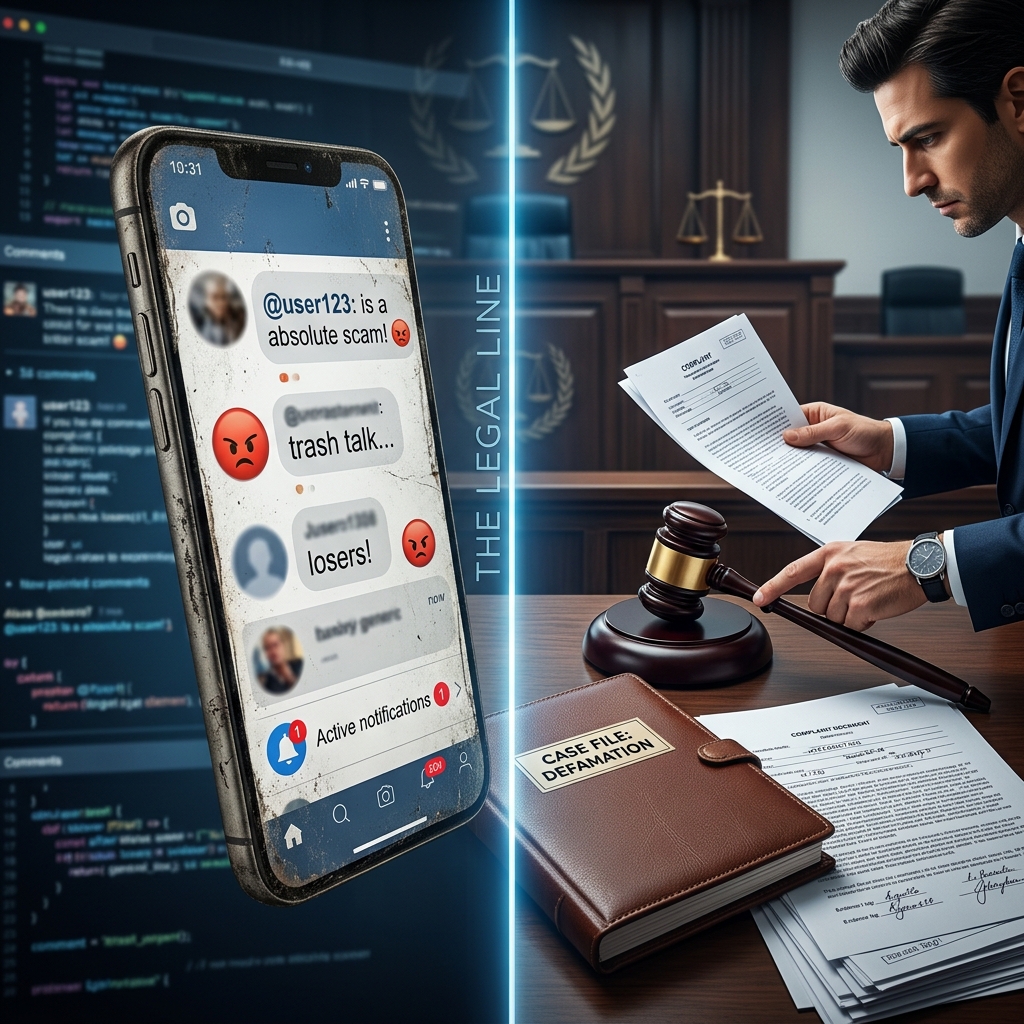
Insults, sarcasm, and bold opinions are a normal part of modern conversation, especially online. But there is a point at which smack talk stops being harmless bluster and turns into defamation, a civil wrong that can lead to serious legal consequences.
This guide explains, in plain language, how the law distinguishes protected speech from defamatory statements, how the rules apply on social media, and what you can do if your reputation is harmed by false accusations.
What Is Defamation, Really?
Under U.S. law, defamation is a statement that injures a third party’s reputation and meets specific legal criteria. Courts treat defamation as a civil wrong (a tort) that can be pursued in a lawsuit for damages.
Defamation includes two traditional categories:
- Libel — Defamation in written, recorded, or otherwise “fixed” form, such as posts, articles, emails, or videos.
- Slander — Defamation that is spoken, such as statements in a conversation, phone call, or live broadcast.
Even though the labels differ, courts today focus less on whether the content is written or spoken and more on whether it contains false assertions of fact that harm someone’s reputation.
Core Legal Elements: When Smack Talk Becomes Defamation
For ordinary trash talk to cross the line into defamation, most U.S. jurisdictions require four basic elements to be proven.
| Element | What It Means | Why It Matters |
|---|---|---|
| False statement of fact | The speaker conveys a claim that can be proven true or false, and it is inaccurate. | Pure opinions, obvious jokes, or vague insults usually do not qualify. |
| Publication | The statement is shared with at least one person other than the subject. | Private thoughts or messages seen only by the target typically are not defamation. |
| Fault | The speaker is at least negligent in failing to check the truth, or acts with malice in some cases. | Careless or reckless accusations raise legal risk. |
| Damage to reputation | The statement tends to lower the person in the eyes of others or harms their public image. | Hurt feelings alone are not enough; there must be reputational harm. |
If any of these elements is missing, the claim is less likely to be treated as defamation. For example, harsh name-calling that cannot reasonably be taken as a factual assertion may be seen as mere vulgar abuse rather than a defamatory allegation.
Opinion vs. Fact: The Critical Distinction
Most smack talk consists of opinions — subjective judgments, reactions, or emotional outbursts. The law largely protects this sort of speech. The danger arises when insults quietly slip into the territory of statements of fact that can be verified.
What Counts as Opinion?
Court decisions and legal guidance treat statements as opinion when they:
- Express personal taste or preference (“I think that restaurant is awful”).
- Use loose, exaggerated language that no reasonable person would take literally.
- Clearly reflect speculation without claiming inside knowledge.
Simply adding phrases like “I think” or “In my opinion” is not enough to protect a statement if a reasonable reader would still understand it as asserting a concrete fact.
What Counts as a Statement of Fact?
A statement is treated as factual when it makes a claim that can be proven true or false. Examples include:
- Accusing someone of specific criminal behavior.
- Claiming they lack a valid professional license or engage in professional misconduct.
- Alleging they have a serious contagious disease.
- Stating they committed a particular unethical or immoral act.
If such statements are false and damaging, they often fall into a category known as defamation per se, where harm to reputation is presumed and may not require detailed proof of financial loss.
Social Media and Online Smack Talk
Social platforms amplify the impact of casual comments. Posts can be shared, screenshotted, and searched indefinitely, making reckless accusations far more risky than a heated remark in a private conversation.
Why Online Defamation Is Especially Serious
Legal sources on digital communication emphasize several factors that make online defamation uniquely harmful:
- Speed and reach — False statements can reach hundreds or thousands of people within minutes.
- Permanence — Even deleted posts may live on through caches, backups, or screenshots.
- Searchability — Harmful content can appear in search results for a person’s name, affecting work and social relationships.
Because social media posts are generally considered written and persistent, online defamatory statements are treated as libel rather than slander, with corresponding legal consequences.
Who Is Legally Responsible Online?
U.S. law draws a sharp distinction between content creators and the platforms that host their speech. Under Section 230 of the Communications Decency Act, website operators and social media services are generally not liable for defamatory statements posted by their users.
The person who authors and publishes the post, comment, video description, or review remains the one who can be sued for defamation.
Public Figures vs. Private Individuals
Not everyone is treated the same way in defamation law. The level of proof required often depends on whether the person targeted by the statement is a public figure or a private individual.
Public Figures and Actual Malice
For celebrities, elected officials, and others who have achieved significant public prominence, defamation claims typically require showing actual malice. This means the speaker:
- knew the statement was false, or
- acted with reckless disregard for whether it was true or false.
This higher threshold reflects the strong protections for free speech and robust debate about public figures and political issues.
Private Individuals and Negligence
For ordinary citizens, the law is less forgiving. A private person claiming defamation generally needs to show that the speaker was at least negligent — that a reasonable person would have taken more care before repeating or posting the accusation.
For everyday smack talk about coworkers, neighbors, or businesses, this negligence standard means that repeating rumors without checking them can create legal exposure.
Damages: How Defamation Hurts in Practice
A successful defamation claim does not just label conduct as wrongful; it can lead to monetary damages. Legal guidance outlines several types of harm that may support an award of compensation.
- Damage to reputation — Loss of standing in the community, professional setbacks, or diminished trust in personal relationships.
- Economic loss — Lost job opportunities, reduced business, or clients withdrawing contracts due to the false statement.
- Emotional distress — Anxiety, humiliation, or depression tied to the reputational injury.
However, legal materials emphasize that injury only to feelings is not enough; the law focuses on credibility and reputation rather than purely emotional upset.
Common Misconceptions About Smack Talk and Defamation
People often rely on informal rules that do not match what courts actually apply. Several myths are worth clearing up.
Myth 1: “If I Say It’s My Opinion, I’m Safe”
Labeling a statement as opinion does not automatically shield it from liability. Courts look to how a reasonable reader would understand the statement. If it contains specifics that can be verified and implies undisclosed facts, it may still be treated as a factual assertion.
Myth 2: “Deleting the Post Fixes the Problem”
Removing a defamatory statement does not erase the legal risk from originally publishing it. Some jurisdictions allow retractions or corrections to reduce the amount of damages, but the underlying act of defamation may remain actionable.
Myth 3: “Repeating a Rumor Is Harmless”
Legal guidance warns that people who repeat someone else’s defamatory statements can be held just as responsible as the original speaker, especially if they had reason to doubt the truth.
Practical Tips: Staying on the Safe Side
To enjoy candid conversation and vigorous debate without sliding into defamation, consider the following practical safeguards drawn from legal standards.
- Separate opinion from fact — Make clear when you are expressing a personal view, and avoid implying you have undisclosed evidence if you do not.
- Verify serious accusations — Before alleging criminal conduct, professional misconduct, or serious wrongdoing, check reliable sources or refrain from posting.
- Avoid specific factual claims based on rumor — General criticism is far safer than claiming concrete acts that you cannot substantiate.
- Think about audience and impact — Ask how the statement would appear to a stranger reading it without context; would it reasonably lower the person in their eyes?
- Use private channels for sensitive concerns — When discussing unverified issues, consider private communication rather than public posting.
What To Do If You Think You’ve Been Defamed
If online or offline smack talk has damaged your reputation through false assertions of fact, there are structured steps you can consider. This is informational guidance only; for legal advice, consult a qualified attorney.
Document the Statement
First, preserve evidence. Take screenshots, note URLs, record dates and times, and identify any witnesses or viewers. Because online content can be edited or removed, early documentation is important.
Assess the Legal Elements
Compare your situation against the core legal requirements:
- Is there a false statement of fact rather than a harsh opinion?
- Was it communicated to other people (published)?
- Did the speaker act with at least negligence in checking the truth?
- Can you show harm to your reputation or related damages?
If the answer is yes to each question, you may have the elements of a potential defamation claim.
Consider Non-Legal Responses
Not every harmful statement needs a lawsuit. Some alternative responses include:
- Requesting a correction or retraction from the poster.
- Posting a factual clarification or response.
- Using platform tools to report harmful content that violates community guidelines.
In some jurisdictions, issuing a retraction can reduce potential damages, although it does not completely erase liability.
Seek Legal Advice When Needed
For serious reputational harm, consulting an attorney familiar with defamation and media law is important. Lawyers can explain local rules, assess strength of the case, and discuss options such as demand letters, negotiation, or formal litigation.
FAQs: Smack Talk and Defamation
Is calling someone a liar or a cheat always defamation?
Not always. General name-calling can be treated as opinion or rhetoric. However, if the accusation is tied to a specific, verifiable event — such as claiming they committed fraud in a particular transaction — and that statement is false and harmful, it may become defamatory.
Can a joke or meme be defamation?
If a joke or meme clearly appears as parody and no reasonable viewer would think it states actual facts, it is less likely to be defamation. But if it presents false factual claims with realistic framing and harms reputation, it may still create legal exposure.
What if I only shared someone else’s post?
Legal guidance indicates that people who repeat or share defamatory content may be treated as responsible if they knew or had reason to know it was defamatory. Simply forwarding harmful allegations can carry risk, particularly if you add approving comments or context.
Is a bad online review defamation?
Critical reviews that express honest opinions usually fall within protected speech. Defamation arises when a review includes false factual assertions, such as claiming a business committed criminal acts or professional fraud without evidence.
How long do I have to sue for online defamation?
Most states impose a statute of limitations on libel and slander claims, often starting from the date the statement was first published. For example, California generally uses a one-year period. The exact deadline depends on state law, so local legal advice is essential.
References
- Defamation | Wex — Legal Information Institute, Cornell Law School. 2024-01-01. https://www.law.cornell.edu/wex/defamation
- Online Defamation Law — Electronic Frontier Foundation. 2010-01-01. https://www.eff.org/issues/bloggers/legal/liability/defamation
- Libel and Slander on Social Media: When Posting Becomes Defamation — Purdue Global Law School. 2023-05-01. https://www.purduegloballawschool.edu/blog/news/social-media-libel-defamation
- Online Defamation Law and Social Media — Justia Personal Injury Law Center. 2022-06-01. https://www.justia.com/injury/defamation/online-defamation-and-social-media/
- Defamation — Wikipedia (summary of global approaches; primary sources cited therein). 2024-03-01. https://en.wikipedia.org/wiki/Defamation
Similar Articles








Read full bio of medha deb


