
Free Speech, Profanity, and Police: Lessons from the Sixth Circuit
How an Ohio county fair dispute turned into a major Sixth Circuit ruling on profanity, police authority, and the limits of disorderly conduct.
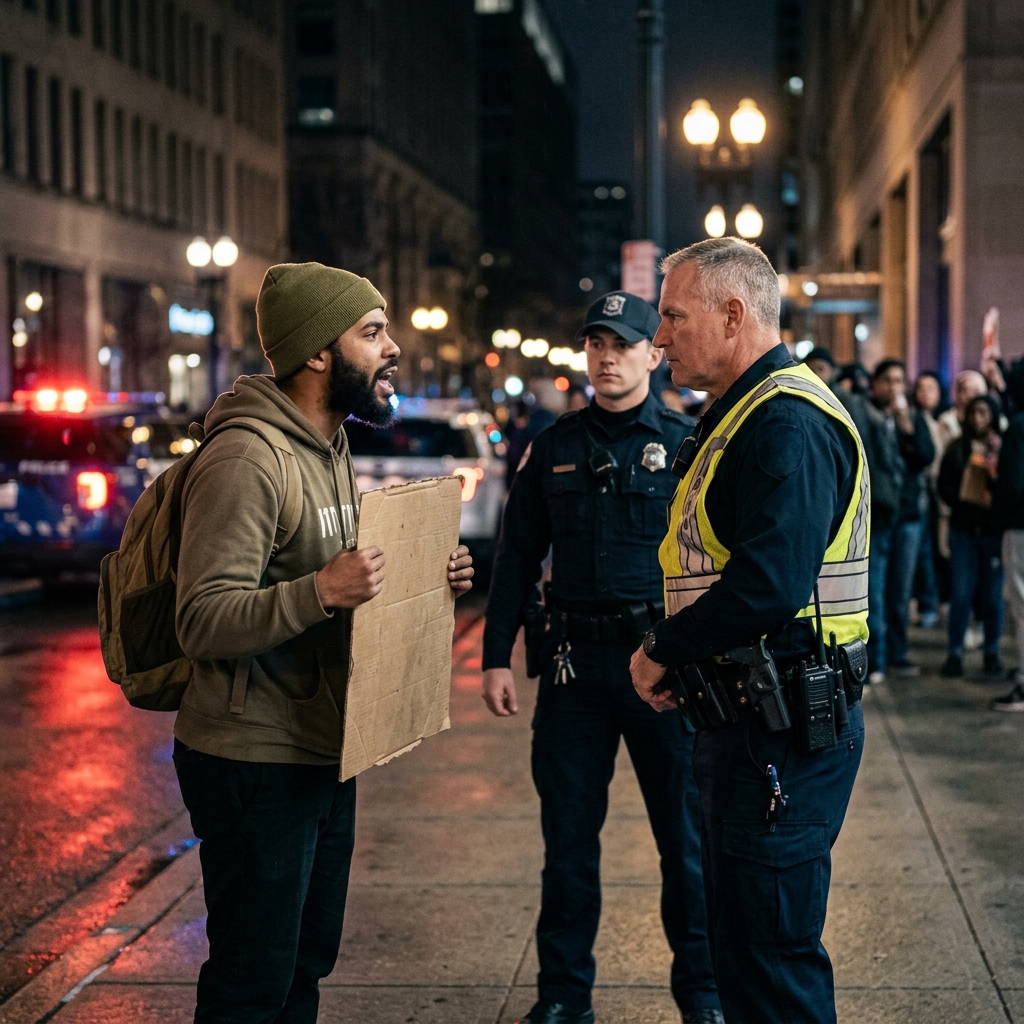
In a closely watched decision, the U.S. Court of Appeals for the Sixth Circuit reaffirmed that profane criticism of police officers at a public event is protected by the First Amendment, even when the language is vulgar and confrontational. The ruling arose from an Ohio county fair incident where a fairgoer wearing an anti-police T-shirt and using coarse language was arrested for disorderly conduct and later removed from the fairgrounds.
This decision clarifies how courts distinguish between protected speech and criminal conduct, particularly under disorderly conduct statutes, and underscores the high bar government must meet before punishing speech as “fighting words” or granting officers qualified immunity for arrests based solely on offensive expression.
Background: A County Fair, a Profane T-Shirt, and an Arrest
The case centers on an Ohio man, often referenced in commentary as Wood, who attended a county fair wearing a shirt that read a blunt expletive aimed at the police. While walking through the fairgrounds and filming officers, he exchanged words with law enforcement, using profanity during the interaction.
Officers arrested him for disorderly conduct under Ohio law and removed him from the public fair. The arrest and removal raised critical constitutional questions:
- Can profanity directed at police, without threats or violence, be treated as disorderly conduct?
- Is wearing a shirt saying “F
the Police” at a public event protected speech or evidence of criminal intent?
- Were the officers shielded by qualified immunity, or did they violate clearly established constitutional rights?
The Sixth Circuit ultimately revived Wood’s civil rights claims, concluding that his speech was constitutionally protected and that the officers lacked probable cause to arrest him, defeating their qualified immunity defense.
First Amendment Basics: Why Offensive Speech Often Remains Protected
The First Amendment generally prohibits the government from punishing citizens for speech, including expression critical of public officials, unless that speech falls within a few narrow categories such as true threats, incitement, or obscenity. Profanity and rude criticism of government actors do not automatically lose protection simply because they are disrespectful.
Supreme Court and Sixth Circuit precedent emphasize several key principles:
- Criticism of government—including law enforcement—is at the core of First Amendment protection.
- Profanity alone is generally insufficient to justify criminal prosecution or arrest.
- Only speech that meets the strict standard of “fighting words” can be punished as disorderly conduct based on content.
As a Sixth Circuit-related First Amendment clinic has noted, “The First Amendment protects speech critical of the government, including law enforcement, even when laced with profanity.”
Fighting Words vs. Disorderly Conduct: The Legal Line
Central to the Sixth Circuit’s analysis is the distinction between protected offensive speech and unprotected fighting words. Under the Supreme Court’s decision in Chaplinsky v. New Hampshire, “fighting words” are those that “by their very utterance inflict injury or tend to incite an immediate breach of the peace.”
The Sixth Circuit has long held that, under Ohio law and the First Amendment, speech can be treated as disorderly conduct only when it rises to this level. In evaluating Wood’s statements at the fair, the court looked at whether his profanity was:
- Likely to provoke a violent, immediate response, and
- Directed in a manner that created imminent risk of a breach of the peace.
The court found that while Wood’s language was undeniably profane, it was not likely to provoke violence and did not cross the threshold of fighting words. As a result, his speech remained protected and could not legally constitute disorderly conduct.
Police and a Higher Tolerance Threshold
Importantly, the Sixth Circuit emphasized that police officers are expected to have a higher tolerance for verbal abuse than the average person. Being sworn public officials, their role requires them to endure harsh criticism, including coarse and provocative language.
The court rejected the officers’ argument that Wood’s use of “personally abusive epithets” against them provided probable cause for arrest. Instead, it stressed that law enforcement may not convert ordinary, rude speech into criminal conduct simply because they are the target.
In the words of other Sixth Circuit decisions involving offensive gestures toward officers, “fits of rudeness or lack of gratitude” do not become grounds for lawful seizure or arrest. The same principle applies to verbal criticism.
Probable Cause and Qualified Immunity: Why the Arrest Was Unlawful
The officers defended themselves in the civil suit by claiming they had probable cause to arrest Wood for disorderly conduct and therefore were entitled to qualified immunity in the constitutional lawsuit. Qualified immunity protects government officials from liability unless they violate a right that was clearly established at the time.
The Sixth Circuit analyzed whether a reasonable officer, in light of existing law, could have believed Wood’s profanity alone justified a disorderly conduct arrest. It concluded:
- Wood’s speech, though vulgar, was clearly protected by the First Amendment.
- Prior Sixth Circuit cases and Supreme Court precedent had long established that profanity directed at police cannot, by itself, justify criminal charges.
- Because the officers lacked probable cause and violated a well-established right, they were not entitled to qualified immunity.
This determination revived Wood’s unlawful arrest claims and allowed a jury to consider whether the officers’ actions violated his constitutional rights.
Retaliation for Protected Speech: The Role of the T-Shirt
Beyond the arrest, Wood also alleged that the officers retaliated against him for exercising his First Amendment rights. The Sixth Circuit agreed that his T-shirt, which proclaimed “F the Police,” was “clearly protected speech”.
The court used a three-part analysis often applied to First Amendment retaliation claims:
- Protected activity: Wood’s shirt and verbal criticism were constitutionally protected expression.
- Adverse action: Being forcibly removed from a public fair by armed officers is an action likely to chill a reasonable person from continuing protected speech.
- Causation: A jury could reasonably find that the officers’ decision to engage with and remove Wood was motivated by his anti-police message, rather than neutral law enforcement concerns.
The Sixth Circuit held that this evidence was sufficient for a jury to decide whether retaliation occurred, and therefore the case should proceed rather than ending at summary judgment.
Comparing Sixth Circuit Free Speech Cases Involving Police
Wood’s case fits into a broader pattern of Sixth Circuit decisions protecting offensive criticism of law enforcement. Courts have consistently rejected attempts to treat rude gestures or profanity as criminal behavior when they do not involve threats or incitement.
| Case / Situation | Expression at Issue | Court’s Key Holding |
|---|---|---|
| County fair case (Wood) | Anti-police T-shirt, profanity directed at officers | Profanity and T-shirt were protected; no probable cause for arrest; officers not entitled to qualified immunity. |
| Motorist middle finger case | Driver gave an officer the middle finger after a traffic stop | Middle finger is protected speech; second stop was an unreasonable seizure and violated First Amendment rights. |
| Public employee social media case | Off-duty EMS worker’s inflammatory and profane posts about a police shooting | Profane speech on a public concern may be protected; case remanded to balance employee’s speech interests against government efficiency. |
Together, these cases signal a strong judicial trend: vulgar criticism of police, including gestures and slogans, is generally protected expression, and law enforcement cannot use disorderly conduct or similar charges to suppress it.
Practical Takeaways for Citizens and Police
The Sixth Circuit’s county fair ruling offers real-world guidance for both the public and law enforcement agencies.
For Citizens
- You have a protected right to criticize police and other officials, including with profanity, as long as you do not threaten, incite violence, or obstruct lawful duties.
- Wearing clothing with critical or offensive political messages at public events is typically First Amendment-protected speech.
- If you are arrested or removed from a public place solely because of your message, you may have grounds for a constitutional claim.
For Law Enforcement
- Offensive speech directed at officers—whether words, hand gestures, or T-shirts—rarely provides valid probable cause for an arrest.
- Qualified immunity will not protect officers who arrest people merely for protected criticism, where precedent clearly prohibits such actions.
- Training should emphasize that officers must tolerate verbal abuse and distinguish between truly disruptive, dangerous conduct and mere disrespectful speech.
FAQs About Profanity, Police, and the First Amendment
Is it always legal to curse at police officers?
Not always, but in most situations profanity alone is protected. If the language includes true threats, incites imminent violence, or interferes with lawful police duties, it may be punishable. The Sixth Circuit has made clear that ordinary profanity directed at officers, without more, cannot be treated as disorderly conduct.
Can I be arrested for wearing a shirt critical of the police?
Generally no. Clothing with political or critical messages is a classic form of protected expression. The Sixth Circuit explicitly recognized that a shirt saying “F*** the Police” worn at a public fair was clearly protected speech, and could not justify an arrest.
What are “fighting words” and why do they matter?
“Fighting words” are statements that, by their very utterance, are likely to provoke immediate violence or a breach of the peace. Only speech that meets this narrow standard can be punished as disorderly conduct based on its content. Most rude or profane comments do not qualify.
What is qualified immunity in this context?
Qualified immunity shields government officials from civil liability unless they violate a right that was clearly established at the time of their conduct. In the county fair case, the Sixth Circuit ruled that the officers violated a well-established First Amendment right by arresting Wood for protected speech, so they were not entitled to qualified immunity.
Does this mean police can never act against offensive speech?
No. Police may intervene when speech crosses into true threats, incitement of imminent lawless action, or when a person’s overall conduct—regardless of viewpoint—creates a genuine public safety risk. However, officers cannot act against speech simply because it is profane, disrespectful, or critical of them.
References
- Wood v. Eubanks, No. 20-3599 (6th Cir. 2022) — United States Court of Appeals for the Sixth Circuit. 2022-01-26. https://www.opn.ca6.uscourts.gov/opinions.pdf/22a0025p-06.pdf
- CWRU First Amendment Clinic Wins Case in U.S. Court of Appeals — Case Western Reserve University. 2022-02-03. https://case.edu/news/cwru-first-amendment-clinic-wins-case-us-court-appeals
- Cop Critic Prevails on Constitutional Claims in the 6th Circuit — Rocky Mountain Sign Law. 2022-03-03. https://www.rockymountainsignlaw.com/2022/03/cop-critic-prevails-on-constitutional-claims-in-the-6th-circuit/
- Sixth Circuit Upholds County Fairgoer’s Right to Swear at Police — FindLaw Legal Blogs. 2022-02-08. https://www.findlaw.com/legalblogs/federal-courts/sixth-circuit-upholds-county-fairgoers-right-to-swear-at-police/
- Flipping Off Cops Is Free Speech, Sixth Circuit Rules — Courthouse News Service. 2019-03-13. https://www.courthousenews.com/flipping-off-cops-is-free-speech-sixth-circuit-rules/
- Court rules First Amendment protects motorist who gave the middle finger to police officer — Free Speech Center, Middle Tennessee State University. 2019-04-08. https://firstamendment.mtsu.edu/post/court-rules-first-amendment-protects-motorist-who-gave-the-middle-finger-to-police-officer/
- Sixth Circuit: A Raised Middle Finger Is Free Speech — First Amendment Watch. 2019-03-21. https://firstamendmentwatch.org/sixth-circuit-a-raised-middle-finger-is-free-speech/
Similar Articles








Read full bio of medha deb




