
Filing a Civil Rights Complaint: A Step‑By‑Step Legal Guide
Learn how to recognize a civil rights violation, preserve evidence, choose the right agency, and file an effective complaint that protects your legal rights.
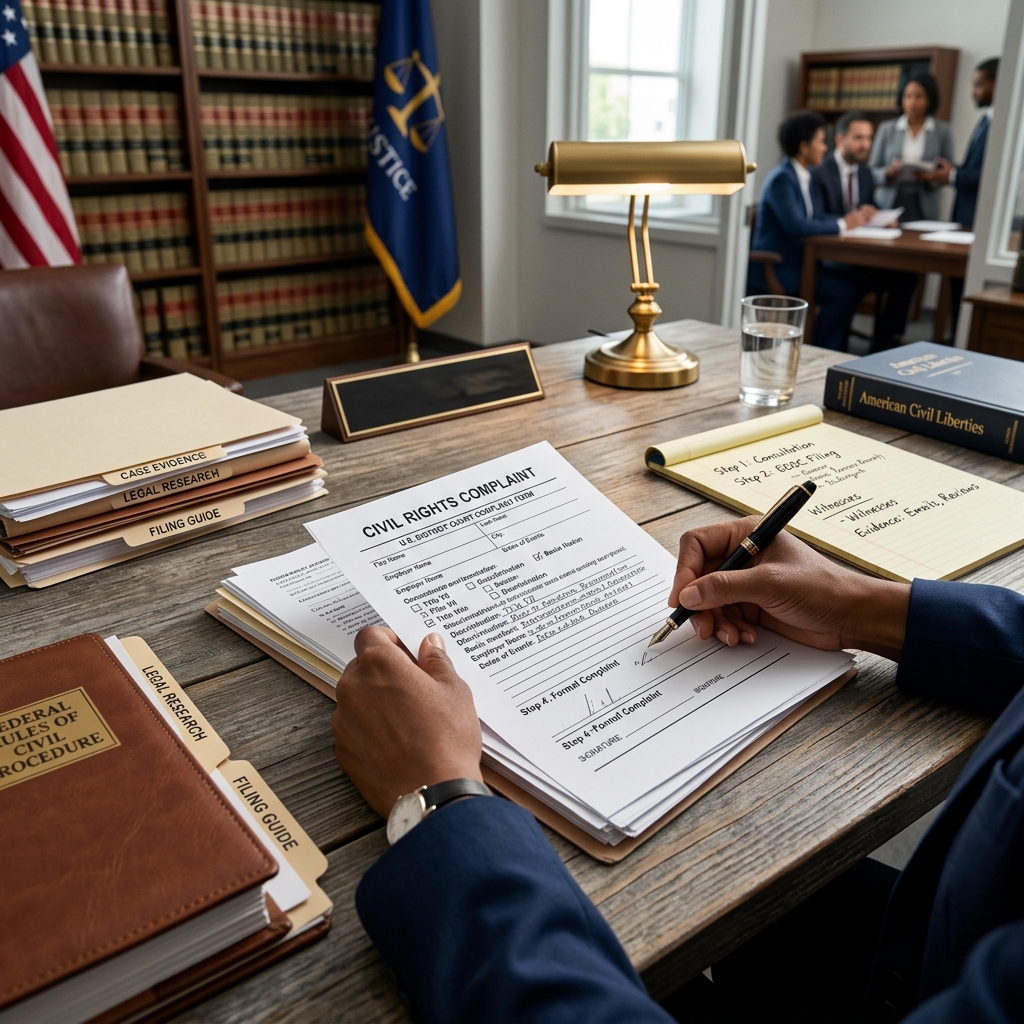
Civil rights laws exist to ensure that people are treated fairly and equally by governments, schools, employers, housing providers, health care entities, and others. When those rights are violated through discrimination, harassment, or retaliation, you may be able to file a formal civil rights complaint with a government agency or, in some cases, bring a lawsuit in court.[10]
This guide explains how to recognize a civil rights violation, gather evidence, select the proper agency, and file an effective complaint while protecting important deadlines. It is general information, not personalized legal advice. Consulting a qualified attorney is strongly recommended for complex or serious matters.
Understanding What Counts as a Civil Rights Violation
In the United States, civil rights laws prohibit discrimination in key areas of life such as employment, housing, education, health care, and access to public services. These laws typically protect people based on specific characteristics, often called protected classes, such as race, color, national origin, sex, religion, disability, age, and, in many jurisdictions, additional categories like sexual orientation and gender identity.[10]
A civil rights violation occurs when an individual or organization that is covered by these laws treats you unfavorably, denies you benefits or access, or retaliates against you because of a protected characteristic or because you asserted your rights.
- Discrimination – Being treated differently in employment, housing, education, health care, or public services because of a protected characteristic.[10]
- Harassment – Severe or pervasive abusive conduct based on a protected characteristic that creates a hostile environment (for example, at work or school).[10]
- Retaliation – Punishing someone for filing a complaint, reporting misconduct, or participating in an investigation about civil rights.[10]
Not every unfair situation is a civil rights violation. To qualify for protection, the behavior generally must be linked to a protected characteristic or your exercise of legal rights, and it usually must occur in a context covered by specific federal or state laws.
Common Areas Where Civil Rights Complaints Are Filed
| Context | Typical Issues | Key Agencies |
|---|---|---|
| Employment | Hiring, firing, promotions, pay, harassment, retaliation based on protected characteristics | Equal Employment Opportunity Commission (EEOC), state civil rights agencies[10] |
| Education | Student discipline, admissions, disability accommodations, sexual harassment, unequal programs | U.S. Department of Education Office for Civil Rights (OCR), state education agencies |
| Health care & human services | Discriminatory denial of care, unequal access to federally funded health programs | U.S. Department of Health and Human Services Office for Civil Rights (HHS OCR) |
| Police & justice system | Excessive force, discriminatory policing, unequal treatment in justice programs | U.S. Department of Justice Civil Rights Division, Office for Civil Rights at OJP |
| Housing & public accommodations | Refusal to rent or sell, discriminatory terms, denial of services in public places | HUD, state civil rights or fair housing agencies |
First Steps: Documenting What Happened
Strong documentation is the foundation of an effective civil rights complaint. Government agencies typically require detailed facts, dates, and evidence to evaluate whether they have jurisdiction and whether a violation likely occurred.
Information You Should Collect Early
- Timeline of events – Write down when each incident occurred, who was involved, where it happened, and what was said or done.
- Names and contacts – Identify the individuals or organizations you believe violated your rights and any witnesses who saw or heard key events.
- Supporting documents – Preserve emails, letters, text messages, policies, performance reviews, medical or school records, and any other relevant documents.
- Physical or digital evidence – Keep photographs, videos, social media posts, or voicemail recordings that reflect the discriminatory behavior.
- Notes on impact – Describe how the violation affected you (financial loss, emotional distress, lost opportunities, health effects).
Store these materials securely and back them up when possible. Do not alter documents or create misleading evidence, as doing so can damage your credibility and harm your case.
Why Early Documentation Matters
Most agencies ask for detailed facts about the incident, including dates, names, and your explanation of why you believe the action was discriminatory or retaliatory. If you document events as they happen, you reduce the risk of forgetting important details and strengthen your ability to show patterns of conduct rather than isolated events.
Choosing Where to File Your Complaint
Different agencies enforce different civil rights laws. Filing your complaint with the wrong agency can delay the process or result in dismissal for lack of jurisdiction. To maximize your chances of a meaningful investigation, focus on:
- The type of discrimination (employment, education, health care, justice, housing).
- Whether the entity receives federal funding (often relevant for education, health, and justice agencies).
- Geographic location (some agencies have jurisdiction only in certain states or regions).
Major Federal Agencies Handling Civil Rights Complaints
- EEOC – Handles most employment discrimination charges against private employers, unions, and federal agencies; complaints are usually initiated through an online portal or intake interview.[10]
- U.S. Department of Education OCR – Investigates discrimination in education programs and activities that receive federal funds; complaints can be filed electronically using OCR’s complaint form.
- HHS OCR – Receives complaints of discrimination in health and human services programs that HHS operates or funds; complaints can be filed through an online portal.
- Department of Justice Civil Rights Division – Accepts reports of civil rights violations in areas such as policing, hate crimes, and justice programs via an online reporting form.
- Office for Civil Rights at OJP – Investigates discrimination by agencies or organizations that receive funding from the Office of Justice Programs; complaints can be submitted electronically or by mail.
State and Local Civil Rights Agencies
Almost every state has its own civil or human rights agency that enforces state anti-discrimination laws. These agencies often handle complaints involving employment, housing, and public accommodations and may provide additional protections beyond federal law.
For example:
- California’s Civil Rights Department uses an intake form and electronic case system to review complaints and determine whether it has jurisdiction.
- Colorado’s Civil Rights Division requires an intake questionnaire and applies specific filing deadlines for employment and housing complaints.
- State attorneys general sometimes maintain civil rights divisions and online forms for reporting discrimination or hate incidents.
A civil rights attorney can help you decide whether to file with a federal agency, a state or local agency, or both, and whether you should also consider a private lawsuit.
Respecting Filing Deadlines and Time Limits
Civil rights complaints are subject to strict deadlines, often called statutes of limitations or filing periods. If you miss these deadlines, you may lose the right to pursue your claim through certain agencies or in court.[10]
Examples of Common Time Limits
- Employment discrimination: Many federal employment claims must be filed with EEOC within a set number of days from the last discriminatory act, although exact deadlines depend on where you live and whether state agencies are involved.[10]
- Education discrimination: The U.S. Department of Education OCR generally requires complaints to be filed within a specific period following the discriminatory event, commonly 180 days.
- State agency deadlines: Some state civil rights agencies have different filing periods for employment and housing claims, such as 300 days for employment and one year for housing discrimination.
These deadlines can change and may be extended in limited circumstances, for example when a person did not know about the discrimination until later. Because the rules are complex, getting prompt advice from an attorney or directly from the agency can be crucial.
How to Prepare and File Your Civil Rights Complaint
Although each agency has its own forms and procedures, most civil rights complaints follow a similar structure: you provide your contact information, identify the respondent (the party you are complaining about), explain what happened, and describe why you believe it was discriminatory or retaliatory.
Typical Steps in Filing a Complaint
- Complete an intake or complaint form
Many federal and state agencies require an intake form before they formally accept a complaint. This allows them to determine jurisdiction and assess whether your allegations fall under the laws they enforce.[10] - Provide personal and contact information
You will be asked to supply your name, address, phone number, and sometimes an email address. If you are filing on behalf of someone else or a group, you may need to explain your relationship and authority to do so. - Identify the respondent
Agencies generally need the name and address of the person, business, school, government body, or program you believe violated your rights. Provide as much contact information as you can to facilitate notice and investigation. - Describe the alleged violation
Most forms ask for a detailed narrative of what happened, including dates of each incident, who was involved, what was said or done, and why you believe it was based on a protected characteristic or retaliatory. - Attach supporting evidence
When possible, upload or send copies of relevant documents and evidence such as emails, letters, photographs, or witness statements. These materials help agencies evaluate the strength of your claim. - Certify and submit your complaint
Before submission, you may be required to affirm that your statement is true and complete, often by checking a certification box or signing the form. Complaints can usually be filed online, by mail, or sometimes by fax or email, depending on the agency.
Online vs. Paper Filing
Many agencies now encourage electronic filing through secure complaint portals or web-based forms. For instance, federal offices like HHS OCR and Education OCR provide online complaint mechanisms, and state agencies increasingly use electronic case management systems.
However, paper forms sent by mail or fax remain available, particularly for people who need accommodations or do not have reliable internet access. When you request accommodations, explain what assistance you need (such as large-print forms, help with completing documents, or language interpretation).
After You File: What Happens to Your Complaint?
Submitting a civil rights complaint is the beginning of a process, not the end. Agencies generally review the information you provided, determine whether they have jurisdiction, and decide on next steps such as investigation, mediation, or closure.
Common Stages of Agency Handling
- Intake review – Staff assess whether your allegations fall under the laws they enforce and whether the complaint was filed on time.
- Jurisdiction decision – The agency may accept the complaint, refer it elsewhere, or dismiss it if it lacks authority or required details.
- Investigation – If accepted, investigators may request additional information, interview witnesses, and review documents from you and the respondent.
- Informal resolution or mediation – Some agencies offer voluntary resolution, mediation, or conciliation to help parties reach agreements without formal findings.[10]
- Findings and remedies – The agency may issue a determination that discrimination did or did not occur and, in some cases, require corrective actions or policy changes.
During the process, you are usually expected to respond to requests for information and keep the agency updated if your contact information changes. Failing to cooperate may lead to dismissal of the complaint.
When a Lawsuit Might Be Appropriate
Administrative complaints are often the fastest way to address civil rights concerns, but sometimes they are not enough. In certain situations, you may also have the option to file a civil rights lawsuit in court. These cases can seek remedies such as damages, injunctions, or attorneys’ fees, but they are complex and subject to their own deadlines and procedural rules.
An experienced civil rights lawyer can help you evaluate whether to:
- Pursue agency complaints only.
- File a lawsuit after completing required administrative steps (for example, obtaining a “right to sue” notice in some employment cases).[10]
- Combine state and federal claims in a single court action.
Because lawsuits involve significant risk and cost, including possible discovery, motion practice, and trial, legal representation is strongly recommended.
Practical Tips for Strengthening Your Complaint
- Be specific and factual – Avoid vague statements. Provide detailed dates, quotes when possible, and clear descriptions of actions that harmed you.
- Connect the facts to protected characteristics – Explain why you believe the treatment was based on race, sex, disability, age, or other protected status, or why you think it was retaliatory.[10]
- Stay organized – Keep copies of all forms, correspondence, and evidence in a dedicated folder, arranged by date.
- Respond promptly – Agencies often set deadlines for replies to information requests or rebuttals; meeting these timelines shows that you are engaged and serious.
- Seek legal help early – A lawyer can help you frame your allegations effectively and avoid common mistakes.
Frequently Asked Questions
Do I need a lawyer to file a civil rights complaint?
You are generally allowed to file civil rights complaints with government agencies on your own, using available online or paper forms. Many agencies provide guidance and sometimes mediation services to unrepresented individuals.[10] However, an attorney can improve the clarity and strength of your complaint and advise you about related legal options, including lawsuits.
Can I file with more than one agency?
In some circumstances, yes. For example, discrimination in a federally funded school might be relevant to both a federal agency and a state civil rights commission. However, multiple filings can complicate the process. Before submitting duplicate complaints, contact the agencies or a lawyer to ask about cross-filing or referrals between agencies.
What if I missed the filing deadline?
Deadlines are strict, but there are limited exceptions. Some agencies may consider whether you learned about the discrimination later or whether there were extraordinary circumstances preventing timely filing. If you think you missed a deadline, contact the relevant agency or a civil rights attorney immediately to explore any remaining options.
Will my employer, school, or provider be notified?
Yes. When a complaint is accepted, agencies typically notify the respondent and often request a response or position statement. This is necessary for investigation and due process. Agencies generally protect confidentiality to the extent allowed by law, but they must share enough information for the respondent to understand and answer the allegations.
What outcomes can a civil rights complaint produce?
Possible outcomes include informal settlements, policy changes, training requirements, restoration of benefits, or, in some cases, findings of non-discrimination. Administrative agencies may or may not provide monetary relief directly, but their findings can support later negotiation or litigation.[10] The exact remedies depend on the laws involved and the agency’s authority.
References
- Filing a Civil Rights Complaint — Office for Civil Rights, Office of Justice Programs, U.S. Department of Justice. 2023-06-01. https://www.ojp.gov/program/civil-rights-office/filing-civil-rights-complaint
- Filing a Civil Rights Complaint — Office for Civil Rights, U.S. Department of Health and Human Services. 2024-02-15. https://www.hhs.gov/civil-rights/filing-a-complaint/index.html
- Filing a Charge of Discrimination — Equal Employment Opportunity Commission. 2024-01-10. https://www.eeoc.gov/filing-charge-discrimination
- Office for Civil Rights Discrimination Complaint Form — U.S. Department of Education, Office for Civil Rights. 2023-05-12. https://ocrcas.ed.gov/office-for-civil-rights-discrimination-complaint-form
- Contact the Department of Justice to report a civil rights violation — Civil Rights Division, U.S. Department of Justice. 2023-09-20. https://civilrights.justice.gov/report/
- Complaint Process — Civil Rights Department, State of California. 2024-01-05. https://calcivilrights.ca.gov/complaintprocess/
- The Complaint Process — Colorado Civil Rights Division, State of Colorado. 2023-11-01. https://ccrd.colorado.gov/the-complaint-process
Similar Articles








Read full bio of Sneha Tete


