
The Fight Against Discriminatory School Dress Codes
How LGBTQ+ students combat sexist dress codes and embrace their identities.
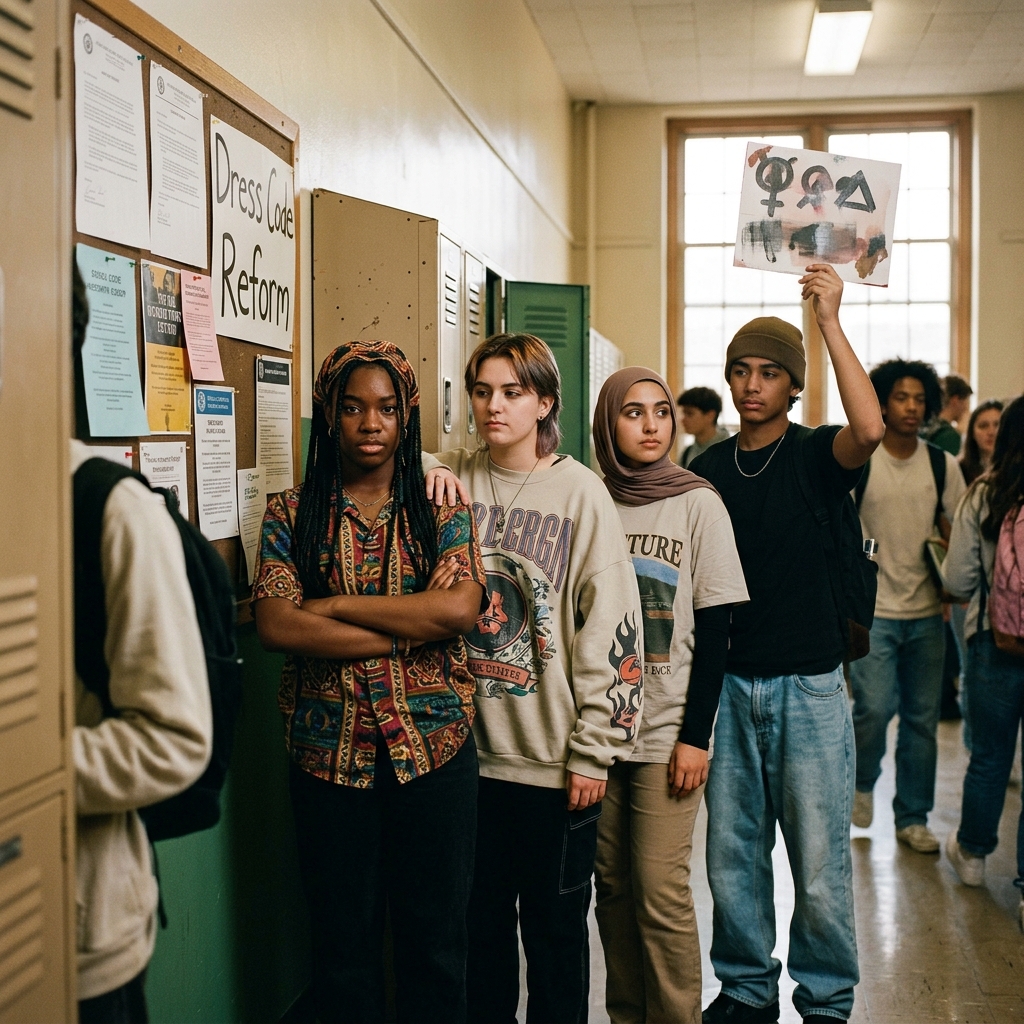
The Battle for Authenticity: Confronting Discriminatory Dress Codes
The journey through high school is punctuated by widely celebrated rites of passage—milestones like proms, senior class portraits, and graduation ceremonies. These capstone events are meant to capture the culmination of a student’s hard work, representing a launchpad into early adulthood. However, for many LGBTQ+ students, these supposed moments of celebration are overshadowed by archaic, restrictive, and sexist dress codes. Across the United States, educational institutions frequently enforce strict gender-binary clothing regulations, demanding that female-assigned students wear gowns, dresses, or “drapes” for photographs, while male-assigned students are permitted or required to wear tuxedos and dark suits.
When an educational institution mandates presentation according to rigid sex stereotypes, it does far more than simply police adolescent clothing choices; it dictates identity and enforces conformity at the expense of mental well-being. For a gay woman of color, a transgender youth, or a nonbinary student, being coerced into wearing clothing that fundamentally contradicts their internal sense of self isn’t just physically uncomfortable—it is a devastating form of institutional erasure. Taking pride in who you are requires visibility, and taking away a student’s right to that visibility is an infringement on their civil liberties.
Defying these discriminatory mandates is not merely an act of teenage rebellion. Instead, it is a profound declaration of self-determination. The ongoing battle for authentic self-expression sits squarely at the intersection of civil rights, adolescent mental health, and educational equity. When marginalized young people push back against these restrictive policies, they are actively dismantling systemic barriers and safeguarding the fundamental rights of every student who will walk those school halls in the future.
The Hidden Impact of Gender-Binary Policies
To the casual observer or an outdated administration, a school dress code might seem like a benign administrative tool designed to maintain order, minimize distractions, and promote a unified student body. However, beneath the surface of these seemingly neutral rules, many of these regulations silently enforce rigid, outdated notions of gender. By delineating strictly between “boys’ attire” and “girls’ attire,” schools communicate a clear, incredibly harmful message to their student population: there are only two acceptable ways to exist, and any deviance from this binary will be swiftly penalized.
For LGBTQ+ youth, clothing is deeply and inextricably connected to gender expression and sexual orientation. When a student who traditionally wears masculine clothing as a core component of their identity is told they must wear a dress to participate in a graduation ceremony, the psychological toll is immense. According to the Centers for Disease Control and Prevention (CDC), school environments that fail to actively support LGBTQ+ youth can significantly exacerbate feelings of isolation, leading to measurable negative impacts on their mental health. The imposition of binary dress codes forces a completely unfair ultimatum upon these students: conform and suffer quietly, or remain authentic and face exclusion from your own educational milestones.
This dynamic creates an environment of hostility rather than the inclusivity that schools should foster. To understand the structural differences between these policies, consider the following breakdown of dress code frameworks and their impacts on student populations:
| Policy Type | Key Characteristic | Impact on LGBTQ+ Youth |
|---|---|---|
| Strict Gender-Binary | Specifies entirely different clothing requirements based solely on a student’s sex assigned at birth. | Dramatically increases gender dysphoria, heavily enforces outdated stereotypes, and directly leads to social and academic exclusion. |
| Vaguely Neutral (Biased Enforcement) | Uses gender-neutral language on paper but enforces rules disproportionately against LGBTQ+ or minority students. | Creates an atmosphere of anxiety, mistrust, and confusion, as students are targeted based on subjective administrative biases. |
| Fully Gender-Neutral & Inclusive | Requires specific levels of formality (e.g., “formal wear”) but allows students to choose the garment that fits the occasion regardless of gender. | Promotes a widespread sense of inclusion, reduces school-related anxiety, and allows for unapologetic, authentic self-expression. |
Intersectionality in Educational Spaces
The conversation surrounding self-expression and civil rights in schools cannot be complete without addressing intersectionality. The overlapping layers of discrimination that certain students face mean that the fight against sexist dress codes is rarely a single-issue battle. For example, a gay student of color navigating a predominantly conservative school district faces compounding barriers. The erasure they experience isn’t solely tied to gender nonconformity; it is intricately linked to how race, gender expression, and sexual orientation intersect in the eyes of authority figures.
Often, dress codes are disproportionately enforced against students of color. When you add the layer of LGBTQ+ identity, these students become heavily surveilled targets. A young woman of color who opts for a tailored tuxedo and natural hair over a traditional gown and straightened hair is asserting a multi-faceted identity. She is rejecting both the patriarchal expectation of hyper-femininity and the Eurocentric standards of formal presentation.
For marginalized groups, achieving visibility in educational spaces is a critical component of feeling a sense of belonging. Schools are supposed to be safe havens for learning and personal growth. When administrative policies deliberately attempt to sanitize the diverse realities of their student body by forcing them into homogenous, sanitized molds, they actively harm the community. Championing intersectional identities means recognizing that taking pride in who you are is a holistic endeavor, one that schools should celebrate rather than suppress.
Erasure at the Finish Line: Yearbooks and Graduations
The true harshness of discriminatory dress codes often reveals itself during a school’s most public capstone events—specifically, the publication of the annual yearbook and the execution of the graduation ceremony. These events are designed to foster community, cement lasting memories, and honor the diverse paths students are about to take. Yet, for LGBTQ+ youth who refuse to compromise their identities, these milestones rapidly transform into punitive battlegrounds.
When a student bravely takes their senior portrait in clothing that reflects their authentic self—such as a tuxedo instead of a feminine drape—some school administrations retaliate with aggressive censorship. There are well-documented instances where schools have explicitly refused to print these portraits in the yearbook. In some of the most egregious cases, even when families have purchased private ad space to commemorate their child’s achievements, administrations have gone so far as to black out the student’s image, replacing a smiling, proud face with a stark black box. This is not just a disagreement over attire; it is a literal and symbolic attempt to erase the student’s existence from the community’s historical record.
Similarly, graduation ceremonies often serve as the ultimate leverage point for non-inclusive schools. Administrators may threaten to withhold a student’s diploma or physically bar them from walking across the stage if they do not adhere to sex-specific attire underneath their graduation gowns. Forced to choose between sacrificing their integrity or missing out on a once-in-a-lifetime celebration, many LGBTQ+ youth are put in an impossibly painful position. Skipping graduation rather than conforming to an inauthentic mold is a heartbreaking decision that no young person should ever have to make.
The Legal Framework: Title IX and the First Amendment
Fortunately, students who are targeted by discriminatory dress codes are not without powerful legal recourse. The foundation of the fight against these sexist policies rests largely on two critical legal pillars: Title IX of the Education Amendments of 1972 and the First Amendment of the United States Constitution.
Title IX states that no person in the United States shall, on the basis of sex, be excluded from participation in, be denied the benefits of, or be subjected to discrimination under any education program or activity receiving federal financial assistance. In recent years, both the courts and the U.S. Department of Education have clarified that discrimination “on the basis of sex” inherently includes discrimination based on sexual orientation and gender identity. Therefore, when a public school mandates that a female-assigned student must wear a dress, while allowing male-assigned students to wear suits, they are imposing disparate treatment based entirely on sex. This rigid enforcement of sex stereotypes is a clear violation of Title IX protections, prompting numerous students and advocacy organizations to file federal civil rights complaints against non-compliant school districts.
Furthermore, the First Amendment protects students’ rights to free speech and expression. Historically, the Supreme Court has ruled that students do not “shed their constitutional rights to freedom of speech or expression at the schoolhouse gate.” Clothing is widely recognized as a potent form of symbolic speech and personal expression. As long as a student’s attire does not cause a “substantial disruption” to the educational environment, schools have very little legal standing to censor it. Wearing a tuxedo instead of a drape, or a suit instead of a gown, does not disrupt the educational process; it simply challenges the administration’s outdated social preferences. The arbitrary suppression of this expression is a direct affront to a student’s constitutional rights.
Forging a Path Forward for LGBTQ+ Students
The burden of changing these discriminatory systems often falls unjustly on the shoulders of the youth themselves. Yet, time and again, LGBTQ+ students demonstrate immense courage, choosing to stand firm in their truth rather than bowing to institutional pressure. When one student refuses to accept an unfair, sexist rule, their individual defiance frequently sparks a much broader systemic change.
Building supportive coalitions is essential to forging a more inclusive path forward. Students, parents, allied educators, and national civil rights advocacy groups must work collaboratively to hold school districts accountable. This involves challenging outdated handbooks, attending school board meetings, and, when necessary, bringing legal action against districts that refuse to modernize their policies. Education must evolve to meet the needs of all students, creating environments where self-discovery is nurtured.
Looking ahead, the ultimate goal is the universal adoption of gender-neutral dress codes—policies that dictate the level of formality required for an event without attaching those requirements to a student’s gender or assigned sex. A truly inclusive policy ensures that the next student who walks into a portrait studio or steps onto a graduation stage is entirely free to choose their attire based on who they are, not who a school administrator thinks they should be. Taking pride in one’s identity is an unalienable right, and ensuring that our educational institutions reflect that reality is a fight worth having.
Frequently Asked Questions (FAQ)
What makes a school dress code discriminatory?
A dress code is considered discriminatory when it imposes different rules or expectations on students based on their sex assigned at birth, gender identity, or race. For example, requiring only girls to wear dresses or only boys to have short hair enforces rigid gender stereotypes and marginalizes LGBTQ+ and nonbinary students.
How does Title IX protect LGBTQ+ students from sexist dress codes?
Title IX prohibits sex-based discrimination in any federally funded educational program. The U.S. Department of Education and various federal courts have interpreted this to include discrimination based on gender identity and sexual orientation. Forcing students to conform to sex-stereotyped clothing violates this protection.
Can a school legally ban me from graduation for my gender expression?
Generally, no. Under the First Amendment and Title IX, public schools cannot arbitrarily exclude students from educational activities or capstone events simply because their clothing does not conform to traditional gender norms, provided the attire does not cause a substantial disruption to the event.
What should I do if my school enforces a discriminatory dress code?
Students facing dress code discrimination should first document the incidents and the specific policies. You can bring the issue to the school board, seek support from local LGBTQ+ advocacy groups, or file a formal Title IX complaint with the U.S. Department of Education’s Office for Civil Rights.
References
- Title IX and Sex Discrimination — U.S. Department of Education. 2021-08-20. https://www2.ed.gov/about/offices/list/ocr/docs/tix_dis.html
- Supporting LGBTQ+ Youth — Centers for Disease Control and Prevention (CDC). 2024-11-29. https://www.cdc.gov/healthyyouth/disparities/smy.htm
- LGBTQ+ youth policy and mental health: Indirect effects through school experiences — National Center for Biotechnology Information / PMC. 2024-12-29. https://www.ncbi.nlm.nih.gov/pmc/articles/PMC11016834/
- Dress Codes — The First Amendment Encyclopedia, Middle Tennessee State University. 2023-08-07. https://firstamendment.mtsu.edu/article/dress-codes/
Similar Articles








Read full bio of medha deb


