
U.S. Federal Privacy Laws: Practical Guide For Businesses 2026
A clear guide to the main federal privacy rules shaping personal data protection in America.
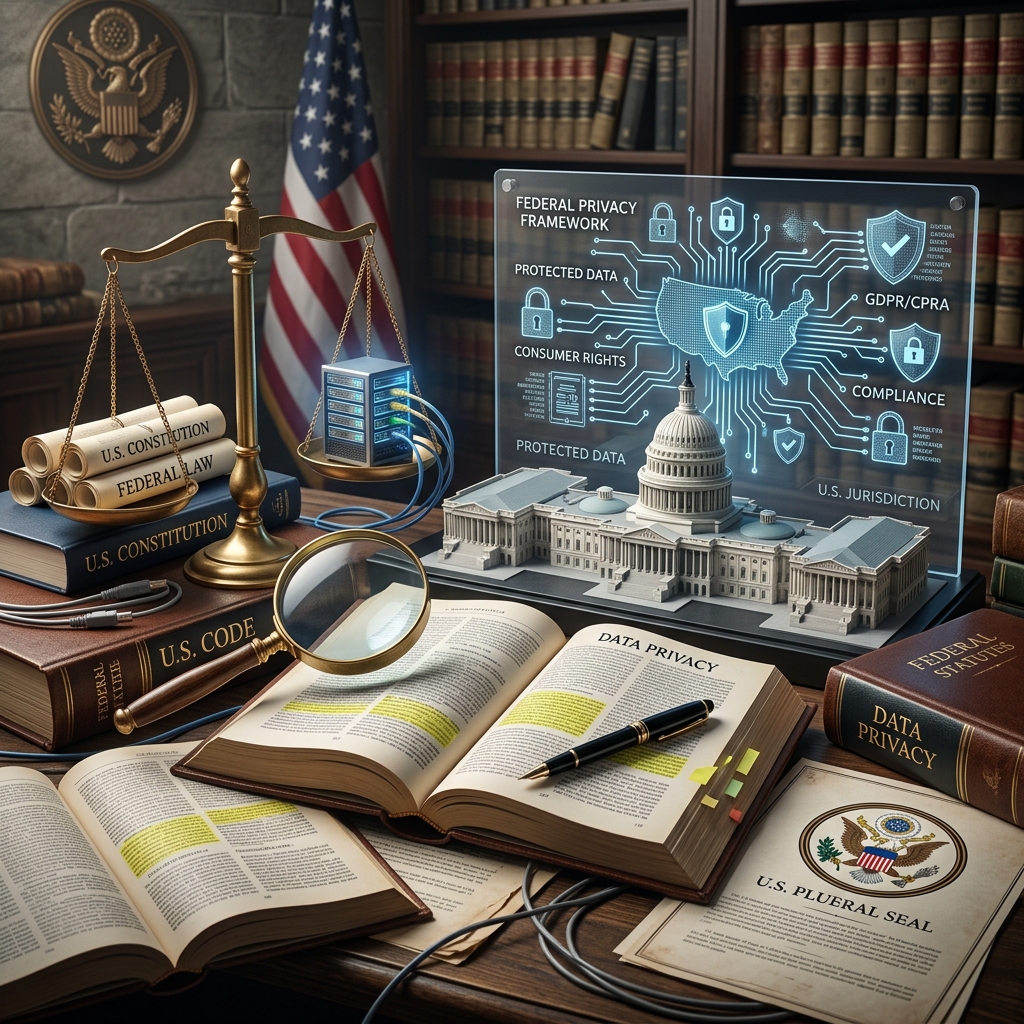
The United States does not have one all-purpose federal privacy statute that covers every type of personal data. Instead, privacy protection is built from a mix of sector-specific federal laws and a growing set of state privacy laws, which means the rules a business must follow depend heavily on the kind of data it handles and the context in which it is collected or shared.
That patchwork approach matters for both consumers and businesses. For consumers, it means rights can differ depending on whether the information involves health care, banking, education, children, or a federal agency. For businesses, it means compliance is rarely one-size-fits-all and often requires understanding multiple overlapping obligations.
Why the U.S. privacy system is fragmented
Unlike legal systems that rely on a single broad privacy code, the U.S. relies on targeted laws for specific industries or categories of information. Federal law provides important safeguards, but those safeguards are not uniform across all personal data.
This structure developed because privacy concerns arose in different settings at different times. Medical records, student files, consumer banking records, and children’s online information each triggered distinct legal responses. As a result, modern privacy compliance in the U.S. often starts with identifying the type of data at issue before asking which law applies.
The main federal laws that protect personal information
Several federal statutes stand out as the most important privacy laws in everyday practice. Each protects a different category of information and imposes different duties on the organizations that collect or use that information.
| Law | Primary focus | Who it mainly applies to |
|---|---|---|
| Privacy Act of 1974 | Federal agency records | U.S. government agencies |
| HIPAA | Health information | Covered entities and business associates in health care |
| COPPA | Children’s online data | Websites and online services directed to children or knowingly collecting from children |
| GLBA | Financial data | Banks, insurers, securities firms, and related financial institutions |
| FERPA | Education records | Schools and educational institutions receiving federal funds |
| RFPA | Financial records requested by the government | Financial institutions and federal agencies |
The Privacy Act and federal agency records
The Privacy Act of 1974 is a foundational federal privacy law because it governs how federal agencies collect, use, maintain, and disclose records about individuals. It was designed to create fair information practices for government-held data and to limit unauthorized disclosure from systems of records.
At a practical level, the law gives individuals access rights, including the ability to review records kept about them by federal agencies and request corrections in some circumstances. It also restricts disclosure unless an exception applies and allows individuals to bring suit in certain situations when the government violates the statute.
For consumers, the Privacy Act matters because it governs some of the most sensitive records held by the government. For agencies, it creates recordkeeping and disclosure requirements that are intended to prevent misuse of personal information.
HIPAA and the protection of health information
The Health Insurance Portability and Accountability Act, commonly known as HIPAA, is the main federal law governing the privacy of medical information. Its privacy rule sets national standards for safeguarding protected health information and limits how covered entities may use or disclose that information.
HIPAA does not apply to every organization that touches health-related data. It primarily covers health plans, health care clearinghouses, certain health care providers, and business associates acting on their behalf. That distinction is important because many apps, websites, and wellness platforms fall outside HIPAA even if they collect health-related details.
In practice, HIPAA is best understood as a baseline rule for formal health care settings. It creates expectations around notice, confidentiality, and controlled disclosure, but it does not replace broader consumer privacy expectations in every digital health context.
COPPA and children’s online privacy
The Children’s Online Privacy Protection Act, or COPPA, is the central federal law governing online collection of personal information from children under 13. It applies to operators of websites and online services that are directed to children, as well as to operators who have actual knowledge that they are collecting data from children under that age.
One of COPPA’s core requirements is verifiable parental consent before collecting, using, or disclosing a child’s personal information. Recent updates also place stricter limits on using children’s data for targeted advertising or sharing it with third parties without separate, specific opt-in consent.
COPPA is especially important because children may not understand how their information is being used. The law therefore shifts decision-making authority to parents and requires websites and online services to be more transparent about their data practices.
Financial privacy laws and the handling of banking data
Financial information receives separate treatment under federal law because of the sensitivity of banking, credit, and account records. The Gramm-Leach-Bliley Act and the Right to Financial Privacy Act are among the most important federal statutes in this area.
The Gramm-Leach-Bliley Act applies to many financial institutions and requires them to explain how they share consumer information and what choices consumers may have. It helps regulate the relationship between financial services providers and their customers by placing limits and notice obligations on the handling of nonpublic personal information.
The Right to Financial Privacy Act addresses a different concern: access by the federal government. It generally requires notice and an opportunity to object before a bank or similar institution discloses personal financial information to a federal agency, subject to statutory exceptions. That makes it an important safeguard in investigations and law-enforcement-related requests.
FERPA and student records
The Family Educational Rights and Privacy Act, or FERPA, protects the confidentiality of student education records. It generally bars educational institutions from disclosing information from those records without written consent, unless a recognized exception applies.
FERPA also gives students and, in some cases, parents important access rights. These include the ability to inspect and review education records, request corrections, and learn about institutional policies governing record access. In that sense, FERPA operates as both a privacy statute and a transparency law for educational data.
For families, FERPA is one of the main laws that preserves control over school records. For schools, it creates obligations that affect everyday administrative, disciplinary, and academic recordkeeping.
How federal privacy law compares with state privacy law
Federal privacy law is only part of the picture. State privacy laws now play a major role in shaping consumer rights, particularly in relation to online tracking, data sales, sensitive data processing, and opt-out rights.
Many state laws require businesses to provide notice about what personal information they collect, how they use it, and what choices consumers have. Several also require consent for certain categories of sensitive data, while others provide the right to opt out of sales, targeted advertising, or profiling.
Because state laws vary, a business that is compliant in one state may still need to change its practices elsewhere. That is one reason privacy compliance teams often treat federal law as the floor and state law as the layer that adds more detailed obligations.
What consumers can realistically expect
Consumers in the United States have meaningful privacy protections, but those protections are uneven. In some contexts, such as health care or children’s websites, the law is relatively specific and strong. In other contexts, consumers rely more on notices, consent mechanisms, or state-law rights than on one universal federal standard.
- Ask which type of data is being collected.
- Check whether the organization is a regulated entity under HIPAA, COPPA, GLBA, FERPA, or another statute.
- Review privacy notices to understand disclosures, sharing, and opt-out options.
- Be aware that state laws may provide additional rights beyond federal law.
These steps help consumers understand why the same company may treat different information differently. A medical app, a bank, and a school all operate under different privacy expectations because the law treats their data differently.
What businesses need to watch closely
For businesses, the biggest challenge is matching the right compliance program to the right data set. A company may need one set of procedures for customer accounts, another for marketing data, another for employee records, and another for children’s information.
Common compliance themes appear across many laws. These include advance notice, limits on disclosure, data security expectations, opt-in consent for certain sensitive uses, and the right for individuals to access or correct information in some settings.
Businesses should also remember that collecting data for one purpose does not automatically authorize using it for another. In several privacy frameworks, using personal information in a materially different way than originally disclosed can trigger new consent or notice obligations.
Where the law is heading
The U.S. privacy landscape continues to evolve. State laws are becoming more comprehensive, federal agencies continue to enforce existing rules, and policymakers keep debating whether a single national consumer privacy law should eventually replace the current patchwork.
Until that happens, the most reliable approach is to treat privacy law as context-specific. The strongest way to understand a privacy question is to ask who collected the data, what type of information it is, what was promised to the consumer, and which federal or state statute applies.
Frequently asked questions
Is there one federal privacy law that covers all personal data?
No. The United States uses a patchwork system of sector-specific federal laws rather than one comprehensive national privacy statute.
What is the most important federal privacy law for health data?
HIPAA is the main federal law governing health information in the health care system, though its scope is limited to certain covered entities and related business associates.
What law protects children’s data online?
COPPA is the primary federal law for online privacy involving children under 13, and it requires verifiable parental consent in many situations.
Do state laws matter if a business already follows federal law?
Yes. State privacy laws can add separate duties, broader consumer rights, and different compliance thresholds, so federal compliance alone may not be enough.
Can consumers see government records about themselves?
Under the Privacy Act, individuals generally have rights to access and sometimes amend records held by federal agencies, subject to statutory limits and exceptions.
Practical takeaway
Federal privacy law in the United States is best understood as a set of targeted protections rather than a single all-purpose code. The Privacy Act, HIPAA, COPPA, GLBA, FERPA, and RFPA each protect different kinds of information, while state laws increasingly fill gaps and expand consumer rights.
For consumers, that means privacy rights depend on the setting. For businesses, it means careful data mapping and legal review are essential before collecting, using, or sharing personal information in new ways.
References
- Data protection laws in the United States — DLA Piper. 2026. https://www.dlapiperdataprotection.com/countries/united-states/law.html
- U.S. Privacy Laws — Electronic Privacy Information Center. 2026. https://epic.org/issues/privacy-laws/united-states/
- Privacy Act of 1974 — U.S. Department of Justice, Office of Privacy and Civil Liberties. 2026. https://www.justice.gov/opcl/privacy-act-1974
- Consumer Data Privacy Laws — Bloomberg Law. 2026. https://pro.bloomberglaw.com/insights/privacy/consumer-data-privacy-laws/
- U.S. Data Privacy Laws: A Guide to the 2026 Landscape — Osano. 2026. https://www.osano.com/us-data-privacy-laws
- Privacy and Security — Federal Trade Commission. 2026. https://www.ftc.gov/business-guidance/privacy-security
- US Data Privacy Guide — White & Case LLP. 2026. https://www.whitecase.com/insight-our-thinking/us-data-privacy-guide
Similar Articles








Read full bio of medha deb


