
Fair Housing Protections for LGBTQ+ Couples
How the Fair Housing Act and related rules protect LGBTQ+ couples from discrimination in renting, buying, and accessing housing.
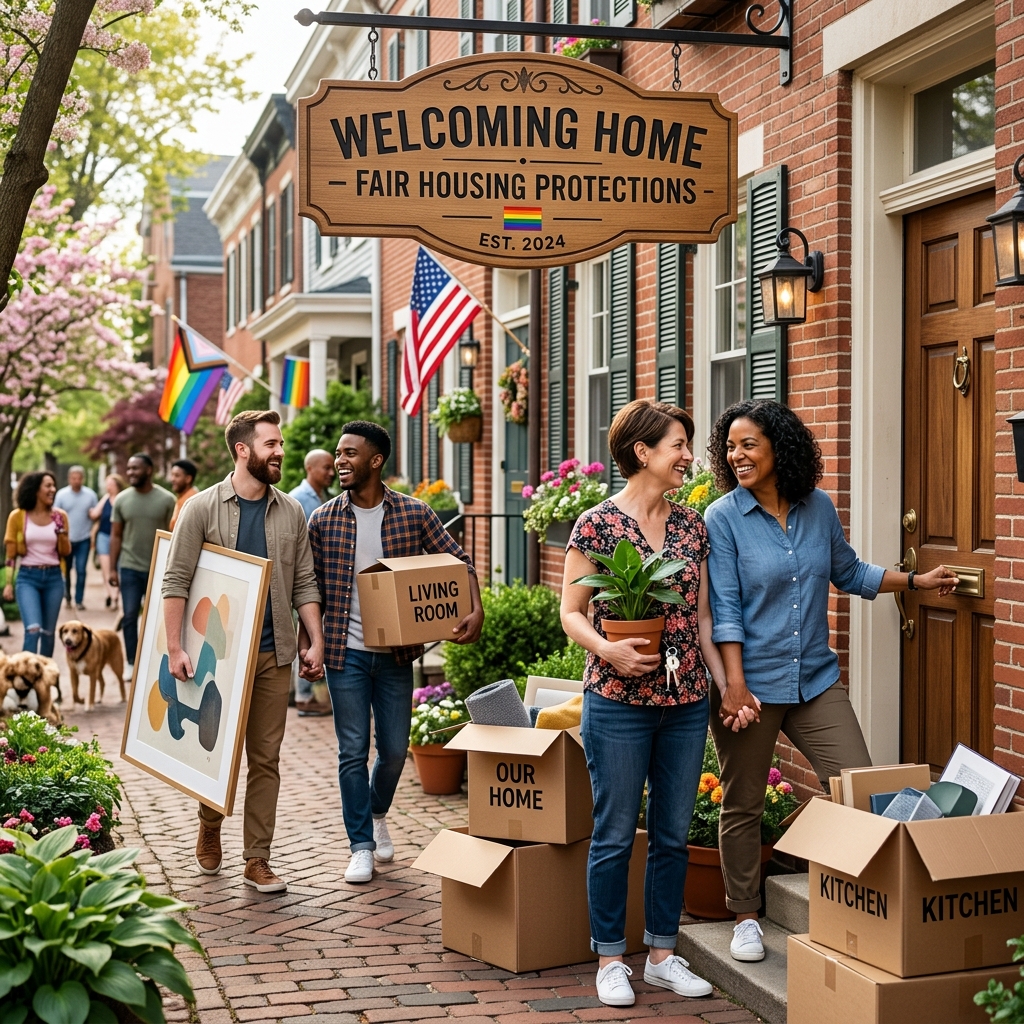
LGBTQ+ couples have important protections against housing discrimination under federal law, agency regulations, and many state and local ordinances. While the federal Fair Housing Act does not explicitly list sexual orientation or gender identity, recent interpretations and rules now treat discrimination against LGBTQ+ people as a form of prohibited sex discrimination in most housing-related situations.
Understanding these protections is critical for couples seeking to rent, buy, or finance a home. This article explains how the Fair Housing Act works, how federal agencies interpret it for LGBTQ+ people, where state laws add more protection, and what steps couples can take if they face discrimination.
Core Promise of the Fair Housing Act
The Fair Housing Act (FHA) is the primary federal law governing housing discrimination in the United States. It covers nearly all aspects of housing, including rental units, home sales, mortgage lending, homeowners’ insurance, and advertising. Under the FHA, housing providers may not discriminate against people because of:
- Race
- Color
- Religion
- National origin
- Sex
- Disability
- Familial status (for example, having children under 18 in the household)
Although sexual orientation and gender identity are not named directly in the statute, federal agencies and courts have increasingly treated anti-LGBTQ+ discrimination as discrimination because of sex, bringing LGBTQ+ couples within the FHA’s protection.
How LGBTQ+ Protections Emerged Under Federal Law
For many years, LGBTQ+ couples relied primarily on state and local protections because federal law did not clearly address sexual orientation or gender identity. That changed through a combination of court decisions and executive branch policy.
Key Legal Developments
- In 2020, the U.S. Supreme Court ruled in Bostock v. Clayton County that discrimination based on sexual orientation or gender identity is a form of sex discrimination under Title VII, the federal employment discrimination law.
- In early 2021, the Biden Administration directed agencies to apply that same reasoning to other federal laws that prohibit sex discrimination, including the Fair Housing Act.
- Shortly afterward, the U.S. Department of Housing and Urban Development (HUD) issued guidance stating that discrimination against people based on sexual orientation or gender identity would be treated as illegal sex discrimination under the FHA.
As a result, housing providers covered by the FHA may not refuse to rent, sell, or lend to a couple because they are same-sex partners or because one or both partners are transgender. HUD has announced that it will investigate complaints alleging such discrimination as violations of the Act.
HUD’s Equal Access Rule and Its Impact on Couples
Beyond its interpretation of “sex” under the Fair Housing Act, HUD has adopted an Equal Access rule that directly addresses sexual orientation and gender identity in certain housing programs.
The Equal Access rule bars discrimination against LGBTQ+ people in HUD-funded or HUD-insured housing, including:
- Public housing authorities
- HUD-funded shelters and transitional housing programs
- Housing supported by HUD-backed mortgages or other HUD financial assistance
For LGBTQ+ couples, this means they cannot be turned away from public housing, emergency shelter, or HUD-supported rental units because of their relationship or individual identity. If one partner is transgender, staff may not refuse appropriate placement or insist on separating the couple solely on that basis.
Common Forms of Housing Discrimination Against LGBTQ+ Couples
Discrimination does not always take the form of an outright refusal to rent or sell. It can appear in subtle or indirect ways that still violate federal or state law when based on a protected characteristic.
Examples Couples Might Encounter
- A landlord refuses to show an apartment or stops responding once learning the applicants are a same-sex couple.
- A property manager states that “families here must be a man and a woman,” and denies a unit to two women raising children together.
- A mortgage lender quotes higher interest rates or fees to a couple after perceiving them as LGBTQ+.
- A condominium association applies rules more strictly to a gay couple than to different-sex couples.
- A shelter turns away a couple because one partner is transgender, even though the shelter receives HUD funding.
If the underlying reason for these actions is the couple’s sexual orientation or gender identity, they are likely unlawful under HUD’s current interpretation of the FHA and its Equal Access rule.
Federal Protections vs. State and Local Laws
Federal law now offers significant protection, but the details of LGBTQ+ housing rights can vary depending on the state or city. Some states have explicit protections in their own fair housing statutes, while others rely only on federal interpretation.
Landscape of State-Level Protections
According to research on nondiscrimination laws, explicit housing protections for both sexual orientation and gender identity exist in just under half of U.S. states, as well as in the District of Columbia and certain territories. Other states provide partial protection, sometimes covering sexual orientation but not gender identity.
| Type of State Law | Coverage for Same-Sex Couples | Coverage for Transgender Partners |
|---|---|---|
| Explicit protection for sexual orientation and gender identity | Clear protection in renting, buying, and lending | Clear protection for transgender and non-binary individuals |
| Protection for sexual orientation only | Protection for same-sex couples, at least regarding orientation | May leave gaps for discrimination based solely on gender identity |
| No explicit LGBTQ+ language in state statute | Reliance on federal FHA interpretation and local ordinances | Same reliance, with possible uneven enforcement |
In addition to state laws, many cities and counties have adopted ordinances that specifically prohibit housing discrimination based on sexual orientation and gender identity. These local rules can offer strong protection even in states without comprehensive statewide safeguards.
How Couples Can Assert Their Rights
LGBTQ+ couples who believe they have experienced housing discrimination should take prompt steps to document the situation and consider filing a complaint. Federal law imposes time limits, so waiting too long can close off certain options.
Immediate Actions to Take
- Write down what happened: Include names, dates, locations, and the exact words used by the housing provider.
- Save evidence: Keep emails, text messages, application forms, advertising screenshots, and notes of phone calls.
- Identify witnesses: Ask anyone who observed the events if they are willing to provide a statement.
Filing a Complaint Under the Fair Housing Act
Couples can file complaints with HUD when they believe a landlord, seller, lender, or other housing-related entity violated the Fair Housing Act. HUD investigates alleged discrimination that falls within the protected classes and the agency’s current interpretation of “sex.”
A typical FHA complaint should include:
- The names of the housing providers and any staff involved
- The address and description of the property or program
- Specific events that the couple believes violated the law
- Dates when the events occurred
The Act also prohibits retaliation. That means a housing provider may not evict, harass, or otherwise punish a couple for reporting discrimination or helping with an investigation.
Ongoing Challenges and Enforcement Gaps
Even with stronger federal interpretations, many LGBTQ+ couples continue to face barriers in obtaining safe and stable housing. Advocacy organizations report that discrimination persists, particularly in regions without explicit state protections.
Enforcement also depends on federal and state priorities. Changes in administration can influence how vigorously HUD pursues sexual orientation and gender identity cases. Advocates have raised concerns when investigations slow or when agencies threaten to reduce support for local bodies that enforce LGBTQ+ protections.
These gaps illustrate why it is important for couples to understand both their rights and the practical realities of enforcement in their area, and to seek legal help or advocacy support when needed.
Practical Tips for LGBTQ+ Couples Seeking Housing
While the law offers important protections, many couples want concrete strategies to reduce risk and respond effectively if issues arise. The following tips focus on preparation, documentation, and using available legal tools.
- Research protections in your state and city: Look for fair housing agencies or civil rights commissions that list LGBTQ+ as protected categories. Many provide guidance and complaint forms online.
- Use written communication when possible: Email or text can create a record of what was said and when, making it easier to demonstrate discriminatory treatment.
- Compare treatment with other applicants: If you suspect discrimination, note how your experience differs from that of similarly qualified non-LGBTQ+ applicants.
- Consult legal or advocacy organizations: LGBTQ+ rights centers, fair housing nonprofits, and legal aid groups can help interpret your situation and guide next steps.
- Act quickly: Because deadlines apply to fair housing complaints, couples should not wait to seek advice or file initial paperwork.
FAQs About Fair Housing and LGBTQ+ Couples
Does the Fair Housing Act explicitly list sexual orientation or gender identity?
No. The statute lists sex but not sexual orientation or gender identity by name. However, HUD currently interprets sex discrimination to include discrimination based on sexual orientation and gender identity, and applies that interpretation when enforcing the Fair Housing Act.
Can a landlord legally refuse to rent to us because we are a same-sex couple?
Under HUD’s current policy, refusing to rent to a couple because they are same-sex partners is treated as illegal sex discrimination under the Fair Housing Act. Many state and local laws independently forbid this conduct as well.
Are protections different for transgender partners?
Discrimination based on gender identity is also treated as sex discrimination under HUD’s interpretation and under the Supreme Court’s reasoning in Bostock. In states with explicit gender identity protections, couples benefit from both federal and state safeguards.
What if our state has no explicit LGBTQ+ housing law?
Even in states without explicit LGBTQ+ language in housing law, couples are still covered by the federal Fair Housing Act and HUD’s interpretations. Local ordinances may add further protection in specific cities or counties.
Is it safe to file a complaint, or can we be punished for it?
The Fair Housing Act makes it illegal to retaliate against anyone for reporting discrimination or assisting in an investigation. Landlords and other housing providers cannot lawfully evict, harass, or otherwise penalize you for asserting your rights.
References
- HUD Announces Sexual Orientation & Gender Identity are Protected under the Federal Fair Housing Act — Fair Housing Project, Legal Aid of North Carolina. 2021-02-11. https://www.fairhousingnc.org/newsletter/hud-announces-sexual-orientation-gender-identity-are-protected-by-federal-fair-housing-act/
- Bipartisan Bill Introduced to Extend Fair Housing Act Protections to LGBTQ+ People — National Low Income Housing Coalition. 2025-06-10. https://nlihc.org/resource/bipartisan-bill-introduced-extend-fair-housing-act-protections-lgbtq-people-0
- Housing Discrimination Laws Protecting LGBTQ+ Individuals — Justia. 2023-08-01. https://www.justia.com/lgbtq/housing-discrimination/
- Federal LGBTQ Equal Access Rule — National Center for Lesbian Rights. 2016-09-20. https://www.nclrights.org/our-work/legislation-policy/federal-lgbt-equal-access-rule/
- Housing Discrimination Remains a Big Barrier for the LGBTQ+ Community — American Civil Liberties Union of Illinois. 2021-02-18. https://www.aclu-il.org/news/housing-discrimination-remains-big-barrier-lgbtq-community/
- Nondiscrimination Laws Equality Map — Movement Advancement Project. 2024-03-01. https://mapresearch.org/equality-map/nondiscrimination-laws/
- What is the state of LGBTQ+ fair housing rights? — Equal Rights Center. 2026-01-15. https://equalrightscenter.org/lgbtq-housing-rights-2026/
Similar Articles








Read full bio of Sneha Tete


