
Essential Evidence for Strong Contract Drafting and Review
Learn which documents and proof to gather before drafting or reviewing a contract so you can prevent disputes and protect your legal rights.
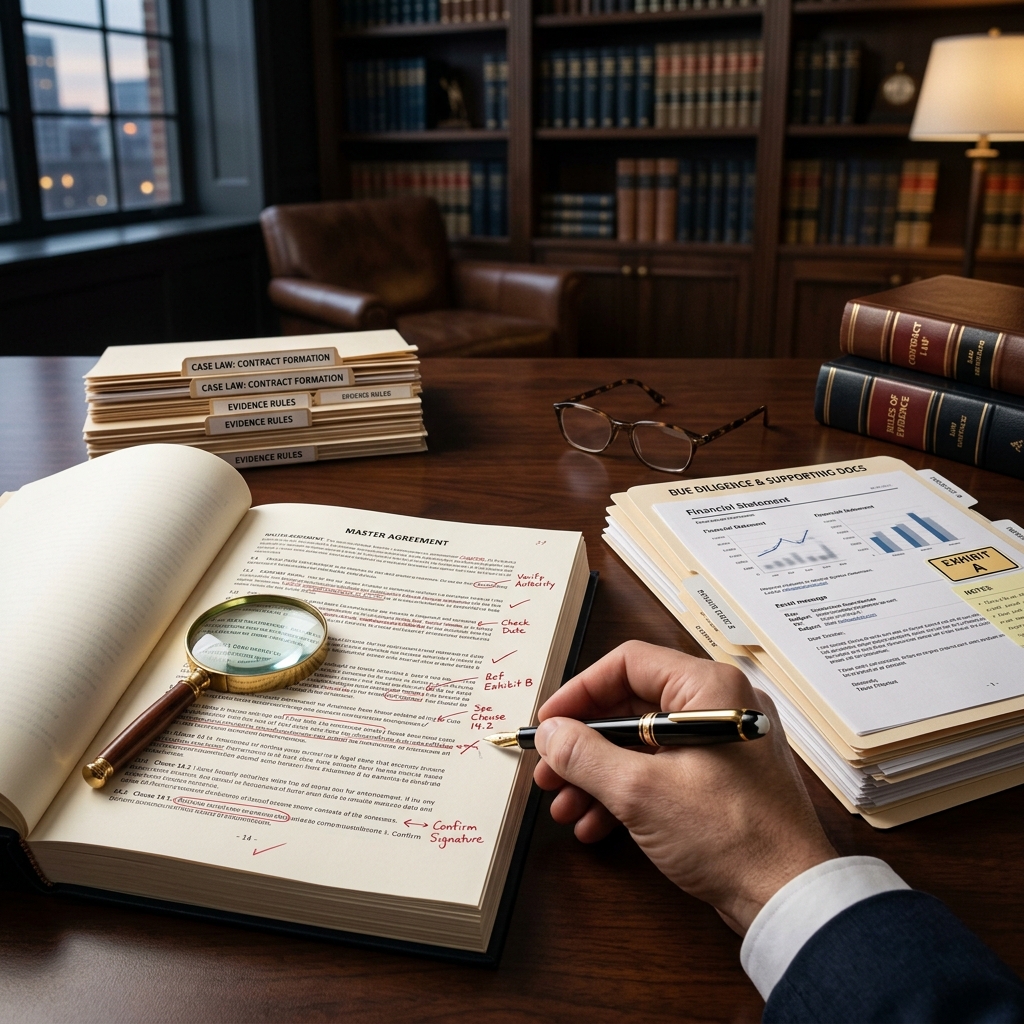
Effective contract drafting and review does not start when you open a template and begin editing clauses. It begins earlier, with careful collection of the documents and evidence that explain the parties’ relationship, expectations, and performance history. When you gather the right materials before drafting or reviewing, you reduce ambiguity, manage risk, and improve your chances of enforcing the agreement if a dispute arises.
This guide explains the most important types of evidence to assemble for a contract drafting or review matter, why each category is valuable, and how to organize the information so lawyers and business teams can work efficiently.
Why Evidence Matters in Contract Drafting and Review
Modern commercial contracts are often long, complex documents that try to capture a business relationship in precise legal terms. Without the right background evidence, drafters may miss critical facts, leading to unclear obligations, gaps in risk allocation, or clauses that do not reflect real-world practices.
Courts typically enforce written contracts according to their terms, but they may also consider surrounding materials to interpret ambiguous language or assess whether a contract exists at all.[10] Gathering supporting documents helps in several ways:
- Clarifies intent: Emails, drafts, and negotiations reveal what the parties were trying to achieve, which can guide clear drafting and later interpretation.
- Verifies performance: Payment records and delivery documents show whether each side honored their obligations.[10]
- Supports enforceability: Written contracts, offer and acceptance records, and consideration evidence help demonstrate that a valid contract exists.[10]
- Identifies risks: Prior dispute history or problematic clauses in old agreements highlight issues to address in new drafts.
Core Evidence Categories for Contract Cases
Although every situation is unique, certain document types recur in most contract drafting and review matters. Collecting these systematically provides a strong factual foundation.
1. Existing Contracts, Drafts, and Related Documents
The starting point is the written agreement itself and any related contracting documents. These materials usually provide the clearest statement of rights and obligations.
Key items to gather
- Signed contract: The final version executed by all parties, including signature pages and any annexes or schedules.
- Draft versions: Prior iterations showing changes to wording, pricing, duties, and risk allocation.
- Addenda and amendments: Later documents that modify the original terms, such as extensions, pricing changes, or scope adjustments.
- Statements of work (SOWs): Detailed descriptions of tasks, deliverables, timelines, and pricing that sit alongside a master agreement.
- Related policies or incorporated documents: Manuals, technical specifications, or standard terms that are referenced or linked in the contract text.
When reviewing, pay attention to consistency between the main contract and these related documents. Conflicts between clauses and SOWs or amendments are common sources of litigation.
How this evidence helps
- Shows the final agreed terms and any later modifications.
- Reveals negotiation history and how key clauses evolved, which is useful when language is unclear.
- Ensures new drafts align with existing obligations, avoiding overlapping or contradictory duties.
2. Communications Showing Offer, Acceptance, and Negotiation
Under contract law, a valid agreement generally requires an offer, acceptance, consideration, and mutual assent—that is, a real meeting of the minds around the deal terms.[10] Emails, letters, and messages often provide crucial evidence of how and when these elements occurred.
Important communication records
- Offer correspondence: Proposals, quotes, or term sheets that outline the initial terms and conditions.[10]
- Acceptance messages: Emails or signed letters explicitly agreeing to the offer, counteroffer, or revised terms.[10]
- Negotiation exchanges: Draft language comments, tracked changes, and detailed discussions of risk, responsibilities, and price.
- Clarification and interpretation emails: Messages explaining how parties understand ambiguous clauses or operational details.
- Notices under the contract: Written notices of breach, termination, renewal, or change requests delivered according to the contract’s notice clause.
How this evidence helps
- Documents the formation of the contract, supporting enforceability.[10]
- Highlights what the parties believed they were agreeing to, guiding clearer drafting and resolving disputes over ambiguous terms.
- Shows whether formal notice requirements were followed, which can be critical for termination, renewal, and remedies.
3. Financial and Performance Records
Even a well-drafted contract can be undermined if there is no proof that obligations were met or breached. Collecting payment and performance evidence provides a factual timeline of how the contract has operated in practice.[10]
Examples of performance-related evidence
- Invoices and billing statements: Showing amounts charged, due dates, and services or goods provided.
- Receipts, bank statements, and payment confirmations: Demonstrating that payments were made or missed.[10]
- Delivery records: Bills of lading, shipping confirmations, and acceptance logs for goods.[10]
- Work logs and project reports: Timesheets, milestone reports, and completion certificates for services.
- Quality and compliance documents: Inspection reports, test results, or certifications relating to contractual standards.
How this evidence helps
- Shows whether each party fulfilled their obligations, supporting claims of breach or defenses based on performance.[10]
- Supports calculations of damages, such as unpaid invoices, lost profits, or extra costs because of delays.
- Reveals practical issues that future contracts should address, like recurring delays or quality problems.
4. Witness Evidence and Internal Notes
Not everything relevant to a contract dispute appears in formal documents. Witnesses and internal records often fill in important details about discussions, conduct, and practical interpretation of clauses.
Useful forms of witness and internal evidence
- Witness statements: Written accounts from individuals directly involved in negotiations, drafting, or performance.
- Meeting minutes: Notes from negotiation or project meetings summarizing decisions and agreements.
- Internal emails and memos: Communications within an organization discussing contract terms, risks, and strategic choices.
- Contract review notes: Legal or compliance comments prepared during earlier drafting rounds.
How this evidence helps
- Provides context about how parties understood and applied contract provisions in real life.
- Supports claims of misrepresentation, mistake, or reliance where formal documents are silent.
- Helps lawyers reconstruct events for litigation preparation or settlement negotiations.
5. Policy, Regulatory, and Template Materials
Contracts rarely exist in a vacuum. They interact with internal policies, industry standards, and legal requirements. Gathering these materials helps ensure new drafts are compliant and aligned with organizational practice.
Examples of supporting materials
- Internal contract templates and clause libraries: Standard language approved by legal or compliance teams.
- Company policies: Procurement rules, data protection policies, information security standards, and ethics guidelines that influence contract terms.
- Regulatory guidance or legislation excerpts: Statutory rules relevant to the contract, such as consumer protection, data privacy, or public procurement requirements.
- Previous related contracts: Earlier agreements with the same counterparty or for similar deals, which can guide consistent drafting.
How this evidence helps
- Ensures contracts comply with applicable law and internal governance standards.
- Improves consistency across agreements, reducing review time and negotiation friction.
- Identifies clauses that need updating because of regulatory change or shifts in business strategy.
Organizing Evidence for Efficient Contract Review
Collecting documents is only the first step. To make them useful for drafting and review, they must be organized logically and easily accessible. Poor organization leads to missed facts and duplicated effort.
Suggested evidence organization framework
| Evidence Category | Examples | Primary Use in Drafting/Review |
|---|---|---|
| Contract Documents | Signed agreements, drafts, SOWs, amendments | Identify current obligations, gaps, and inconsistencies |
| Communications | Emails, letters, notices, term sheets | Clarify intent, formation, and negotiated risk allocation |
| Financial & Performance | Invoices, payment records, delivery logs | Assess performance, breach, and damages exposure |
| Witness & Internal Notes | Statements, minutes, internal memos | Fill gaps, explain practical interpretation and conduct |
| Policy & Regulatory | Templates, policies, legal guidance | Align drafting with law and organizational standards |
Practical tips for managing evidence
- Create a document index: Maintain a simple table listing each document, date, author, and category so reviewers can navigate quickly.
- Use consistent naming conventions: Name files to reflect their type and version, such as Master-Services-Agreement-v3-signed.
- Separate privileged material: Keep legal advice and privileged communications in clearly marked folders to avoid inadvertent disclosure.
- Centralize storage: Store evidence in a shared, secure repository with controlled access for all stakeholders.
Connecting Evidence to a Structured Review Process
Evidence is most valuable when paired with a disciplined contract review framework. High-performing legal and business teams often take a multi-stage approach:
- Initial triage: Use key documents (main contract, SOWs, high-level correspondence) to categorize the matter by risk and complexity.
- Detailed clause review: Compare contract provisions against internal playbooks and policy documents to find misalignments.
- Cross-functional input: Involve finance, operations, and risk teams to interpret performance records and practical feasibility of terms.
- Risk mitigation planning: Use evidence of past issues (late payments, delivery problems) to adjust clauses on remedies, service levels, and termination.
FAQs: Evidence for Contract Drafting and Review
Why do I need documents beyond the signed contract?
The signed contract is essential, but it may not fully explain how the agreement was formed or how parties have behaved over time. Drafts, communications, and performance records help interpret ambiguous language, prove breach or compliance, and guide better drafting going forward.
Are emails and messages really considered evidence?
Yes. Courts and arbitrators regularly consider emails, letters, and other written communications to determine offer, acceptance, intent, and notice.[10] These materials can show how parties understood key terms and whether they agreed to modifications.
What if some contract terms were agreed orally?
Oral agreements can be enforceable in many situations, though they can be difficult to prove and may be limited by statutes requiring certain contracts to be in writing.[10] In those cases, witness statements, meeting notes, and subsequent written confirmations are especially important.
How far back should I go when collecting performance records?
At minimum, gather records covering the entire term of the contract and any relevant renewal or extension periods. If the dispute involves a particular project or phase, focus on documents from that timeframe, but include earlier materials if they show a pattern of conduct.
Do internal templates and policies matter for external contracts?
Internal templates and policies are important because they reflect your organization’s risk appetite and compliance obligations. Comparing external contracts against these standards helps you identify when you are accepting higher risk or deviating from approved practices.
Should I involve legal counsel in evidence collection?
For significant contracts or potential disputes, involving legal counsel early is recommended. Lawyers can advise on which documents are most relevant, how to preserve privilege, and how to avoid inadvertent destruction or alteration of evidence.
References
- Top 5 Types of Documents/Evidence to Gather for Your Contract Drafting and Review Case — LegalMatch. 2024-01-01. https://www.legalmatch.com/law-library/article/top-5-types-of-documents-evidence-to-gather-for-your-contract-drafting-and-review-case.html
- Contract drafting: the step-by-step guide for businesses — DocJuris. 2023-06-15. https://www.docjuris.com/post/contract-drafting
- Contract Drafting & Review Guide: Best Practices & Modern Tools — Sirion. 2023-09-10. https://www.sirion.ai/library/contracts/contract-drafting-and-review/
- Contract Drafting and Review Manual — North Dakota Office of the Attorney General. 2010-10-20. https://www.library.nd.gov/statedocs/AttorneyGeneral/ContractDraftManual20101020.pdf
- IX. Common Types of Contract Documents — George Washington University Procurement. 2019-01-01. https://procurement.gwu.edu/ix-common-types-contract-documents
- Ten Things – How to Read a Contract — Ten Things Blog. 2019-08-28. https://tenthings.blog/2019/08/28/ten-things-how-to-read-a-contract/
- Types of Contracts: 13 Common Agreements Explained — Rev. 2022-05-01. https://www.rev.com/blog/types-of-contracts
Similar Articles








Read full bio of medha deb


