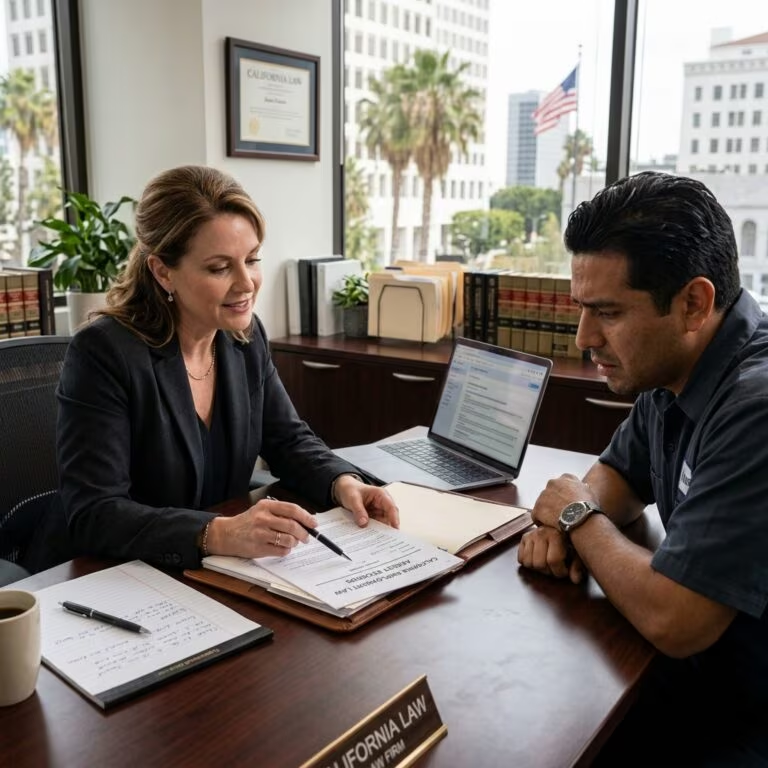
California law gives workers broad protection against discrimination in hiring, pay, promotions, discipline, and termination. Those protections apply when an employer makes decisions because of a worker’s membership in a protected category, and the law also provides several possible remedies when a violation occurs.
What workplace discrimination means in California
Workplace discrimination happens when an employer treats an applicant or employee worse because of a legally protected characteristic. In California, the list of protected traits is broad and includes race, color, ancestry, national origin, religion, age, disability, sex, gender, sexual orientation, gender identity, gender expression, medical condition, genetic information, marital status, military or veteran status, and reproductive health decision-making.
These protections can apply to many employment decisions, including hiring, firing, pay, scheduling, discipline, promotions, benefits, and other terms or conditions of work.
Who is covered by the law
California’s workplace discrimination rules are not limited to full-time employees. The state’s poster on workplace discrimination states that the law protects employees, applicants, unpaid interns, volunteers, and independent contractors from harassment, and it prohibits discrimination by covered employers in employment decisions.
For many discrimination claims, the size and type of employer matter. California law applies broadly to employers with five or more employees in many contexts, while public employers are also covered.
Common examples of illegal treatment
Discrimination can appear in obvious and subtle ways. A worker may be denied a job because of ethnicity, passed over for promotion because of pregnancy, paid less because of sex, disciplined more harshly because of religion, or dismissed after requesting a disability accommodation.
- Refusing to hire a qualified applicant because of race or national origin
- Cutting hours after an employee discloses a pregnancy or medical condition
- Giving promotions only to workers of a certain age group
- Using stereotypes about gender identity or sexual orientation in job assignments
- Retaliating after a complaint about discriminatory treatment
How discrimination claims are usually proven
A discrimination case generally requires proof that the adverse employment action was connected to a protected trait. In civil cases, the standard is usually a preponderance of the evidence, meaning the worker must show that discrimination was more likely than not a reason for what happened.
That does not always mean a worker needs direct evidence such as a written admission. California employees often rely on a combination of documents, timelines, witness testimony, and patterns of unequal treatment to show discriminatory motive.
Useful evidence can include emails, text messages, letters, performance reviews, disciplinary records, offer or termination paperwork, pay stubs, calendar entries, photos, recordings where lawful, and statements from co-workers or others who observed the events.
When multiple factors may be involved
Many workplace decisions are explained by employers as being based on performance, attendance, restructuring, or business needs. In some cases, the employer may have several reasons for the decision, only one of which is unlawful. California employees can still have a valid claim if discrimination was a motivating factor in the adverse action, even if the employer points to other explanations.
This is why documentation matters. A worker who can compare the employer’s explanation with earlier comments, inconsistent discipline, or unequal treatment of similarly situated co-workers may be able to challenge the stated reason for the decision.
Administrative steps before filing a lawsuit
Most workers must first complete an administrative process before going to court. California’s Civil Rights Department, and in some cases the federal Equal Employment Opportunity Commission, handle complaints and may investigate the matter.
Filing with the Civil Rights Department is important even if a worker later wants to file a court case. The agency process can lead to settlement efforts, investigation, or a right-to-sue letter if the matter does not resolve administratively.
Deadlines that can affect your claim
Timing is critical in discrimination cases. California generally requires a complaint to be filed within three years of the alleged discriminatory act. Some older guidance and older materials discussed shorter deadlines, but the current California Civil Rights Department guidance states the three-year rule for employment discrimination complaints.
Missing a deadline can prevent recovery even when the underlying facts are strong. Workers should act quickly once they suspect discrimination, especially if the issue involves termination, demotion, pay differences, or repeated hostile conduct.
What remedies may be available
If a worker proves discrimination, California law allows a range of remedies designed to make the person whole and discourage future violations. The exact relief depends on the facts of the case, the severity of the harm, and whether the employer acted intentionally or with reckless disregard.
| Possible remedy | What it can do |
|---|---|
| Back pay | Compensates for wages and benefits lost before judgment or settlement |
| Front pay | Replaces future earnings when reinstatement is not realistic |
| Hiring or reinstatement | Restores the worker to a position they were denied or lost |
| Promotion | Places the employee in the role discrimination prevented |
| Emotional distress damages | Addresses mental and emotional harm caused by the unlawful conduct |
| Punitive damages | Penalizes especially wrongful conduct in appropriate cases |
| Attorney’s fees and costs | Helps cover the expense of bringing the claim |
| Policy changes and training | Can reduce the chance of future violations at the workplace |
California’s Civil Rights Department also identifies additional remedies such as out-of-pocket expenses, reasonable accommodations, and cease-and-desist orders. In many cases, the goal is not only compensation for the worker but also correction of the employer’s practices.
How accommodation issues fit into discrimination claims
Some discrimination cases overlap with disability, pregnancy, or medical-condition issues. California law protects workers from discrimination based on disability and related categories and also recognizes rights related to pregnancy, childbirth, breastfeeding, and related medical conditions.
When an employer ignores a legitimate accommodation request or treats a worker unfairly because of a medical condition, the worker may have multiple legal theories to explore. Those claims can involve both the refusal to accommodate and the adverse treatment that follows.
Why early documentation matters
The strongest cases often begin with careful recordkeeping. Workers should preserve evidence as soon as something feels wrong, rather than waiting until the situation becomes severe.
- Save messages that refer to protected traits or make biased remarks
- Keep copies of job reviews, schedules, pay records, and discipline forms
- Write down dates, names, and what was said or done
- Identify co-workers who were treated differently in similar situations
- Track whether the employer changed its explanation over time
Even small pieces of evidence can matter when they help show a pattern, a change in treatment, or a timeline that supports the employee’s version of events.
When legal help can be useful
Discrimination cases often turn on nuance: the wording of a memo, the timing of a transfer, or whether similarly situated workers were treated differently. Because the rules on exhaustion, deadlines, and remedies are specific, many workers benefit from guidance before filing a complaint or lawsuit.
An attorney can help evaluate whether the facts fit one or more protected categories, whether the employer is covered, whether a CRD complaint is required, and what type of damages may be available. Legal advice can also help a worker decide whether settlement, agency investigation, or court litigation is the better path.
Practical steps after suspected discrimination
- Document the incident and save every related record.
- Report the issue internally if doing so is safe and consistent with company policy.
- Keep track of all deadlines for a CRD or EEOC filing.
- Compare how the employer treated you versus similar workers.
- Consult an employment lawyer if the matter affects pay, employment status, or future job prospects.
FAQs
What types of discrimination are most common in California workplaces?
Common claims involve race, sex, pregnancy, disability, age, religion, national origin, sexual orientation, and gender identity, but the protected categories are broader than that list.
Do I have to file with the Civil Rights Department first?
In most cases, yes. California generally requires an administrative complaint process before a worker files a discrimination lawsuit.
What if my employer says there was another reason for the decision?
An employer may offer a non-discriminatory explanation, but the worker can still challenge that reason with evidence showing discrimination was part of the decision-making process.
Can I recover money for stress or humiliation?
Yes, California law allows emotional distress damages in appropriate cases, along with other forms of relief such as back pay, front pay, and attorney’s fees.
How long do I have to act?
California Civil Rights Department guidance states that employment discrimination complaints generally must be filed within three years of the discriminatory act.
References
- How to Prove Workplace Discrimination in California — King & Siegel LLP. 2024-01-01. https://www.kingsiegel.com/blog/how-to-prove-workplace-discrimination-in-california/
- California Law Prohibits Workplace Discrimination Poster — California Civil Rights Department. 2023-01-01. https://calcivilrights.ca.gov/wp-content/uploads/sites/32/2023/01/Workplace-Discrimination-Poster_ENG.pdf
- Employment Discrimination — California Civil Rights Department. 2026-01-01. https://calcivilrights.ca.gov/employment/
- California Workplace Discrimination and Harassment Poster — California Civil Rights Department. 2023-01-01. https://titleix.sfsu.edu/sites/default/files/documents/DFEH_WorkPlaceDiscriminationHarassmentPoster_A_Eng.pdf
- California Employment Law Overview — Brightmine. 2025-01-01. https://www.brightmine.com/us/resources/hr-compliance/california-employment-law/
- California Employment Discrimination Laws — Nolo. 2024-01-01. https://www.nolo.com/legal-encyclopedia/california-employment-discrimination-31690.html