
Essential Evidence for Landlord–Tenant Disputes
Learn which documents, photos, messages, and records can make or break your landlord–tenant dispute and how to organize them effectively.
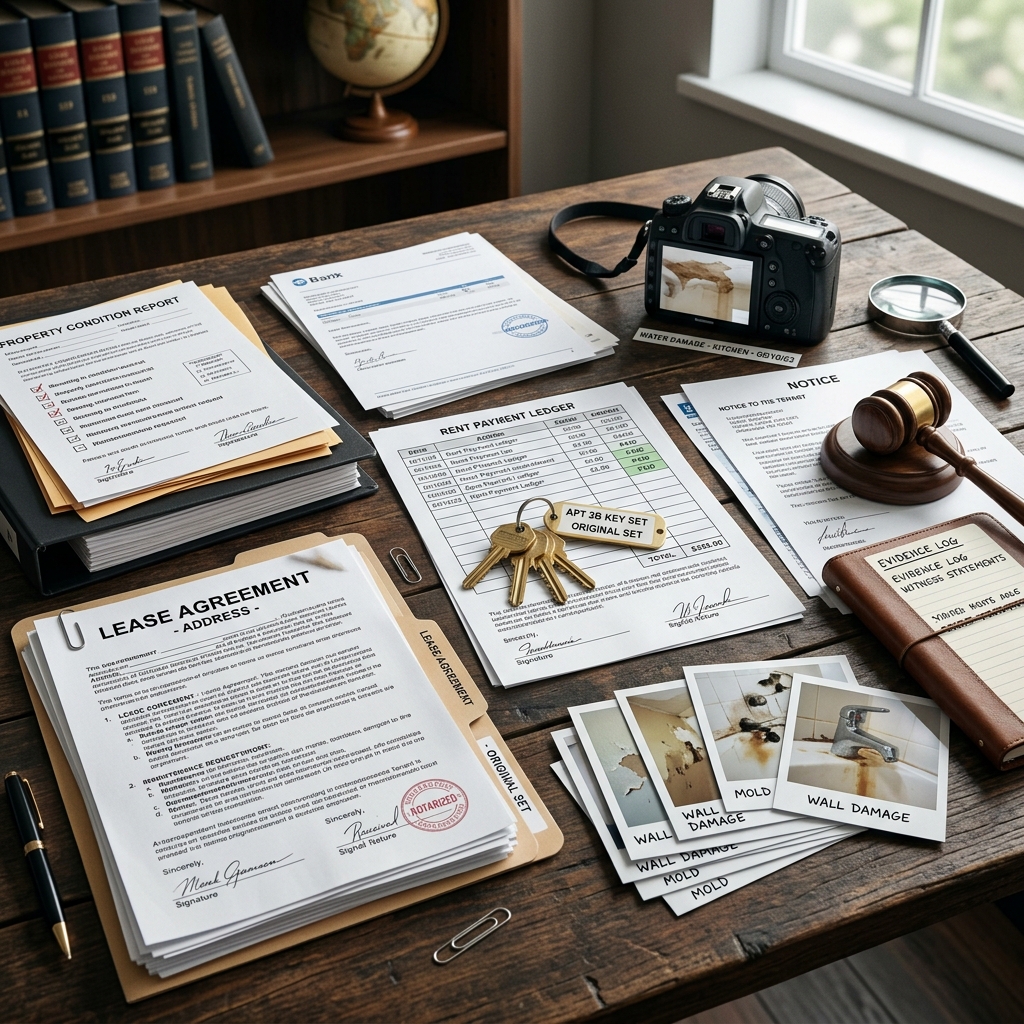
When a rental disagreement escalates into a formal dispute, the outcome often turns on one thing: evidence. Judges, arbitrators, and hearing officers do not decide cases based on who seems more sympathetic; they decide based on reliable documents, records, and testimony that demonstrate what actually happened. Learning what to collect—and how to present it—can dramatically improve your chances of success, whether you are a landlord or a tenant.
Why Evidence Matters in Rental Conflicts
Evidence is any information that helps prove or disprove a fact in your case, including documents, photos, videos, witness statements, and your own testimony. In landlord–tenant disputes, strong evidence can:
- Show what both parties agreed to in the lease or rental agreement.
- Demonstrate the condition of the property at move-in and move-out.
- Confirm whether rent was paid on time and in full.
- Support claims about repairs, damage, or habitability problems.
- Clarify the history of communications and notices between landlord and tenant.
Legal aid and housing organizations emphasize that good evidence should be relevant, reliable, authentic, complete, and legible. In practice, that means collecting clear documentation tied directly to the issues in dispute and organizing it so a decision-maker can quickly understand your story.
Core Categories of Evidence You Should Gather
Although every case is unique, most landlord–tenant disputes benefit from the same core categories of documentation. The sections below explain each major type of evidence, why it matters, and practical tips for collecting and using it effectively.
1. Agreements and Formal Rental Documents
Your primary evidence in almost any rental dispute is the written lease or rental agreement. The lease sets the legal framework for the relationship by outlining rent, responsibilities for repairs, rules about guests and pets, penalties for late payments, and procedures for ending the tenancy. In deposit disputes, adjudicators routinely start by examining the lease to see whether a deduction is permitted under its terms.
Important documents in this category include:
- Signed lease or rental agreement, including all pages.
- Renewal agreements or extensions.
- House rules, addenda, or separate policies (e.g., parking, pets).
- Notices such as rent increase letters, termination notices, or violation warnings.
These documents are crucial because they show:
- The exact obligations both parties accepted.
- Any procedures that must be followed before eviction or deposit deductions.
- Whether a claimed fee, penalty, or deduction is authorized at all.
| Document | What It Proves |
|---|---|
| Lease / Rental Agreement | Rent amount, duration, rules, deposit terms, repair obligations. |
| Notices (e.g., termination, violation) | Whether proper legal steps were taken before ending or changing tenancy. |
| Rules and Addenda | Specific conditions about pets, smoking, parking, or maintenance. |
Practical tip: Always keep a complete copy of your signed lease and related documents. If you only have a partial copy, ask the other party—or the property manager—for a full version well before any hearing.
2. Move-In, Move-Out, and Condition Inspection Records
Arguments about property damage, cleanliness, and wear-and-tear are extremely common. To resolve them, decision-makers often rely on condition inspection reports, inventories, and checklists created when the tenant first moves in and when the tenancy ends. These reports typically list the status of each room and fixture, sometimes with photos attached.
Useful condition records include:
- Move-in inspection forms signed by both parties.
- Move-out or checkout reports, ideally signed by both parties.
- Room-by-room inventories of furnishings and appliances.
- Any repair logs or maintenance records tied to specific dates.
These documents help answer key questions such as:
- Was a stain, crack, or broken item present before the tenancy began?
- Did the tenant return the unit in roughly the same condition, aside from normal wear?
- Were promised repairs ever completed?
In many deposit disputes, adjudicators treat detailed inventories and check-in/check-out reports as highly reliable. If a landlord seeks compensation for damage, but there is no move-in documentation, it may be difficult to prove that the tenant caused the problem rather than inheriting it.
3. Financial Records: Rent, Deposits, and Repair Costs
Money is at the heart of most landlord–tenant disagreements. To show what has been paid—and what is allegedly owed—you should gather a complete set of financial records related to the tenancy.
Key financial evidence includes:
- Proof of rent payments such as bank statements, online payment screenshots, or receipts.
- Security deposit receipts and statements showing any deductions.
- Invoices and receipts for cleaning, repairs, or replacements.
- Quotes or estimates from contractors for expected repair costs.
These records clarify:
- Whether rent is current or in arrears.
- Whether deposit deductions match the actual costs of repair or cleaning.
- Whether claimed repairs actually occurred and at what price.
Housing organizations recommend marking rent payments clearly in bank statements (for example, highlighting each payment) so the adjudicator can quickly see the payment history. Landlords, in turn, should support any deductions with detailed invoices and, where possible, photographs showing the damage that required repair.
4. Communications: Letters, Emails, Texts, and Messages
Many disputes revolve around what one party told the other and when. Written communications form a timeline that can support or undermine claims about notice, consent, agreement, and attempts to resolve problems.
Relevant communication evidence may include:
- Emails discussing repairs, rent changes, complaints, or agreements.
- Text messages about access to the unit, late payments, or scheduling inspections.
- Formal letters such as demand letters, complaint letters, or responses.
- Digital messages sent through property management portals or apps.
These communications can demonstrate that:
- One party requested repairs and the other failed to respond.
- The landlord provided—or did not provide—legally required notice before entering the unit.
- Both parties attempted (or did not attempt) to resolve issues informally before going to court.
Legal guidance on dispute resolution emphasizes that good recordkeeping includes documentation of all communications with tenants or landlords. Keeping messages organized by topic or date, and printing them out for hearings, helps decision-makers quickly follow the narrative of the case.
5. Visual and Digital Evidence: Photos, Videos, and Audio
Visual evidence is often the most compelling way to show the condition of a rental unit or the extent of damage. Photographs and videos can illustrate issues such as mold, leaks, broken fixtures, or unauthorized alterations. However, their usefulness depends heavily on whether you can show when they were taken and what they depict.
Effective visual evidence includes:
- Date-stamped photographs of the property at move-in and move-out.
- Videos showing ongoing problems, such as repeated leaks or malfunctioning systems.
- Audio recordings of persistent noise issues, if legally permitted.
Guides to deposit disputes warn that photos or videos may be discounted if the adjudicator cannot determine when they were taken. To strengthen your visual evidence, you should:
- Use cameras or phones that embed metadata with dates, and be prepared to point that out.
- Label each photo clearly (e.g., “Kitchen sink – move-in,” “Bedroom wall – move-out”).
- Avoid sending large numbers of repetitive images; choose the most representative ones.
Digital evidence also includes documents stored electronically, such as PDFs of inspection reports or emails exported from your inbox. Legal resources note that these digital items are acceptable as long as they are well-organized, authentic, and legible.
Organizing and Presenting Evidence for Hearings
Gathering evidence is only half the task. The way you organize and present your materials can significantly affect how easily a judge or arbitrator can understand your case. Legal aid guidance on dispute resolution recommends assembling all evidence into clear, indexed packets.
Building a Coherent Evidence File
A structured evidence file typically includes:
- Cover page with case number, hearing date, and names of parties.
- Table of contents listing each document and page number.
- Written summary that explains the issues, key facts, legal points, and requested outcome.
- Supporting documents grouped by topic (e.g., rent, repairs, communications).
For example, you might create sections such as:
- Section A: Lease, notices, and rules.
- Section B: Move-in and move-out reports, photos.
- Section C: Rent records and deposit statements.
- Section D: Emails and letters regarding repairs.
Dispute resolution materials recommend combining documents into a single PDF with page numbers, or a small set of numbered files, so that arbitrators can quickly locate items during a hearing.
Witnesses and Written Statements
In addition to documents, witness testimony can be vital. Evidence rules often treat sworn, real-time testimony as particularly strong, because the witness can be questioned by both sides. However, when a witness cannot attend, a written statement or affidavit may help.
Effective witness statements usually include:
- Full name and address of the witness.
- The date the statement was made.
- A clear subject line describing what the statement is about.
- A concise, bullet-pointed list of relevant facts.
- The witness’s signature at the end.
For certain specialized evidence, such as housing inspection reports, courts may require a representative from the inspector’s office to testify about the report. In those situations, you may need to request a subpoena from the court clerk and ensure it is properly served and documented.
Using Evidence in Different Types of Dispute Resolution
Landlord–tenant conflicts can be addressed through several forums, including informal negotiation, mediation, arbitration, and court proceedings. The best evidence to gather is largely the same across these settings, but how you use it may differ.
Informal Negotiation
Many problems can be resolved simply by talking with the other party. Legal guidance notes that respectful communication, listening, and willingness to compromise often resolve tenant complaints without formal action. In negotiations:
- Use evidence to clarify misunderstandings (for example, showing the lease clause that applies).
- Share selected documents or photos to support your position without overwhelming the other party.
- Record any settlement agreement in writing and have both parties sign it.
Mediation and Arbitration
In mediation, a neutral third party helps the landlord and tenant communicate and explore solutions, but does not impose a decision. Arbitration is more formal; the arbitrator hears evidence and issues a binding decision. In both:
- Organized evidence helps the mediator or arbitrator understand key facts quickly.
- Clear documentation of payments, communications, and property condition supports fair outcomes.
- Parties can agree on what evidence rules will apply in arbitration, which may be more flexible than court procedures.
Court or Formal Hearings
In landlord–tenant court, judges apply formal rules to decide what evidence they will allow and how they will weigh it. While each jurisdiction differs, you can generally expect:
- Your testimony to be considered alongside documents and photos.
- Requirements for authenticating certain documents, especially official reports.
- Strict timelines for submitting evidence before the hearing.
Preparing well—collecting comprehensive evidence, organizing it clearly, and understanding how it supports your legal arguments—can make a significant difference in the outcome of litigation.
Frequently Asked Questions
What if I don’t have a written lease?
Many jurisdictions recognize oral rental agreements, but proving the terms becomes more difficult without a written document. In that situation, gather alternative evidence such as payment records, emails or texts that mention rent and rules, and any written notices from the landlord. These materials can help reconstruct the likely terms of the agreement.
Are text messages and emails really accepted as evidence?
Yes. Legal resources on dispute resolution list emails and text messages as common forms of documentary evidence in tenancy hearings, as long as they are relevant, authentic, and legible. Screenshots, printouts, or exported message threads are often used to show what was communicated and when.
Do I need professional photos or video?
No. What matters is clarity and the ability to show when and where the images were taken. Guidance on deposit disputes emphasizes the importance of metadata or other proof of the date, along with clear labels for each image. Standard phone photos are usually sufficient if they are well-organized.
How many documents should I bring to a hearing?
There is no fixed number. Focus on documents that directly support the claims or defenses in your case: lease, condition reports, payment records, key communications, and relevant photos. Overloading the court with unnecessary material can make it harder for the judge to identify the important points, so aim for completeness without redundancy.
Is it worth trying to resolve the dispute without going to court?
Often, yes. Authoritative legal guidance suggests that informal discussions and mediation can resolve many landlord–tenant problems more quickly and inexpensively than litigation. Even if informal efforts fail, the evidence you gathered for those conversations will be valuable if the case proceeds to a formal hearing.
References
- Proving Your Case in Landlord and Tenant Court — LawHelp.org DC. 2016-03-01. https://www.lawhelp.org/dc/resource/proving-your-case-in-landlord-and-tenant-cour
- Guide to Submitting Evidence When You Have a Tenancy Deposit Dispute — Justice for Tenants. 2021-05-10. https://www.justicefortenants.org/guide-to-submitting-evidence-when-you-have-a-tenancy-deposit-dispute-with-your-landlord-or-letting-agent/
- Dispute Resolution Best Practices — Legal Aid BC. 2018-09-01. https://legalaid.bc.ca/document/231
- 3.1 Types of Evidence – Renting It Right — TRAC Tenant Resource & Advisory Centre. 2019-06-01. https://rentingitright.ca/course3/31-types-evidence
- Resolving a Dispute With Your Tenant — Justia. 2020-07-01. https://www.justia.com/real-estate/landlord-tenant/information-for-landlords/resolving-problems-with-tenants/
- Landlord-Tenant Disputes in Litigation: What You Need to Know — William A. Miller PLLC. 2021-02-15. https://williamamillerpllc.com/landlord-tenant-disputes-in-litigation/
- Three Ways to Resolve Landlord/Tenant Disputes in Chicago IL — C.E. Land & Associates. 2019-11-01. https://celandassociates.com/three-ways-to-resolve-landlordtenant-disputes-in-chicago-il/
Similar Articles








Read full bio of medha deb


