
Extending or Changing Your U.S. Immigration Status
Practical guidance to help nonimmigrant visitors lawfully extend their stay or transition to a new status in the United States.
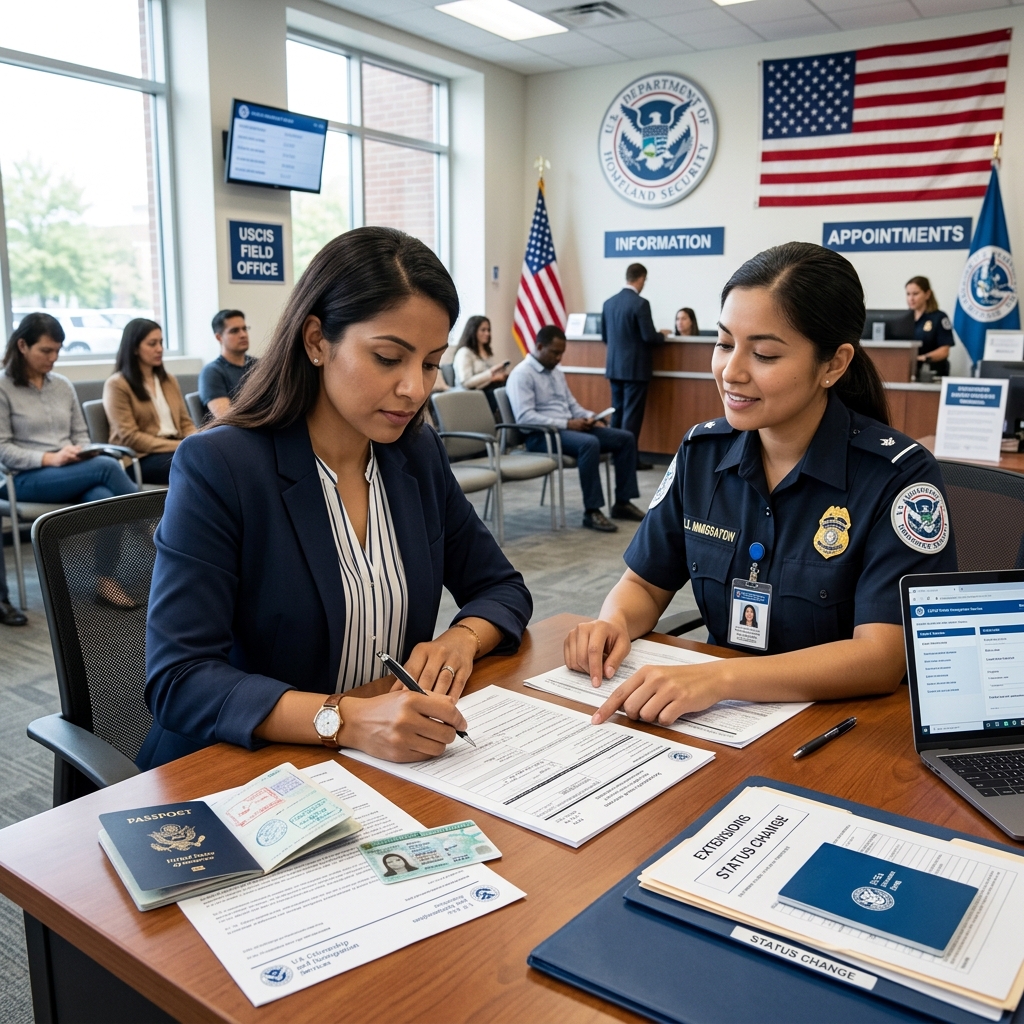
Nonimmigrant visitors and temporary residents often find that their plans in the United States change over time. You may need extra time to finish a degree, additional months to complete a work project, or wish to switch to a different visa category that better fits your long-term goals. U.S. immigration law allows many people to request an extension of stay or a change of status, but strict rules apply and missing a step can have serious consequences.
This article explains, in clear language, how extension and change of status requests work, who may qualify, which forms are involved, and common mistakes to avoid. It is written for general informational purposes and does not replace advice from a qualified immigration attorney.
Understanding Your Current Nonimmigrant Status
Before deciding whether to extend or change your status, you must understand exactly what status you hold now and how long it remains valid. In U.S. immigration law, your visa and your status are related but not identical.
- Visa: The visa stamp in your passport, issued by a U.S. consulate abroad, allows you to travel to a U.S. port of entry and request admission.
- Status: The classification and time period granted when you are admitted to the U.S. by Customs and Border Protection (CBP), typically reflected on your Form I-94 arrival/departure record.
In many cases, your status—and not your visa—controls whether you may stay in the U.S. and for how long. For example, students and certain exchange visitors may be admitted for “duration of status” (indicated as D/S on the I-94), while visitors in other categories receive a specific date of authorized stay.
Key actions you should take as a starting point include:
- Retrieve your most recent Form I-94 record online from the official CBP website.
- Confirm your admit-until date or that you are in the U.S. for D/S.
- Review documents such as Form I-20, DS-2019, or I-797 approval notices if you are in a study, exchange, or employment-based status.
Only after you understand this baseline can you decide whether an extension or a change of status better fits your needs.
Extension of Stay vs. Change of Status
Although the processes share some similarities, extending your stay and changing your immigration status are legally distinct actions.
| Aspect | Extension of Stay | Change of Status |
|---|---|---|
| Primary purpose | Remain in the U.S. longer in the same status. | Switch to a new nonimmigrant classification. |
| Typical form | Form I-539 for many categories. | Form I-539 for many categories; Form I-129 for most employment-based changes. |
| Key factor | Proving continued eligibility under existing rules for your current status. | Proving you meet the requirements of the new status you seek. |
| Effect on travel | Does not automatically grant a new visa stamp; applies to status while in the U.S. | May change your classification inside the U.S., but you might still need a new visa stamp for future travel. |
In both cases, timely filing and maintaining lawful status are critical.
General Eligibility to Request an Extension or Change
U.S. Citizenship and Immigration Services (USCIS) typically requires several baseline conditions before granting an extension or change of status, though specific rules depend on your visa category.
Common eligibility elements include:
- You entered the U.S. lawfully with a valid nonimmigrant visa.
- Your current status has not expired and you have not violated the terms of that status.
- Your passport is valid for at least the period you seek to stay.
- You have not engaged in unauthorized employment or other activities inconsistent with your classification.
- You do not fall into a category whose rules generally prohibit extensions or certain changes of status.
Some nonimmigrant categories, such as individuals admitted under the Visa Waiver Program, typically cannot extend their stay or change status from within the U.S. and may need to depart and re-apply for a proper visa abroad.
Planning Ahead: Timing and Deadlines
Immigration agencies place heavy emphasis on timely filings. If your request arrives after your status expires, you may lose eligibility and risk unlawful presence.
Important timing principles include:
- File before your current status expires. USCIS recommends filing well in advance of the end date on your I-94, often about 45 days before for many visitors.
- Students and exchange visitors changing status should file before or during any grace period applicable to their category.
- You generally must remain in the U.S. while a change-of-status application is pending; leaving the country may convert the request into an abandoned application in some situations.
If you miss a deadline, there may be limited options for requesting forgiveness, but approval is never guaranteed. Because consequences can include bans on reentry, get professional advice as soon as you realize a deadline may be missed.
Common Forms Used in Extension and Change Requests
USCIS relies on specific application forms to process most extension and change-of-status requests. Using the wrong form or submitting an incomplete form can delay your case or lead to a denial.
Form I-539: Application to Extend/Change Nonimmigrant Status
Form I-539 is the most widely used application for individuals who are not seeking work-based status or are dependents of certain principal visa holders.
Typical uses include:
- Extending stay in categories such as B-1/B-2 visitors, certain students, and dependents of employment-based nonimmigrants.
- Changing from one nonimmigrant status to another when employment is not the main factor, such as from visitor to student.
Along with the form, USCIS requires a filing fee and, in many cases, a separate biometrics fee, which covers fingerprinting and other identity checks.
Form I-129: Petition for a Nonimmigrant Worker
For most changes into employment-based nonimmigrant categories, your prospective employer must file Form I-129 with USCIS.
This petition is typically used when you seek classification such as:
- H-1B specialty occupation worker
- L-1 intra-company transferee
- O-1 person of extraordinary ability
An approved I-129 can support a change of status inside the U.S., an extension of an existing employment-based status, or a new visa application at a consulate abroad.
Essential Supporting Documents
Forms alone are not enough. USCIS generally expects a complete documentation package demonstrating that you qualify for the extension or change you request.
Although the exact list varies by category, many applications include:
- Copy of the biographic page of your passport, valid for at least six more months.
- Most recent Form I-94, showing your current status and admitted-until date.
- Evidence of current status, such as I-20s for students, DS-2019s for exchange visitors, EAD cards, or prior approval notices.
- Financial documentation proving your ability to support yourself without violating immigration rules, such as bank statements or employment letters.
- Relationship evidence for dependents, such as marriage certificates or birth certificates, with certified translations if not in English.
- Where applicable, documentation related to two-year home residency requirements and any waivers for J-status holders.
Providing organized and clearly labeled documentation helps USCIS officers understand your case and may reduce the likelihood of delays caused by requests for additional evidence.
Two Main Paths to Change Your Status
Nonimmigrant visitors generally have two main procedural options to obtain a new status: applying for a change within the U.S. or departing and re-entering with a new visa.
Staying in the U.S. and Filing with USCIS
Many nonimmigrants can request a change of status by filing Form I-539 or having their employer file Form I-129 while they remain in the country.
Key points about this route:
- You must submit the application before your current status expires or within any allowed grace period.
- While the application is pending, you are generally expected to remain in the U.S.; travel may disrupt or effectively cancel the request.
- If approved, you will receive documentation (such as an I-797 notice and updated I-94) showing your new classification.
Departing the U.S. and Applying for a New Visa
In some situations, individuals choose—or are required—to leave the U.S., apply for a new visa at a U.S. consulate abroad, and re-enter in the new status.
This approach often involves:
- Gathering all required documentation for the new visa category.
- Scheduling a consular interview, unless exempt.
- Obtaining the new visa and re-entering the U.S., where CBP decides whether to admit you and for how long.
Canadian citizens are an important exception in some categories because they often do not require a visa stamp, though they still must meet all legal requirements for entry and classification.
Travel, Work Authorization, and Status Changes
Immigration status is closely connected to travel and permission to work. A misunderstanding in either area can lead to violations, even when an extension or change request is pending.
Travel While an Application Is Pending
If you depart the U.S. while a change-of-status application is pending, the departure can, in many cases, be treated as abandoning that request. You may still be able to use an underlying petition to seek a new visa abroad, but your change from within the U.S. will likely not be completed.
For extensions of stay, travel before adjudication may cause confusion about which I-94 and period of stay applies. Always review updated I-94 records after travel and consider consulting legal counsel before making any trip while an application is pending.
Work Authorization
Having a pending extension or change of status does not automatically grant the right to work. Work authorization is usually controlled by your current valid classification, the terms of your employer’s petition, or by a separate document such as an Employment Authorization Document (EAD).
Important reminders include:
- Do not start a new job in a different category until you have clear evidence that your status allows it.
- Unauthorized employment can severely damage your immigration record and jeopardize future applications.
- Some categories allow continued employment with the same employer for a limited period after a timely filed extension petition, but these rules are specific and must be confirmed on official guidance.
Risks of Falling Out of Status
Failing to maintain lawful status is one of the most serious issues nonimmigrants face. Remaining in the U.S. beyond the authorized period or violating the terms of your classification can lead to unlawful presence, deportation, and bars on future entry.
Examples of violations include:
- Staying past the date on your I-94 without filing a timely extension.
- Working without authorization or outside permitted conditions.
- Dropping below full-time enrollment as a student without proper approval.
If you realize you may have fallen out of status, seek advice immediately. Sometimes limited remedies, such as a request for reinstatement for certain students, may exist, but outcomes depend heavily on the specifics of your case and are not guaranteed.
Practical Tips for a Strong Application
While no application is ever guaranteed approval, careful preparation increases the likelihood of a smooth process.
- Start early: Track your I-94 dates and program end dates, and plan extensions or changes well before deadlines.
- Use official instructions: Download the latest USCIS form instructions and follow them closely; requirements and fees can change over time.
- Keep copies: Save complete copies of every form and supporting document you submit, along with mailing receipts and tracking numbers.
- Stay consistent: Make sure information on all forms and documents matches, especially names, dates, and immigration history.
- Seek guidance: Consider consulting an immigration attorney or, for students and scholars, your international office, which often has detailed checklists and experience with common situations.
Frequently Asked Questions (FAQs)
1. Can I extend my stay if I entered under the Visa Waiver Program?
Individuals admitted under the Visa Waiver Program generally cannot extend their stay or change status from within the U.S. They are usually limited to the allowed short stay and must depart before that period ends. Consult official guidance or legal counsel if you believe an exception applies.
2. What happens if USCIS has not decided my case before my current status expires?
If you file a timely, non-frivolous application before your status expires, you may often remain in the U.S. while the application is pending. However, your ability to work or engage in other activities depends strictly on existing rules for your category, and remaining in the U.S. while a case is pending does not guarantee approval.
3. Do I automatically get a new visa stamp when my change of status is approved?
No. A change of status approved by USCIS affects your classification inside the U.S. but does not itself create a new visa stamp in your passport. If you travel abroad, you may need to apply for an appropriate visa at a U.S. consulate before returning.
4. Can my dependents extend or change status with me?
Dependents in categories such as H-4, L-2, or F-2 often file Form I-539 and I-539A to extend or change status alongside the principal visa holder. They must provide relationship evidence and, in some cases, show compliance with any special rules affecting the principal’s status.
5. Is professional legal help required?
U.S. immigration law does not require you to hire an attorney, and many people file successfully on their own. However, because extension and change-of-status requests can carry high stakes, professional guidance is strongly recommended, especially if you have prior immigration issues, complex employment arrangements, or criminal history.
References
- Extension of Stay & Change of Status — Gaston Law Firm. 2024-01-15. https://www.gastonlawfirm.com/immigration/extension-of-stay-change-of-status/
- Change of Status for Nonimmigrant Visa Holders — Washington University in St. Louis, Office for International Students and Scholars. 2023-09-01. https://oiss.washu.edu/change-of-status/
- United States Customs and Border Protection: I-94 Website — U.S. Customs and Border Protection. 2022-03-10. https://i94.cbp.dhs.gov/
- USCIS Form I-539, Application to Extend/Change Nonimmigrant Status — U.S. Citizenship and Immigration Services. 2024-02-20. https://www.uscis.gov/i-539
- USCIS Form I-129, Petition for a Nonimmigrant Worker — U.S. Citizenship and Immigration Services. 2024-02-20. https://www.uscis.gov/i-129
Similar Articles








Read full bio of medha deb


