
Evicting Someone Without a Lease: Legal Steps and Risks
Understand when and how you can legally remove occupants who have no written lease, and the rights both landlords and tenants have in that situation.
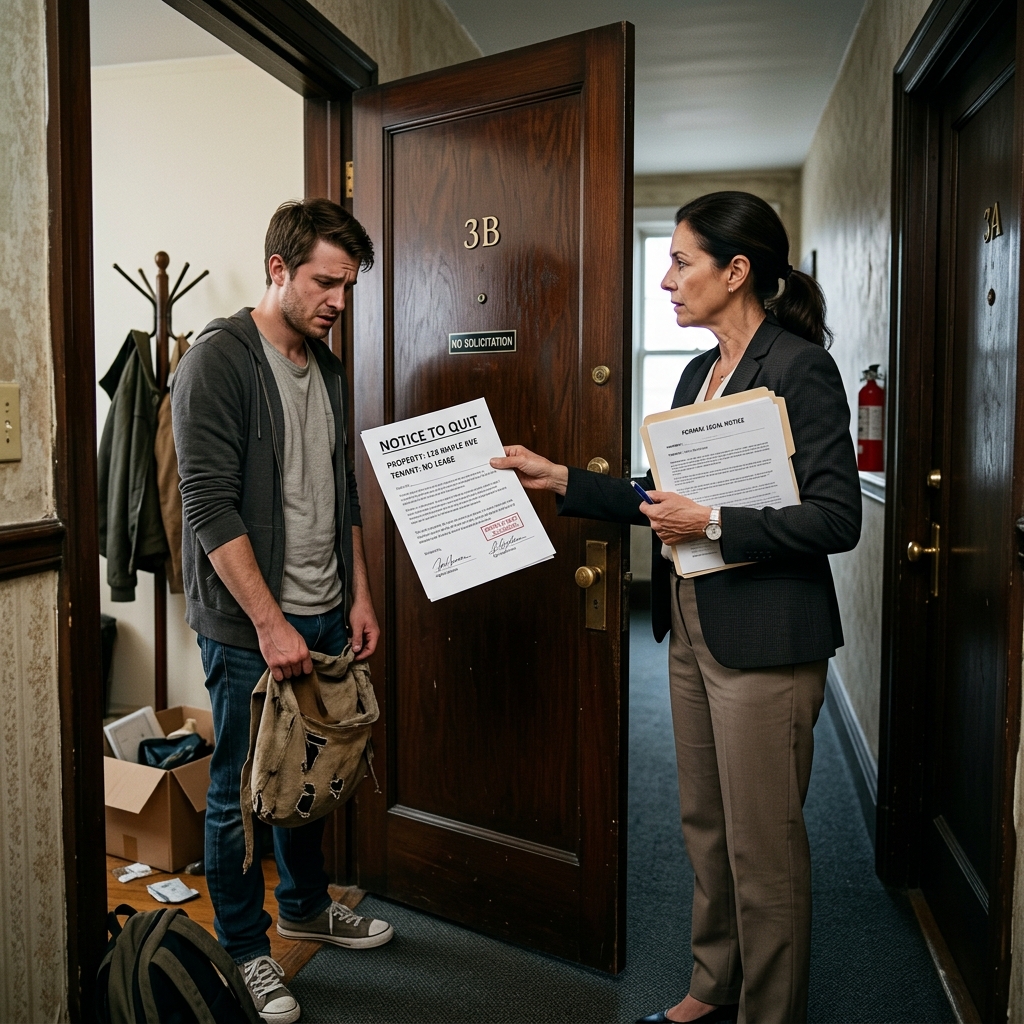
Removing someone from a property when there is no written lease can be legally complex. In most places in the United States, a landlord can evict an occupant without a formal lease, but only by following specific notice and court procedures established by state and local law. This guide explains how those rules typically work, what rights each side has, and practical steps to handle these situations as safely and legally as possible.
1. What It Means to Live Without a Written Lease
Not having a written lease does not mean there is no legal relationship between the occupant and the property owner. The law often recognizes several types of informal tenancy even when nothing is in writing.
1.1 Common situations with no written lease
- Month-to-month tenants who started on a written lease that expired but stayed and kept paying rent.
- Tenants at will, where the landlord allows someone to live in the property and collect rent without a fixed end date or written contract.
- Verbal rental agreements, where rent amount and due dates were agreed orally but never documented.
- Guests who become residents, such as friends or partners who move in and begin treating the property as their home.
In all of these situations, courts usually look at whether the person is treated as a resident: do they receive mail there, keep belongings there, pay rent or utilities, and stay there on an ongoing basis. If so, they likely have the legal status of a tenant and cannot be removed by simple police action in most cases.
1.2 Tenants vs. guests vs. trespassers
Understanding the occupant’s status is critical because it determines whether you need a formal eviction or can rely on trespass laws.
| Type of occupant | Key characteristics | Typical removal process |
|---|---|---|
| Tenant (with or without lease) | Ongoing residence, pays rent or is allowed to stay, recognized by landlord. | Formal eviction through court; notice required. |
| Guest | Short-term stay, no rent payments, limited access rights. | In some cases, trespass complaint may be possible, but eviction is often still required for safety. |
| Trespasser / squatter | No permission to be there, no rental relationship. | Police can sometimes remove as trespassers, but long-term squatters may still require eviction. |
When in doubt, many legal aid organizations advise treating the person as a tenant and using the formal eviction process, because improperly labeling someone as a trespasser can expose a landlord to civil liability.
2. Can You Evict Someone Without a Lease?
In general, a landlord can evict an occupant who has no written lease, but they must respect state notice requirements and file an eviction lawsuit rather than taking matters into their own hands. The absence of a lease rarely eliminates the need for a court order.
2.1 The basic legal principle
Most states treat these arrangements as a periodic tenancy (often month-to-month) or a tenancy at will. That means:
- The landlord can end the tenancy by giving proper written notice.
- If the occupant does not leave after the notice period, the landlord must file an eviction case (commonly called an “unlawful detainer” or “forcible detainer”).
- Only after winning in court can the landlord get a writ of possession, authorizing law enforcement to remove the occupant.
Self-help measures—such as changing locks, removing belongings, or shutting off utilities to force someone out—are illegal in most jurisdictions and can result in damages and penalties against the landlord.
2.2 Different states, different rules
While the basic structure is similar, details vary significantly by state. Here are examples drawn from official and reputable legal sources:
- Texas: A landlord must serve a written Notice to Vacate (often at least 3 days) and then file a “forcible detainer” case in justice court if the tenant does not leave. Even tenants without a lease must be removed through this process.
- California: Occupants who are not on the lease can still be included in the eviction lawsuit, and if they remain without joining the case, the sheriff can remove them once the writ is issued.
- Washington: Landlords generally must have a legally valid reason to terminate a tenancy and must provide specific types of notice, even for tenants who are not named on the lease.
Because of these differences, both landlords and tenants should consult local law or legal aid resources in their state to understand exact timeframes and grounds for eviction.
3. Key Rights of Tenants Without a Written Lease
Tenants without a written lease still enjoy many of the same protections as tenants under formal contracts. Legal aid organizations and housing guides consistently stress that occupants cannot be deprived of basic rights simply because their agreement is informal.
3.1 Right to notice before eviction
Most states require the landlord to give a written notice before filing for eviction. The length and type of notice depend on the situation:
- Nonpayment of rent: Short “pay or quit” notices (for example, 3–14 days) are common.
- No-cause termination: Ending a month-to-month tenancy often requires 30 days or more.
- Special rules for occupants not on a lease: Some states require additional steps, like asking the occupant to apply as a tenant or giving a specific longer notice period.
Even in the absence of a written lease, failing to give proper notice can cause a court to dismiss an eviction case, forcing the landlord to start over.
3.2 Right to habitable living conditions
Tenants at will and month-to-month tenants are generally entitled to habitable conditions, which typically include:
- Functioning heat and electricity.
- Reasonable protection against leaks and mold.
- Secure doors and windows.
- Compliance with health and safety codes.
Legal resources emphasize that landlords cannot retaliate against tenants for complaining about habitability by cutting off services or using eviction as punishment without following lawful procedures.
3.3 Right to a court hearing
Because eviction is a formal lawsuit, tenants have the right to:
- Receive the court papers and understand the claims against them.
- File a response or “answer” in many states.
- Attend the hearing, present evidence, and raise defenses—such as improper notice, miscalculated rent, or landlord misconduct.
Legal aid organizations repeatedly warn that not attending the hearing almost always results in a judgment for the landlord, followed by a writ of possession and removal from the property.
4. Legal Steps for Landlords Without a Lease
Landlords who want to remove an occupant without a lease should follow a structured process. Skipping steps can lead to delays, financial losses, and potential legal claims from the occupant.
4.1 Step 1: Clarify the occupant’s status
Before acting, clarify whether the person is:
- A month-to-month tenant who has been paying rent.
- A long-term guest who has effectively become a resident.
- A short-term guest with no rental relationship.
- A trespasser who never had permission to be there.
For anyone who has lived in the property for more than a brief period and claims residency, legal guides strongly recommend using the eviction process rather than calling police.
4.2 Step 2: Serve the appropriate notice
Next, prepare and deliver a written notice that complies with state law. A proper notice typically includes:
- Property address and names of known occupants.
- The legal reason for ending the tenancy (nonpayment, lease violation, or no-cause termination where allowed).
- The date the notice is served and the deadline for the occupant to leave or correct the problem.
- Landlord’s name and contact information.
States specify how the notice must be delivered—such as personal delivery, posting on the door, or mailing—and courts may reject cases where notice requirements were not followed.
4.3 Step 3: File an eviction lawsuit
If the occupant does not leave by the deadline, the landlord must file an eviction case in the appropriate court. This case is often called an “unlawful detainer” or “forcible entry and detainer.”
Landlords should bring:
- A copy of the notice and proof of delivery.
- Records of rent payments or nonpayment.
- Evidence of lease violations, such as photographs, inspection reports, or written complaints.
The court will schedule a hearing, where both parties can present their side. Maintaining professionalism and clear documentation often helps the judge resolve the case more efficiently.
4.4 Step 4: Obtain and enforce the writ of possession
If the landlord wins, the court issues a writ of possession, authorizing law enforcement to physically remove the occupant if they still refuse to leave. For example, official guidance in Texas explains that the landlord can secure a writ several days after the judgment, and then the sheriff or constable must give a final 24-hour notice before executing the writ.
Landlords must never carry out the removal themselves; only officers acting under the writ may do so. Any attempt at a self-help lockout can expose the landlord to significant liability and sometimes criminal penalties.
5. Risks of Self-Help Eviction and Informal Agreements
Trying to shortcut the legal process can be costly. Legal sources consistently warn that informal measures—such as changing locks or shutting off utilities—may be considered illegal eviction or harassment.
5.1 Common unlawful practices
- Locking an occupant out without a court order.
- Removing or damaging the occupant’s belongings.
- Disconnecting water, power, or heat to force the person out.
- Threatening or harassing the occupant to make them leave.
Such tactics are risky because courts often award damages, sometimes including penalties and attorney’s fees, to occupants who suffer illegal lockouts or harassment.
5.2 Problems with vague verbal agreements
Informal arrangements can also backfire for both sides:
- Landlords may struggle to prove the terms of the agreement, making it harder to show that the occupant violated those terms.
- Tenants may find it difficult to prove promises made about rent, repairs, or duration of stay.
Because of these challenges, legal organizations often encourage both landlords and tenants to put basic terms in writing whenever possible, even for month-to-month situations.
6. Practical Tips for Tenants Without a Lease
Tenants or occupants facing eviction without a written lease can take steps to protect themselves and better understand their rights.
- Keep records of payments: Save bank statements, receipts, or electronic transfers showing rent paid.
- Document communications: Preserve text messages, emails, and notes of conversations with the landlord.
- Review the notice carefully: Check the deadline, reason, and whether the notice complies with local law.
- Seek legal help quickly: Many states have short deadlines—sometimes only a few days—to respond to an eviction case.
- Consider negotiation: Courts and legal aid often encourage negotiating move-out dates or payment plans where possible.
Attending the court hearing and explaining your situation—especially if the landlord ignored habitability issues or gave improper notice—can affect the judge’s decision.
7. Frequently Asked Questions
7.1 Is a verbal rental agreement legally binding?
Yes. In many states, verbal rental agreements are enforceable if rent is paid and the tenant occupies the property, even though proving the exact terms may be more difficult. Courts often recognize such arrangements as tenancies at will or month-to-month tenancies.
7.2 Can a landlord evict me for no reason if I have no lease?
It depends on the state. In some places, landlords can end a month-to-month tenancy without cause, provided they give proper notice. In others, especially where “just cause” rules apply, they must have a legally valid reason such as nonpayment, lease violation, or business need. Always check local law or consult legal aid to understand your protections.
7.3 How much notice does a landlord need to give if there is no lease?
Notice periods vary. Many states require around 30 days for month-to-month arrangements, while some allow shorter periods for certain violations. Official state and local legal resources are the best place to confirm exact timeframes in your area.
7.4 Do I need to be on the lease to be evicted?
No. A landlord can include people who are not on the lease in the eviction lawsuit if they live in the rental as their home. Occupants who do not join the case but remain in the property can still be removed by law enforcement once a writ of possession is issued.
7.5 Can police remove someone without a lease as a trespasser?
Police may remove short-term guests or clear trespassers as visitors who overstayed their welcome, but once someone has been living in the property and claims to be a resident, legal resources state that a formal eviction is usually required. Treating a resident as a trespasser without due process can expose the owner to legal risk.
8. When to Seek Legal Help
Whether you are a landlord or an occupant, disputes over residency without a written lease are often fact-specific and governed by detailed local statutes. Some warning signs that you should seek legal assistance include:
- An occupant refuses to leave despite notice and claims they are a tenant.
- A landlord has changed locks or cut off utilities instead of filing in court.
- Multiple people live in the property and only some are named on the lease or notice.
- There are questions about habitability, retaliation, or discrimination.
State legal aid websites, bar association referral services, and housing authorities often provide free or low-cost guidance. Official court self-help pages can also explain procedures in plain language and offer sample forms.
References
- Guests, Tenants, and In Between: When There Is No Lease — TexasLawHelp.org. 2022-08-04. https://texaslawhelp.org/article/guests-tenants-and-in-between-when-there-is-no-lease
- Eviction — TexasLawHelp.org. 2023-06-27. https://texaslawhelp.org/article/eviction
- The Eviction Process – Landlord/Tenant Law — Texas State Law Library. 2023-01-10. https://guides.sll.texas.gov/landlord-tenant-law/eviction-process
- If you’re not on the lease or rental agreement — California Courts Self-Help. 2023-11-15. https://selfhelp.courts.ca.gov/eviction-tenant/not-on-lease
- Eviction Notices — WashingtonLawHelp.org. 2024-02-01. https://www.washingtonlawhelp.org/en/eviction-notices
- Evictions — LouisianaLawHelp.org. 2022-09-07. https://louisianalawhelp.org/resource/evictions
- What Rights Do Tenants Have Without a Lease? — Azibo. 2023-05-19. https://www.azibo.com/blog/what-rights-do-tenants-have-without-a-lease
Similar Articles








Read full bio of Sneha Tete


