
Practical CCPA Compliance Guide for Small Businesses
A clear, actionable overview of CCPA duties, consumer rights, and practical steps small businesses can take to comply with California’s data privacy law.
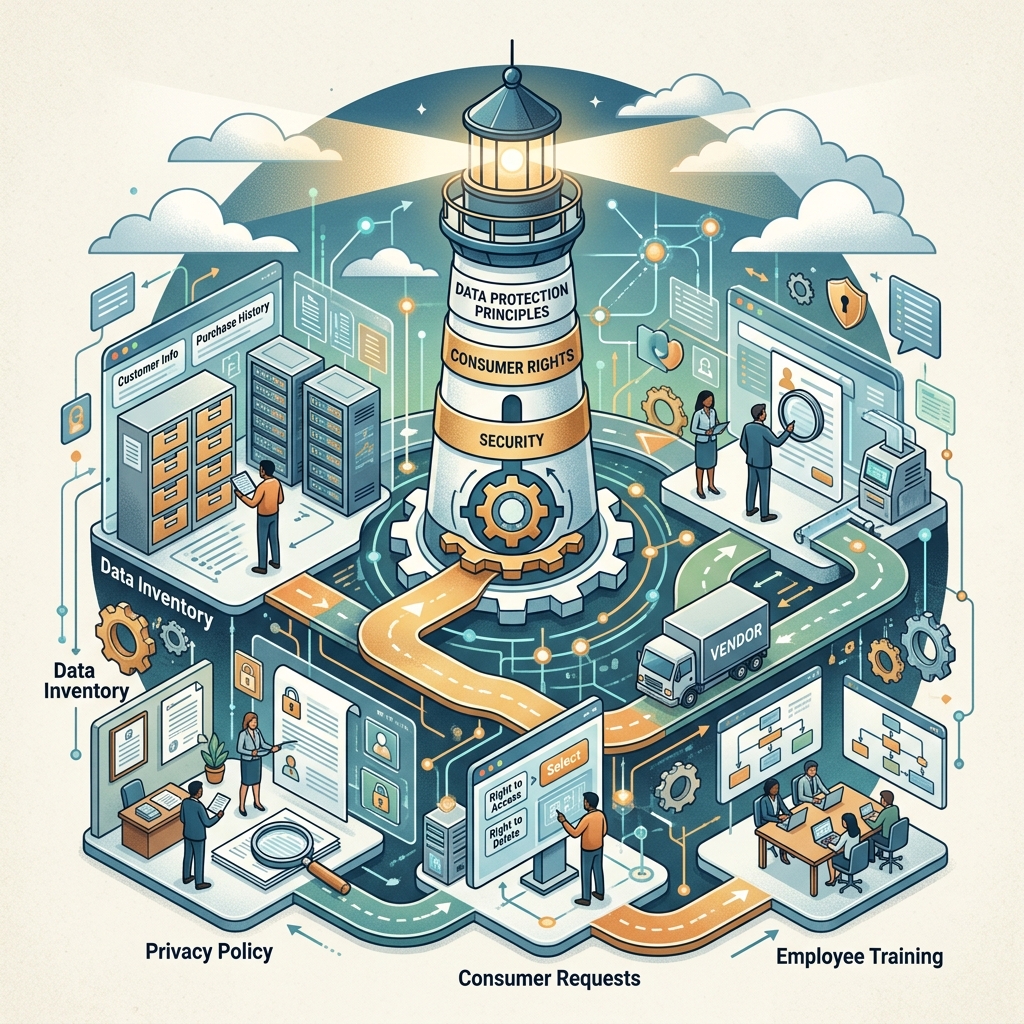
The California Consumer Privacy Act (CCPA) gives California residents powerful rights over how businesses collect, use, and share their personal information. For small businesses, understanding when this law applies and what it requires is critical to avoiding regulatory risk and building customer trust.
This guide explains the CCPA in plain language, focusing on what smaller organizations need to know. You will learn when the law applies, key consumer rights, core compliance duties, and practical steps to design a privacy program that fits your resources.
1. What the CCPA Is and Why Small Businesses Should Care
The CCPA is a state law that increases transparency around personal data and gives consumers more control over information businesses hold about them. It applies to for-profit entities that do business in California and meet certain thresholds.
Even if your company is relatively small today, CCPA compliance is relevant for several reasons:
- Growth planning — Businesses that scale quickly may cross the revenue or data volume thresholds sooner than expected.
- Customer expectations — Privacy awareness is rising, and transparent practices can strengthen your reputation.
- Regulatory alignment — CCPA requirements often overlap with other privacy laws, making early preparation more efficient.
- Data breach exposure — Failing to protect personal information can increase legal and financial risk.
Taking CCPA seriously is not just about checking a legal box; it is about building a responsible approach to data that supports long-term business stability.
2. Does the CCPA Apply to Your Business?
The CCPA does not cover every company automatically. Instead, it applies to for-profit businesses that do business in California, collect California residents’ personal information, and meet at least one of several criteria.
2.1 Core Applicability Thresholds
Based on official guidance from the California Attorney General and other authoritative summaries, a business is generally subject to the CCPA if it:
- Has annual gross revenues over $25 million; or
- Buys, sells, or shares personal information of 100,000 or more consumers, households, or devices in a year; or
- Derives at least 50% of annual revenue from selling or sharing California residents’ personal information.
Location alone is not a limitation. A non-California or even international business can be covered if it meets the thresholds while handling data of California residents.
2.2 Practical Indicators for Small Businesses
If you are unsure whether your organization falls under the law, consider the following indicators:
- Your online store or app has a significant customer base in California.
- You run targeted advertising campaigns using detailed customer profiles.
- You operate data-driven services that rely heavily on consumer information.
Small businesses that are not yet covered may still choose to follow CCPA principles voluntarily. This can simplify compliance if you later cross the thresholds and aligns your practices with consumer expectations.
3. What Counts as “Personal Information” Under the CCPA?
The CCPA defines personal information broadly. It includes data that identifies, relates to, describes, or could reasonably be linked to a particular consumer or household.
Examples relevant to small businesses may include:
- Names, addresses, email addresses, phone numbers
- Account credentials and transaction history
- Device identifiers, IP addresses, and online tracking data
- Geolocation data from mobile apps or services
- Inferences drawn to create consumer profiles or segments
Because the definition is wide, most customer-facing data you collect will fall under the CCPA if your business meets the applicability criteria.
4. Core Consumer Rights You Must Support
The CCPA grants several important rights to California consumers. Covered businesses must provide mechanisms for people to exercise these rights through what is called a verifiable consumer request.
4.1 Right to Know and Access
Consumers can request details about the categories and specific pieces of personal information your business has collected about them, along with related information such as sources, purposes, and types of third parties with whom data is shared.
Upon receiving a verifiable request, businesses must disclose the relevant information, including both direct and inferred data, in a portable and machine-readable format].
4.2 Right to Deletion
The CCPA gives consumers the right to request deletion of their personal information. In response, covered businesses must delete the data and instruct service providers to do the same, subject to specific exceptions.
Exceptions include situations where information must be retained to:
- Complete a transaction requested by the consumer
- Detect or prevent security incidents and illegal activity
- Conduct public-interest research
- Comply with legal obligations or exercise certain rights
4.3 Right to Opt Out of Sale or Sharing
If your business sells or shares personal information in ways covered by the CCPA, consumers have a right to opt out. Covered businesses must provide a clear mechanism, typically including a “Do Not Sell” link where applicable.
4.4 Right to Non-Discrimination
Businesses may not discriminate against consumers for exercising their CCPA rights. For example, you cannot deny goods or services or offer different prices solely because someone chose to opt out or requested deletion, subject to specific permitted exceptions tied to data-driven services.
5. Key Compliance Duties for Small Businesses
Once your business is subject to the CCPA, you must implement several practical measures. Two central responsibilities are:
- Providing clear privacy notices at appropriate points in your interactions with consumers.
- Establishing reliable processes to handle consumer requests concerning their rights.
5.1 Notice at Collection and Privacy Policy
Covered businesses must give consumers a notice at collection that lists the categories of personal information collected and the purposes for which they are used.
In addition, you need a comprehensive privacy policy that:
- Explains what data you collect and why
- Describes consumers’ rights under the CCPA
- States how they can submit requests
- Discloses whether you sell or share personal information and how consumers can opt out
Authoritative guidance emphasizes that notices should be easy to understand, readable on different devices, accessible, multilingual where appropriate, and provided at or before the point of data collection.
5.2 Processes for Verifiable Consumer Requests
Businesses must offer at least two methods for consumers to submit requests, such as a toll-free phone number and an online form. Small businesses typically rely on:
- A dedicated web form or portal
- An email address or postal address for written requests
- A phone line staffed by trained personnel
Once a request is received, you must verify the identity of the consumer and respond within 45 days, with a possible extension of another 45 days when reasonably necessary.
5.3 Reasonable Security Measures
The CCPA expects covered businesses to implement reasonable security to protect personal information against unauthorized access or disclosure. While the law does not list specific technologies, guidance commonly references:
- Encryption for sensitive data
- Access controls and authentication mechanisms
- Regular backups and security monitoring
- Incident response procedures and breach notification plans
6. Building a CCPA-Aligned Privacy Program
For small businesses, the challenge is translating legal requirements into a manageable set of actions. The following steps provide a practical framework.
6.1 Map and Inventory Your Data
Begin by conducting a data inventory — a structured overview of what personal information you collect, where it comes from, where it is stored, and who it is shared with. Consider:
- Customer databases and CRM tools
- Website analytics and marketing platforms
- Payment processing systems and logs
- Third-party service providers and integrations
This mapping supports accurate notices, helps identify unnecessary collection, and informs your security measures.
6.2 Design a Data Strategy and Governance Process
Experts recommend forming a data strategy that explains how information moves from collection to storage and eventual deletion or retention. For a small business, this can be a concise document that covers:
- Which business functions rely on personal data
- How data is transferred between systems or departments
- Criteria for retaining, anonymizing, or deleting information
- Roles and responsibilities for privacy oversight
6.3 Update Policies, Notices, and Contracts
Using insights from your data inventory, revise your privacy policy and notices to accurately reflect current practices and CCPA rights.
You should also review contracts with service providers to ensure they include appropriate privacy and security obligations, especially when they handle consumer information on your behalf.
6.4 Train Staff and Document Procedures
Employees involved in customer service, marketing, IT, and operations must understand their role in CCPA compliance. Training should cover:
- Recognizing and properly routing consumer requests
- Verifying identities and protecting sensitive data
- Using approved tools for data access and deletion
- Responding appropriately to potential incidents
Document your procedures in internal guidelines. Written processes help maintain consistency and support compliance in audits or investigations.
6.5 Monitor, Audit, and Improve
Privacy compliance is not a one-time exercise. Periodic reviews help ensure that your practices remain aligned with evolving regulations and business operations.
Regular activities might include:
- Auditing privacy notices and policies at least annually
- Reviewing data retention schedules and deleting data that is no longer needed
- Testing request-handling workflows to confirm deadlines are met
- Evaluating new tools or marketing methods for privacy impact
7. Example CCPA Readiness Checklist for Small Businesses
The following checklist illustrates how small businesses can structure their compliance work. It is not exhaustive, but it covers many practical elements.
| Area | Key Actions |
|---|---|
| Applicability Assessment | Determine if your business meets CCPA thresholds; analyze revenue, data volumes, and data sales or sharing. |
| Data Mapping | Create an inventory of personal information, data flows, systems, and service providers involved in processing. |
| Notice & Policy | Draft or update notice at collection and privacy policy; ensure they are clear, accessible, and accurately describe practices. |
| Consumer Requests | Set up request channels, identity verification procedures, and response workflows to meet the 45-day deadline. |
| Security Controls | Implement reasonable security measures such as encryption, access controls, and incident response plans. |
| Training & Governance | Train staff, assign responsibility for privacy oversight, and document internal procedures and escalation paths. |
| Ongoing Review | Schedule periodic audits of data practices, notices, vendor contracts, and retention policies. |
8. Frequently Asked Questions About CCPA and Small Businesses
8.1 If my business is not in California, do I still need to worry?
Yes, potentially. The CCPA applies to businesses that do business in California and meet the thresholds, regardless of where they are physically located. If you have significant customers or data activities involving California residents, you should assess applicability.
8.2 What if I do not sell data — can the CCPA still apply?
It can. Selling or sharing personal information is only one of the thresholds. A business can be covered based on revenue or the volume of personal information processed even without selling data.
8.3 How quickly must I respond to consumer requests?
Under CCPA, businesses generally must respond to verifiable consumer requests within 45 days. In some cases, the response period can be extended by an additional 45 days if reasonably necessary, but you must inform the consumer about the extension.
8.4 Do I need a lawyer to become CCPA compliant?
Legal counsel is strongly recommended, especially for interpreting complex requirements and updating contracts. However, many practical steps — such as mapping data, drafting clear notices, and establishing request-handling processes — can be led internally, supported by trusted guidance from official sources.
8.5 How often should I update my privacy policy?
Best practice is to review and, if necessary, update your privacy policy at least annually and whenever your data practices or relevant laws change. Regular updates help keep your disclosures accurate and support compliance with CCPA and related regulations.
References
- California Consumer Privacy Act (CCPA) — Office of the Attorney General, State of California. 2023-05-01. https://oag.ca.gov/privacy/ccpa
- CCPA Compliance: Business Eligibility & Rules — Scrut Automation. 2024-02-15. https://www.scrut.io/post/who-needs-ccpa-compliance
- CCPA Compliance Guide: Requirements & Regulations — Snowflake Inc. 2023-09-12. https://www.snowflake.com/en/data-governance/regulatory-compliance/ccpa/
- Navigating the California Consumer Privacy Act: 30+ Essential FAQs — Jackson Lewis P.C. 2024-01-10. https://www.jacksonlewis.com/insights/navigating-california-consumer-privacy-act-30-essential-faqs-covered-businesses-including-clarifying-regulations-effective-1126
- CCPA compliance requirements: A practical guide — Optro. 2023-11-03. https://optro.ai/blog/ccpa-compliance-requirements
- CCPA Compliance: A Complete Guide for Small Businesses — GDPR Local. 2023-03-07. https://gdprlocal.com/ccpa-compliance-a-complete-guide-for-small-businesses/
Similar Articles








Read full bio of medha deb


