
Drug Swabs at DUI Checkpoints: Rights, Risks, and Legal Limits
Understand how roadside saliva tests work at DUI checkpoints, what police can and cannot do, and the rights you have when asked to submit to a drug swab.
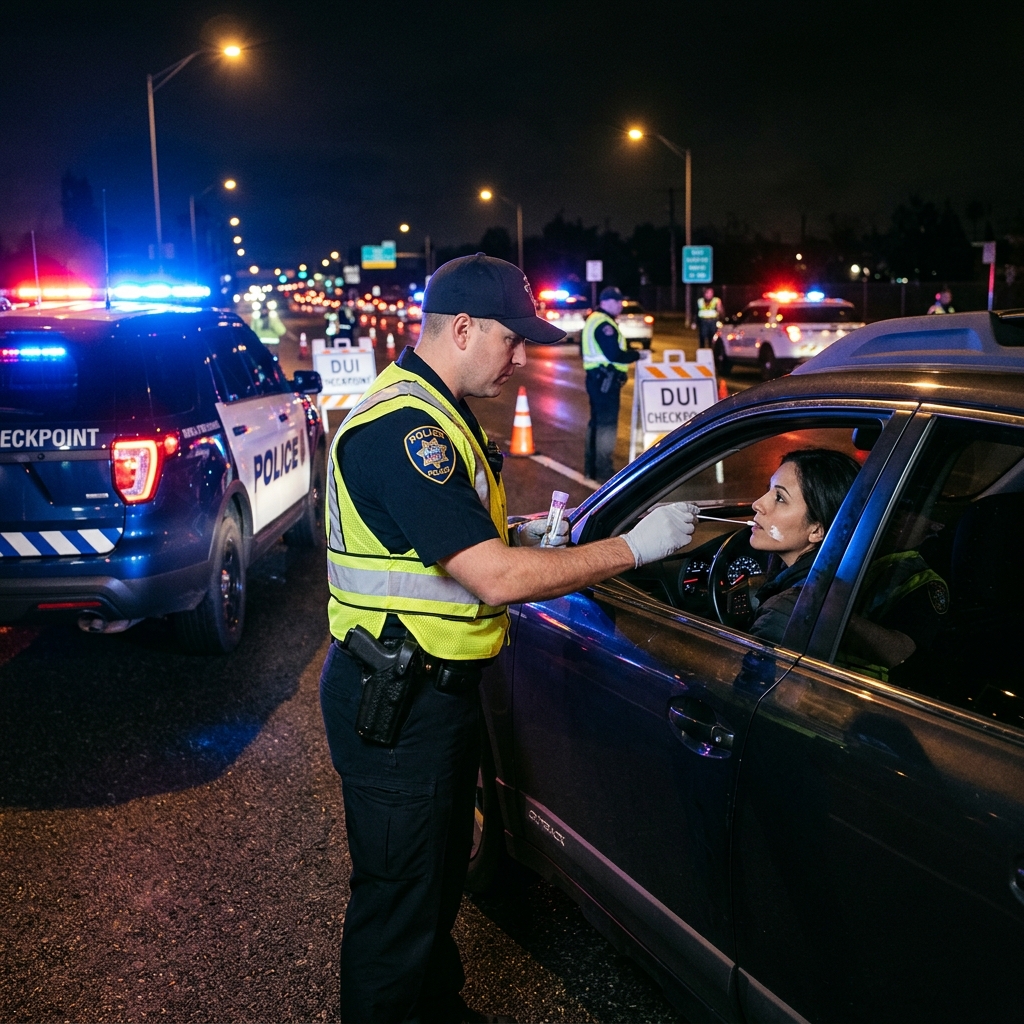
Across the United States, law enforcement agencies are experimenting with oral fluid drug tests at DUI checkpoints as a way to detect drivers impaired by marijuana, cocaine, prescription medications, and other substances. These roadside drug swabs raise important questions: Are they legal? Can officers require you to take them? What happens if you refuse?
This guide explains how drug swabs work, outlines the legal framework behind DUI checkpoints, and helps you understand the rights and risks you face if an officer asks to test your saliva for drugs. It is general information, not legal advice, and laws vary significantly by state.
Why Police Use Drug Swabs at DUI Checkpoints
Traditional DUI enforcement has focused largely on alcohol, using breath tests and standardized field sobriety tests to determine whether drivers are impaired. As drug-impaired driving has increased, many agencies have searched for tools that can quickly identify drivers under the influence of substances other than alcohol.
- Growth in drugged driving: National data show substantial numbers of crashes involving drivers who test positive for drugs, including cannabis and prescription medications.
- Limitations of alcohol-only tools: Breathalyzers measure blood alcohol concentration (BAC) but do not detect THC, opioids, stimulants, or sedatives.
- Need for roadside screening: Blood and urine tests require medical settings or laboratory analysis, making them impractical for immediate roadside decisions.
To address these challenges, jurisdictions such as California and some major cities have started using oral fluid drug swabs at checkpoints and traffic stops as a fast screening method.
How Oral Fluid Drug Swab Tests Work
A drug swab at a checkpoint is typically an oral fluid screening test. The officer uses a small device, often with a cotton or absorbent tip, to collect saliva from the inside of the driver’s mouth. The device is then inserted into a reader that analyzes the sample for selected drugs.
Typical Substances Detected
Depending on the brand and configuration, roadside drug swabs may test for:
- Marijuana (THC)
- Cocaine
- Methamphetamine and amphetamines
- Opioids (such as some pain medications)
- Benzodiazepines and other sedatives
Some systems also screen for certain prescription medications that can cause impairment. States like California have explicitly allowed oral swab testing in DUI investigations, and these devices are being used in conjunction with other evidence such as officer observations and field sobriety tests.
Timeline and Process
While specific products differ, many oral fluid devices produce a result within several minutes. A typical checkpoint procedure may look like this:
- The vehicle enters a marked DUI or sobriety checkpoint.
- An officer briefly speaks with the driver, looks for signs of impairment, and may ask questions about drinking or drug use.
- If the officer suspects drug impairment, they may request consent to an oral fluid drug swab.
- The driver’s saliva is collected with a swab and placed into a testing device.
- The device indicates whether targeted drugs are present above a certain detection threshold.
Importantly, these tests are often treated as screening tools. A positive result may lead to further investigation, formal arrest, and more definitive laboratory testing of blood or other samples.
Legal Foundations of DUI Checkpoints
Before looking at drug swabs specifically, it helps to understand the legal status of sobriety and DUI checkpoints in general. In the United States, the constitutionality of checkpoints has been shaped by both federal and state law.
Federal Constitutional Framework
The U.S. Supreme Court has upheld the use of properly designed sobriety checkpoints as a limited exception to the usual requirement of individualized suspicion for vehicle stops. The Court has reasoned that checkpoints can be permissible when narrowly focused on roadway safety, conducted according to neutral, pre-set procedures, and minimally intrusive.
However, states retain the power to impose stricter rules under their own constitutions. As a result, checkpoint legality is not uniform nationwide.
Variation by State
According to data summarized by the National Highway Traffic Safety Administration (NHTSA):
- Approximately 38 states and the District of Columbia permit sobriety checkpoints in some form.
- Checkpoints are not conducted in 13 states, and in 10 of those, they are explicitly prohibited by state law, constitution, or judicial interpretation.
- States that allow checkpoints vary in how frequently they use them and how they must be publicized to the public.
In states where checkpoints are prohibited, officers must rely on traditional traffic stops based on observed violations or reasonable suspicion instead of roadblocks.
Where Drug Swabs Fit Into Checkpoint Law
The legal status of drug swabs at DUI checkpoints builds on the foundation of checkpoint law and on broader rules relating to searches, bodily samples, and implied consent.
Implied Consent and Chemical Testing
Most states have implied consent laws that say drivers, by operating a vehicle, agree in advance to chemical testing (usually breath, blood, or urine) after a lawful DUI arrest. Refusing such tests can trigger automatic administrative consequences, such as driver’s license suspension, and may carry additional criminal penalties.
These laws traditionally focus on measuring alcohol concentration, but many states extend implied consent to tests for drugs. The key distinction is often whether:
- The driver has been formally arrested for DUI; and
- The test is considered a post-arrest chemical test or a pre-arrest screening test.
Oral fluid drug swabs at checkpoints are frequently used before an arrest decision is made, raising questions about whether implied consent laws clearly cover them.
Voluntary vs. Compulsory Drug Swabs
Because law and technology are evolving, many jurisdictions treat roadside drug swabs as voluntary tests. In practice this can mean:
- The officer asks the driver to consent to a saliva swab.
- The driver may legally decline in some states, especially before arrest.
- Refusal may still influence the officer’s decision about probable cause and further investigation.
Some states or local policies go further, linking refusal of certain tests to administrative penalties like automatic license suspension, particularly where implied consent laws or court rulings have been interpreted to allow such consequences. However, explicit statutory authority for mandatory oral fluid drug tests is still limited and under development in many places.
Accuracy and Limits of Oral Fluid Drug Testing
Drug swabs offer speed and convenience, but they have limitations that affect how courts and officers use them.
Screening vs. Evidence
Oral fluid tests typically measure the presence of targeted drugs above set thresholds. They do not measure a precise level equivalent to a blood concentration for all substances, and their ability to distinguish recent use from past use varies by drug and device.
As a result:
- Officers may use a positive swab as part of the probable cause analysis, alongside driving behavior and physical signs.
- Prosecutors often rely more heavily on laboratory-confirmed blood tests or other evidence in court.
- Defense attorneys may challenge the reliability, calibration, or interpretation of oral fluid device results.
Table: Comparing Common DUI Testing Methods
| Test Type | What It Detects | Typical Use | Key Strengths | Major Limitations |
|---|---|---|---|---|
| Breathalyzer | Alcohol (BAC) | Screening and post-arrest chemical test | Fast; well-established legal standards | Cannot detect drugs other than alcohol |
| Oral fluid drug swab | Select drugs (THC, cocaine, stimulants, etc.) | Checkpoint or roadside screening | Rapid detection; non-invasive | Limited ability to quantify impairment; evolving case law |
| Blood test | Alcohol and wide range of drugs | Post-arrest evidentiary test | Highly probative in court; precise measurement | Requires medical personnel; more invasive |
Your Rights and Choices at a DUI Checkpoint
Drivers often feel pressured and uncertain when they encounter a checkpoint, especially if officers request a drug swab. While particulars vary by state, several general principles are helpful to understand.
What Officers Can Usually Do
- Stop vehicles briefly: In states where checkpoints are legal, officers may stop vehicles under pre-set, neutral patterns (for example, every third car).
- Observe and ask limited questions: Officers typically can converse with drivers, look for signs of impairment, and ask for license and registration.
- Request voluntary tests: Officers may ask drivers to perform field sobriety tests or consent to a drug swab, particularly if they see indicators of impairment.
What You May Decline
Depending on your state, you may have the right to decline certain tests, especially before arrest:
- Field sobriety tests: In many jurisdictions, field sobriety tests are voluntary, and drivers may refuse them without automatic license penalties, though refusal can be considered as part of probable cause.
- Pre-arrest oral swab tests: In some states, there is no statute explicitly requiring drivers to submit to a roadside oral fluid drug test prior to arrest, making participation voluntary in practice.
However, refusing tests can carry practical consequences, including increased suspicion or a decision to arrest based on other evidence.
Implied Consent After Arrest
Once a driver is lawfully arrested for DUI, implied consent laws often require submission to an approved chemical test (breath, blood, and in some states urine) to measure alcohol or drugs. Refusal can lead to:
- Automatic license suspension through the state motor vehicle agency.
- Potential enhanced criminal penalties for test refusal, separate from the underlying DUI charge.
Some jurisdictions are beginning to integrate oral fluid swabs into this framework, but practices and statutes remain in flux and may be subject to future court rulings.
Legal Risks of Drug Swabs for Drivers
Agreeing to a drug swab may feel cooperative, but it carries risks that drivers should understand.
- Positive result as evidence: A positive swab can support probable cause for arrest and be used, at least initially, as evidence of drug presence.
- Prescription medications: Many states allow DUI charges based on impairment from lawfully prescribed medications if those drugs make safe driving difficult; an oral swab can detect such substances even when they are legally prescribed.
- Uncertain thresholds: For some drugs, there is no universally accepted roadside concentration threshold that directly quantifies impairment, creating room for legal dispute.
Because of these issues, defense attorneys often advise drivers to understand their rights and to obtain legal counsel promptly if they are arrested or tested.
Practical Tips for Encountering a DUI Checkpoint
While this article cannot offer state-specific advice, these general practices can help drivers navigate checkpoints more safely:
- Stay calm and respectful: Remaining polite and cooperative with basic requests can reduce tension and confusion.
- Provide required documents: Have your driver’s license, registration, and proof of insurance available.
- Know that you can ask questions: You may calmly ask if a test is mandatory, whether you are free to leave, or whether you are under arrest.
- Avoid volunteering incriminating information: You are generally not required to answer detailed questions about your drug or alcohol use.
- Seek legal counsel promptly: If you are arrested or administered a drug swab, consulting a qualified DUI attorney as soon as possible can be critical.
FAQs About Drug Swabs at DUI Checkpoints
Are drug swabs at DUI checkpoints legal everywhere?
No. The legality of checkpoints themselves varies by state, and the use of oral fluid drug tests is governed by a mix of statutes, case law, and law enforcement policies. Roughly 38 states and D.C permit sobriety checkpoints, but not all of them use drug swabs, and some states prohibit checkpoints entirely.
Can I be forced to take a drug swab?
In many jurisdictions, pre-arrest oral fluid swabs at checkpoints are treated as voluntary. Whether you can be compelled to take one or face automatic penalties for refusal depends on state law and whether implied consent provisions have been extended to such tests. You should consult an attorney about the rules in your specific state.
Will a legal prescription drug cause a problem if I take a swab?
Yes, potentially. Even legally prescribed medications can support a DUI charge if they impair your ability to drive safely, and oral swabs may detect their presence. The key legal question is not only whether you took a medication, but whether it contributed to impairment.
How accurate are roadside drug swab tests?
Modern oral fluid devices are designed to detect targeted drugs at specified thresholds, but they are generally considered screening tools rather than definitive evidentiary tests. Positive results are often followed by more precise laboratory testing, and defense attorneys may challenge aspects of device reliability and interpretation.
What happens if I refuse a chemical test after arrest?
Under implied consent laws in many states, refusing a required post-arrest chemical test (usually breath or blood) can lead to automatic license suspension and, in some cases, additional criminal charges or enhanced penalties. The specific consequences depend heavily on state statutes and prior DUI history.
Do checkpoints have to be announced in advance?
Many states that permit checkpoints require them to be highly visible and sometimes publicly announced as part of an ongoing deterrence program. Requirements for advance publicity vary, but visibility is considered important to their legal and policy justification.
References
- At DUI Checkpoints, Are Drug Swabs Legal? — FindLaw. 2014-12-30. https://www.findlaw.com/legalblogs/criminal-defense/at-dui-checkpoints-are-drug-swabs-legal/
- Publicized Sobriety Checkpoints — National Highway Traffic Safety Administration (NHTSA). 2022-01-01. https://www.nhtsa.gov/book/countermeasures-that-work/alcohol-impaired-driving/countermeasures/enforcement/publicized
- The Impact of Oral Swab Testing on DUI Arrests in California — Tyler Law. 2023-05-10. https://www.tylerlaw.com/dui-oral-swab-testing/
- Roadside Drug Tests: What You Need to Know — Scott C. Thomas, Attorney at Law. 2021-09-15. https://scottcthomaslaw.com/roadside-drug-tests-what-you-need-to-know/
- Are DUI Checkpoints Unconstitutional: What Drivers Can Legally Refuse? — Scheuerman Law. 2020-08-01. https://www.scheuermanlaw.com/blog/are-dui-checkpoints-unconstitutional/
Similar Articles








Read full bio of medha deb




