
Building a Strong DUI Defense: Essential Evidence to Gather
Learn which documents, records, and witness statements matter most when defending a drunk driving, DUI, or DWI charge in court.
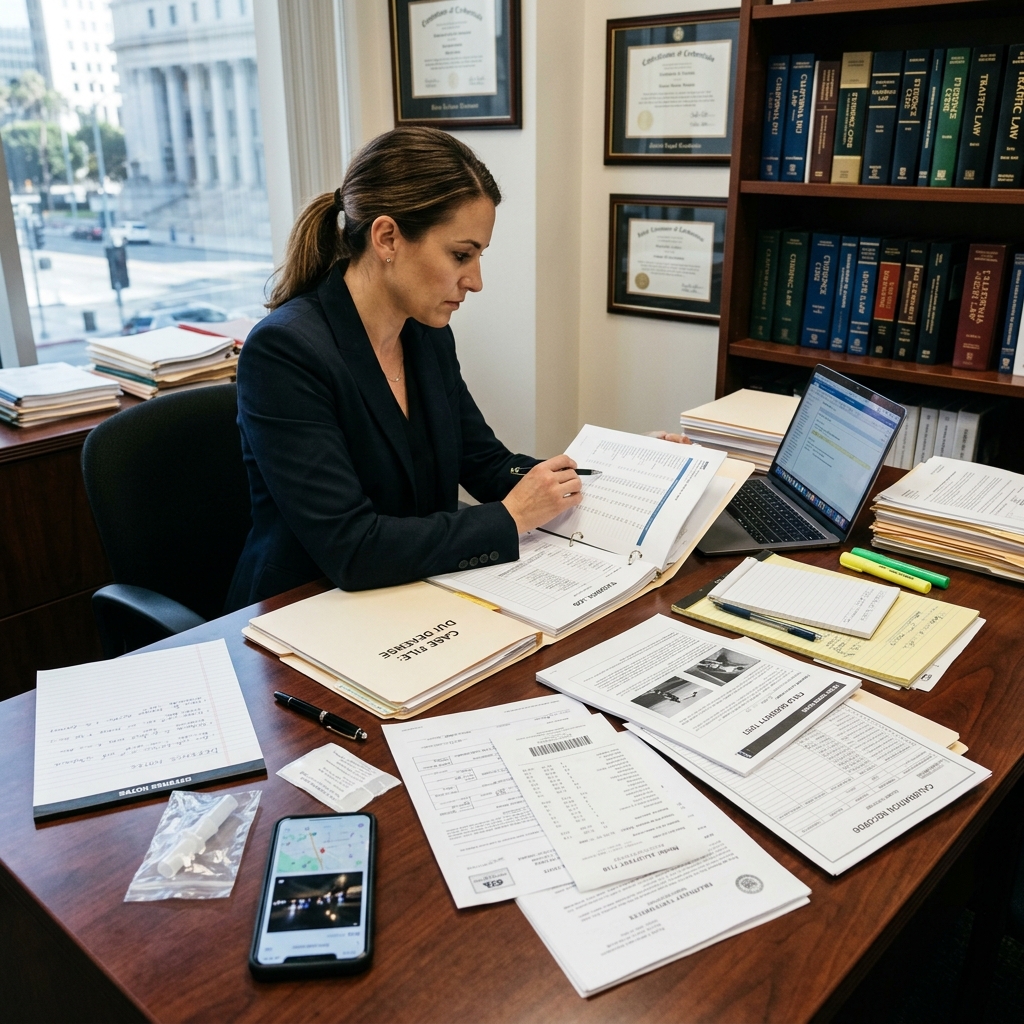
Facing a drunk driving, DUI, or DWI charge can be overwhelming. Yet the strength of your defense often depends less on what happened in a few minutes on the roadside and more on the quality and completeness of the evidence you can present later in court. Gathering the right documents and records early helps your attorney evaluate the case, challenge weak points in the prosecution’s story, and protect your legal rights.
This guide explains the most important types of evidence you should consider collecting if you have been arrested or cited for DUI or DWI. It is not legal advice, but it will help you understand what your lawyer is likely to ask for and why those materials matter.
Why Evidence Collection Matters in DUI and DWI Cases
DUI and DWI charges are usually proven through a combination of chemical tests, officer observations, and
Thoughtful evidence gathering serves several purposes:
- Reconstruct the event: A detailed picture of what happened before, during, and after the stop can reveal errors or misunderstandings.
- Test reliability: Documents and records help your lawyer examine whether chemical tests, field sobriety tests, or officer conclusions are accurate and properly conducted.
- Identify rights violations: Evidence may show that the stop, search, arrest, or questioning violated constitutional or procedural rules, which can render some evidence inadmissible.
- Support alternative explanations: Medical conditions, medications, environmental factors, and other circumstances might explain your behavior or test results without implying impairment.
Core Evidence Categories to Focus On
While every case is unique, most DUI and DWI defenses revolve around a few central groups of evidence. Below are five major categories, with examples of what to collect and how that information can help.
1. Official Records: Identification, Licensing, and Prior History
Basic documents may not seem important at first, but they often serve as the foundation of your legal defense file.
Key official documents to gather
- Driver’s license: Current license, temporary permit, or any paperwork showing a restricted or suspended status.
- Vehicle registration and insurance: Proof of lawful ownership and insurance coverage at the time of the stop.
- Identification documents: Passport, state ID card, or birth certificate if your identity or age becomes relevant.
- Prior criminal or traffic history: Certified driving records, prior DUI dispositions, and records of completed programs or probation.
These materials can help in several ways:
- Confirm that you were legally licensed and insured at the time of the incident.
- Allow your attorney to evaluate potential sentencing exposure or enhancement based on prior offenses.
- Demonstrate past compliance with court orders or treatment programs, which can be helpful in negotiations.
2. Police Documentation and Chemical Test Evidence
In many DUI and DWI cases, the prosecution relies heavily on police reports and chemical testing results—such as breath, blood, or urine tests—to argue that you were impaired or above the legal blood alcohol concentration (BAC) limit.
Police reports and officer notes
- Incident or arrest report: The primary narrative outlining why the officer stopped you, what they observed, and the basis for arrest.
- Accident report: If a collision occurred, this report may describe road conditions, damage, injuries, and other factors that explain driving behavior.
- Supplemental or investigative reports: Additional documentation, such as notes about field sobriety tests or witness statements.
Your attorney will compare these reports to other evidence—like video footage and witness accounts—to look for inconsistencies, omissions, or language that overstates impairment.
Chemical test results
- Breath test printouts: Readings from roadside devices or station-based Breathalyzer machines, including time stamps and error codes.
- Blood or urine lab reports: Laboratory analyses showing BAC or the presence of drugs, with chain-of-custody records when available.
- Maintenance and calibration logs: Records showing whether the testing equipment was properly serviced, calibrated, and validated.
According to legal and scientific guidance, chemical test results are often treated as presumptive evidence of alcohol influence, but they are not always conclusive. Errors in administration, improper calibration, medical conditions, or contamination can undermine their reliability. Reviewing these documents allows your lawyer to consider challenges such as:
- Whether the test was administered according to approved procedures and observation periods.
- Whether the equipment met regulatory standards for maintenance and accuracy.
- Whether non-impairing substances, mouth alcohol, or medical factors could have influenced results.
3. Video, Audio, and Photographic Evidence
Visual and audio recordings are often critical because they capture the interaction between you and law enforcement in real time. Courts commonly admit authenticated video as evidence when it accurately represents events.
Types of recordings to look for
- Police dash camera footage: Video from the patrol car showing driving behavior, the stop, and much of the roadside interaction.
- Body-worn camera recordings: Footage capturing close-up officer observations, instructions for field sobriety tests, and your responses.
- Surveillance video: Recordings from bars, restaurants, parking lots, or nearby businesses that show your condition before driving.
- Cell phone videos or photos: Images or recordings taken by passengers, bystanders, or even you.
To be useful, video generally must be authenticated as a genuine depiction of what occurred. Once obtained, these recordings can:
- Show whether your speech, balance, and coordination matched the officer’s written description.
- Reveal how clearly instructions for field sobriety tests were given.
- Document environmental conditions, such as poor lighting, uneven surfaces, or bad weather, that might affect performance on tests.
- Capture whether you were cooperative, confused, or treated improperly.
Simple comparison table: officer narrative vs. video evidence
| Officer Claim in Report | What Video Might Show |
|---|---|
| “Driver staggered and could not walk straight.” | Driver walks steadily but briefly stumbles on uneven pavement or debris. |
| “Instructions were clearly explained before field sobriety tests.” | Officer gives rapid or incomplete instructions in a noisy environment. |
| “Driver appeared confused and uncooperative.” | Driver asks clarifying questions and expresses concern, but follows directions. |
4. Medical, Medication, and Health-Related Documentation
Medical information can be especially important when the prosecution relies on how you looked or performed on roadside tests. Certain conditions or medications can mimic signs of impairment—such as unsteady gait, slurred speech, or unusual eye movements—without actual intoxication.
Useful medical records and information
- Diagnosis and treatment records: Documents showing chronic conditions, recent surgeries, neurological disorders, or musculoskeletal problems that affect balance or coordination.
- Medication lists: Prescriptions and over-the-counter drugs you were taking at or before the incident, including dosing schedules.
- Physician letters or evaluations: Statements from doctors explaining how a condition or medication could influence physical or cognitive performance.
- Emergency room or urgent care records: If you were evaluated after the arrest, those notes may mention your level of alertness and any injuries.
These materials can help explain:
- Why you might have had difficulty with one-leg-stand or walk-and-turn tests endorsed by traffic safety authorities.
- Why your eyes might show nystagmus (involuntary jerking) even without alcohol, which complicates interpretation of horizontal gaze tests.
- Whether medications, medical events, or fatigue could have affected breath or blood test results.
Any health-related documentation should be shared with your attorney first, so they can decide what to disclose strategically while respecting your privacy and working within evidentiary rules.
5. Witness Statements and Personal Accounts
Witnesses are often overlooked, yet they can play a significant role in countering assumptions based solely on officer impressions.
Potential witnesses to consider
- Passengers in your vehicle: They may describe how much you drank, your behavior, and any conversations with the officer.
- Friends, coworkers, or staff: People who observed you at a restaurant, party, or workplace shortly before the incident.
- Third-party bystanders: Individuals who saw the stop, field sobriety testing, or an accident.
- Expert witnesses: Toxicologists, accident reconstruction specialists, or medical experts who can interpret technical data.
Statements from these witnesses may:
- Confirm that you consumed little or no alcohol.
- Explain non-alcohol-related reasons for your behavior or appearance.
- Dispute or clarify key parts of the officer’s narrative.
- Support arguments that the tests were unreliable under the circumstances.
You should avoid coaching or influencing witnesses. Instead, you can help your attorney identify who was present, how to contact them, and what they likely observed. Your lawyer can then decide whether and how to formally take statements or depositions.
Evidence and Your Legal Rights
Not all evidence gathered by the police is automatically admissible. In many jurisdictions, evidence must comply with constitutional protections and procedural rules, including proper justification for a traffic stop, arrest, and search.
Issues that can affect admissibility
- Probable cause for the stop: If the officer lacked a lawful basis to stop or detain you, key evidence—like breath test results—may be excluded.
- Search and seizure rules: Improper vehicle searches or blood draws may violate constitutional protections.
- Miranda warnings: Statements made during custodial interrogation without proper warnings can be barred from trial.
- Chain of custody: For blood or urine samples, evidence must show how the sample was handled from collection to analysis.
Collecting documentation related to these issues—such as test request forms, consent documents, or records of the timing of the arrest—gives your lawyer the information needed to raise suppression motions or other legal challenges.
Practical Steps to Start Gathering Evidence
Once you have an attorney, they will guide you on what to collect and how. However, you can take a number of practical steps early on.
Initial actions after a DUI or DWI arrest
- Write your own detailed timeline: As soon as possible, record everything you remember—where you were, what you drank or consumed, medications, interactions with the officer, and how tests were conducted.
- Preserve physical items: Keep receipts, bar tabs, medication packaging, or event tickets that show your activities and timing.
- Request copies of documents: Ask for copies of citations, temporary licenses, tow notices, or release paperwork.
- Identify possible recordings: Make a list of businesses or locations with potential surveillance cameras and note the time window before their footage may be overwritten.
Working with your attorney on evidence requests
Your lawyer can formally request many records through legal processes, such as discovery requests or subpoenas. To support this work:
- Provide accurate contact information for witnesses and businesses.
- Share any videos, photos, or messages that you or others already have.
- Sign authorizations as needed so your attorney can obtain medical records ethically and legally.
- Stay organized by keeping all documents in a dedicated folder—physical or digital—labeled by type.
Frequently Asked Questions (FAQ)
Do I need all of this evidence if I plan to plead guilty?
Even if you believe you will plead guilty, collecting evidence can still be very important. It may reveal legal issues with the stop or testing that reduce charges, lead to diversion or treatment alternatives, or improve sentencing outcomes. Your attorney will need a full picture of the facts to advise you responsibly.
How quickly should I start gathering DUI-related documents?
You should begin as soon as possible. Some types of evidence—especially surveillance video—may be automatically deleted or overwritten within days or weeks. Memories fade quickly, and the sooner you write down your account and identify witnesses, the more detailed and reliable that information will be.
Can I get dashcam or bodycam footage on my own?
In some areas, you can request certain recordings through public records laws or police procedures. However, in a criminal case, it is generally best to let your lawyer request and review this footage as part of formal discovery. That helps ensure the material is complete and properly preserved for use in court.
Are medical records always helpful in a DUI case?
Medical records can be very helpful when they explain physical or neurological conditions affecting balance, speech, or eye movements, or show how medications might influence behavior. That said, health information is sensitive, and disclosing it can have consequences beyond the case. You should discuss the pros and cons with your attorney before releasing any medical documentation.
What if I think the breathalyzer or blood test was wrong?
It is possible to challenge test results, but doing so usually requires detailed records and, in some cases, expert review. Maintenance logs, operator training records, and lab procedures may reveal errors. Medical conditions, recent food or medication consumption, or improper observation periods can also affect readings. Your attorney can decide whether hiring an expert to evaluate these issues is appropriate.
Key Takeaways
- DUI and DWI prosecutions rely heavily on documentation, test results, officer observations, and witness testimony.
- Collecting your own evidence early—identification, police reports, medical records, video, and witness information—helps your lawyer identify defenses and rights violations.
- Chemical test results are influential but can be challenged when procedures, equipment, or medical factors raise doubts about accuracy.
- Video and witness statements often provide a more complete and nuanced picture than written reports alone.
- Always review evidence decisions with a qualified attorney, who can apply local law and ethical rules to your specific situation.
References
- Top 5 Types of Documents/Evidence to Gather for Your Drunk Driving/DUI/DWI Case — LegalMatch Law Library. 2025-03-12. https://www.legalmatch.com/law-library/article/top-5-types-of-documents-evidence-to-gather-for-your-drunk-driving-dui-dwi-case.html
- Evidence in DUI Cases — AZ DUI Laws (Law Office of James E. Novak). 2024-01-05. https://www.azduilaws.com/dui/evidence-in-dui-cases/
- What Types of Evidence Are Used in DUI Cases? — Alonzo & Associates Criminal Defense. 2023-07-18. https://www.alonzocriminaldefense.com/articles/what-types-of-evidence-are-used-in-dui-cases/
- Evidence in DWI Cases — Tilem & Associates, PC. 2023-11-02. https://www.tilemlawfirm.com/our-practice-areas/dwi-dui/dwi-process/evidence-in-dwi-cases/
- Evidence in DUI Cases — Ellis and Bryant, Attorneys at Law. 2022-09-21. https://www.ellisandbryant.com/practice-areas/dui-defense/evidence-in-dui-cases/
- The Legal Environment in DUI & DWI Cases — Justia Criminal Law Center. 2021-05-10. https://www.justia.com/criminal/drunk-driving-dui-dwi/docs/the-legal-environment/
- DUI and DWI Defenses — Western Kentucky University Employee Assistance Program, Anthem. 2024-04-03. https://www.anthemeap.com/wku/find-legal-support/resources/criminal-law/legal-assist/dui-and-dwi-defenses
Similar Articles








Read full bio of Sneha Tete




