
Drug Convictions and Special Driver Licensing Rules
How drug-related convictions can affect your driving privileges and what special licensing rules may apply.
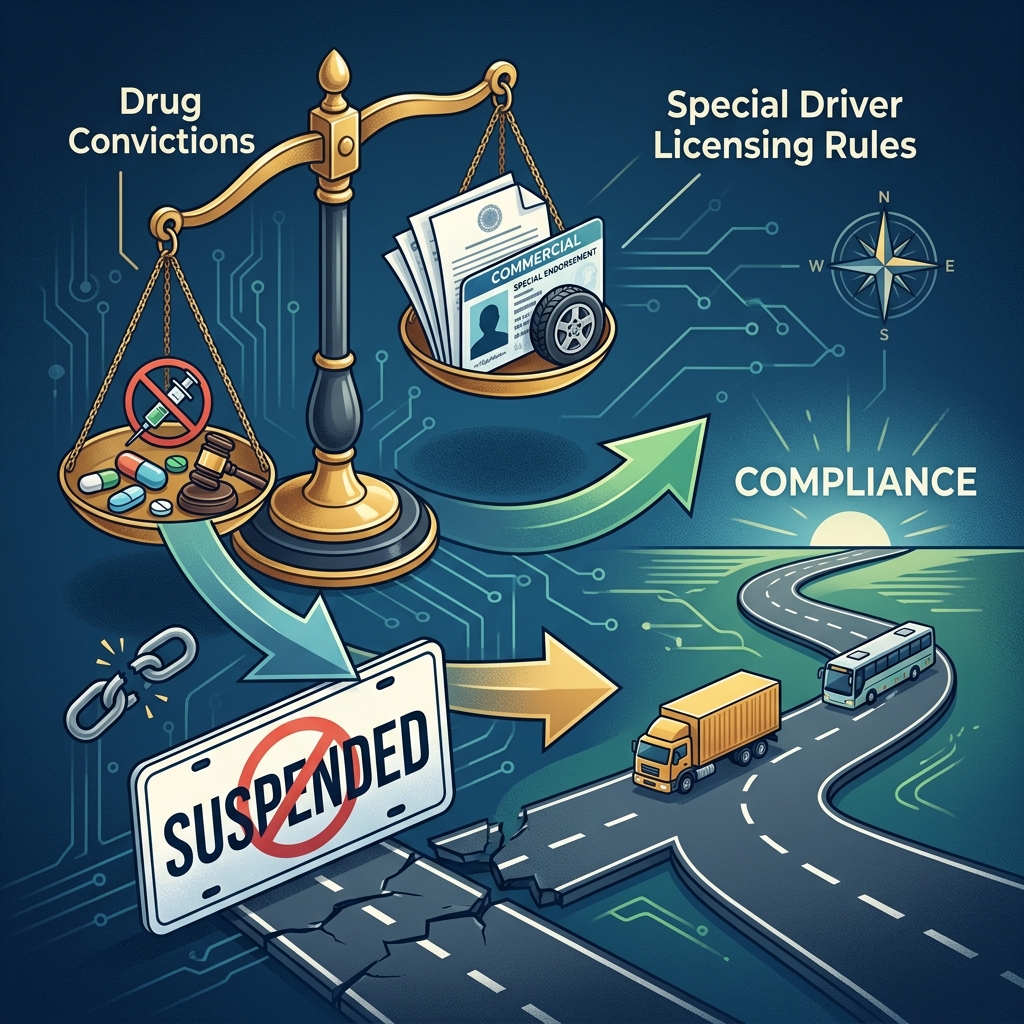
In many parts of the United States, a conviction for a drug offense does far more than create a criminal record. It can also restrict or suspend your ability to drive, even when the offense had nothing to do with a motor vehicle. States and the federal government have built an intricate system of driver’s license penalties, special licensing rules, and limited-use driving privileges aimed at drug offenders.
This article explains how these systems work, why they exist, and what options may be available to individuals seeking to regain some driving rights after a drug-related conviction. It focuses on key policy examples, such as Massachusetts and New York, while recognizing that each state’s rules are different.
Why Drug Convictions Affect Driver’s Licenses
Driver’s license penalties for drug offenses grew out of a mix of state policy choices and federal incentives. In 1989, Massachusetts, for example, adopted a law that automatically suspended driver’s licenses for drug convictions for up to five years and required at least a $500 fee to restore driving privileges. The goal was to deter drug crimes and encourage rehabilitation, using driving privileges as leverage.
At the federal level, a statute now codified at 23 U.S.C. § 159 encouraged states to enact and enforce license suspensions for drug offenders or risk losing certain forms of highway funding. While the details vary, the result in most states has been:
- Automatic or mandatory license suspensions for defined drug offenses.
- Eligibility for restricted or conditional licenses in limited circumstances.
- Complex interaction between criminal court orders and motor vehicle agency rules.
Over time, critics have questioned whether suspending driver’s licenses for conduct unrelated to driving actually improves public safety or reduces drug abuse. Research commissioned by the American Association of Motor Vehicle Administrators found that license suspensions for non-safety reasons are generally ineffective at changing behavior. In response, some states have begun rolling back automatic suspension rules.
Common Types of License Consequences for Drug Offenders
Although specific penalties differ by jurisdiction, several broad patterns appear again and again in state law.
1. Automatic Suspension or Revocation
Many states impose a mandatory suspension of driver’s licenses after certain drug convictions, regardless of whether the offense involved driving. For example:
- Massachusetts (historically): Prior to reform, individuals convicted under the state controlled substances law faced an automatic suspension between six months and five years, depending on the offense.
- New Jersey: Under NJSA 2C:35-16, a person convicted of any drug offense under Title 35 or 36 must forfeit driving privileges for at least six months and up to two years.
Loss of driving rights can apply to simple possession, possession with intent to distribute, trafficking, or even possession of drug paraphernalia.
2. Suspensions Scaled by Offense Severity
Some states scale the length of suspension to the seriousness of the drug offense. Massachusetts historically imposed longer suspensions for distribution or trafficking compared to simple possession. Criminal statutes may distinguish:
- Possession of controlled substances (shorter suspensions).
- Possession with intent to distribute or sale (longer suspensions).
- Drug trafficking or school zone offenses (longest suspensions).
This tiered approach reflects a policy judgment that more serious drug crimes merit a more severe impact on driving privileges.
3. Out-of-State Drug Convictions
Drug convictions that occur in other states often follow drivers home. States such as Massachusetts treat qualifying out-of-state drug convictions as if they had occurred locally, imposing comparable driver’s license suspensions.
Information about out-of-state convictions is typically exchanged through national databases and interstate compacts, which allow motor vehicle agencies to identify drug-related offenses and respond under their own suspension rules.
4. Fees and Reinstatement Requirements
Even after the suspension period ends, reinstating a driver’s license can require payment of significant fees and proof that the individual has complied with court orders or treatment programs. Massachusetts historically set reinstatement fees of at least $500 for certain drug convictions. Reinstatement may also require:
- Proof of completion of a court-ordered drug treatment program.
- Evidence of negative drug screens over a defined period.
- Letter(s) from probation officers or treatment providers documenting compliance.
Special, Conditional, and Hardship Licenses
Recognizing that a complete suspension can threaten a person’s ability to work, support dependents, or attend treatment, many states allow limited forms of driving under tightly controlled conditions. These are often called conditional, restricted, or hardship licenses.
What Is a Conditional or Restricted License?
A conditional or restricted license is a limited-use driver’s license that allows a person to drive only for specific, approved purposes. New York’s Department of Motor Vehicles can issue conditional licenses to drivers whose licenses were suspended or revoked because of alcohol or drug-related violations, as long as they qualify and enroll in an approved Impaired Driver Program.
Under New York rules, drivers with conditional privileges may only drive:
- To and from work.
- During work hours if the job requires driving.
- To and from DMV offices for program-related business.
- To and from classes or activities associated with the Impaired Driver Program.
- To and from college or vocational training (with some limits).
- To and from probation activities ordered by the court.
- To and from a child’s school or daycare when necessary to maintain employment or education.
Violation of any condition can result in loss of the conditional license and re-imposition of the full suspension.
Hardship Licenses in Massachusetts
Massachusetts offers hardship licenses that provide limited driving rights to individuals whose licenses are suspended, including for certain drug-related offenses. Hardship licenses are only available to Massachusetts license holders and require a formal hearing before a Registry of Motor Vehicles hearings officer.
To apply, drivers must:
- Attend a hearing at designated RMV hearing sites.
- Bring all required documents, which may include proof of employment, medical needs, or educational enrollment.
- Show that a severe hardship exists, such as inability to reach work, necessary medical appointments, or essential child care without driving.
Hardship licenses are discretionary. The hearings officer evaluates whether the applicant has served a portion of the suspension, completed required treatment, and demonstrated responsible behavior since the conviction.
Typical Conditions on Special Licenses
Both conditional and hardship licenses often carry similar restrictions. Common limits include:
- Driving only during specified hours.
- Driving only for employment, education, medical, or court-ordered activities.
- Mandatory participation in treatment or education programs.
- Zero-tolerance for subsequent drug or alcohol-related violations while licensed.
| License Type | Typical Purpose | Key Requirements | Common Restrictions |
|---|---|---|---|
| Conditional License (e.g., New York) | Allow limited driving during suspension for alcohol or drug-related violations. | Enroll in Impaired Driver Program; meet DMV eligibility criteria. | Driving only to work, school, DMV, program classes, probation, and certain child care needs. |
| Hardship License (e.g., Massachusetts) | Relieve severe hardship from a full suspension, including drug convictions. | RMV hearing; documentation of hardship; partial service of suspension; treatment compliance. | Limited hours and purposes; revocable if conditions or laws are violated. |
Reforming Driver’s License Suspensions for Drug Offenses
Policymakers have increasingly questioned whether non-driving-related drug offenses should automatically impact driver’s licenses. The Prison Policy Initiative, for example, highlighted that Massachusetts’ suspension policy damaged employment prospects and family stability without demonstrable public safety benefits.
Research commissioned by motor vehicle administrators concluded that suspensions for non-highway safety reasons do not effectively deter the underlying behavior. Based on these concerns, some states have moved to reform their laws.
Massachusetts Legislative Changes
Massachusetts passed legislation, signed by the governor, eliminating mandatory license suspensions for certain drug offenses that did not involve operating a motor vehicle. The law took effect in 2016 and removed automatic suspensions for many controlled substance convictions under the state’s Chapter 94C.
Key elements of this reform include:
- Ending the automatic suspension for many non-driving drug offenses.
- Reducing barriers to employment and transportation for individuals in recovery.
- Maintaining suspension authority where drugs and driving are closely linked, such as driving under the influence.
Advocates argue that these changes align driver’s license penalties more closely with actual highway safety risks, while reducing collateral consequences that may hinder reintegration after a conviction.
Federal Regulatory Developments
The Federal Highway Administration has proposed regulatory changes affecting how states certify whether they choose to enact and enforce driver’s license suspensions for drug offenders under 23 U.S.C. § 159. This reflects an evolving federal stance that gives states more discretion and acknowledges the criticisms of blanket suspension policies.
States must still consider the impact of federal law and funding, but they now have clearer pathways to modify or repeal harsh suspension requirements, especially for non-driving-related offenses.
Practical Steps for Individuals Facing a Drug-Related Suspension
Anyone facing a driver’s license suspension due to a drug conviction should act quickly to understand their rights and options. While legal advice must come from a qualified attorney, several general steps can be useful.
Document Your Circumstances
- Gather proof of employment, including work schedules and job descriptions.
- Collect documentation of medical needs, such as regular appointments and treatment plans.
- Obtain school or training enrollment records if education is affected.
- Keep a record of your responsibilities for children or dependents who rely on your transportation.
These materials can be essential when requesting a hardship or conditional license.
Complete Required Programs
- Enroll promptly in any court-ordered drug treatment or education program.
- Attend all sessions and follow clinical recommendations.
- Maintain negative drug screens and keep copies of test results where appropriate.
Program completion is often a prerequisite for conditional or hardship licensing and for full reinstatement.
Consult Legal and Administrative Resources
- Speak with a criminal defense or motor vehicle law attorney to understand local rules.
- Review your state’s motor vehicle agency policies on hardship or restricted licenses.
- Confirm how an out-of-state conviction may affect your local license status.
Because laws differ widely and frequently change, individualized advice is critical.
Frequently Asked Questions
Do all drug convictions automatically suspend a driver’s license?
No. Automatic suspensions depend on state law and the type of offense. Some states, such as New Jersey, suspend licenses for nearly all drug offenses. Others, including Massachusetts after reform, limit automatic suspensions mainly to driving-related offenses.
Can I get a special license to drive to work during a suspension?
In many states, yes, but eligibility varies. New York’s conditional license allows limited driving to work, school, treatment, and certain other approved activities after enrollment in an Impaired Driver Program. Massachusetts hardship licenses may permit restricted driving where severe hardship can be proven.
If my drug conviction happened in another state, can my home state still suspend my license?
Often yes. States may treat qualifying out-of-state drug convictions as if they occurred locally, resulting in a suspension or revocation under home-state rules. Motor vehicle agencies rely on interstate data sharing to identify such convictions.
Do driver’s license suspensions for drug offenses improve public safety?
Evidence is mixed, and many studies suggest that suspensions for non-driving offenses are not effective deterrents. A major study cited by motor vehicle administrators found that suspending licenses for non-highway safety reasons did not significantly improve compliance or change underlying behavior.
Has federal law changed the way states use license suspensions for drug offenders?
Federal law still addresses drug offender license suspensions, but regulatory changes proposed by the Federal Highway Administration give states more flexibility in how they certify and implement these policies. This flexibility has supported state-level reforms such as Massachusetts’ rollback of automatic suspensions.
References
- Suspending Common Sense in Massachusetts — Prison Policy Initiative. 2003-09-12. https://www.prisonpolicy.org/driving/report.html
- Drug Conviction in Massachusetts and Suspended Driver’s License — DelSignore Law. 2015-07-01. https://www.delsignoredefense.com/massachusetts-licence-suspension-for-drug-offenses.html
- Massachusetts License Suspensions for Drug Convictions — RMV Lawyer. 2016-04-05. https://rmvlawyer.com/blog/massachusetts-license-suspensions-for-drug-convictions/
- Massachusetts Drug Convictions No Longer Mean an Automatic Driver’s License Suspension — Matthew Gilman Law. 2016-03-31. https://www.matthewgilmanlaw.com/blog/massachusetts-drug-convictions-no-longer-mean-an-automatic-driver-s-license-suspe/
- Conditional and Restricted Use Licenses — New York State Department of Motor Vehicles. 2024-01-10. https://dmv.ny.gov/points-and-penalties/conditional-and-restricted-use-licenses
- Drug Offender’s Driver’s License Suspension — Federal Highway Administration, Federal Register. 2022-02-18. https://www.federalregister.gov/documents/2022/02/18/2022-03172/drug-offenders-drivers-license-suspension
- Apply for a Hardship Driver’s License — Mass.gov. 2023-08-15. https://www.mass.gov/how-to/apply-for-a-hardship-drivers-license
Similar Articles








Read full bio of Sneha Tete




