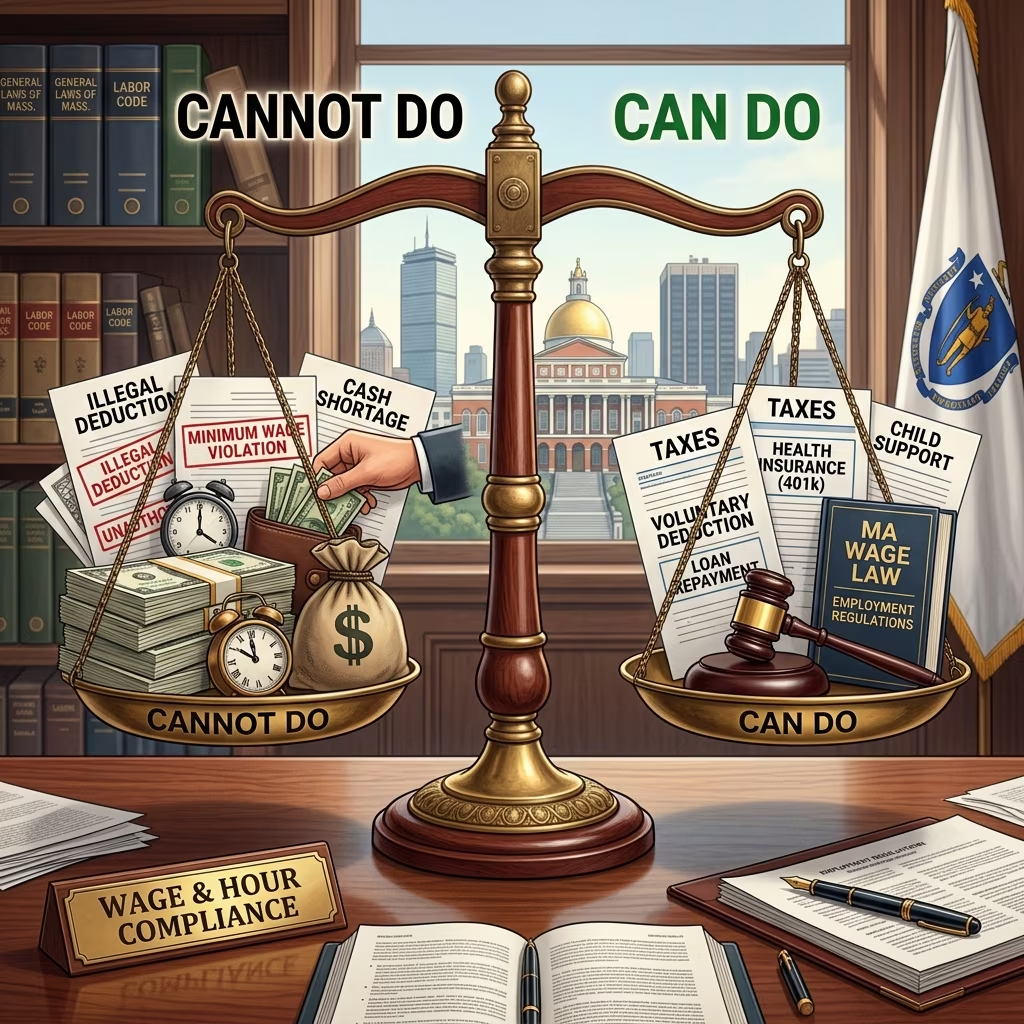
In Massachusetts, employers must follow strict wage laws that sharply limit when they can deduct money from a worker’s paycheck. State rules generally prohibit using wage deductions as a punishment, even when an employee caused damage or violated a workplace policy. Understanding these rules is critical for both employers and employees, because improper docking of pay can lead to financial penalties, lawsuits, and orders to pay back wages.
What Does “Docking Pay” Mean?
People often use the term dock pay to describe any situation where an employer reduces a worker’s paycheck because of something that happened at work. In legal terms, docking pay usually refers to:
- Taking money out of earned wages as a deduction.
- Paying an employee less than they otherwise earned due to a company rule or penalty.
- Refusing to pay for hours actually worked, such as cutting pay for tardiness even where some work was performed.
Massachusetts law treats these actions as wage-related decisions, and the state’s wage statutes strictly control when they are allowed.
Core Principles of Massachusetts Wage Deduction Law
Several key principles underlie how Massachusetts regulates deductions and penalties from wages. These rules are largely derived from the Massachusetts Wage Act and guidance from the Attorney General.
- Employees must be paid for all hours worked. If a worker performs work, those hours must be compensated at least at minimum wage.
- Deductions are only lawful in narrow circumstances. Employers can generally deduct wages only when the law allows or the employee requests a deduction for their own benefit.
- Ordinary business costs cannot be passed onto employees. Employers may not take money from paychecks to cover routine costs such as tools, supplies, or breakage.
- Minimum wage must always be preserved. Even authorized deductions cannot reduce a worker’s effective pay below the minimum wage for each hour worked.
- Transparency is required. Employers must give workers pay slips that clearly list all deductions taken from wages.
These principles mean that wage deductions used as a penalty for misconduct or mistakes are usually illegal unless they fit specific, narrowly defined exceptions.
Mandatory Deductions Employers Must Take
Some deductions are required by law, and employers have no choice but to withhold these amounts from employee pay.
- Income tax withholding (state and federal).
- Social Security and Medicare contributions under the Federal Insurance Contributions Act (FICA).
- Court-ordered payments, such as child support or wage garnishments.
These mandatory deductions are not considered improper docking of pay, because they are explicitly required by law and apply uniformly to covered employees.
Voluntary Deductions Employees May Authorize
Massachusetts also allows employers to make certain deductions that the employee actively requests or agrees to, as long as they serve the worker’s own interests.
Common examples include:
- Contributions to retirement accounts, such as 401(k) or IRA plans.
- Payments toward health, dental, or vision insurance premiums.
- Union dues or contributions to an employee stock purchase plan.
- Transfers to savings accounts or other accounts managed by the employee.
To be lawful, these deductions generally must be:
- Clearly authorized in writing by the employee.
- For the employee’s benefit, not to cover normal business expenses.
- Transparent, with the amounts listed on regular pay statements.
Using Deductions as Penalties: Why It Is Usually Illegal
Massachusetts courts and regulators have addressed whether employers can dock pay because an employee damaged property, made an error, or violated a policy. The answer is typically no.
A leading Massachusetts Supreme Judicial Court decision explained that employers cannot unilaterally decide that an employee owes money and then simply deduct it from wages. The court held that wage deductions based on the employer’s own determination of fault or damages are generally prohibited under the Massachusetts Payment of Wages Law.
In practice, this means employers usually may not do any of the following as a penalty:
- Dock pay for breaking a cash register or damaging equipment.
- Deduct money for customer complaints or lost business.
- Charge workers through payroll for uniforms, tools, or supplies needed for the job.
- Subtract amounts for mistakes like wrong orders or spoilage.
When employers use wage deductions to punish employees, they risk violating the Wage Act, which can trigger triple damages and attorney’s fees if a worker sues and wins.
What Counts as a “Valid Set-Off” Against Wages?
Despite these restrictions, Massachusetts law does recognize a few limited situations where employers may offset or deduct amounts from wages to satisfy debts, known as valid set-offs.
According to the Supreme Judicial Court and the Attorney General’s interpretation:
- Undisputed loans or wage advances. If an employer advanced money to a worker and the debt is undisputed, the employer can deduct repayment through payroll.
- Theft or misappropriation proved in an independent proceeding. If an employee steals from the employer and that theft is established in a separate process that provides due process, some wage offsets may be allowed.
- Judgment against the employee. If the employer obtains a court judgment for the value of property or damages, the judgment may be satisfied in part through wage set-offs, subject to other legal limits.
- Collective bargaining agreement procedures. Deductions supported by a union contract that includes mutually agreed mechanisms for determining and handling employee debts may qualify.
- Correction of clear overpayments. Legitimate recovery of mistaken overpayment of wages can also be treated as a valid set-off, usually with written notice and documentation.
Even in these scenarios, employers must ensure that deductions do not push the employee’s effective hourly pay below minimum wage and that all set-offs comply with statutory and regulatory requirements.
Non-Exempt vs. Exempt Employees: Different Rules on Pay Docking
Massachusetts workers are also covered by federal Fair Labor Standards Act (FLSA) rules, which distinguish between non-exempt employees (generally hourly workers) and exempt employees (often salaried professional, executive, or administrative staff).
Non-Exempt (Hourly) Employees
For non-exempt workers:
- Employers must pay for all hours actually worked, including work beyond scheduled hours.
- Employers may pay less when an employee is late, but they cannot deduct more than the wages for time not worked.
- Deductions still cannot be used to cover normal business costs or serve as a punitive fine.
Exempt (Salaried) Employees
Exempt employees under the FLSA generally must receive a fixed salary that does not fluctuate based on day-to-day work performance. Federal law allows deductions from salaried pay only in specific circumstances, including:
- Full-day absences for personal reasons, not due to sickness or disability.
- Full-day absences related to sickness or disability when covered by a bona fide plan, policy, or practice.
- Offsets for jury duty, witness fees, or military pay.
- Unpaid leave under the Family and Medical Leave Act (FMLA).
- Unpaid disciplinary suspensions of one or more full days for serious conduct violations, if imposed in good faith.
- First and last week of employment, when the employee does not work a full week.
Partial-day docking of an exempt employee’s salary is generally prohibited and can jeopardize their exempt status, potentially requiring overtime payments and other remedies. Employers in Massachusetts must comply with both these federal rules and the state wage deduction restrictions.
Common Scenarios: Is Docking Pay Legal?
| Scenario | Likely Legality in Massachusetts | Key Considerations |
|---|---|---|
| Docking pay because an employee breaks company equipment | Generally illegal | Ordinary business cost; cannot be treated as a wage penalty. |
| Deducting to recover a clearly documented wage overpayment | Possibly lawful | May qualify as a valid set-off if documented and preserves minimum wage. |
| Charging workers for uniforms through paycheck without benefit to worker | Often illegal | Uniforms may be considered business costs; deductions cannot drop pay below minimum wage. |
| Reducing pay for late arrival of an hourly worker | Limited legality | Employer may not pay for time not worked, but cannot deduct more than the value of missed time. |
| Full-day unpaid disciplinary suspension of an exempt employee | Generally allowed | Must be for serious conduct violations, in good faith, and for full days only under FLSA. |
Recordkeeping and Notice Requirements
Massachusetts employers must keep careful records and provide clear information to employees about their pay and deductions.
Key requirements include:
- Providing a pay statement each pay period with the employer and employee name, date of payment, hours worked, hourly rate, and all deductions and increases.
- Maintaining payroll records for at least three years, including amounts paid and hours worked.
- Informing new employees in writing about deductions and contributions at the time of their first paycheck, and updating all employees in writing when new deductions will be taken.
- Posting a wage and hour laws notice in a visible location in the workplace.
Failure to meet these transparency and recordkeeping requirements can compound liability when improper wage deductions occur.
Employee Options When Pay Is Improperly Docked
When workers believe their pay has been unlawfully reduced, they have several avenues for relief under Massachusetts law.
- Ask for an explanation in writing. Employees can request a detailed breakdown of any deduction and the legal basis for it.
- Use internal complaint procedures. Many organizations have HR or grievance processes to address pay disputes.
- File a complaint with the Massachusetts Attorney General’s Office. The Attorney General enforces wage and hour laws and can investigate employers.
- Bring a private lawsuit. The Wage Act allows employees to sue for unpaid wages, with potential triple damages and attorney’s fees.
- Consult a lawyer. Employment law attorneys can evaluate whether specific deductions violate state or federal law.
Because wage laws are interpreted strictly in favor of paying employees fully and on time, workers often have strong claims when pay is docked outside of the narrow exceptions allowed by law.
Employer Best Practices to Avoid Illegal Docking
Employers can reduce the risk of violating wage laws by adopting careful policies and practices around deductions and disciplinary measures.
- Use discipline, not paycheck penalties. Address conduct issues with written warnings, performance plans, or suspension rather than automatic wage deductions.
- Get clear written authorizations for voluntary deductions. Ensure documentation explains why the deduction is for the employee’s benefit.
- Never deduct for routine business costs. Treat equipment, supplies, uniforms, and breakage as operating expenses.
- Train managers on FLSA rules for exempt employees. Avoid partial-day salary docking that could undermine exempt status.
- Consult counsel before using any set-off. Recovery of loans, overpayments, or theft-related amounts should be vetted against current case law and regulatory guidance.
Frequently Asked Questions (FAQs)
Can my Massachusetts employer dock my pay because I was late?
For hourly workers, an employer does not have to pay for time not worked, so they may pay less if you arrive late and perform fewer hours. However, they cannot deduct more than the value of the missed time, and they must still pay for all hours actually worked at least at minimum wage. For exempt salaried employees, docking partial days can violate federal law.
Can an employer take money from my paycheck for damaged company property?
Ordinarily, no. Massachusetts law does not allow employers to treat wage deductions as a way to pay for ordinary business costs such as tools, equipment, or supplies. Unless the situation fits a narrow valid set-off category—such as a proven theft or a court judgment—deducting pay for damage is typically illegal.
Is it legal for my employer to deduct union dues or health insurance premiums?
Yes, if you have authorized those deductions and they are for your benefit. State law specifically allows deductions for union dues, health insurance, stock purchase plans, and similar benefits when properly authorized.
What can I do if my paycheck shows deductions I did not approve?
You can first ask your employer for a written explanation and correction. If the issue is not resolved, you may file a complaint with the Massachusetts Attorney General or consult an employment lawyer to explore a wage claim under the Wage Act. Improper deductions can lead to significant liability for employers.
Are disciplinary suspensions without pay allowed for salaried staff?
Under federal law, employers may impose unpaid disciplinary suspensions of one or more full days for serious conduct violations, and salary can be reduced accordingly. However, this must be done in good faith and in compliance with both FLSA and Massachusetts wage requirements.
References
- Massachusetts High Court: Employers Can’t Dock Pay! — Littler Mendelson. 2011-01-27. https://www.littler.com/news-analysis/asap/massachusetts-high-court-employers-cant-dock-pay
- Practice Pointer: When is it Permissible to Dock Pay of an Employee? — Hilb Group. 2023-05-10. https://www.hilbgroup.com/blog/practice-pointer-when-is-it-permissible-to-dock-pay-of-an-employee/
- Massachusetts law about wages — Commonwealth of Massachusetts, Mass.gov. 2023-01-01 (updated). https://www.mass.gov/info-details/massachusetts-law-about-wages
- Pay and recordkeeping — Commonwealth of Massachusetts, Mass.gov. 2023-01-01 (updated). https://www.mass.gov/guides/pay-and-recordkeeping
- Massachusetts Wage Payment Law — Collora LLP (archived PDF). 2013-07-01. https://www.wagehourlitigation.com/wp-content/uploads/sites/22/2013/07/C.J.-Wage-Payment-Article.pdf
- Massachusetts Wage & Hour Laws — Villanova University HR (summary document). 2018-01-01. https://www.villanova.edu/content/dam/villanova/hr/documents/MA%20Fair%20Wage%20Law.pdf
- Deductions from your paycheck — Massachusetts Legal Help. 2019-06-01. https://www.masslegalhelp.org/employment-unemployment/getting-paid/deductions-your-paycheck