
Chrysler Bankruptcy and Lemon Law Rights
Understand how Chrysler’s bankruptcy intersects with state lemon laws and what it means for owners of defective vehicles.
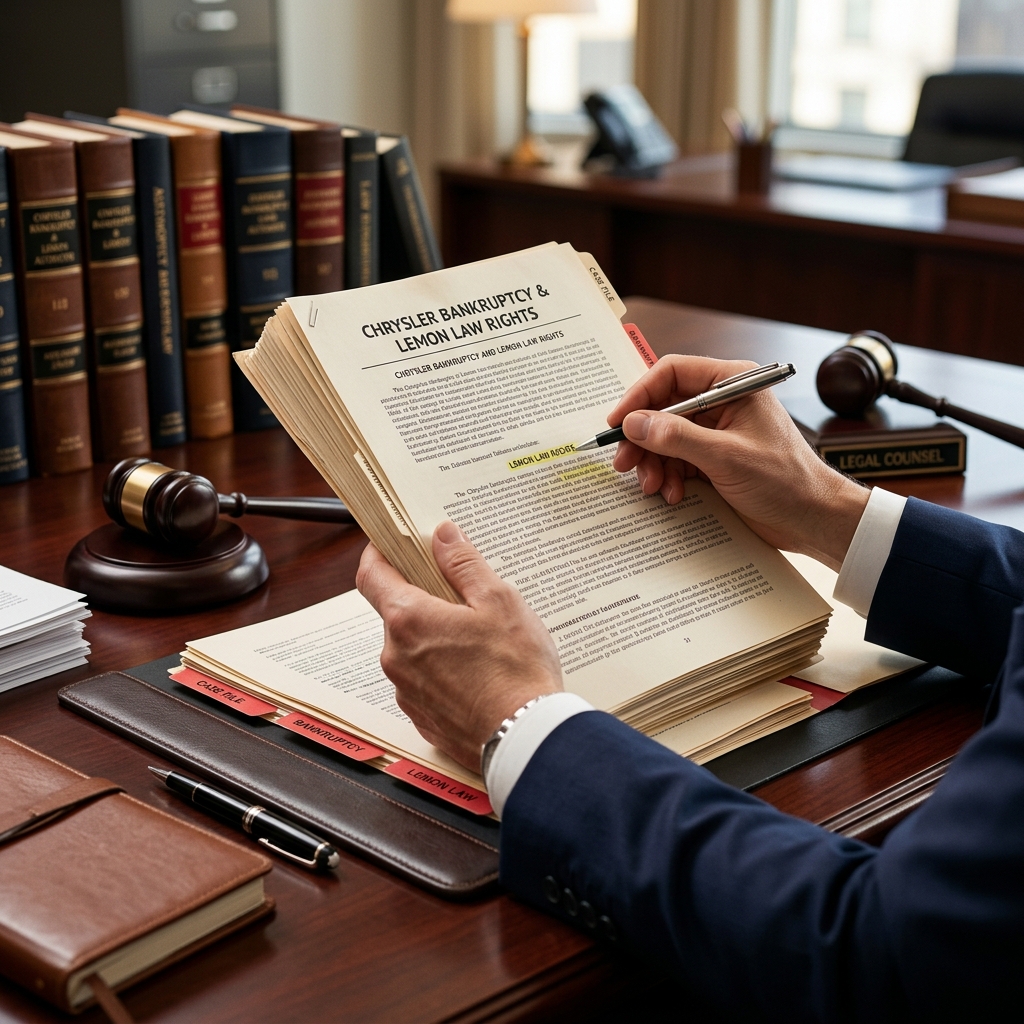
When a major automaker like Chrysler goes through bankruptcy, owners of defective vehicles understandably worry about whether their lemon law rights still mean anything. Bankruptcy can alter financial obligations, but it does not erase the underlying framework of consumer protection laws. This article explains how state lemon laws and federal warranty rules interact with automaker bankruptcy, what Chrysler owners can reasonably expect, and how to assert their rights when a vehicle turns out to be a lemon.
Why Bankruptcy Raises Questions for Chrysler Owners
Automaker bankruptcies are rare but consequential events. When Chrysler entered bankruptcy proceedings and reorganized, many drivers asked a basic question: if the company changes hands or restructures, will it still have to honor promises to repair or repurchase defective vehicles under state lemon laws?
Consumer advocates warned that bankruptcy could leave owners with fewer practical remedies if a new company disclaimed certain obligations. At the same time, Chrysler assured several state attorneys general that the reorganized entity intended to honor existing lemon law commitments. This tension—between legal technicalities in bankruptcy court and public statements about honoring consumer rights—makes it important to understand how lemon laws work in the first place.
- Legal uncertainty: Bankruptcy can allow a company to restructure contracts and shed some liabilities.
- Public assurances: Chrysler indicated it would continue to comply with state lemon law obligations.
- Consumer concern: Owners feared losing buyback or replacement remedies for vehicles already showing serious defects.
To see where Chrysler’s promises fit, it helps to look first at the basic structure of lemon law protections in the United States.
The Legal Framework: State Lemon Laws and Federal Warranty Law
Vehicle lemon protections in the U.S. rest on two pillars: state lemon laws and the federal Magnuson-Moss Warranty Act. Each plays a distinct role.
State Lemon Laws
Every state has some version of a lemon law that covers new vehicles sold or leased for personal, family, or household use. While details vary, these statutes share several core features:
- Substantial defect: The vehicle must have a problem that substantially impairs its use, value, or safety.
- Covered by warranty: The defect must be covered under the manufacturer’s written warranty.
- Reasonable repair attempts: The manufacturer or dealer must be given a reasonable number of chances to fix the defect—commonly three or four attempts, or a set number of days out of service.
- Rights period: Many states limit lemon law coverage to problems arising within a specific time or mileage window, such as 24 months or 24,000 miles.
- Remedies: If the defect remains unresolved, the consumer may be entitled to a refund, replacement vehicle, or other compensation.
For example, Georgia’s lemon law requires that repairs occur during a defined “rights period,” and that the consumer be the original purchaser or lessee of the new vehicle. These kinds of conditions exist in many states, even if the exact numbers differ.
Magnuson-Moss Warranty Act
The Magnuson-Moss Warranty Act is a federal statute governing consumer product warranties. It applies broadly to consumer goods with a retail price of at least $15, which includes automobiles.
Key aspects of Magnuson-Moss include:
- Encouraging clear and understandable written warranties.
- Allowing consumers to sue in federal court for breach of warranty.
- Permitting recovery of attorney’s fees for successful plaintiffs, which makes litigation more accessible.
While Magnuson-Moss does not replace state lemon laws, it often works alongside them. A Chrysler owner might bring state lemon law claims and federal warranty claims in the same case, especially if the state lemon law does not cover all circumstances but the warranty obligations are still in dispute.
How Chrysler’s Bankruptcy Interacts with Lemon Law Rights
Bankruptcy law and consumer protection law operate in different domains. Bankruptcy focuses on how a company’s debts and obligations are reorganized or discharged, while lemon laws focus on what manufacturers owe consumers when products are defective.
Consumer groups argued that allowing Chrysler’s bankruptcy sale to proceed without explicit lemon law obligations could severely limit owners seeking refunds under state statutes. Their concern was that a new or reorganized entity might claim it was not bound by prior refund or repurchase commitments under state law. In response, Chrysler assured state attorneys general that it intended to honor lemon law duties.
| Legal Area | Primary Focus | Effect on Owners |
|---|---|---|
| Bankruptcy Law | Restructuring liabilities, contracts, and assets of the company. | May change which entity is responsible for certain obligations. |
| State Lemon Laws | Ensuring remedies for defective vehicles (refund, replacement, repair). | Still theoretically available if statutory criteria are met. |
| Magnuson-Moss | Governing consumer warranties and breach of warranty disputes. | Provides a federal pathway to enforce warranty rights. |
In practice, Chrysler owners after the bankruptcy were not automatically stripped of lemon law rights. The laws remained on the books, and Chrysler publicly indicated it would continue to comply. However, the path to obtain a buyback or replacement might be more complex, requiring careful documentation and sometimes dispute resolution through programs associated with the manufacturer.
What Chrysler Owners Need for a Lemon Claim
Whether or not bankruptcy is in the background, the threshold question for any Chrysler owner is whether the vehicle meets the legal definition of a “lemon.” The answer depends on state law but usually includes these elements:
- Substantial defect: The issue is not trivial; it significantly affects the vehicle’s use, value, or safety.
- Warranty coverage: The defect is covered by Chrysler’s written warranty.
- Repeated repair attempts: The dealer or manufacturer has had a reasonable number of opportunities to fix the problem, often three or four attempts for the same defect or a lengthy period when the car is out of service.
- Timing: The problem arises within the lemon law rights period, defined by time or mileage (for example, 24 months or 24,000 miles in Georgia).
- Original consumer: Many laws require you to be the original purchaser or lessee of the vehicle for personal or household use.
Even in a post-bankruptcy environment, these substantive requirements remain the gatekeepers to lemon law remedies. The question is not just “Did Chrysler go through bankruptcy?” but “Does my vehicle meet the statutory criteria for a lemon?”
Steps to Protect Your Rights as a Chrysler Owner
Owners concerned about a defective Chrysler should follow a deliberate process. This approach matters regardless of the company’s bankruptcy status, because both lemon laws and warranty claims depend heavily on documentation.
1. Work Through the Dealership and Customer Care
Chrysler-related brands provide guidance through official channels on lemon law and warranty issues. Typically, you will be instructed to:
- Discuss the problem with the sales representative or service manager at the dealership.
- Allow the dealer to attempt repairs under warranty.
- If unresolved, contact customer care for Chrysler (now FCA US) to escalate the issue.
If customer care does not resolve the concern to your satisfaction, you may be directed to independent dispute resolution, such as the National Center for Dispute Settlement (NCDS)
2. Maintain Meticulous Records
State guidance emphasizes the importance of keeping detailed records of every repair attempt and communication with the manufacturer or dealer.
- Repair orders and invoices
- Dates the vehicle was in the shop
- Descriptions of the defect as reported and as diagnosed
- Letters or emails sent to Chrysler or the dealer
These documents help prove how many repair attempts occurred, how long the car was out of service, and whether the defect substantially impairs use, value, or safety—all core issues in a lemon case.
3. Provide Written Notice to the Manufacturer
Many lemon law regimes require that the manufacturer be formally notified of the defect in writing within a specified time or mileage, which triggers obligations to attempt a final repair or consider refund or replacement.
- Send written notice describing the defect.
- Include your contact information, vehicle identification number (VIN), and copies of repair records.
- Keep proof of delivery (certified mail or similar).
This written notice becomes part of the record if you later seek arbitration or court relief under state lemon laws or Magnuson-Moss.
4. Consider Arbitration or Legal Counsel
States often provide or require arbitration before filing a lawsuit. For example, Georgia’s program offers information and assistance to consumers who register problems with new vehicles. Manufacturer-linked arbitration programs, such as those using NCDS, can also be part of the process.
If arbitration does not resolve the matter, or if your state does not require it, consulting a lemon law attorney can help you evaluate whether your Chrysler claim is strong enough to pursue a refund or replacement.
Remedies Available to Chrysler Owners with Lemons
When a Chrysler vehicle meets the legal definition of a lemon, consumers typically have several potential remedies under state law and sometimes federal law.
- Replacement vehicle: A new vehicle of comparable value and features.
- Refund (buyback): Reimbursement of the purchase price, often with adjustments for mileage or use, plus certain incidental costs.
- Continued repair: In some situations, a negotiated repair plan or warranty extension may be acceptable to the owner.
- Attorney’s fees: Under Magnuson-Moss, successful consumers may recover attorney’s fees, which encourages legal enforcement of warranty rights.
Bankruptcy does not change the fundamental list of remedies recognized in state lemon laws, but it may influence how those remedies are funded or which entity—old Chrysler, new Chrysler, or a successor company—is responsible. That is largely a legal question handled in bankruptcy court, but from the consumer’s perspective, the practical goal remains the same: obtaining a fair resolution for a defective vehicle.
Frequently Asked Questions
Does Chrysler’s bankruptcy mean my lemon law rights disappeared?
No. State lemon laws and the Magnuson-Moss Warranty Act remain in force regardless of Chrysler’s corporate restructuring. The laws continue to grant remedies for qualifying defective vehicles. The key question is whether the reorganized company honors those obligations in practice, and Chrysler has publicly stated it intended to comply with lemon law duties.
Can I still get a refund or replacement for a defective Chrysler vehicle?
Yes, if your vehicle meets your state’s definition of a lemon and you follow required procedures. That typically means demonstrating a substantial defect covered by warranty, multiple unsuccessful repair attempts or significant time out of service, and timely notice to the manufacturer.
What if Chrysler refuses to treat my vehicle as a lemon?
If Chrysler or the dealer disputes that your vehicle is a lemon, you may have options such as dispute resolution through programs like NCDS, state-arranged arbitration, or filing a lawsuit under state lemon law and Magnuson-Moss. Speaking with a lemon law attorney can help clarify the strength of your case.
Do lemon laws apply to used Chrysler vehicles?
Most state lemon laws primarily cover new vehicles purchased or leased for personal or household use. Some states have separate protections for used cars, but these are usually more limited. Federal warranty law (Magnuson-Moss) may still apply if a written warranty covers the used vehicle.
How many repair attempts are considered “reasonable”?
While the exact number varies by state, four attempts to repair the same defect are often considered a general benchmark. Some states, and some types of safety-related defects, may require fewer attempts—sometimes only one or two. Long periods when the vehicle is out of service can also qualify under lemon laws.
Practical Tips for Chrysler Owners
If you suspect your Chrysler vehicle is a lemon, consider the following practical steps:
- Act early: Report defects as soon as they arise, especially within the lemon law rights period.
- Use authorized repair facilities: Many laws require repairs at manufacturer-authorized dealers to preserve warranty and lemon law claims.
- Keep everything: Save all repair orders, invoices, and correspondence.
- Follow dispute procedures: Utilize Chrysler’s customer care and any mandated arbitration program before litigating.
- Seek legal advice: If the defect persists and Chrysler resists a buyback or replacement, consider consulting an attorney experienced in lemon law and warranty cases.
By understanding the interplay between bankruptcy, state lemon laws, and federal warranty rights, Chrysler owners can make informed decisions and better protect themselves when a new vehicle turns out to be anything but roadworthy.
References
- Lemon Law for Consumers — Justia. 2023-06-01. https://www.justia.com/consumer/deceptive-practices-and-fraud/lemon-law/
- Georgia Lemon Law — Georgia Department of Law, Consumer Protection Division. 2024-02-15. https://consumer.georgia.gov/resolve-your-dispute/georgia-lemon-law
- Chrysler Lemon Law Lawyers | Chrysler Buyback Program — Allen Stewart, P.C. 2024-01-10. https://allenstewart.com/manufacturers/chrysler-repurchase-lemon-law/
- Consumer Groups Call for Reversal of Bankruptcy Court’s Decision Approving Sale of Chrysler — Center for Auto Safety et al. 2009-06-02. https://www.autosafety.org/wp-content/uploads/import/chryslerbankruptcyappeal.pdf
- Force Chrysler To Comply With Lemon Laws: Groups — Law360. 2009-06-04. https://www.law360.com/articles/104476/force-chrysler-to-comply-with-lemon-laws-groups
- Lemon Law, Warranty and Repair Help — Mopar (FCA US LLC). 2023-11-01. https://www.mopar.com/en-us/lemon-law.html
Similar Articles








Read full bio of Sneha Tete


