
Child Custody When a Parent Serves in the Military
A practical guide to understanding child custody, deployment, and parenting plans when one parent is an active-duty or reserve service member.
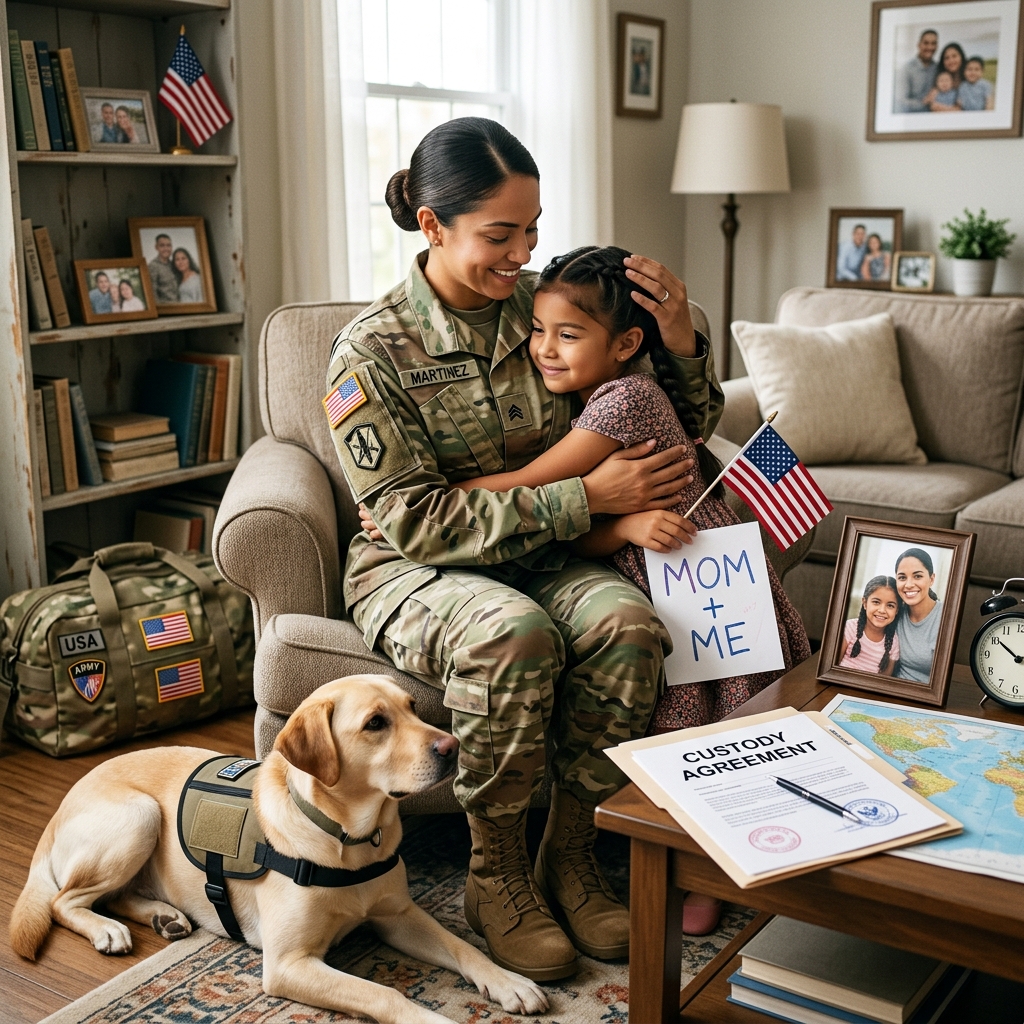
When parents separate or divorce, decisions about child custody are challenging in any family. Military families face additional layers of complexity: deployments, frequent relocations, unpredictable schedules, and the need to balance service obligations with parenting responsibilities. Despite these challenges, military parents share the same fundamental right as civilian parents to maintain relationships with their children, and they benefit from specific legal protections that help safeguard those rights.
This article explains how custody decisions are made when one parent serves in the military, what special rules and protections may apply, and how parents can plan for deployment and long-distance parenting in ways that prioritize the child’s well-being.
Core Principle: The Child’s Best Interests
Family courts in the United States use the “best interests of the child” standard to make custody decisions, whether the parents are civilians or members of the Armed Forces. Military status does not change this basic rule. Judges focus on how each parenting arrangement will affect the child’s stability, safety, emotional development, and ongoing relationships.
Typical factors courts consider include:
- The child’s physical and emotional needs and developmental stage.
- The child’s relationship with each parent and other important caregivers.
- Each parent’s ability to provide a safe, stable home environment.
- History of domestic violence, substance abuse, or neglect (if any).
- Continuity in schooling, community, and medical care.
- Where appropriate, the child’s own preferences.
Military service can influence some of these factors, but it cannot be the sole reason to deny custody or visitation. Rather, the court looks at how specific aspects of service—like long deployments or frequent moves—might affect the child’s best interests.
How Military Service Interacts With Custody Decisions
Service members sometimes worry that deployment or relocation will automatically count against them in custody cases. Modern state laws and military-related protections aim to prevent that outcome. All states now include meaningful provisions in their custody laws to protect the rights of service members, ensuring that military duty alone does not determine custody.
Common Misconceptions About Military Parents and Custody
- Myth: A deployed parent cannot have primary custody.
Reality: A military parent may have primary custody if that arrangement serves the child’s best interests. Short-term changes during deployment may be needed, but the permanent plan is not automatically changed because of service. - Myth: Courts always favor the non-military parent.
Reality: Courts must treat both parents equally and consider the full circumstances. Military parents have the same legal rights and responsibilities as civilians. - Myth: Future deployment alone can justify taking custody away.
Reality: Many states expressly prohibit using possible deployment as the sole reason to alter custody or visitation.
Protections Commonly Found in State Laws
Although details vary by state, several protective themes appear across U.S. custody statutes:
- Courts generally may not enter permanent orders changing custody while a parent is unavailable due to military duties.
- The custody arrangement that existed before deployment is often reinstated within a specified period after the service member returns, unless the other parent proves that reinstatement would harm the child’s best interests.
- Temporary changes made during deployment are typically just that—temporary—unless there is clear evidence of a significant change in circumstances.
- Some states allow deployed parents to delegate visitation to a relative or another trusted adult, so the child can maintain extended family connections while the parent is away.
Legal and Physical Custody in Military Families
Custody is often divided into two components: legal custody, meaning decision-making authority, and physical custody, meaning where the child lives. Military families may opt for joint or sole arrangements in both categories, tailored to their circumstances.
| Type of Custody | What It Means | Common Military Considerations |
|---|---|---|
| Joint Legal Custody | Both parents share authority over major decisions (education, health, religion). | Usually feasible even during deployment, using email, video calls, and secure messaging for joint decision-making. |
| Sole Legal Custody | One parent has primary decision-making power. | May be ordered in high-conflict or safety-risk cases; military status alone is not a sufficient reason. |
| Joint Physical Custody | The child spends substantial time living with each parent. | Can be more complex when one parent faces relocations; may require detailed scheduling and travel arrangements. |
| Primary Physical Custody | The child primarily lives with one parent, with visitation for the other. | Common when one parent expects deployment or frequent moves; long school breaks may be used for extended visitation. |
Deployment Planning: Building Flexible Parenting Plans
A well-crafted parenting plan is essential for military families. It should anticipate deployment, training, and possible relocation, while minimizing disruption to the child’s routine. Legal professionals often recommend including specific clauses tailored to military life.
Key Elements to Include in a Military Parenting Plan
- Deployment Clause
Describe what happens if the military parent is deployed or assigned to an unaccompanied tour. This may include temporary shifts in physical custody, delegated caregiving arrangements, and timelines for review when the parent returns. - Communication Plan
Outline how the child will stay in touch with a deployed parent, such as scheduled video calls, email, letters, or secure messaging through military channels. - Long-Distance Parenting Provisions
Specify travel logistics, how costs will be shared, and how visits will be scheduled when parents live in different states or countries. - Right of First Refusal
Indicate whether the non-custodial parent has the first opportunity to care for the child when the custodial parent is temporarily unavailable, rather than relying on babysitters or extended family. - Emergency Notification
Establish rules for quickly sharing information about medical emergencies, school issues, or changes in deployment status.
Parents should revisit and update their parenting plan as careers progress, new assignments arise, or the child’s needs change. In high-mobility military careers, ongoing communication and periodic legal review are critical.
Jurisdiction, Relocation, and Military-Specific Legal Protections
Military families often move across state lines or overseas. Jurisdiction—deciding which state’s court has authority over the custody case—can be complex. Generally, jurisdiction is based on the child’s home state, often defined as the state where the child has lived for at least six months.
Servicemembers Civil Relief Act (SCRA)
The federal Servicemembers Civil Relief Act (SCRA) provides important protections to active-duty members who are involved in civil court cases, including custody disputes. Under SCRA, a service member may be able to delay court or administrative proceedings if military duties materially affect their ability to participate.
Key points about SCRA in the custody context include:
- It helps prevent default judgments against service members who are deployed or otherwise unable to appear in court.
- Courts may grant continuances or other accommodations when the member’s service conflicts with hearing dates.
- Judges must balance these protections with the child’s need for timely decisions, especially in urgent safety-related cases.
Choosing Where to File
In many military divorces, families can file for divorce—and address custody—in:
- The service member’s legal state of residence.
- The state where the service member is currently stationed.
- Another state if both parents consent and jurisdictional rules are met.
Because state laws differ significantly, consulting a family law attorney experienced in military issues can help parents choose the most appropriate forum and understand how local statutes treat deployment and relocation.
Child Support and Financial Responsibilities
Military parents have the same obligation as civilian parents to financially support their minor children. Child support is usually determined under state guidelines that take into account both parents’ income, the number of children, and the time each parent spends with them.
For service members, child support calculations typically consider:
- Base pay and allowances, including Basic Allowance for Housing (BAH) and other regular income.
- Special or incentive pays, when they are predictable and ongoing.
- Health insurance coverage provided through TRICARE and any out-of-pocket medical expenses.
- Childcare costs, including on-base child development centers or private daycare.
The Former Spouse Protection Act (FSPA) can also play a role in long-term financial planning. FSPA allows state courts to treat military retired pay as marital property and, in certain circumstances, enables direct payments to a former spouse from the Defense Finance and Accounting Service (DFAS) for property division, alimony, or child support, subject to specific limitations.
Delegating Care and Maintaining Contact During Deployment
When a military parent deploys, children may stay with the other parent or, if that is not appropriate or possible, with another trusted caregiver. Many states allow the service member to request that visitation or temporary caregiving be assigned to a grandparent, stepparent, or close family friend, provided this is consistent with the child’s best interests.
Practical strategies for maintaining strong parent–child relationships during deployment include:
- Scheduling regular video calls or phone calls, taking into account time zone differences and operational constraints.
- Encouraging children to send letters, drawings, and school updates.
- Using age-appropriate explanations about deployment to reduce anxiety and confusion.
- Involving the non-deployed parent or caregiver in reinforcing the child’s connection to the deployed parent (for example, keeping photos visible and talking positively about the parent’s role).
Support Resources for Military Families
Military families do not have to navigate custody and deployment issues alone. A network of legal, counseling, and support programs is available through both the Department of Defense and nonprofit organizations.
Examples include:
- Installation legal assistance offices, which can help service members understand their rights in custody cases and draft or review parenting plans.
- Judge Advocate General (JAG) offices, providing specialized legal guidance in military and family law matters.
- Military family support organizations, which offer education on separation and divorce, financial counseling, and child and youth programs to support children through transitions.
- Civilian family law attorneys experienced in military divorce, who can manage jurisdictional questions and represent parents in court.
Practical Tips for Military Parents Facing Custody Decisions
Every family’s situation is unique, but several practical steps can help military parents protect their rights and support their children:
- Document your involvement: Keep records of your parenting time, communication with the child, and participation in school or medical decisions.
- Plan ahead for deployment: Discuss potential orders with the other parent early, and work toward a written agreement that addresses temporary changes.
- Stay informed about state laws: Learn how your current state handles deployment-related custody issues and whether it has adopted acts like the Uniform Deployed Parents Custody and Visitation Act.
- Use mediation where possible: Cooperative problem-solving can reduce conflict and help parents create flexible, child-centered plans.
- Prioritize the child’s routine: Design schedules around school, activities, and medical needs to minimize disruption, even when orders change suddenly.
Frequently Asked Questions
Can a military parent be awarded primary custody?
Yes. Courts can award primary custody to a military parent if that arrangement aligns with the child’s best interests. Military service, by itself, is not a bar to primary custody and cannot legally be used as the sole reason to deny it.
What happens to custody when the military parent deploys?
Deployment often leads to temporary adjustments to physical custody or visitation, usually outlined in the parenting plan or ordered by the court. Many jurisdictions require that the original custody arrangement be reinstated when the parent returns, unless evidence shows that doing so would harm the child.
Can a deployed parent transfer visitation rights to a relative?
In numerous states, a deployed parent may request that visitation be delegated to a grandparent or other close relative, especially to preserve established bonds. Courts will approve such arrangements only when they serve the child’s best interests.
Does the Servicemembers Civil Relief Act stop custody cases entirely?
No. SCRA provides protections, such as the ability to request delays in hearings when military duties interfere, but it does not permanently halt custody proceedings. Judges balance these protections with the need for timely decisions in the child’s life.
How is child support calculated for active-duty service members?
Child support is calculated under state guidelines that consider total income, including base pay and allowances, alongside factors like number of children and parenting time. The obligation to support minor children applies equally to military and civilian parents.
References
- Child Custody Considerations for Military Families — U.S. Department of Defense, Military OneSource. 2023-05-01. https://www.militaryonesource.mil/relationships/separation-divorce/child-custody-considerations-for-military-families/
- Child Custody When One Parent Is in the Military — DeWoskin Law Firm. 2022-07-15. https://www.dewoskinlawfirm.com/blog/child-custody-when-one-parent-is-in-the-military/
- Military Divorce and Custody Agreements: What You Need to Know — Ejiofor Law Firm. 2023-03-10. https://www.ejioforlaw.com/blog/military-divorce-and-custody-agreements-what-you-need-to-know/
- How to Handle Relocation and Custody Issues in a Military Divorce — Shemtob Draganosky Taylor Stein, PC. 2025-10-12. https://www.shemtoblaw.com/blog/2025/october/how-to-handle-relocation-and-custody-issues-in-a/
- Military Divorce in New Jersey — Lyons & Associates, P.C. 2024-02-01. https://www.lyonspc.com/family-law-and-divorce-overview/divorce-in-new-jersey/military-divorce-new-jersey/
- Separation + Divorce — National Military Family Association. 2023-08-20. https://www.militaryfamily.org/info-resources/separation-divorce/
- Child Custody & Military Divorce — Clawson & Clawson, LLP. 2022-11-05. https://www.clawsonattorney.com/family-law/military-divorce/child-custody/
Similar Articles








Read full bio of medha deb


