
Certificate of Good Standing: Business Compliance Guide
Unlock the essentials of certificates of good standing: when businesses need them, how to obtain one, and why compliance matters for growth.
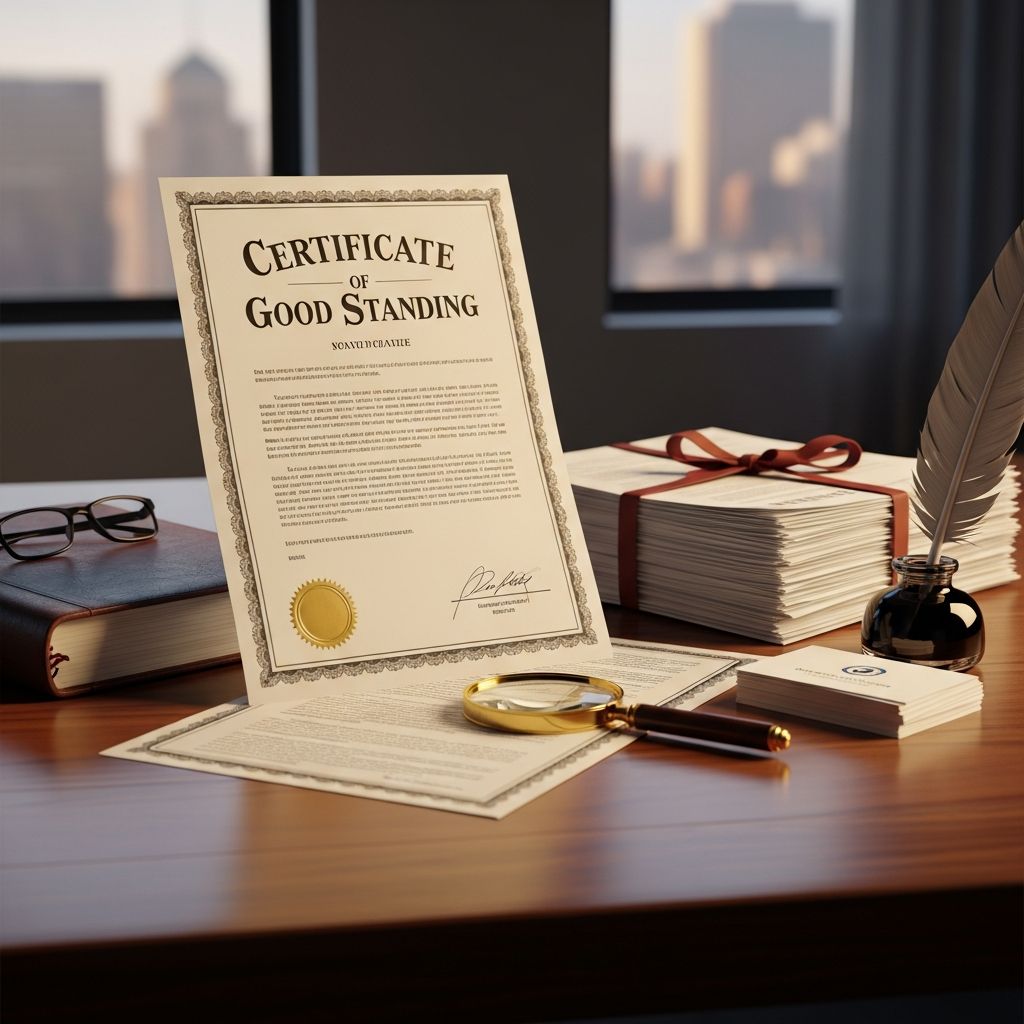
A
certificate of good standing
is an official document issued by a state authority verifying that a registered business entity, such as an LLC or corporation, is legally active and compliant with state regulations. It confirms the business has met filing requirements, paid necessary fees, and remains ingood standing
status.Defining Good Standing for Businesses
Maintaining good standing ensures a business retains its legal privileges, including the ability to operate, sue, or enter contracts. This status means the entity has fulfilled statutory obligations like annual reports and tax payments. For instance, in Colorado, good standing indicates compliance with the Secretary of State’s office requirements.
Businesses lose good standing if they fail to file reports, pay fees, or respond to state notices, leading to delinquency or dissolution. Regular checks prevent these issues, safeguarding operational rights.
Who Qualifies for This Certificate?
Only registered entities like LLCs, corporations, partnerships, and nonprofits can obtain a certificate. Sole proprietorships, which do not register with the state, are ineligible. Foreign entities—businesses formed elsewhere but operating in a new state—may need a home-state certificate for qualification.
- LLCs: Proves formation date, compliance, and active status.
- Corporations: Confirms incorporation details and regulatory adherence.
- Nonprofits: Verifies current annual filings.
- Foreign Entities: Shows compliance in the operating state.
Key Elements Included in the Document
Standard certificates list essential details for verification. These typically encompass:
| Element | Description |
|---|---|
| Business Name | Official registered name of the entity. |
| Entity Type | LLC, corporation, etc. |
| Formation Date | Date of initial registration. |
| State of Authorization | Issuing state. |
| Compliance Statement | Affirms all requirements met. |
| Official Seal/Signature | Secretary of State’s authentication. |
Variations exist by state; some offer ‘long form’ versions with additional history, though not all do anymore.
Critical Reasons Businesses Require It
This certificate acts as proof of legitimacy in various scenarios, protecting stakeholders and enabling growth.
Opening Business Bank Accounts
Banks demand it to separate personal and business finances, ensuring liability protection. It verifies the entity is active and compliant, preventing accounts for dissolved businesses.
Securing Loans and Credit
Lenders use it to assess risk, confirming legal capacity for contracts and ongoing operations. It’s standard in underwriting for business loans or credit lines.
Expanding to New States
For foreign qualification, states like Colorado require a home-state certificate to register as an out-of-state entity.
Business Transactions and Licensing
Investors, vendors, and licensors request it for mergers, acquisitions, or permits. Loss of standing blocks lawsuits or contracts.
Step-by-Step Process to Obtain One
Acquiring a certificate is straightforward for compliant entities. Follow these steps:
- Verify Registration: Ensure your business is formed as an LLC, corporation, etc., via articles of organization or incorporation.
- Confirm Compliance: Check status on the state’s business portal. Update annual reports, taxes, and fees.
- Access State Portal: Visit the Secretary of State’s website (e.g., Colorado SOS).
- Search Entity: Enter business name or ID to view summary.
- Request Certificate: Select ‘Get Certificate of Good Standing’; download PDF instantly if eligible.
- Pay Fees if Needed: Some states charge (e.g., Colorado ~$115 for expedited).
For labor-related standing, like in Colorado’s MyUI Employer+, request via account dashboard.
Handling Multi-State Operations
If operating across states, secure a certificate from your formation state first, then qualify as foreign in others.
Consequences of Losing Good Standing
Falling out of compliance triggers penalties:
- Inability to obtain certificates or expand.
- Fines and back fees accrual.
- Loss of lawsuit rights or contract enforceability.
- Administrative dissolution, requiring reinstatement.
Reinstatement involves filing overdue reports and paying penalties. Proactive annual reviews mitigate risks.
State-Specific Insights: Focus on Colorado
Colorado’s Secretary of State issues certificates confirming compliance with filings and taxes. Process via business search tool yields instant PDFs for good-standing entities. Foreign entities get tailored versions. Beware third-party solicitors charging unnecessary fees; use official sites.
Alternatives for Unqualified Businesses
Sole proprietors use EIN letters, DBAs, or tax IDs for verification. Unregistered entities must formalize first.
Best Practices for Ongoing Compliance
- Schedule annual report reminders.
- Monitor state portals quarterly.
- Use registered agents for notices.
- Budget for fees and renewals.
Frequently Asked Questions
What exactly proves a business is in good standing?
A certificate stating compliance with state filings, fees, and reports, issued by the Secretary of State.
Can sole proprietorships get this certificate?
No, as they aren’t state-registered entities.
How much does it cost in most states?
Often free online; fees vary, e.g., $115+ in Colorado for some services.
What if my status isn’t good standing?
Resolve delinquencies via filings and payments; no certificate until compliant.
Is it needed for every bank account?
Most business banks require it for verification.
How long is a certificate valid?
Typically current as of issuance; some expire in 30-90 days.
This guide equips business owners to navigate compliance confidently, ensuring smooth operations and growth opportunities.
References
- What is a certificate of good standing & how do I get one? — Brex. 2023. https://www.brex.com/journal/certificate-of-good-standing
- Colorado Certificate of Good Standing — Wolters Kluwer. 2024. https://www.wolterskluwer.com/en/solutions/ct-corporation/colorado-certificate-of-good-standing
- Good Standing Certificate — Colorado Department of Labor and Employment. 2025. https://cdle.colorado.gov/employers/myui-employer/resources/user-guide/good-standing-certificate
- Understanding Certificates of Good Standing and Registration — Colorado Fiscal Institute or similar. 2025-02. https://cfgv.org/wp-content/uploads/2025/02/Understanding-Certificates-of-Good-Standing-and-Registration.pdf
- Certificate of Good Standing – Business FAQs — Colorado Secretary of State. 2024. https://www.sos.state.co.us/pubs/business/FAQs/certGoodStanding.html
Similar Articles








Read full bio of Sneha Tete


