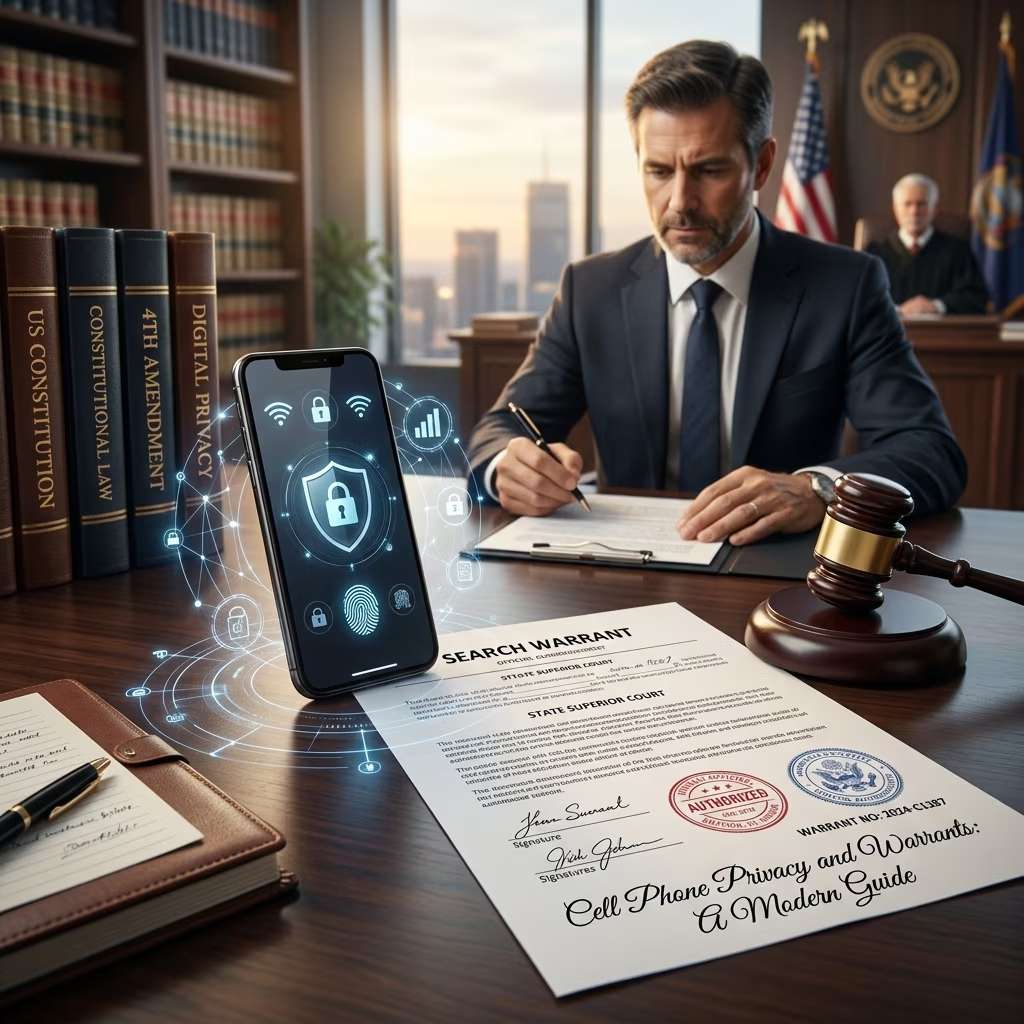
Your cellphone is more than a communication device. It is a detailed archive of your life — where you go, who you talk to, what you search, and what you photograph. Because of this, modern law treats cellphone searches very differently from traditional physical searches, especially under the Fourth Amendment to the U.S. Constitution, which protects against unreasonable searches and seizures.
This guide explains when police and other authorities need a warrant to access your phone, how courts have reshaped privacy rules for digital data, and what practical steps you can take to safeguard your information.
Core Legal Foundations of Cellphone Privacy
Cellphone privacy in the United States is built on several overlapping legal pillars:
- Fourth Amendment protections against unreasonable searches and seizures by the government.
- Supreme Court decisions adapting constitutional rules to modern technology, especially phones and location data.
- Statutory privacy laws that regulate access to communications and data, such as the Electronic Communications Privacy Act (ECPA).
- State-level privacy statutes that may give residents stronger control over their personal information.
Together, these frameworks determine when a warrant is required, what data can be obtained without a warrant, and how courts view the privacy expectations of cellphone users.
The Fourth Amendment and Digital Expectations of Privacy
The Fourth Amendment states that people have the right to be secure in their persons, houses, papers, and effects, against unreasonable searches and seizures. Traditionally, this has meant that police usually need a warrant supported by probable cause before entering a home or searching personal items.
Modern cases have asked how this protection applies to cellphones, which contain far more sensitive information than a wallet or notebook. Courts have increasingly recognized that:
- Cellphones can reveal intimate details of a person’s health, relationships, finances, and political beliefs.
- Location tracking through a phone can reconstruct a detailed map of where a person has been over days, months, or even years.
- Digital records are often stored not only on the device itself, but also on servers operated by phone carriers and technology companies.
Because of this, the U.S. Supreme Court has issued several decisions that limit warrantless access to cellphone content and location data, reshaping older rules about what counts as a protected “search.”
Understanding Search, Seizure, and the Third-Party Doctrine
Before focusing on cellphones, it helps to clarify three key concepts in search-and-seizure law:
| Concept | Meaning | Relevance to Phones |
|---|---|---|
| Search | Government intrusion into an area where you have a reasonable expectation of privacy. | Looking through your texts, photos, or app data is usually a search. |
| Seizure | Government interference with your possessory interest in property. | Taking and holding your phone as evidence is a seizure. |
| Third-party doctrine | Rule that you have reduced privacy expectations in information you voluntarily share with others, such as businesses. | Historically allowed access to phone company records without a warrant, but has been limited for location data. |
Under the classic third-party doctrine, information shared with a company — like dialed numbers or basic account records — was not protected by the Fourth Amendment, and police could obtain much of it without a warrant. However, recent cases have carved out important exceptions, especially for long-term cellphone location tracking.
Key Supreme Court Cases Shaping Cellphone Privacy
Several Supreme Court decisions are central to understanding when warrants are required for cellphone-related searches.
Riley v. California: Searching a Phone After Arrest
In Riley v. California (2014), the Court addressed whether police can search the contents of a cellphone taken from someone during an arrest without a warrant. The Court unanimously held that officers must obtain a warrant before examining digital information stored on the phone.
- Police may seize the phone to prevent destruction of evidence and ensure safety.
- However, they generally cannot browse photos, messages, or apps without a warrant supported by probable cause.
- The decision recognized that phones contain “vast quantities of personal information,” justifying stronger protections than traditional items like a cigarette pack or wallet.
In practice, this means that being arrested does not, by itself, give officers a legal right to inspect your phone’s contents.
Carpenter v. United States: Location Tracking and Cell Site Records
Carpenter v. United States (2018) involved cell site location information (CSLI) — records showing which cell towers a phone connected to at particular times. Police obtained months of CSLI from a phone carrier without a warrant to place the defendant near crime scenes.
The Court ruled that:
- Users have a legitimate expectation of privacy in long-term CSLI, even though the data is held by phone companies.
- Accessing extended location history constitutes a search under the Fourth Amendment and usually requires a warrant.
- The traditional third-party doctrine does not automatically apply to detailed, long-term location tracking.
This decision strongly protects location data, acknowledging that tracking a phone over time reveals extremely sensitive details about a person’s movements and associations.
When Police Need a Warrant for Your Phone
Based on these rulings and related laws, police generally need a warrant in the following situations:
- Searching phone contents after arrest — Messages, photos, app data, and other stored information are protected under Riley, and require a warrant in most circumstances.
- Obtaining long-term location records from a phone carrier or other provider — Carpenter requires a warrant for extended CSLI.
- Intercepting the content of calls, texts, and emails — The ECPA generally requires a warrant or equivalent judicial authorization to access communication content.
In each of these cases, the warrant must be supported by probable cause and issued by a neutral judge. The warrant should describe the device or records to be searched and, in many cases, the types of data sought.
When Police May Access Phone-Related Data Without a Warrant
Despite strong protections, some categories of data may still be accessible with reduced legal requirements or no warrant at all.
- Basic subscriber information — Account identifiers and simple records may be obtainable with a court order or subpoena rather than a full warrant, depending on the situation.
- Limited metadata about calls or texts — Non-content information such as timestamps or phone numbers sometimes can be accessed under lower standards than probable cause.
- Information you disclose voluntarily to police — If you hand over your phone or give a password after being fully informed, you may consent to a search that does not require a warrant.
- Exigent circumstances — In rare, urgent scenarios involving imminent danger or risk of evidence destruction, officers may act without a warrant but must later justify the emergency.
These exceptions are narrow and often contested. Courts examine whether consent was truly voluntary, whether an emergency was genuine, and whether the scope of any warrantless access stayed within legal limits.
Cloud Backups, Apps, and Corporate Data Requests
Modern cellphone use relies heavily on cloud services and third-party applications. Law enforcement may seek data not only from the device in your hand but also from providers that store backups and application data.
For example:
- Cloud backups of photos, messages, and app data may be stored by technology companies and accessed through warrants or subpoenas.
- Communication services such as email and messaging platforms are regulated by the ECPA, which differentiates between content and non-content records.
- Data brokers and app developers may hold behavioral and location data subject to state privacy laws that grant users access and opt-out rights.
Some states, including California and others with comprehensive privacy laws, allow individuals to request copies of personal data, demand deletion in certain circumstances, and restrict how companies use sensitive information for advertising or profiling. While these laws primarily regulate businesses, they indirectly affect how much data exists for law enforcement to seek.
Location Tracking: Why It Is Especially Sensitive
Location tracking through cellphones has become a focal point of privacy debates. Civil liberties advocates have emphasized that knowing where a phone is located can reveal:
- Visits to medical clinics, therapists, or religious institutions.
- Attendance at protests, political meetings, or union gatherings.
- Patterns of behavior that expose intimate details about relationships and daily routines.
Because of these risks, the Carpenter decision and subsequent discussions have pushed courts and legislators to treat location data as highly sensitive, often requiring robust legal safeguards, including warrants and careful limits on data retention.
Practical Tips for Protecting Your Cellphone Privacy
While legal rules set the boundaries for government access, individuals can take steps to better safeguard their phones:
- Use strong authentication — Enable strong passwords or passcodes and avoid easily guessed patterns. Consider using device-level encryption.
- Review app permissions — Limit location, microphone, camera, and contacts access to apps that genuinely need it.
- Manage cloud backups — Understand what is backed up and consider whether sensitive items should remain only on the device.
- Be cautious with consent — You can decline voluntary searches; if unsure, ask whether officers have a warrant and seek legal advice.
- Know state privacy rights — Some states give you rights to access, delete, and control how businesses use your data, which can indirectly reduce exposure.
These measures do not replace legal protections but complement them by reducing the amount and accessibility of sensitive information.
Frequently Asked Questions About Cellphone Warrants
Do police always need a warrant to search my cellphone?
In most cases, yes. After the Riley decision, police generally must obtain a warrant before searching digital content on a phone they have seized, even during or after an arrest. Exceptions may apply if you voluntarily consent or if there is a genuine emergency, but these exceptions are narrowly interpreted.
Can officers force me to give them my password?
Rules differ across jurisdictions, and courts are still developing standards for compelled decryption. In many cases, officers cannot simply demand your password without additional legal process. Refusing to provide a password may lead to further legal complexity, so consulting a lawyer is critical if this issue arises.
Is my location history with my phone company protected?
Extended historical location records held by phone carriers are strongly protected. Under Carpenter, police generally need a warrant to access long-term CSLI because it reveals detailed information about where you have been over time. Shorter or more limited records may raise different questions, but broad, long-term tracking is treated as a search.
What about messages stored in the cloud or on apps?
Messages and communication content are regulated by statutes such as the ECPA, which typically require a warrant or equivalent court authorization before law enforcement can access the content. Non-content records, such as basic metadata, may be subject to different standards, but state privacy laws increasingly restrict how companies store and share such data.
Does using a smartphone mean I give up my privacy rights?
No. While using a phone inevitably involves sharing some data with service providers, courts have rejected the idea that merely using modern technology eliminates constitutional privacy protections. Key decisions recognize that people maintain a reasonable expectation of privacy in many forms of digital data, especially detailed location history and the contents of their phones.
References
- Cellphone Privacy and Warrant Requirements — FindLaw. 2023-10-01. https://www.findlaw.com/criminal/criminal-rights/cell-phone-privacy-and-warrant-requirements.html
- Supreme Court Protects Cell Phone Users’ Constitutional Privacy Rights — Brennan Center for Justice. 2018-06-22. https://www.brennancenter.org/our-work/analysis-opinion/supreme-court-protects-cell-phone-users-constitutional-privacy-rights
- Cell Phone Privacy Laws: Key Regulations to Know — Cape Privacy. 2023-05-10. https://www.cape.co/blog/cell-phone-privacy-laws-key-regulations-to-know
- Cell Phone Privacy — American Civil Liberties Union (ACLU). 2022-11-15. https://www.aclu.org/issues/privacy-technology/location-tracking/location-tracking-cell-phone-privacy
- Data Protection Laws in the United States — DLA Piper Data Protection Handbook. 2025-01-20. https://www.dlapiperdataprotection.com/countries/united-states/law.html