
Can Landlords Limit Signs and Displays on Rental Property?
Understand when landlords may restrict political signs, flags, and other displays on rental property without violating tenants’ legal rights.
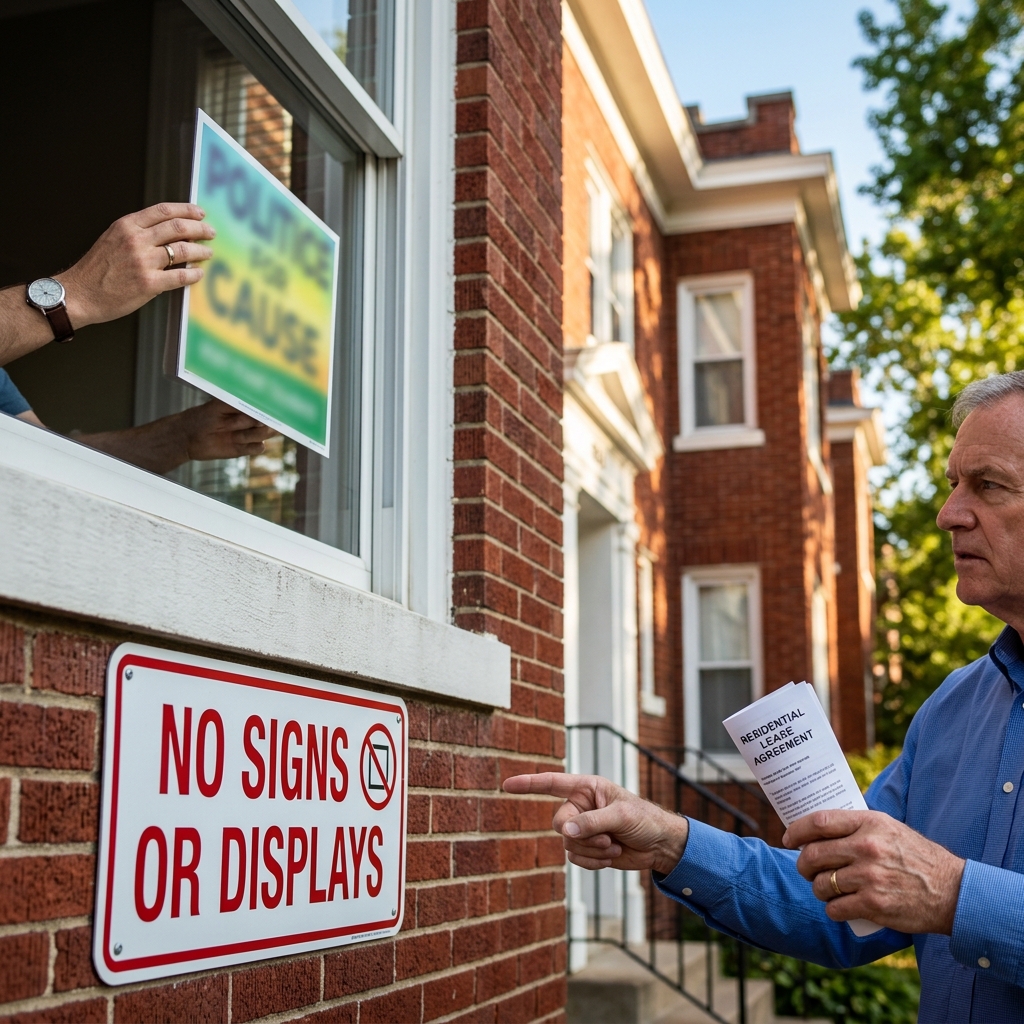
Disputes about flags, political signs, holiday decorations, and other displays on rental property have become more common as tenants look for ways to express their beliefs while landlords try to protect property value, safety, and community standards. Understanding how the law treats these situations is critical for both sides of a lease.
This guide explains when a landlord may legally restrict displays on or around a rental home, which rights tenants retain, and how federal, state, and local rules interact. It does not provide legal advice, but it will help you recognize common legal boundaries and potential issues.
Why Displays on Rental Property Raise Legal Questions
Landlord-tenant relationships are based on a simple idea: the landlord owns the property, but the tenant has the right to possess and use it during the lease term. Once a tenant moves in, they gain important rights to privacy and quiet enjoyment, while the landlord retains limited rights of access and control.
Displays such as flags, banners, yard signs, and window posters sit at the intersection of several legal concepts:
- Property rights – The owner’s interest in controlling what happens on and to their property.
- Contract law – Lease terms that address decorations, alterations, and conduct.
- Free expression – Tenants’ desire to express political, religious, or social views, subject to legal limits.
- Safety and maintenance – Rules intended to prevent damage, clutter, or hazards.
- Anti-discrimination law – Federal and state fair housing rules that restrict certain kinds of landlord decisions.
Because these interests can conflict, many disputes come down to whether a particular restriction is reasonable, lawful, and clearly communicated in the lease.
Landlord Property Rights vs. Tenant Possession Rights
When a lease begins, the landlord transfers possession of the unit to the tenant. The tenant then has the right to live in the home free from unreasonable interference by the landlord. At the same time, the landlord keeps ownership and certain rights of access.
| Landlord Rights | Tenant Rights |
|---|---|
| Owns the building and land; may enforce reasonable rules through the lease. | Holds exclusive possession of the unit; can use and enjoy it as a home. |
| Can enter for inspections, repairs, and showings with advance notice, except in emergencies. | Has a right to privacy and protection from frequent, unannounced entries. |
| May regulate exterior appearance and structural changes. | Can decorate and display items within the unit, subject to safety and lease limits. |
| May terminate tenancy through lawful eviction procedures if the tenant violates the lease or law. | Is protected against unlawful lockouts, utility shutoffs, and discriminatory treatment. |
Restrictions on displays must be evaluated against this backdrop: does the rule fit within the landlord’s legitimate interest in the property, or does it improperly interfere with the tenant’s lawful use and rights?
Common Types of Displays and How They’re Regulated
Not all displays are treated the same way under the law. What a landlord can restrict often depends on the type of display and where it is placed.
1. Flags (Including the U.S. Flag)
Flags are a frequent source of disagreement. Some states have adopted specific protections for tenants who wish to display the United States flag in a respectful manner. For example, Florida law explicitly states that a landlord may not prohibit a tenant from displaying one portable, removable U.S. flag of a certain size in or on the dwelling unit, and that a tenant must follow guidelines for respectful display.
In places without such statutes, the landlord may have more flexibility in regulating flags through the lease, especially for:
- Flags attached to building surfaces in ways that could cause damage.
- Large flags that block windows, entrances, or fire escapes.
- Illuminated or noisy flag displays that disturb other residents.
However, even where landlords can regulate flags, they must avoid using flag rules as a way to discriminate against tenants protected under fair housing laws.
2. Political Signs and Campaign Materials
Political signs in windows, balconies, or yards are a classic example of tension between free expression and property control. Unlike public sidewalks or government property, private rental property is generally not a forum where free speech rights override private ownership. That means a landlord often can prohibit or limit political signs, particularly on shared or exterior areas.
Still, there are practical and legal limits. Rules on political signs should:
- Be written clearly in the lease or house rules.
- Apply evenly to all tenants, regardless of political viewpoint.
- Focus on location, size, and safety rather than content.
Some local governments and homeowners’ associations have adopted protections for political yard signs during election seasons, but these vary widely, and tenants remain bound by both their lease and any applicable association rules.
3. Religious Symbols and Cultural Displays
Religious and cultural items—such as menorahs, crosses, or holiday decorations—raise special concerns because of federal and state fair housing laws. Under the federal Fair Housing Act, landlords may not discriminate in housing based on religion, race, national origin, sex (including gender identity and sexual orientation), familial status, or disability.
A neutral policy that limits all exterior displays may be allowed, but a rule that targets specifically religious symbols, or is enforced only against certain groups, can be evidence of illegal discrimination. Landlords therefore need to be cautious when drafting and applying rules that affect religious expression.
4. Holiday Decorations and Seasonal Displays
Landlords often regulate holiday decorations to prevent fire hazards, damage, and excessive clutter. Typical restrictions might cover:
- Prohibiting candles or open flames in hallways or common areas.
- Limiting extension cords or overloaded outlets that pose electrical risks.
- Require removal of decorations by a specific date after a holiday.
These rules are generally permissible as long as they are:
- Reasonable and tied to legitimate safety or maintenance concerns.
- Applied consistently to all tenants.
- Communicated in advance, ideally in writing.
5. Commercial Signs and Business Advertising
Most residential leases restrict tenants from operating a business open to the public or placing commercial signage on the property. Landlords can often prohibit storefront-style signs, banners advertising services, and window lettering that changes the character of the building.
In mixed-use or commercial settings, signage is frequently governed by more detailed rules in the lease and local zoning or sign ordinances. Tenants should review those rules before placing any sign that promotes a business.
How Lease Agreements Shape Display Rules
The lease is usually the primary place where display restrictions appear. Many leases include general clauses about decorations, alterations, and conduct, and some address signs expressly. A typical lease might say that tenants must obtain written permission before placing signs visible from the exterior or that certain types of signs are prohibited.
Key points to consider include:
- Scope of the clause – Does it cover interior windows, balconies, yards, or only shared common areas?
- Type of display – Does the lease distinguish between temporary signs, permanent fixtures, and minor decorations?
- Enforcement mechanisms – What happens if a tenant ignores the rule: fees, warnings, or potential lease termination?
- Consistency with law – Does the clause conflict with any state protections, such as statutory rights to display the U.S. flag?
Because leases are contracts, courts often enforce clear display restrictions unless they violate a statute or public policy. Tenants should read these clauses carefully before signing and ask questions if anything is unclear.
Privacy, Access, and Control: Where Can Landlords Regulate?
Display rules are also affected by where the item is located. The law generally views three broad zones:
- Inside the unit (not visible from outside)
- Exterior of the unit (windows, balconies, doors)
- Common areas (hallways, lobbies, grounds, shared amenities)
Inside the Rental Unit
Within the unit, tenants have strong privacy and possession rights. Landlords are not entitled to enter at will or inspect decor unless there is a lawful reason and proper notice. As a result, displays that remain inside and do not create a safety hazard or violate criminal law are rarely restricted.
Landlords do retain rights to:
- Prevent alterations that damage walls, fixtures, or flooring.
- Require that tenants remove items and repair damage when moving out.
- Inspect the unit periodically with proper advance notice to check condition and compliance.
Exterior Windows, Doors, and Balconies
Displays visible from outside—such as window posters, balcony banners, or door hangings—directly affect the building’s appearance. Landlords often regulate these areas through lease terms or building policies, particularly in multi-unit properties.
Typical restrictions may include:
- Size limits on window signs.
- Prohibitions on attaching items to railings or siding.
- Rules about what can be hung from doors or doorframes.
Whether a particular rule is enforceable depends on the jurisdiction and whether it conflicts with any statutory rights (such as protected flag displays) or anti-discrimination laws.
Common Areas and Grounds
Tenants generally do not have exclusive rights to common areas like hallways, lobbies, stairwells, and shared yards. Landlords have broad authority to manage these spaces and can typically prohibit:
- Personal signs posted on walls, doors, or bulletin boards.
- Unapproved displays in shared courtyards or entryways.
- Decorations that interfere with access or emergency exits.
In some buildings, landlords may designate specific spaces for community notices or seasonal decorations. Tenants should follow posted rules for using these areas.
Fair Housing and Anti-Discrimination Limits
Regardless of the type of display, landlords must obey fair housing laws. The federal Fair Housing Act prohibits discrimination in rental housing based on race, color, national origin, religion, sex (including gender identity and sexual orientation), familial status, or disability. Many states add additional protected categories.
In the context of displays, this means landlords generally cannot:
- Allow some tenants to display religious symbols while prohibiting others because of their faith.
- Target political or cultural signs associated with a protected class while allowing similar signs for other groups.
- Use display rules as a pretext to pressure or evict tenants belonging to protected classes.
Even a neutral policy can raise concerns if it is enforced inconsistently. Tenants who believe display rules are being used to discriminate may have grounds to file complaints with housing agencies or seek legal advice.[10]
Landlord Access, Harassment, and Display Enforcement
How a landlord enforces display rules matters as much as the rules themselves. Landlords have a legal right of entry for limited purposes—such as inspections, repairs, or showing the property to prospective tenants or buyers—but they must give reasonable notice and avoid abusing this right.
Good practice and, often, legal requirements include:
- Providing advance written notice before entering the unit for inspections or showings, commonly at least 24 hours.
- Scheduling entry at reasonable times, generally during daytime hours.
- Avoiding frequent or unnecessary visits that reasonably appear to harass the tenant.
If a landlord repeatedly enters a tenant’s home under the pretext of checking decorations or displays, especially without proper notice, this may violate the tenant’s privacy and quiet enjoyment rights and could lead to claims for trespass or harassment.
Best Practices for Landlords
Landlords who want to manage displays effectively while staying within legal boundaries should consider the following practices:
- Draft clear, neutral policies – Focus on size, locations, safety, and building aesthetics rather than message or viewpoint.
- Check state and local law – Some states, such as Florida, have specific rules about flags or tenant rights that may limit restrictions.
- Apply rules consistently – Enforce policies uniformly to avoid claims of discriminatory treatment.
- Communicate expectations – Provide written rules when tenants sign the lease and remind them before major holidays or election seasons.
- Use proper notice for enforcement – Respect legal requirements for entry when inspecting or addressing display-related issues.
Practical Tips for Tenants
Tenants who want to display flags, signs, or decorations without creating conflicts should:
- Review the lease carefully – Look for clauses on signs, decorations, alterations, and use of common areas.
- Ask for written permission – When in doubt, request approval for a display, especially if it’s large or placed outside the unit.
- Consider safety and neighbors – Avoid blocking exits, creating fire hazards, or disturbing other residents.
- Know your rights – Familiarize yourself with local law on flags, privacy, and fair housing protections.
- Document communications – Keep copies of emails or letters about display permissions or disputes.
If a dispute arises, tenants should try to resolve it through calm discussion. If that fails, consulting a local legal aid organization, bar association, or housing authority can help clarify options.[10]
Frequently Asked Questions
Can my landlord ban all political signs from my apartment windows?
In many jurisdictions, a landlord can restrict political signs in visible areas if the lease clearly prohibits them and the rule is applied equally to all tenants regardless of their views. However, the landlord must ensure that the rule does not target or disproportionately affect tenants based on protected characteristics such as race, religion, or national origin, which would raise fair housing concerns.
Do I have a legal right to display the U.S. flag at my rental home?
Some states specifically protect the right of tenants to display the United States flag under certain conditions. Florida law, for example, forbids landlords from prohibiting one portable, removable U.S. flag of a specified size displayed respectfully in or on the dwelling. In other states, you may need to look to your lease and local law to determine whether flag restrictions are permitted.
Can my landlord remove a sign or decoration without my permission?
Landlords generally may not enter a tenant’s unit to remove items without proper notice, a valid reason, or, in serious disputes, a court order. They do have greater control over common areas and may remove unauthorized signs posted there. If a landlord believes a display violates the lease, the typical approach is to request removal and, if necessary, pursue formal remedies rather than unilateral action inside the tenant’s home.
Is it harassment if my landlord keeps visiting to check my decorations?
Landlords have a limited right of entry, but they must give reasonable notice and may not abuse this right or use it to harass tenants. Frequent, unannounced visits focused on monitoring decor could be considered an invasion of privacy or a breach of the tenant’s right to quiet enjoyment. Tenants facing such conduct may want to document incidents and seek legal advice or assistance from local housing authorities.
What can I do if I think display rules are being enforced in a discriminatory way?
If you believe your landlord is applying display restrictions unfairly based on your religion, race, or another protected characteristic, you may have rights under the Fair Housing Act and similar state laws.[10] Options include filing a complaint with a fair housing agency, contacting a legal aid organization or local bar association, or consulting a private attorney knowledgeable about housing discrimination.
References
- 2023 Florida Statutes, Chapter 83 — Florida Senate. 2023-01-01. https://www.flsenate.gov/Laws/Statutes/2023/Chapter83/All
- Rights and Duties of Tenants and Landlords — The Florida Bar. 2025-05-01. https://www.floridabar.org/public/consumer/tip014/
- Section 83.53, Florida Statutes (2025) — Florida Legislature / Online Sunshine. 2025-01-01. https://www.leg.state.fl.us/statutes/index.cfm?App_mode=Display_Statute&URL=0000-0099/0083/Sections/0083.53.html
- Landlord/Tenant Law in Florida — Florida Department of Agriculture and Consumer Services. 2024-06-01. https://www.fdacs.gov/Consumer-resources/landlord-tenant-law-in-florida
- Tenants’ Legal Rights to Privacy — Justia. 2023-03-01. https://www.justia.com/real-estate/landlord-tenant/information-for-tenants/tenants-right-to-privacy/
- Right of Possession and Right of Entry — Maryland People’s Law Library. 2022-09-01. https://www.peoples-law.org/right-possession-and-right-entry
- Law Facts: Tenant & Landlord Rights and Obligations — Ohio State Bar Association. 2021-01-01. https://www.ohiobar.org/public-resources/commonly-asked-law-questions-results/law-facts/law-facts-tenant–landlord-rights-and-obligations/
Similar Articles








Read full bio of Sneha Tete


