
California Exempt vs. Nonexempt Employees Explained
Understand how California law classifies exempt and nonexempt employees, and what those classifications mean for wages, overtime, and workplace rights.
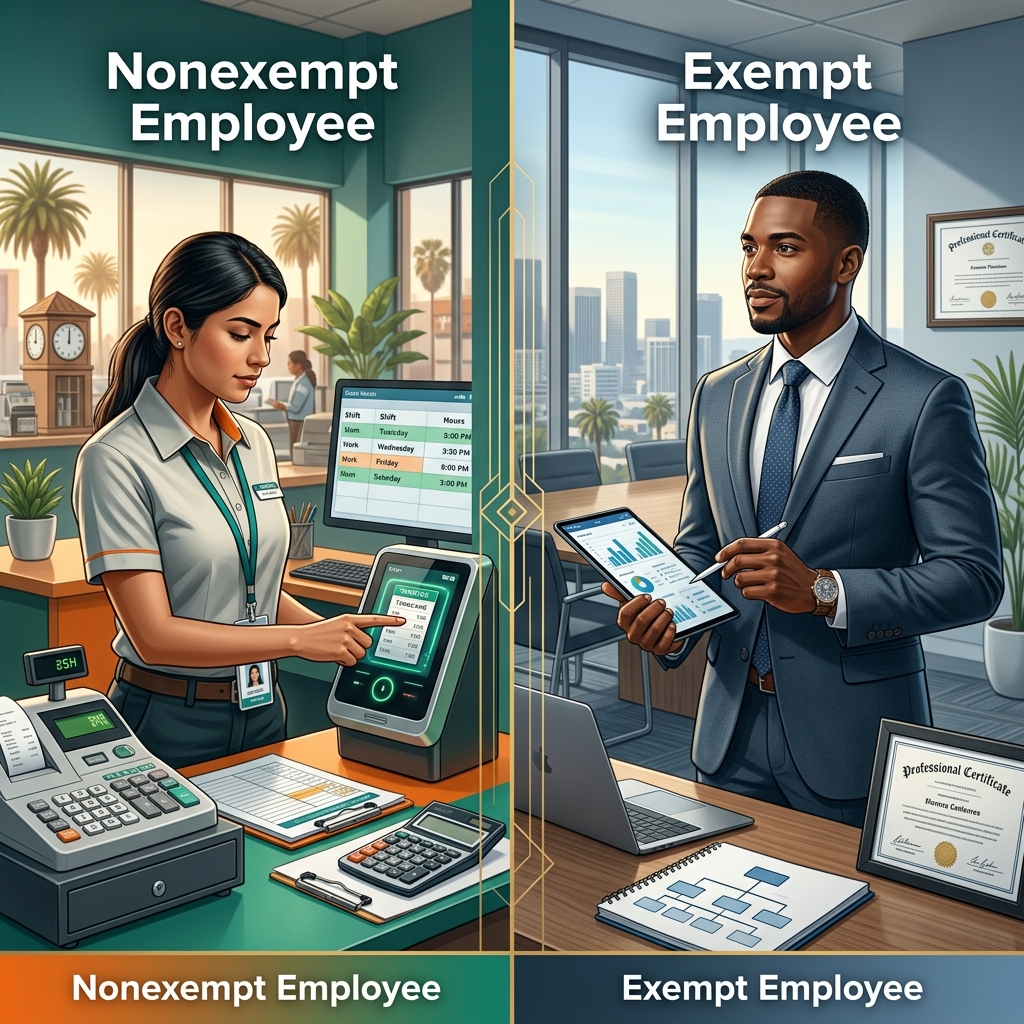
Correctly classifying workers as exempt or nonexempt is one of the most important compliance decisions employers make under California labor law. Misclassification can trigger unpaid overtime claims, penalties, and costly litigation. At the same time, employees need to understand their status to know whether they are entitled to overtime pay, meal and rest breaks, and other protections.
This guide offers a detailed, plain‑language overview of how California distinguishes exempt from nonexempt employees, how those rules relate to federal law, and what practical steps both employers and workers can take to stay compliant and protect their rights.
What Exempt and Nonexempt Mean Under California Law
In California, the terms exempt and nonexempt refer to whether an employee is covered by the state’s wage and hour rules, particularly those dealing with overtime, minimum wage, and meal and rest periods.
- Exempt employees are generally not entitled to overtime pay, and many of the detailed wage and hour rules do not apply to them.
- Nonexempt employees are protected by those rules. They must receive at least the minimum wage for all hours worked, overtime premiums, and statutorily required meal and rest breaks.
It is important to recognize that an employee’s title or the fact that they are paid a salary does not by itself make them exempt. California law uses specific tests based on both pay and job duties to decide which classification applies.
Federal FLSA Rules vs. California Standards
Employee classification is governed at two levels: federal law through the Fair Labor Standards Act (FLSA), and state law through California’s wage orders and Labor Code. Employers operating in California must comply with both sets of rules, and when they differ, the more protective standard for the employee usually prevails.
| Feature | Federal FLSA | California Law |
|---|---|---|
| Minimum wage baseline | Federal minimum wage (currently $7.25/hour). | Statewide minimum wage (higher than federal) used to calculate exempt salary thresholds. |
| Overtime rule | Time‑and‑a‑half for hours over 40 in a workweek. | Time‑and‑a‑half for hours over 8 in a day or 40 in a week, plus additional daily and seventh‑day overtime rules. |
| Exempt salary floor | Must earn at least a set weekly amount (e.g., $684 per week as of 2025). | Most exemptions require at least two times the state minimum wage for full‑time work, calculated as a monthly salary. |
| Core exemptions | Executive, administrative, professional, outside sales, certain computer employees. | Similar categories, but with stricter duties tests and pay thresholds in many cases. |
When a California employee’s classification is in question, employers must evaluate both the FLSA standards and California’s rules, and default to whichever set provides greater protection to the worker.
Core Tests for Exempt Status in California
For the most common exemptions (executive, administrative, and professional), California typically applies three major tests:
- Salary basis test – The employee must be paid a fixed, predetermined salary that does not vary based on the number of hours worked or the quality or quantity of output.
- Salary level test – The salary must be at least twice the state minimum wage for full‑time employment (40 hours per week).
- Duties test – The employee must primarily perform exempt job duties, with more than 50% of working time spent on executive, administrative, or professional tasks as defined by California wage orders.
Failing any one of these tests generally means the employee should be treated as nonexempt, even if their job title suggests a managerial or professional role.
Salary Basis: How Pay Is Structured
The salary basis test looks at whether the employee receives a consistent salary regardless of hours worked. Under California practice, exempt employees must receive their full salary for any workweek in which they perform any work, subject to narrow exceptions.
- The salary is a set amount paid each pay period.
- The amount is not reduced because the employee worked fewer hours in the week.
- Deductions for partial‑day absences are generally not allowed for exempt employees, with limited exceptions under federal and state rules.
By contrast, hourly pay typically indicates nonexempt status, particularly where the employer closely tracks hours and adjusts pay based on time worked.
Salary Level: Minimum Pay Thresholds
California ties its exempt salary threshold to the state minimum wage. For most white‑collar exemptions, an employee must earn at least twice the state minimum wage, calculated for a 40‑hour workweek. The exact dollar amount changes when the minimum wage increases, so employers must monitor updates.
For example, where the statewide minimum wage is $16 per hour, the annual salary threshold for many exempt positions is set by multiplying:
- $16 (minimum wage)
- × 2 (to reach twice minimum wage)
- × 40 hours per week
- × 52 weeks per year
California also has special pay rules for certain groups such as licensed physicians, computer professionals, and some salespeople, whose exemptions may rely on hourly or commission‑based compensation instead of a monthly salary.
Duties Test: What the Employee Actually Does
The duties test is often the hardest part of classification because it focuses on day‑to‑day responsibilities rather than job titles. California requires that more than half of an exempt employee’s time be spent on duties considered exempt under the applicable wage order.
Common exempt duty categories include:
- Executive/managerial – Managing the enterprise or a recognized department; directing the work of at least two full‑time employees; having authority or significant input into hiring, firing, and promotions.
- Administrative – Performing office or non‑manual work directly related to management policies or general business operations; regularly exercising discretion and independent judgment on important matters.
- Professional – Work requiring advanced knowledge in a field of science or learning, generally acquired through specialized academic training, or work that is creative and original in character.
Routine clerical tasks, manual labor, and strictly supervised work typically do not qualify as exempt duties. If an employee spends most of their time on such tasks, they are likely nonexempt, even if they occasionally perform higher‑level functions.
Rights and Obligations of Nonexempt Employees
Nonexempt employees are entitled to the full suite of wage and hour protections under California law and, in many cases, under the FLSA.
Overtime Pay
Under federal law, nonexempt workers generally must receive at least time‑and‑a‑half their regular rate of pay for hours worked over 40 in one workweek. California maintains additional, more protective overtime rules for nonexempt employees, including daily overtime obligations.
Minimum Wage
Nonexempt employees must be paid at least the applicable California minimum wage for each hour worked. Because California’s minimum wage exceeds the federal rate, it usually controls for employees working in the state.
Meal and Rest Breaks
California’s wage orders provide detailed requirements for meal and rest periods for nonexempt employees, including timing, duration, and premium pay if the employer fails to provide required breaks. Exempt employees generally are not covered by these specific break provisions, though employers may offer breaks as a matter of policy.
Timekeeping and Pay Frequency
Employers must accurately track hours worked by nonexempt employees and pay them at least as frequently as required by California law. By contrast, exempt workers are often paid on a less frequent schedule (such as monthly) and may report leave time differently.
Common Exempt and Nonexempt Roles
While classification always depends on the specific facts, certain job types commonly fall into exempt or nonexempt categories.
- Likely exempt roles
- Senior managers who supervise multiple employees and make key personnel decisions.
- HR or finance professionals who shape policies and exercise independent judgment.
- Licensed professionals such as lawyers, engineers, and doctors.
- High‑level analysts and advisors with decision‑making authority.
- Likely nonexempt roles
- Hourly retail staff and customer service representatives.
- Assembly line workers and other manual laborers.
- Clerical staff with routine, closely supervised duties.
- Technicians whose work is primarily hands‑on and procedural.
These are general patterns, not rigid rules. Employers must always apply the salary and duties tests rather than relying solely on job titles.
Risks of Misclassification in California
Incorrectly treating a nonexempt employee as exempt can create significant legal and financial exposure. Common consequences include:
- Back pay for unpaid overtime – Employees may claim overtime premiums for past periods, sometimes extending several years.
- Penalties and interest – California law provides statutory penalties for unpaid wages and late payment, as well as potential waiting time penalties when employees separate from employment.
- Class or representative actions – Misclassification practices affecting groups of workers can lead to class actions or Private Attorneys General Act (PAGA) claims.
- Compliance audits and reputational harm – Government investigations or public litigation can impact business operations and reputation.
Because of these risks, both employers and employees benefit from a clear, well‑documented classification approach anchored in California’s salary and duties requirements.
Practical Steps for Employers
Employers seeking to comply with California’s exempt/nonexempt rules can take several practical steps:
- Conduct regular classification audits – Review positions when minimum wage rates change, when roles are restructured, or at scheduled intervals.
- Document duties and expectations – Use accurate job descriptions and performance expectations that reflect actual responsibilities, especially for exempt roles.
- Train managers and HR personnel – Ensure those responsible for hiring, promotion, and scheduling understand the distinction between exempt and nonexempt classifications.
- Monitor hours for borderline roles – For positions near the salary threshold or with mixed duties, track how employees spend their time and adjust classification if necessary.
- Consult legal or HR experts – When in doubt, seek advice from professionals familiar with California wage and hour law.
Key Points for Employees
Employees can also take steps to understand and protect their rights under California’s classification rules:
- Ask how your status was determined – Request information on whether you are classified as exempt or nonexempt and the basis for that decision.
- Review your pay and job duties – Compare your salary, how you are paid, and your core responsibilities with the criteria described in this guide.
- Keep your own records – For nonexempt workers, maintaining personal records of hours worked and breaks taken can be helpful if disputes arise.
- Raise concerns early – If you believe you are misclassified, consider contacting HR, a union representative (if applicable), or an employment attorney.
Frequently Asked Questions
Does being paid a salary automatically make me exempt?
No. A salary is only one part of the classification analysis. California requires that exempt employees also meet salary level and job duties tests. If those tests are not satisfied, a salaried worker may still be nonexempt and entitled to overtime.
Can my employer call me a “manager” to avoid paying overtime?
Job titles alone do not decide classification. To qualify as an exempt executive under California law, you must truly manage the business or a department, direct at least two full‑time employees, and have meaningful authority over personnel decisions, among other requirements.
What if my duties changed after I was hired?
Classification should reflect your current job, not just the role initially described. If your responsibilities shift so that you no longer primarily perform exempt duties, your status may need to be reevaluated.
Are all professionals automatically exempt?
Not necessarily. Many learned professionals (such as licensed engineers or attorneys) are exempt, but the role must involve advanced knowledge and independent judgment. Certain technical or paraprofessional roles may still be nonexempt even within professional fields.
How often do exempt salary thresholds change?
Because California pegs many exempt salary thresholds to the state minimum wage, they increase when the minimum wage goes up. Employers should check official state publications and wage orders to stay current.
References
- Exemptions from the overtime laws — California Department of Industrial Relations, Division of Labor Standards Enforcement. 2024-01-01. https://www.dir.ca.gov/dlse/faq_overtimeexemptions.htm
- Exempt vs. Nonexempt Employees | California Labor Law — California Chamber of Commerce. 2023-08-15. https://www.calchamber.com/california-labor-law/exempt-nonexempt-employees
- California’s Rules About Exempt And Non-Exempt Employees — Symmetry Software. 2024-03-10. https://www.symmetry.com/payroll-tax-insights/california-rules-for-exempt-and-non-exempt-employees
- Understanding Employee Classification: Exempt or Non-Exempt? — AIA California. 2024-02-20. https://aiacalifornia.org/news/understanding-employee-classification-exempt-or-non-exempt/
- Exempt vs. non-exempt employees: What’s the difference? — Paylocity. 2025-01-05. https://www.paylocity.com/resources/learn/articles/exempt-vs-nonexempt/
Similar Articles








Read full bio of medha deb




