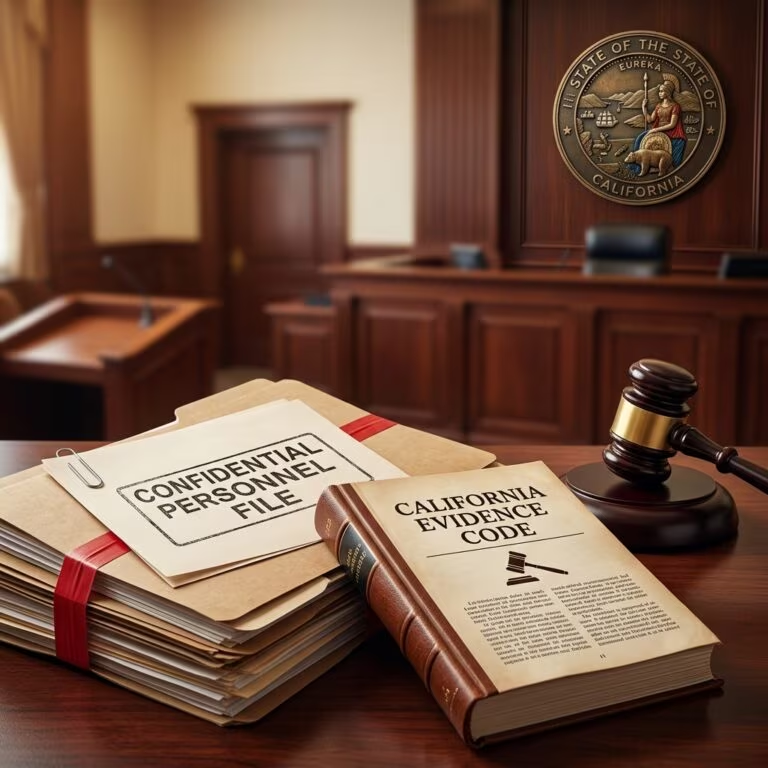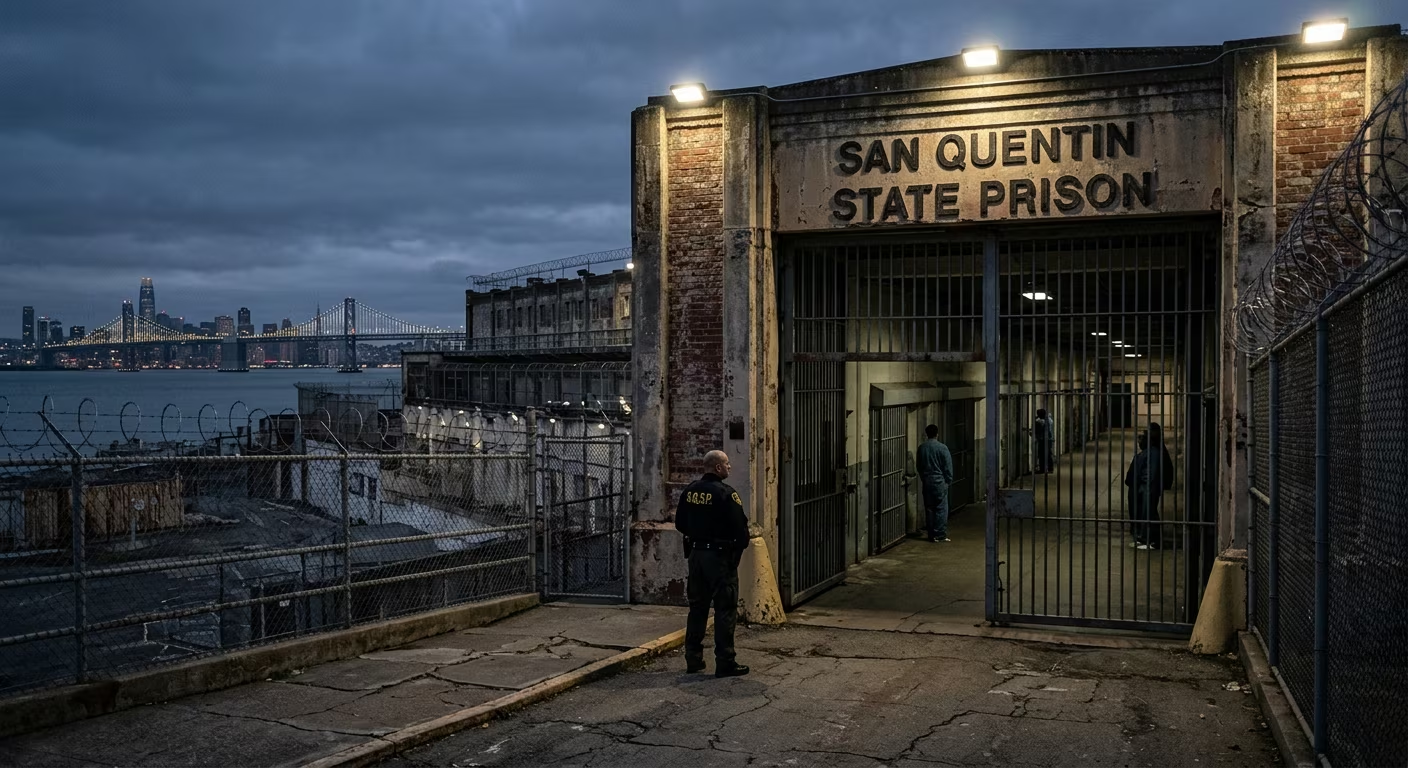
California stands as a paradox in the modern criminal justice landscape. Recognized globally for its progressive policies and substantial investments in rehabilitative justice, the state simultaneously maintains the largest death row population in the Western Hemisphere. Although the execution chamber at San Quentin State Prison has remained dark for nearly two decades, the bureaucratic and legal machinery surrounding capital punishment continues to churn, consuming vast amounts of public resources. This profound contradiction came into sharp focus in 2019 when Governor Gavin Newsom signed an executive order instituting a formal moratorium on the death penalty. While this executive action effectively halted all executions during his tenure, it did not dismantle the underlying legal framework. The death penalty remains on the books, legally viable, and remarkably expensive.
The persistence of capital punishment in California represents a multi-billion dollar anomaly. Taxpayers continue to fund a sprawling infrastructure designed for an outcome that never arrives. The legal battles, specialized incarceration protocols, and relentless appeals process create a financial sinkhole that drains municipal and state budgets. Far from delivering swift and certain justice, the current system traps the state, the accused, and the families of victims in a state of permanent judicial limbo. This comprehensive analysis explores the staggering financial costs, the deeply entrenched systemic failures, and the racial and geographic biases that characterize California’s modern death penalty apparatus.
The Staggering Financial Toll on Taxpayers
When evaluating the utility of capital punishment, the financial burden placed on taxpayers is arguably the most quantifiable metric of its failure. The popular misconception is that executing a prisoner is a cost-effective alternative to housing them for life. In reality, the legal pursuit of death creates an exponential increase in municipal and state expenditures. From the moment a prosecutor decides to seek the ultimate punishment, the financial meter begins running at an accelerated pace. Capital trials are fundamentally different from standard murder trials; they are bifurcated proceedings that require a highly complex guilt phase followed by a separate penalty phase.
At the county level, the decision to pursue a death sentence can cost local governments over $1.1 million more than a non-capital murder trial. These costs stem from the necessity for specialized defense attorneys, extensive pre-trial investigations, highly paid expert witness testimonies, and a significantly elongated jury selection process. Municipal budgets are often stretched to the breaking point just to accommodate the initial trial, leaving fewer funds for essential local services such as community policing, infrastructure, and public education.
Once a defendant is sentenced to death, the financial burden shifts directly to the state, specifically through the California Department of Corrections and Rehabilitation. Historically, death row inmates have been housed in highly specialized, single-occupancy cells with intense security protocols. The cost to maintain an inmate in these maximum-security conditions has been estimated to range between $90,000 and $175,000 annually, a stark contrast to the standard cost of housing inmates in the general population.
A comprehensive analysis published in the Loyola of Los Angeles Law Review revealed that California had spent upwards of $4 billion to $5 billion on capital punishment since it was reinstated in 1978. When divided by the 13 executions that the state has actually carried out over that period, the math is staggering: California taxpayers have effectively paid over $384 million per execution. The state’s independent Legislative Analyst has corroborated the immense financial weight of this system, noting that replacing the death penalty with permanent imprisonment could yield massive structural savings for the state budget.
Systemic Failures: Endless Appeals and Empty Promises
Beyond the financial ruin, the California death penalty is structurally paralyzed. The appellate process in capital cases is notoriously convoluted, mandated by both state and federal law to ensure that irreversible punishments are not administered unjustly. However, this rigorous safeguard mechanism has evolved into an inescapable labyrinth. A condemned inmate in California will typically wait over two decades for their appeals to be exhausted, sitting in an expensive cell while the legal system slowly reviews every aspect of their original trial.
This extensive timeline completely undermines the core justifications for the death penalty: deterrence and closure. For the families of victims, the capital punishment system offers an empty promise. Instead of finality, families are subjected to a multi-decade ordeal of attending appellate hearings, reliving the trauma of the crime, and navigating a complex legal maze that rarely results in an execution. A sentence of life without the possibility of parole, conversely, provides immediate finality, removing the offender from society permanently without the agonizing, protracted legal drama.
Furthermore, the appellate process is not merely a bureaucratic hurdle; it is a necessary defense against wrongful convictions. Across the United States, over 150 individuals have been exonerated from death row after evidence of their innocence emerged. California is not immune to these systemic errors. The risk of executing an innocent person remains an omnipresent threat in a flawed justice system. The Office of the State Public Defender has continually highlighted the emergence of wrongful convictions and prosecutorial misconduct as primary reasons why the capital punishment machinery cannot be trusted. The inherent fallibility of human judgment makes the administration of an irreversible penalty profoundly dangerous.
Additionally, the psychological toll on the correctional officers and prison staff tasked with managing death row cannot be ignored. Maintaining a high-security environment for inmates who possess no hope of rehabilitation creates a uniquely stressful, volatile atmosphere inside correctional facilities. Transitioning these inmates into the general maximum-security population under a sentence of life without parole allows the state to streamline prison operations and alleviate the intense operational strain placed on state employees.
Geography and Racial Bias: An Arbitrary Application of Death
The administration of the death penalty in California is characterized by deeply troubling geographic and racial disparities. The application of capital punishment is not dictated by the severity of the crime statewide, but rather by the specific county in which the crime occurred. This phenomenon, often referred to as “Death by Geography,” reveals that a vast majority of the state’s death sentences originate from a remarkably small handful of counties.
Local prosecutors in these specific jurisdictions choose to aggressively pursue capital charges, while neighboring counties with similar or higher violent crime rates rely almost exclusively on life sentences. Consequently, the geographic border between two counties can literally become the dividing line between life and death. This localized discretion transforms the state’s highest punishment into a geographic lottery, fundamentally undermining the constitutional guarantee of equal protection under the law.
Equally alarming is the pervasive racial bias embedded within the criminal justice system. Decades of empirical data demonstrate that the death penalty is disproportionately imposed on Black and Brown defendants. The race of the victim plays an equally significant role; defendants convicted of killing white victims are statistically far more likely to receive a death sentence than those who kill individuals of color.
| Systemic Disparity Metric | Impact on Capital Sentencing |
|---|---|
| Geographic Concentration | A small fraction of California’s 58 counties generate over 80% of all death sentences, creating an arbitrary justice system. |
| Racial Bias (Defendant) | Black and Latino defendants are disproportionately represented on death row compared to their general population percentages. |
| Racial Bias (Victim) | Cases involving white victims are statistically up to three times more likely to result in prosecutors seeking the death penalty. |
| Socioeconomic Status | Over 90% of individuals facing capital charges cannot afford private legal counsel, relying entirely on an underfunded public defense system. |
The Office of the State Public Defender notes that many individuals currently sitting on death row have also experienced profound childhood trauma, severe mental illness, or intellectual disabilities. When race, geography, and socioeconomic disadvantages intersect, the resulting legal outcomes highlight a deeply discriminatory justice system that applies its harshest penalties to the most vulnerable.
Reallocating Resources: The Argument for Permanent Imprisonment
The movement to replace capital punishment with permanent imprisonment is not merely an ethical crusade; it is a highly pragmatic financial strategy. If California were to officially convert all existing capital sentences to life without the possibility of parole, the immediate and long-term fiscal benefits would be transformative. Independent assessments suggest that such a policy shift could save the state approximately $130 million to $150 million annually. Over a five-year period, this approaches nearly $1 billion in diverted public funds.
The conversation naturally turns to how this massive influx of saved revenue could be reallocated to genuinely enhance public safety. Law enforcement agencies frequently operate with constrained budgets, leading to thousands of unsolved homicides and a massive backlog of untested physical evidence. Redirecting funds from the bloated death penalty apparatus could finance the testing of neglected rape kits, provide advanced forensic training for local investigators, and establish dedicated task forces for cold cases.
Moreover, these resources could be funneled directly into victim compensation programs. Providing robust mental health counseling, financial assistance, and long-term support for the families of murder victims offers a tangible benefit that the hollow promise of an execution never will. Preventative community programs, educational initiatives, and mental health interventions could address the root causes of violent crime before it occurs. Transitioning to a strict life sentence model ensures that the worst offenders remain securely removed from society, but does so in a manner that protects the taxpayer and respects the limitations of an imperfect judicial system.
Frequently Asked Questions (FAQ)
- Why does a death penalty trial cost so much more than a regular murder trial?
Capital trials are uniquely complex and bifurcated, meaning they are split into a guilt phase and a separate penalty phase. They require extensive pre-trial mitigation investigations, the hiring of specialized forensic and psychological experts, far longer jury selection processes, and specialized legal defense teams. This extensive preparation and litigation drive county costs millions of dollars higher than standard life-imprisonment cases. - When was the last time California executed an inmate?
The state of California has not carried out an execution since 2006. Following that execution, federal and state court injunctions halted the process due to profound constitutional concerns regarding the state’s lethal injection protocols. The legal freeze was further cemented in 2019 when the Governor enacted an official executive moratorium on the practice. - What does a moratorium on the death penalty actually mean?
A moratorium is an executive or legal pause on the carrying out of executions. It does not erase the death penalty from the state’s legal code, nor does it automatically commute the sentences of those currently on death row. It simply means that the state will not actively execute any inmates while the moratorium remains in effect. The expensive legal battles and specialized housing costs often continue despite the pause in actual executions. - Are other states experiencing similar financial issues with capital punishment?
Yes. Numerous studies across the country have mirrored California’s findings. States like Texas, Florida, and Pennsylvania have also documented that pursuing a death sentence is overwhelmingly more expensive than seeking a life sentence. Consequently, a growing number of states have completely abolished the practice in recent years, citing an inability to justify the astronomical financial and moral costs to their taxpayers. - Does life without parole keep communities as safe as the death penalty?
Yes. A sentence of life without the possibility of parole guarantees that the convicted individual will never be released into society. It provides the exact same level of physical incapacitation as the death penalty but eliminates the risk of executing an innocent person, saves taxpayers billions of dollars, and provides immediate finality to the families of victims without decades of mandated appeals.
Conclusion
The undeniable reality of California’s death penalty is that it functions as a multi-billion dollar bureaucracy devoid of its intended results. It is an archaic, fractured system that financially punishes taxpayers, traumatizes victims’ families through endless legal delays, and disproportionately targets marginalized communities. The data clearly demonstrates that the state is paying an exorbitant premium for a punishment that exists almost entirely in theory, rather than in practice.
As public opinion continues to shift and the financial strain of maintaining the capital apparatus becomes impossible to justify, the push for permanent imprisonment gains unstoppable momentum. California has the historical opportunity to dismantle this broken system, reclaim billions in wasted public funds, and reinvest those resources into pragmatic, effective strategies that genuinely promote community safety and deliver equitable justice to all its citizens.
References
- Death Penalty in California — Office of the State Public Defender (CA.gov). 2024-04-09. https://www.ospd.ca.gov/death-penalty-in-california/
- Proposition 34: Death Penalty Repeal. Initiative Statute. — Legislative Analyst’s Office (CA.gov). 2012-07-18. https://lao.ca.gov/ballot/2012/34_11_2012.aspx
- Executing the Will of the Voters: A Comprehensive Analysis of California’s Death Penalty Costs — Arthur L. Alarcón & Paula M. Mitchell (Loyola of Los Angeles Law Review). 2011-06-01. https://digitalcommons.lmu.edu/llr/vol44/iss0/1/
- Proposition 62 Arguments and Rebuttals — California Secretary of State. 2016-11-08. https://voterguide.sos.ca.gov/en/propositions/62/arguments-rebuttals.htm