
Are Red-Light Camera Tickets Enforceable in Florida?
Understand how Florida red-light camera notices work, what rights drivers have, and how to respond.
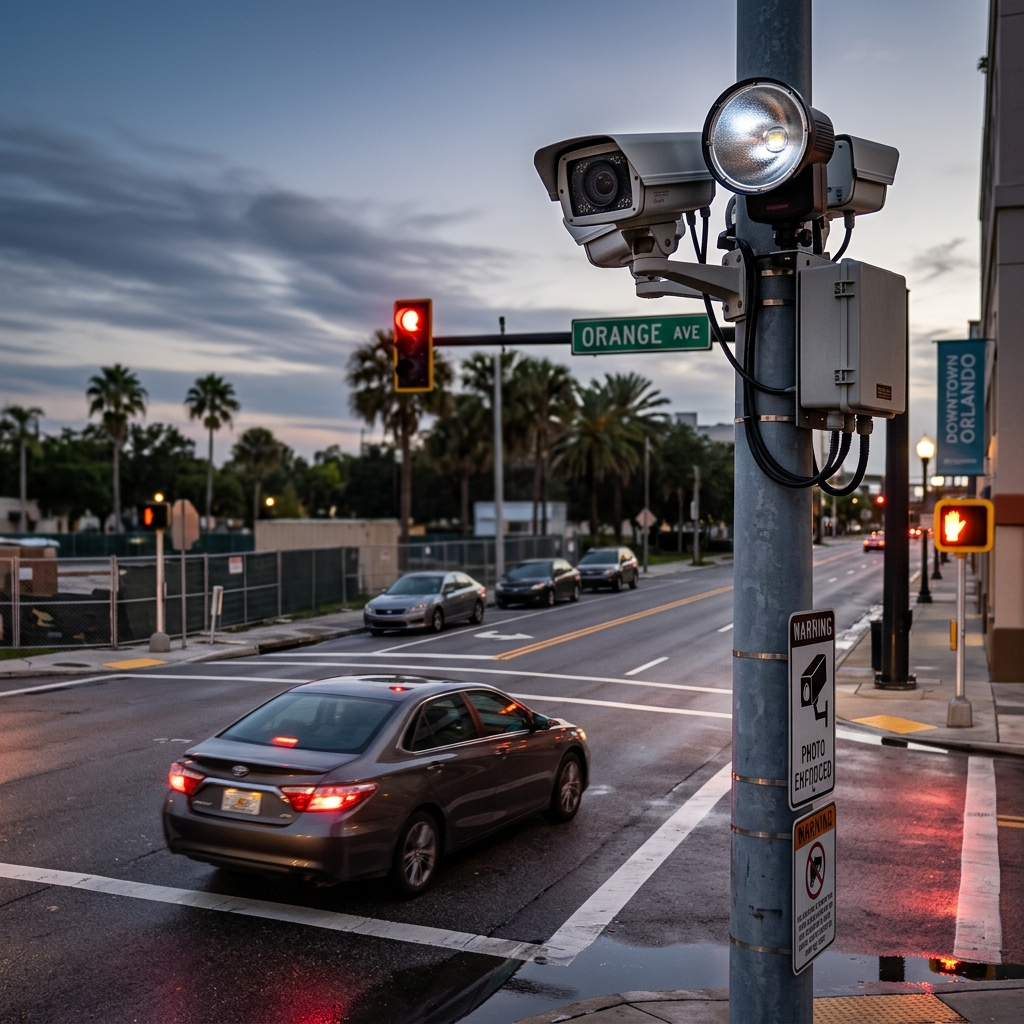
Red-light camera enforcement in Florida often surprises drivers because the notice arrives by mail and names the registered owner, not necessarily the person who was behind the wheel. That structure has led to years of disputes about fairness, evidence, and due process, but the basic system remains in place under Florida law.
If you received a mailed notice, the most important step is to read it carefully and act before the deadline. In Florida, the notice can lead to a penalty, a formal traffic citation, or further consequences if ignored.
How the Florida red-light camera system works
Florida’s red-light camera program uses automated equipment at selected intersections to record vehicles that enter after the signal turns red. The device typically captures images of the car, the license plate, and the intersection itself, and the recorded event is reviewed before a notice is issued.
Local governments use this system as a civil enforcement tool. The initial notice is generally sent to the registered owner of the vehicle, which means the government does not need to identify the driver at the moment the notice is mailed.
- The camera is triggered when a vehicle enters the intersection during a red signal.
- Images or video are reviewed before the notice is sent.
- The notice goes to the vehicle owner on record, not automatically to the driver.
Who is responsible for the fine
Under Florida’s red-light camera statute, the registered owner is usually presumed responsible for the notice unless an exemption applies or an affidavit is submitted within the required time.
This owner-based system is one reason these notices are controversial. Supporters say it makes enforcement practical, while critics argue it can force owners to explain who was driving even when they were not present.
| Issue | Typical Florida rule |
|---|---|
| Who gets the notice | The registered owner of the vehicle |
| What the notice usually means | A civil penalty or a chance to contest the allegation |
| Initial amount commonly cited | $158 statutory penalty |
| Possible escalation if ignored | A uniform traffic citation and additional consequences |
What conduct can trigger a notice
Red-light camera enforcement is not limited to fully blasting through a signal. A violation can also arise when a driver makes a right turn without first making the required complete stop, or when a vehicle enters and remains in the intersection after the light has already turned red.
The statute also contains specific limits on when a notice or citation should not be issued. For example, the law addresses situations involving careful right turns at red lights and other conditions that may fall outside the camera program’s intended reach.
- Driving through an intersection after the light turns red
- Failing to stop properly before a permitted right turn on red
- Entering the intersection and stopping in a prohibited position after the signal changes
Deadlines matter more than many drivers realize
Florida’s process is driven by deadlines. The statute requires notice to the registered owner within a set time after the alleged violation, and the owner then has a limited window to pay, contest, or submit an affidavit.
Many local programs also explain that if the owner takes no action during the notice period, a uniform traffic citation may be issued later. Once that happens, the matter can become more formal and more expensive.
- Review the notice immediately when it arrives.
- Check the response deadline shown on the document.
- Choose one option: pay, contest, or submit an affidavit if an exemption applies.
How much a Florida red-light camera notice can cost
The standard statutory penalty commonly referenced by Florida cities and counties is $158.
If the notice is not handled on time, the matter may become more expensive. Some sources note that continued inaction can lead to a higher amount, court-related costs, and points if the case turns into a traffic citation rather than ending at the notice stage.
That difference matters. A civil notice is not the same as a moving violation handed to you by an officer at the roadside, but letting the notice sit unresolved can change the consequences significantly.
Can you fight a red-light camera ticket?
Yes. Florida drivers can contest a notice instead of simply paying it. Depending on the local program, that may involve submitting an affidavit, requesting a hearing, or waiting for the case to proceed to a more formal citation stage before challenging it.
The strongest defense depends on the facts. Some arguments focus on identity, others on legal exemptions, and others on the quality of the camera evidence itself.
- Someone else was driving the vehicle
- The vehicle was used in an emergency
- The license plate image was unclear or obstructed
- The turn was a lawful, careful right turn at red
- The notice or citation was not issued according to the statute’s requirements
Why due process challenges keep coming up
Red-light camera enforcement has faced repeated constitutional criticism because the system often presumes the registered owner is responsible unless that person proves otherwise. Opponents argue that this can shift the burden away from the government and onto the owner.
In 2018, the Florida Supreme Court upheld the constitutionality of red-light camera enforcement, which allowed local governments to continue using the program. At the same time, later trial-level disputes show that individual citations can still be dismissed when a court believes the process or presumption is defective in a particular case.
The practical takeaway is simple: constitutional debates have not eliminated the program, but they have created room for individualized defenses and litigation.
What happens if you ignore the notice
Ignoring a red-light camera notice is usually the worst option. Local government FAQs explain that if the owner does not pay, request a hearing, or submit a valid affidavit within the notice period, a uniform traffic citation can be issued.
Once the matter escalates, the driver may face additional financial penalties and procedural burdens. Depending on the circumstances, the case can also become more difficult to resolve informally.
- Higher total cost than the original notice
- Possible court involvement
- Potential license-related consequences if the citation remains unpaid
Common response options
Drivers generally have three practical paths: pay the notice, challenge it, or submit an affidavit if a statutory exemption applies. The right choice depends on the facts, the local process, and whether the evidence actually supports the alleged violation.
| Option | What it does |
|---|---|
| Pay | Ends the matter if completed on time, usually without points at the notice stage |
| Contest | Lets the owner challenge liability, the evidence, or the legal basis for the notice |
| Submit an affidavit | Can transfer responsibility or establish a statutory exemption if one applies |
Practical steps after receiving a notice
After a notice arrives, the best approach is to slow down and verify the facts before doing anything else. Check the date of the alleged violation, the vehicle information, the location, and the deadline for response.
If the vehicle was loaned to a family member, an employee, or another driver, gather any records that may help show who was operating the car. If the event involved an emergency, mechanical issue, or confusing signal timing, preserve anything that can support that explanation.
- Keep the notice and all mailing envelopes.
- Review the intersection photos or video if available.
- Look for local instructions on payment, hearing requests, or affidavits.
- Act before the deadline printed on the notice.
When legal help may be useful
Legal help is especially useful when the evidence is unclear, the driver disputes being responsible, or the notice has already escalated to a formal citation. A traffic lawyer can help determine whether the notice was properly issued and whether a defense is likely to succeed.
That does not mean every case requires a lawyer. Some notices are straightforward and can be resolved by payment or by submitting the correct paperwork. But when the stakes rise, getting advice early can prevent a small issue from becoming a larger one.
Frequently asked questions
Are red-light camera notices criminal charges in Florida?
No. The notice is generally treated as a civil violation assessed against the owner of the vehicle, not as a criminal offense.
Do red-light camera notices add points to a license?
At the notice stage, sources commonly state that no points are assessed if the statutory penalty is paid on time. Points may become relevant if the matter escalates into a more formal citation and remains unresolved.
Can the owner avoid liability if someone else was driving?
Often yes, but only if the owner follows the required process and supports the claim with the right affidavit or other proof permitted by the local program.
Is every red-light camera ticket guaranteed to stand?
No. Some citations are disputed successfully because of driver identity issues, legal exemptions, evidence problems, or procedural defects.
Should I just pay the notice to make the problem go away?
That is one option, but not the only one. If you believe the notice is wrong, or if an exemption may apply, it is worth reviewing the available challenge process before paying.
References
- Florida Statute 316.0083 — Florida Legislature, Online Sunshine. 2026. https://www.leg.state.fl.us/statutes/index.cfm?App_mode=Display_Statute&URL=0300-0399/0316/Sections/0316.0083.html
- Florida Red-Light Camera Tickets: Are They Enforceable? — Delgado Trial Attorneys. 2024. https://dplawfl.com/florida-red-light-camera-tickets-are-they-enforceable/
- Judge dismisses red-light camera ticket, rules law is unconstitutional — CBS 12. 2024. https://cbs12.com/news/local/florida-news-judge-rules-red-light-camera-tickets-unconstitutional
- New Florida Red-light Camera Law Changes — Community Law Firm. 2024. https://www.communitylawfirm.com/blog/new-florida-red-light-camera-law-changes
- Red-Light Camera Safety Program FAQs — City of Bartow. 2026. https://www.cityofbartow.net/514/Red-Light-Camera-Safety-Program-FAQs
- Pay a Red Light Camera Violation — City of Orlando. 2026. https://www.orlando.gov/Parking-Transportation/Red-Light-Camera-Violations/Pay-a-Red-Light-Camera-Violation
- Pay Red Light Fines — Hillsborough County, Florida. 2026. https://hcfl.gov/residents/property-owners-and-renters/code-violations/pay-red-light-fines
Similar Articles








Read full bio of Sneha Tete


