
Your Rights During the Hiring Process
Understand the legal protections that apply before you are ever hired.
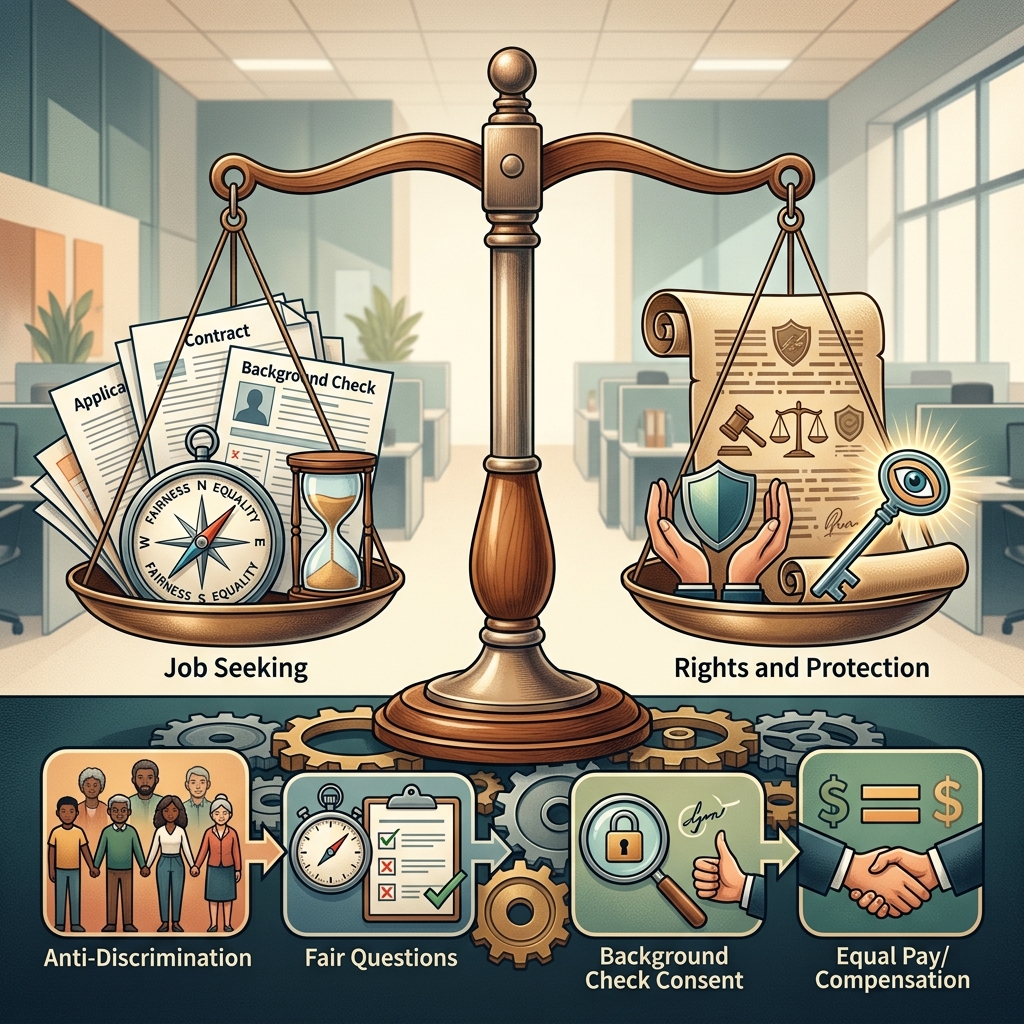
What Job Applicants Are Entitled to During Hiring
Job seekers are protected by laws that reach far beyond the final interview. In the hiring process, employers must follow rules that limit discrimination, regulate background checks, and protect applicants from unfair screening methods. These protections apply to job ads, applications, interviews, assessments, and offer decisions.
In practical terms, employers cannot make decisions based on protected characteristics such as race, sex, age, disability, religion, or national origin. They also must be careful when using credit checks, criminal history, medical questions, or automated screening tools. The law does not require an employer to hire every qualified applicant, but it does require a fair process that does not exclude people for unlawful reasons.
- Hiring protections apply before a person becomes an employee.
- Discrimination can occur at any stage, including recruitment and background screening.
- Applicants may have both federal and state law remedies.
How Discrimination Can Appear in Hiring
Hiring discrimination is not limited to an obvious refusal to interview someone. It can also happen through subtle choices that affect who gets considered, who gets contacted, and who gets selected. An employer may violate the law when it uses biased language in a posting, asks improper questions, or applies screening criteria unevenly.
Discrimination can also be indirect. A rule that appears neutral can still be unlawful if it disproportionately harms a protected group and is not truly necessary for the job. For example, a screening standard that eliminates qualified applicants without a business reason may raise legal concerns even if the employer never states a discriminatory motive.
| Stage of hiring | Possible legal risk |
|---|---|
| Job posting | Language that suggests a preference for a protected class |
| Application | Questions that reveal age, family status, disability, or religion |
| Interview | Improper questions about pregnancy, medical history, or origin |
| Background check | Unlawful use of credit or criminal history |
| Decision | Unequal treatment based on protected traits |
Laws That Commonly Protect Candidates
Several federal laws form the backbone of applicant protection. Title VII of the Civil Rights Act bars discrimination based on race, color, religion, sex, and national origin. The Age Discrimination in Employment Act protects older workers from age-based bias. The Americans with Disabilities Act restricts disability discrimination and requires reasonable accommodation in many situations. Other laws also affect specific parts of the process, including privacy, background checks, and immigration verification.
State and local laws often go further than federal law. Many jurisdictions expand protected categories to include sexual orientation, gender identity, marital status, or other traits. Some states also restrict how employers may use salary history, credit reports, arrest records, or criminal convictions. Because local rules vary, applicants can have broader rights depending on where they apply for work.
- Title VII addresses race, color, religion, sex, and national origin discrimination.
- The ADEA protects applicants age 40 and older.
- The ADA protects qualified applicants with disabilities.
- State and local laws may add extra protections.
What Employers Should Not Ask
Interview questions are supposed to help an employer evaluate job-related qualifications, not gather information about protected traits. That means employers should avoid questions that directly or indirectly reveal an applicant’s age, family circumstances, religion, disability, or other protected status. Even questions that sound casual can become a problem if they are used to steer decisions.
For example, asking whether someone has children, whether they were born in the United States, or what year they graduated from high school can cross legal lines. If an employer needs to know whether an applicant can perform a specific job task, the lawful approach is to ask about that task itself rather than about a medical condition or personal background.
- Do ask whether the applicant can perform the essential functions of the job.
- Do not ask about pregnancy, medical diagnoses, or religious practices.
- Do not ask about age, marital status, or family plans.
- Do not ask questions that expose protected information unnecessarily.
Background Checks and Consumer Reports
Background checks are one of the most sensitive parts of hiring because they can affect opportunities for people with credit issues, criminal records, or incorrect report data. The Fair Credit Reporting Act places limits on how employers use consumer reports. In general, employers must obtain proper authorization before running a report and must follow notice requirements if they intend to take adverse action based on its contents.
Applicants also have the right to dispute inaccurate or incomplete information in a consumer report. Some states and cities limit the use of credit checks or criminal history in hiring decisions. In many places, employers must wait until later in the process before asking about criminal records, a policy often called “ban the box.” The point is to keep background information from being used as an automatic barrier unrelated to job performance.
| Background check issue | Common legal rule |
|---|---|
| Consumer report | Written authorization and required disclosures |
| Adverse action | Notice, copy of report, and dispute rights |
| Criminal history | State or local limits may apply |
| Credit history | Use may be restricted by law |
Artificial Intelligence and Automated Screening
Many employers now use software to sort applications, rank resumes, or analyze interview responses. These tools can improve efficiency, but they can also create discriminatory outcomes if they are trained on biased data or if they screen out qualified candidates for non-job-related reasons. An automated tool that produces unequal results may raise the same legal concerns as a human decision-maker.
In some situations, applicants with disabilities may request human review or accommodation if an automated system creates barriers to access. If a candidate believes an algorithm produced a discriminatory result, the candidate may be able to file a charge with the Equal Employment Opportunity Commission or a state civil rights agency. The legal question is not whether the technology is new, but whether the result is fair and lawful.
- AI tools can be subject to anti-discrimination rules.
- Automated screening must still be job-related and non-discriminatory.
- Applicants with disabilities may seek accommodation in some cases.
- Discriminatory results can be challenged through agency complaints.
The Role of Equal Opportunity Policies
Many employers include equal opportunity statements in job postings and applications. These statements do not solve every legal issue, but they signal that the employer intends to follow the law and avoid biased decisions. More important than the wording, however, is whether the employer uses consistent hiring criteria and documents its choices.
A lawful hiring process usually focuses on qualifications, job-related experience, availability, and the ability to perform essential functions. Employers are safest when they use the same standards for comparable applicants and keep records that explain why a candidate was selected or not selected. Consistency matters because unequal treatment is often proven through patterns, not just explicit statements.
What to Do If You Suspect Hiring Discrimination
If you think an employer treated you unfairly during hiring, start by preserving the facts. Keep the job posting, your application, emails, interview notes, and any rejection messages. Write down the date, location, and names of people involved. That information may help determine whether the issue was a lawful business decision or a possible civil rights violation.
Next, consider whether the conduct appears to involve a protected characteristic. If so, a complaint may be filed with the EEOC or a state agency. The EEOC is the main federal agency that handles employment discrimination charges. In many cases, you must go through the administrative process before filing a federal lawsuit. Deadlines matter: a charge is often due within 180 days, though that can extend to 300 days when a state or local fair employment agency also covers the claim.
- Save records related to the application and interviews.
- Identify which action you believe was unlawful.
- Check the filing deadline before taking action.
- Consider state and local agencies as well as the EEOC.
Possible Remedies and Next Steps
If a claim is successful, the available remedies can vary depending on the law and the facts. Potential relief may include lost wages, compensatory damages, and attorney’s fees. In some cases, the law may also allow injunctive relief or other corrective measures. The exact remedy depends on the statute involved and the harm caused by the unlawful hiring practice.
Not every unfair hiring outcome is illegal, and not every bad interview creates a claim. Still, applicants who experience biased questions, unlawful screening, or a discriminatory rejection should take the concern seriously. A careful review of the process can reveal whether the problem was a lawful qualification decision or a violation of employment law.
Frequently Asked Questions
Can an employer refuse to hire me because of my race or age?
No. Federal law prohibits hiring decisions based on protected characteristics, including race and, for applicants age 40 or older, age. State and local rules may add more protection.
Can an employer ask about my medical history?
Generally, employers should not ask medical questions during the hiring process unless the question is lawful and directly tied to a permitted stage of screening. A better question is whether you can perform the job’s essential functions.
Do I have rights if a background check costs me a job offer?
Yes. Background checks are regulated, and you may have the right to notice, a copy of the report, and a chance to dispute errors if the employer takes adverse action based on the report.
What if an AI hiring tool rejects my application?
Automated tools can still violate anti-discrimination laws if they produce biased results. You may be able to challenge the decision through an agency complaint or request a review, depending on the situation and local law.
How long do I have to file a discrimination charge?
In many cases, the deadline is 180 days from the discriminatory act, but it may extend to 300 days if a state or local agency also enforces the law.
References
- Discrimination in Hiring: What Employees & Employers Should Know — EEOC. 2025-01-01. https://www.eeoc.gov/employers/small-business/what-shouldnt-i-ask-when-hiring
- Equal Employment Opportunity Commission — EEOC. 2025-01-01. https://www.eeoc.gov/
- Fair Credit Reporting Act — Federal Trade Commission. 2025-01-01. https://www.ftc.gov/
- Americans with Disabilities Act — U.S. Equal Employment Opportunity Commission. 2025-01-01. https://www.eeoc.gov/laws/guidance/americans-disabilities-act
- Title VII of the Civil Rights Act of 1964 — U.S. Equal Employment Opportunity Commission. 2025-01-01. https://www.eeoc.gov/statutes/title-vii-civil-rights-act-1964
Similar Articles








Read full bio of medha deb




