Where Teens Can Work: A Practical Guide to U.S. Child Labor Rules
Understand how federal and state child labor laws shape when, where, and how teenagers can legally work in the United States.
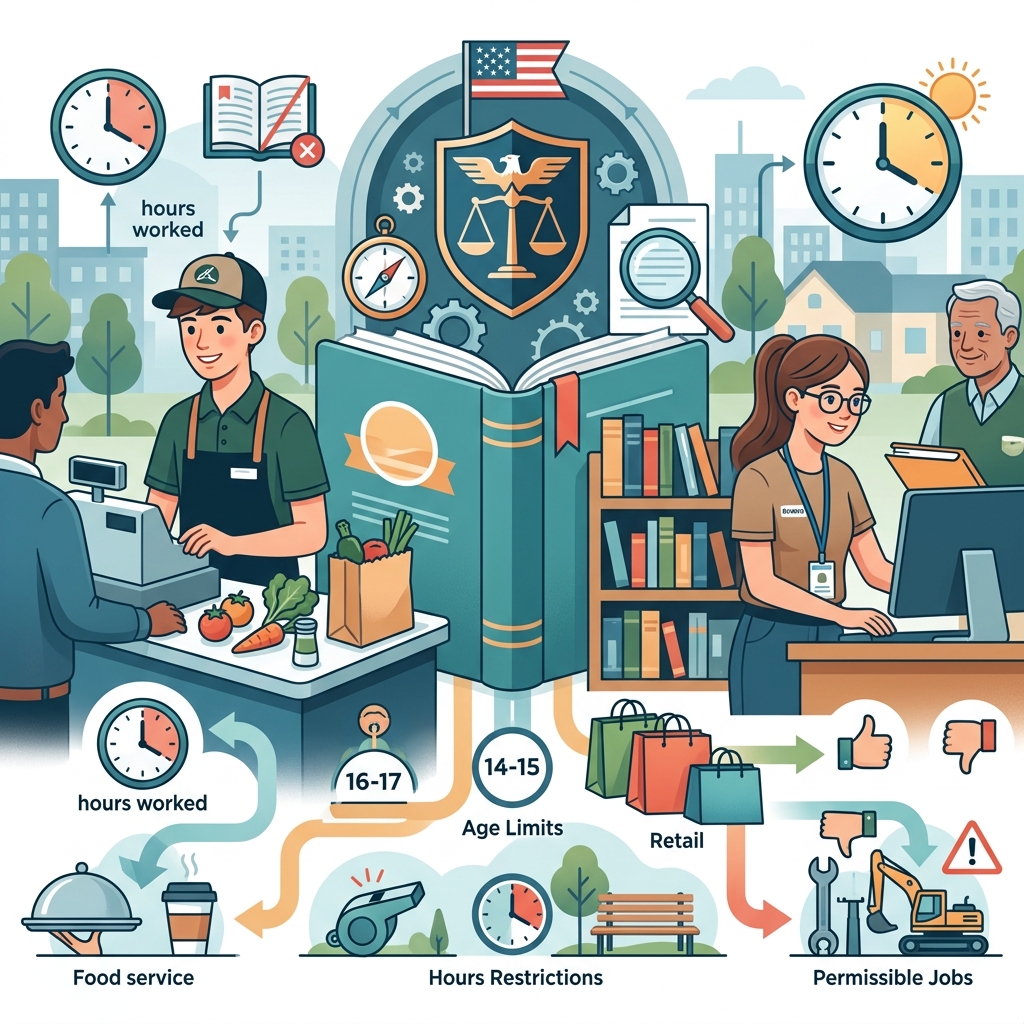
Teenagers across the United States are eager to earn money, gain experience, and build skills, but they must do so within a legal framework designed to protect their safety, health, and education. Federal and state child labor laws set out detailed rules on who can work, where they can work, and how many hours they are allowed to work, depending on age and job type.
This guide explains the key rules that apply to teen workers, focusing on federal law and how it interacts with state regulations. It also explores the kinds of jobs teens can do, the hazardous tasks they must avoid, and what families and employers need to know to stay compliant.
1. Why Child Labor Laws Exist
Child labor laws in the United States developed over more than a century in response to widespread abuses, long workdays, and dangerous conditions that once affected many children in factories, mines, and farms. Today’s rules serve three main purposes:
- Protect education: Limits on work hours aim to prevent jobs from interfering with school attendance and learning.
- Safeguard health and safety: Restrictions on hazardous tasks reduce the risk of serious injury or exposure to dangerous environments.
- Promote fair treatment: Wage standards and age limits seek to prevent exploitation while allowing teens to gain work experience.
The central federal law is the Fair Labor Standards Act (FLSA), which sets nationwide minimum standards on wages, hours, and child labor for covered employers.
2. How Federal and State Rules Work Together
Child labor rules are set at two levels: federal and state. This can be confusing for families and employers, but a simple principle helps:
The law that offers the greatest protection to the young worker is the one that applies. If federal law is stricter than a state rule, federal law controls. If the state has stronger safeguards than federal law, the state rule applies, as long as it does not conflict with federal protections.
In practice, this means employers must compare both sets of rules and follow whichever is more protective. For example, if a state limits late-night work for 16-year-olds more strictly than federal law, the employer must honor the state’s tighter standard.
3. Age-Based Rules: Who Can Work and When
Federal child labor rules are highly dependent on the worker’s age. Below is a clear overview of what is generally allowed, focusing on non-agricultural jobs covered by the FLSA.
| Age Group | General Work Eligibility (Non-Agricultural) | Typical Hour Limits (Federal) |
|---|---|---|
| Under 14 | Most non-agricultural employment is prohibited, with narrow exceptions (family businesses, acting, certain small jobs). | Strictly limited; many jobs not allowed at all. |
| 14–15 | May work in allowed, non-hazardous jobs outside school hours. | Max 3 hours on a school day, 18 hours in a school week; up to 8 hours on a non-school day and 40 hours in a non-school week; between 7 a.m. and 7 p.m., or to 9 p.m. in summer. |
| 16–17 | May work unlimited hours in non-hazardous jobs. | No federal limit on total hours, but cannot perform hazardous tasks; states often impose additional limits. |
| 18 and older | Considered adults for purposes of child labor law. | No special federal child labor limits (standard wage and hour rules still apply). |
Separate federal standards apply to agricultural jobs, often allowing younger children to work on farms under certain conditions, especially when employed by their parents.
4. Where Teens Can Work: Common Job Types by Age
Within these age brackets, teens can take on a range of jobs, provided the work is not considered hazardous and complies with hour restrictions. Below are typical categories of work, with illustrative examples.
4.1 Jobs for Teens Under 14
Most commercial employment for children under 14 is restricted by federal law, but some limited opportunities exist.
- Family businesses: Working in a business owned and run by parents in non-hazardous roles, such as helping in a small office or shop.
- Entertainment: Acting, modeling, or performing in film, television, theater, or radio productions, subject to additional industry and state rules.
- Small, informal tasks: Babysitting or yard work for neighbors, where the arrangement may not fall under formal wage-and-hour rules.
Even in these settings, children must not be exposed to dangerous machinery or environments, and school attendance must remain a priority.
4.2 Jobs for 14- and 15-Year-Olds
At ages 14 and 15, more job options become available, but only in non-hazardous positions and within strict hour limits.
Typical jobs include:
- Retail: Cashier, shelf stocker, sales assistant in stores that do not sell age-restricted products.
- Food service: Host, server assistant, or clerk in restaurants or fast-food establishments, without operating certain kitchen equipment declared hazardous.
- Office work: Filing, basic data entry, reception tasks in a safe office environment.
- Recreation and parks: Attendant at a community pool or recreation center, again avoiding hazardous tasks.
These jobs must be scheduled outside school hours, with strict daily and weekly limits and restrictions on late-night work.
4.3 Jobs for 16- and 17-Year-Olds
Once teens reach 16, federal law allows them to work unlimited hours in non-hazardous jobs, though state laws often regulate late-night shifts and total weekly hours.
Common positions include:
- Expanded retail roles: Supervising small teams, managing inventory, or working longer shifts.
- Advanced food service tasks: Cooking or baking with permitted equipment, serving customers, and handling cash registers.
- Personal services: Work in barbershops or cosmetology salons, where allowed by state law and licensing boards.
- Entry-level manufacturing or warehouse jobs: As long as the tasks do not involve equipment or processes classified as hazardous.
Teens in this age group must still avoid federal hazardous occupations, such as certain kinds of machine operation or work at great heights.
5. Hazardous Work: Jobs Teens Must Avoid
Even older teens face limits on dangerous work. Under federal law, minors under 18 are generally prohibited from specific hazardous occupations, regardless of the industry.
Prohibited work typically includes:
- Operating or assisting with power-driven hoisting equipment or forklifts.
- Working in coal mining or other mining operations.
- Operating certain metal-forming, shearing, or punching machines.
- Logging, sawmilling, and related timber occupations.
- Work that involves explosives or exposure to radioactive substances.
- Jobs on or near roofs, or in deep excavation and trenching work.
These restrictions reflect high injury rates and serious safety risks associated with such work. Employers must know these rules and design youth roles that avoid hazardous duties.
6. Work Hours: Balancing Jobs and Education
For younger teen workers, federal rules tightly control work schedules to protect school attendance and rest. For 14- and 15-year-olds, the main federal standards are:
- Daily limits: No more than 3 hours on a school day and up to 8 hours on a non-school day.
- Weekly limits: No more than 18 hours in a school week and up to 40 hours in a week when school is not in session.
- Time of day: Work is allowed only between 7 a.m. and 7 p.m., except from June 1 through Labor Day, when evening work may extend to 9 p.m.
For 16- and 17-year-olds, federal law does not limit total hours, but many states add restrictions on late-night work or maximum weekly hours, especially during the school year.
7. Special Rules: Agriculture and State Variations
Child labor rules are noticeably different in agriculture. Federal law often allows younger children to work on farms, particularly when they work for a parent or guardian. At the same time, states modify or supplement these rules, creating a patchwork of standards.
Recent years have also seen state-level changes to child labor regulations, some expanding and some tightening youth work allowances. For example, some states have adjusted the hours 16- and 17-year-olds can work or updated rules on night shifts and training programs. These developments show that child labor policy continues to evolve and that employers must stay alert to legislative updates.
8. Work Permits, Certificates, and Employer Duties
Many states require a work permit or employment certificate before a minor can start a job. Schools or labor departments often issue these documents, which confirm the teen’s age and may specify allowable hours or job types.
Employers hiring teen workers should:
- Check whether a permit or certificate is required in their state and ensure it is obtained before work starts.
- Maintain accurate records of hours worked and tasks assigned to minors.
- Provide age-appropriate training on safety procedures and equipment.
- Verify that all duties fall within permitted non-hazardous categories under federal and state rules.
Failure to follow these requirements can lead to enforcement actions, back wages, penalties, and reputational harm for the employer.
9. If Something Goes Wrong: Injury, Violations, and Complaints
Despite legal protections, young workers may experience injuries or illegal working conditions. Federal and state agencies encourage teens, parents, and employers to report concerns and seek guidance.
For example, the U.S. Department of Labor offers resources and contact points for questions about youth employment and potential violations. Workers can gather details about their situation and then file complaints or request information through official channels.
Key steps if a teen is hurt at work or faces unsafe conditions include:
- Seek medical help immediately for any serious injury.
- Document what happened: note the date, time, location, tasks being done, and any equipment involved.
- Inform a supervisor or employer representative about the incident.
- Contact relevant authorities such as state labor agencies or the federal wage and hour division for guidance and possible enforcement.
10. Practical Tips for Teens and Parents
Understanding the law is only one part of safely entering the workforce. Teens and parents can take practical steps to ensure that early work experiences are positive and lawful.
10.1 For Teens
- Ask potential employers about job duties and confirm they are appropriate for your age.
- Discuss work schedules in advance to avoid conflicts with school and extracurricular activities.
- Speak up if you are asked to perform tasks that seem unsafe or beyond what you were hired to do.
- Learn basic safety rules for your workplace, including how to report hazards.
10.2 For Parents and Guardians
- Review both federal and state rules before your child accepts a job, paying attention to age limits and hours.
- Talk candidly with your teen about balancing work with rest, homework, and sleep.
- Monitor how your child’s job affects their health and school performance, and intervene if work demands become excessive.
- Encourage open communication about workplace concerns and be prepared to contact labor authorities if problems arise.
11. Frequently Asked Questions
Can a 13-year-old work in a store?
Under federal law, children under 14 generally cannot work in most non-agricultural businesses, including stores, with limited exceptions for family-owned businesses and entertainment roles. State rules may provide narrow conditions, but in typical retail settings, 13-year-olds are not permitted to work.
How many hours can a 15-year-old work during the school year?
Federal rules limit 14- and 15-year-olds to no more than 3 hours on a school day, 18 hours in a school week, and 8 hours on non-school days, within time-of-day restrictions. States may impose additional limits, so local rules should also be checked.
Is it legal for a 16-year-old to work full-time?
Federal law does not restrict total hours for 16- and 17-year-olds in non-hazardous jobs. However, state laws may limit work hours on school nights or set maximum weekly hours, especially when school is in session.
Can teens operate power tools or heavy machinery?
Many power-driven machines and heavy equipment are classified as hazardous, and minors under 18 are generally barred from operating them. Employers must carefully review federal and state lists of prohibited occupations before assigning such tasks.
Who enforces child labor laws?
The U.S. Department of Labor enforces federal child labor rules, while state labor agencies enforce state-specific laws. Employers must comply with both, and teens or parents can contact these agencies with questions or complaints.
References
- Child Labor — U.S. Department of Labor, Wage and Hour Division. 2023-05-12. https://www.dol.gov/agencies/whd/child-labor
- YouthRules! — Young Workers — U.S. Department of Labor. 2023-06-01. https://www.dol.gov/agencies/whd/youthrules/young-workers
- Child Labor Laws — OSHA Education Center. 2024-02-15. https://www.oshaeducationcenter.com/articles/child-labor-laws/
- States Redraw the Rules on Child Labor — Ogletree Deakins. 2025-01-20. https://ogletree.com/insights-resources/blog-posts/states-redraw-the-rules-on-child-labor/
- Understanding Federal and State Child Labor Laws — National Institute of Standards and Technology (NIST). 2023-08-03. https://www.nist.gov/blogs/manufacturing-innovation-blog/understanding-federal-and-state-child-labor-laws
- Child Labor Laws in the United States — U.S. Historical Overview (summary based on primary sources). 2022-10-01. https://en.wikipedia.org/wiki/Child_labor_laws_in_the_United_States
- Child Labor Laws — Minnesota — Minnesota Department of Labor and Industry. 2024-03-10. https://www.dli.mn.gov/child-labor
Similar Articles








Read full bio of medha deb