Employer Guide to Sponsoring Workers for U.S. Permanent Residence
A practical, step‑by‑step roadmap for U.S. employers seeking to sponsor employees for employment‑based green cards through the PERM process and beyond.
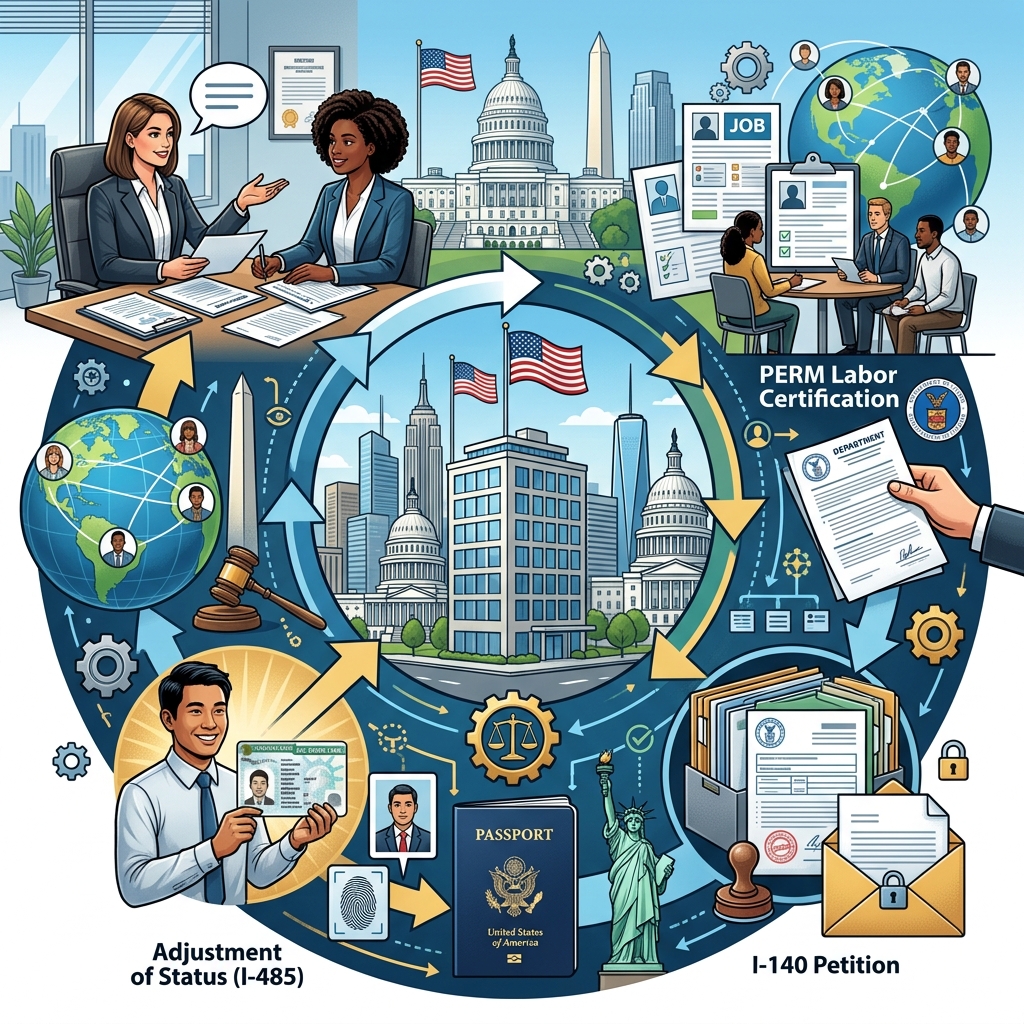
U.S. employers often rely on highly skilled foreign workers to meet business needs, but temporary visas alone cannot guarantee long‑term retention. Sponsoring an employee for lawful permanent residence (a green card) is the primary way to secure their ongoing authorization to live and work in the United States. This guide explains the major steps, requirements, and practical considerations for employers contemplating sponsorship based on employment.
Why Employers Sponsor Employees for Permanent Residence
Permanent residence offers stability for both employer and employee. Once a worker becomes a permanent resident, they are no longer tied to a single nonimmigrant status such as H‑1B or L‑1, and the employer reduces the risk of losing critical talent due to expiring visas or changing quotas.
Common reasons employers decide to sponsor a worker include:
- Long‑term workforce planning – Ensuring continuity in key roles and avoiding disruptions caused by temporary status limits.
- Competitive recruitment – Attracting global talent by offering a pathway to a green card as part of the overall compensation package.
- Retention and loyalty – Demonstrating commitment to valued employees, which can increase engagement and reduce turnover.
- Compliance and risk management – Transitioning from temporary visas to permanent residence can simplify ongoing immigration compliance over time.
Overview of Employment‑Based Green Card Pathways
Employment‑based permanent residence is organized into preference categories under U.S. immigration law. For most private‑sector employers, three categories are especially relevant:
| Category | Typical Beneficiaries | Labor Certification Needed? |
|---|---|---|
| EB‑1 (First Preference) | Multinational managers, outstanding professors and researchers, and individuals of extraordinary ability. | Often no PERM labor certification required for certain subgroups. |
| EB‑2 (Second Preference) | Positions requiring an advanced degree or exceptional ability in sciences, arts, or business. | Usually PERM required, except in some national interest waiver cases. |
| EB‑3 (Third Preference) | Professional, skilled, and some other workers in a broad range of occupations. | PERM required in most cases. |
While EB‑1 can be attractive due to faster timelines and fewer procedural steps, many positions ultimately fall under EB‑2 or EB‑3 and require a formal labor certification from the U.S. Department of Labor (DOL), known as the PERM process.
Core Stakeholders and Responsibilities
Successful sponsorship requires coordination among several parties. Employers should clarify roles early in the process:
- Employer – Initiates sponsorship, provides job details, financial documentation demonstrating ability to pay the offered wage, and supports recruitment efforts.
- Employee – Supplies evidence of qualifications, completes immigration forms, attends medical exams and interviews, and maintains lawful status if already in the U.S.
- Immigration counsel – Designs the sponsorship strategy, ensures legal compliance with DOL and U.S. Citizenship and Immigration Services (USCIS) requirements, and prepares filings.
- Institutional representatives (for universities or research institutions) – Oversee policy limits on sponsorship eligibility and internal approval processes.
Employers should also account for internal time commitments. Institutional policies often stress that departments must devote “considerable staff time and resources” throughout the permanent residence process.
PERM Labor Certification: Proving the Need for a Foreign Worker
For EB‑2 and EB‑3 cases, the PERM labor certification is a central step. DOL uses PERM to confirm two key conditions before allowing the sponsorship to proceed:
- No U.S. workers are able, qualified, and willing to accept the job at the prevailing wage in the local area.
- Hiring the foreign worker will not adversely affect the wages and working conditions of similarly employed U.S. workers.
PERM is generally the most time‑consuming and procedurally complex part of employment‑based sponsorship. Employers should expect months of lead time to complete prevailing wage determinations, mandatory recruitment, and DOL review.
Key Elements of the PERM Process
While specific timelines vary, the PERM process typically involves:
- Defining the permanent, full‑time position – The offered job must be genuinely intended to continue indefinitely, not a short‑term or training role.
- Prevailing wage determination – Requesting an official wage level from DOL based on the job duties, requirements, and location.
- Recruitment and labor market test – Advertising the position and documenting results to show that no qualified U.S. workers are available.
- Filing the PERM application – Submitting an online application (Form ETA 9089) to DOL with evidence of recruitment and job details.
During recruitment, the employer must follow detailed regulatory rules about advertising content, media, and timing. Missteps can lead to denials or audits, which in turn extend processing time.
Employer Financial Obligations and Cost Considerations
Although exact costs depend on attorney fees and organizational structure, employers should expect to pay for all expenses connected to the DOL portion of the PERM process, including required advertising and filings. External estimates for end‑to‑end sponsorship, including USCIS filings and legal services, frequently range from a few thousand dollars to significantly more for complex cases.
Important financial principles include:
- Ability to pay the prevailing wage – Employers must demonstrate they can pay at least the government‑approved wage from the priority date onward, often using tax returns, audited financial statements, or payroll records.
- No shifting of certain costs to the employee – Regulations and state laws may restrict employers from requiring employees to repay sponsorship costs if they leave, especially in jurisdictions like California where new legislation limits “stay‑or‑pay” reimbursement agreements for visa and green card expenses.
- Advance budgeting – Because PERM and subsequent USCIS filings can stretch over several years, employers should include immigration costs in long‑term financial planning.
From PERM Approval to Immigrant Petition (Form I‑140)
Once DOL certifies the PERM application, the employer may file an immigrant visa petition, typically Form I‑140, Immigrant Petition for Alien Worker, with USCIS.
The I‑140 petition has several purposes:
- It classifies the worker under the appropriate employment‑based category (e.g., EB‑2 or EB‑3).
- It confirms the employer’s continuing intention to hire the worker in the sponsored position.
- It documents the employee’s qualifications and the employer’s ability to pay the offered wage.
USCIS review of the I‑140 can result in approval, denial, or a request for additional evidence. Premium processing is often available for a separate fee, allowing faster resolution of the petition.
Final Step: Obtaining the Green Card (Consular Processing or Adjustment of Status)
After USCIS approves the I‑140 and a visa number is available according to the visa bulletin, the employee may move to the final stage: becoming a permanent resident. There are two main procedural options:
- Adjustment of Status (AOS) – If the employee is already in the United States in an eligible status, they may file Form I‑485 with USCIS to adjust to permanent resident without leaving the country.
- Consular Processing – If the employee is abroad or chooses to complete the process overseas, they attend an immigrant visa interview at a U.S. consulate or embassy after the National Visa Center (NVC) collects required documents and fees.
Consular processing involves additional steps such as submitting civil documents, undergoing a medical examination, and demonstrating financial support to avoid becoming a public charge. Regardless of the chosen path, the employee and family members undergo security, medical, and background checks before a green card is issued.
Institutional Policies and Eligibility for Sponsorship
Many universities, research institutions, and large employers maintain internal policies defining which job titles are eligible for permanent residence sponsorship and under what conditions. For example, some institutions sponsor only permanent, full‑time academic or research positions and exclude temporary training roles such as postdoctoral appointments.
Typical internal criteria include:
- The position is intended to continue indefinitely and is full‑time.
- The department or unit is willing to commit staff time and resources to the process.
- Senior leadership, such as a department chair, can attest to the long‑term intent to employ the individual in the role.
Early consultation with immigration counsel and internal offices (such as an international services or global mobility department) helps align sponsorship efforts with institutional rules and strategic priorities.
Compliance Tips and Common Pitfalls for Employers
Because employment‑based sponsorship interacts with both immigration and labor regulations, employers should approach the process with careful planning. Some practical tips include:
- Document everything – Maintain detailed records of recruitment, wage determinations, job descriptions, and internal approval processes.
- Use consistent job requirements – Requirements used during PERM recruitment should align with the actual job and the employee’s qualifications, avoiding artificial inflation that could disadvantage U.S. workers.
- Monitor legal changes – State laws, such as California’s AB 692, can affect how employers handle reimbursement or retention agreements related to sponsorship costs.
- Coordinate timing with other immigration filings – For employees in temporary statuses, ensure that PERM and I‑140 timelines are coordinated with visa extensions to avoid gaps in work authorization.
- Educate HR and managers – Front‑line decision makers should understand that sponsorship is a long‑term commitment and may affect hiring, promotion, and transfer decisions.
Frequently Asked Questions (FAQs)
1. Can any employer sponsor any employee for permanent residence?
In principle, most U.S. employers can sponsor employees for permanent residence if the position is full‑time, permanent, and the employer can meet regulatory requirements, including paying the prevailing wage and completing PERM where required. However, internal institutional policies may limit which roles can be sponsored.
2. Does my employee need to be in the United States before we start?
No. Sponsorship can often begin while a prospective employee is abroad. The PERM and I‑140 processes can proceed regardless of the employee’s physical location. The main difference arises at the final stage, where the individual either adjusts status inside the U.S. or completes consular processing abroad.
3. How long does the sponsorship process usually take?
Timelines vary widely based on government backlogs, the specific category, and the employee’s country of birth. The PERM component alone can take many months from prevailing wage determination through recruitment and DOL review. After PERM approval, I‑140 processing and the availability of immigrant visas depend on USCIS workload and the visa bulletin.
4. Do we have to prove that no U.S. worker could do the job?
For most EB‑2 and EB‑3 cases, the employer must demonstrate that there is no U.S. worker who is able, qualified, and willing to accept the job at the prevailing wage in the local area. This is done through a structured recruitment process under PERM and is documented in the labor certification application.
5. Which costs are we allowed to charge back to the employee?
Federal regulations and state laws significantly limit shifting PERM‑related costs to employees. For example, California’s AB 692 restricts certain “stay‑or‑pay” arrangements that require workers to reimburse visa and green card costs if they leave employment. Employers should consult counsel before drafting any repayment or retention agreements linked to immigration sponsorship.
6. What happens if our business changes after we start sponsorship?
Material changes to job duties, location, or salary during or after the PERM process may require re‑evaluation or refiling. Employers should alert immigration counsel before implementing significant changes affecting the sponsored position to avoid jeopardizing the case.
Strategic Considerations for Employers
Sponsoring employees for permanent residence is more than a legal process; it is a strategic decision that shapes workforce composition, retention, and employer branding. Organizations that treat sponsorship as a structured, transparent program often experience smoother outcomes and stronger employee trust.
Best practices include:
- Creating internal guidelines that define eligibility for sponsorship and expected timelines.
- Aligning sponsorship decisions with long‑term staffing plans and succession strategies.
- Providing clear communication to sponsored employees about each stage of the process and likely time frames.
- Regularly reviewing immigration policies and procedures to ensure ongoing compliance with DOL, USCIS, and state law requirements.
References
- Green Card for Employment-Based Immigrants — U.S. Citizenship and Immigration Services (USCIS). 2023-08-10. https://www.uscis.gov/green-card/green-card-eligibility/green-card-for-employment-based-immigrants
- Employment-Based Immigrant Visas — U.S. Department of State, Bureau of Consular Affairs. 2024-05-01. https://travel.state.gov/content/travel/en/us-visas/immigrate/employment-based-immigrant-visas.html
- Getting a PERM: An Employment-Based Green Card — Immigrants Rising. 2022-03-15. https://immigrantsrising.org/resource/getting-a-perm/
- How To Sponsor an Employee for Permanent Residence — Super Lawyers (Thomson Reuters). 2023-06-01. https://www.superlawyers.com/resources/immigration/california/how-to-sponsor-an-employee-for-permanent-residence/
- California AB 692 and Its Impact on Employer Green Card Reimbursement Agreements — Jackson Lewis P.C. 2026-02-15. https://www.globalimmigrationblog.com/2026/02/california-ab-692-and-its-impact-on-employer-green-card-reimbursement-agreements/
- Permanant Residency — UC San Diego International Services & Engagement Office. 2024-04-02. https://iseo.ucsd.edu/campus-partners/hosting-scholars/pr.html
- Can I Get Permanent Residency Through My Employer? — American Visas. 2023-05-20. https://americanvisas.net/can-i-get-permanent-residency-through-my-employer/
Similar Articles








Read full bio of Sneha Tete