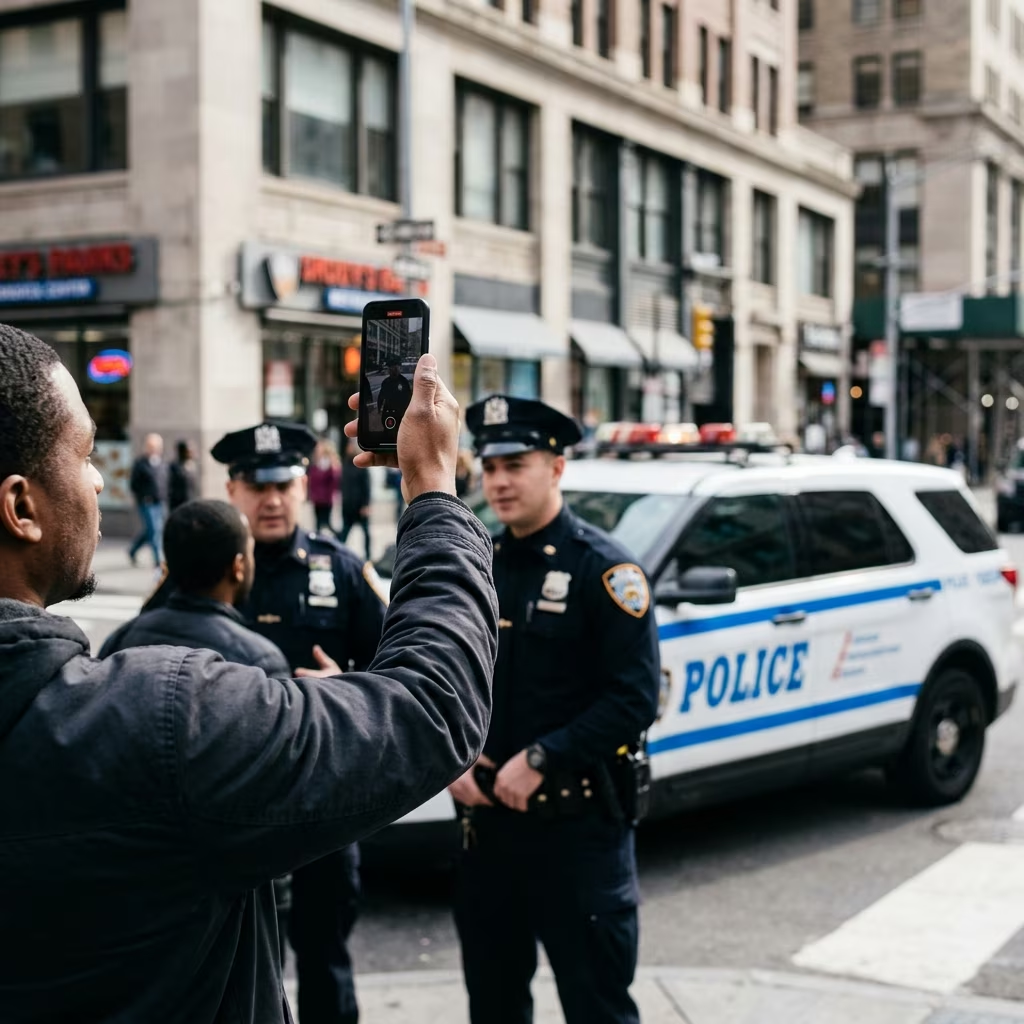
The ability of ordinary people to record police officerscreating these recordings is itself protected by the First Amendment.
This article explains the legal foundations of the right to record police in public, outlines practical limits and responsibilities, and offers concrete guidance for people who want to document law enforcement activity while staying as safe and legally protected as possible.
Why Recording Police Is a Constitutional Issue
The First Amendment to the U.S. Constitution protects freedom of speech, press, assembly, and petition. Modern courts have interpreted these protections broadly, recognizing not only the right to distribute information but also the right to gather it. Recording police activity in public is part of this information-gathering process and has been treated as a form of expressive conduct and newsgathering.
Several federal courts of appeals have explicitly held that individuals—whether journalists or bystanders—have a constitutional right to document public officials performing their duties in public spaces, subject to reasonable restrictions related to safety and operational needs. This emerging consensus recognizes that:
- Public officials are accountable to the people, and transparency is essential to that accountability.
- Digital recording is a modern tool for news reporting and civic participation.
- Ordinary citizens, not only professional press, play a critical role in documenting government conduct.
Importantly, while the U.S. Supreme Court has not yet decided a case directly on the right to record police, multiple appellate decisions and guidance from civil-liberties organizations align around a common principle: if you are lawfully present in a public space, you generally have the right to photograph or record what you can see, including police officers.
Core Legal Principles: What the First Amendment Protects
The First Amendment right to record police in public rests on several interconnected ideas. Understanding these principles helps explain both what is protected and where limits can arise.
| Principle | What It Means |
|---|---|
| Lawful presence | You must be somewhere you are legally allowed to be—such as a sidewalk, park, or other public area. |
| Plain view | You may record anything visible from that location, including police activity and government buildings. |
| Content neutrality | Government generally cannot restrict recording simply because it dislikes what you are documenting or why you are doing it. |
| Reasonable time, place, and manner limits | Officials may impose narrowly tailored restrictions to protect safety, prevent obstruction, or preserve the integrity of sensitive operations. |
| Equal protection for press and public | Courts and civil-liberties groups emphasize that both professional journalists and members of the public share this right. |
In practice, this means that simply holding up a phone or camera and recording police in public is not, by itself, a crime; officers need a separate lawful basis to restrict your activity, such as a genuine safety concern or interference with an ongoing investigation.
Where You May Record: Public vs. Private Spaces
Public Spaces
Public streets, sidewalks, parks, and other open areas are the clearest contexts in which the right to record police applies. If you are lawfully present in such a space, you generally may point your camera at officers and at anything else in plain view.
- Examples of public spaces: Sidewalks, public squares, outside government buildings, public transportation facilities viewed from public areas.
- Typical protections: You may photograph and video police patrols, traffic stops, arrests, crowd control, and other visible activities, so long as you do not physically interfere.
Private Property
When you are on private property, the property owner or manager may set rules about photography and recording. Even if police are present, your ability to record can depend on the terms set by the owner; for example, a store may prohibit filming on its premises.
- Owner rules matter: A mall, apartment complex, or private office building may lawfully restrict recording inside their premises.
- Outside perspective: That same property may be filmed from a public sidewalk, as long as you are not trespassing.
Some states and cities have enacted specific laws addressing the right to document police, which can expand or clarify protections. For instance, New York law explicitly confirms that people have the right to document police activity free from interference and may sue for violations of that right.
Reasonable Limits: Safety, Interference, and Distance
Although the First Amendment provides strong protection, it does not guarantee the right to record in any manner and at any distance. Courts and civil-liberties organizations recognize that reasonable limitations may be imposed to protect legitimate law enforcement needs.
Interference with Police Duties
Officers may lawfully restrict recording when it genuinely interferes with their ability to perform their duties. Interference can include:
- Physically obstructing officers’ movements or blocking access to a scene.
- Entering a controlled area or crossing police tape.
- Refusing to move when directed to a safe distance, where the order is grounded in safety or operational concerns.
- Attempting to record in a way that distracts officers at a critical moment or escalates tensions.
In contrast, simply recording from a reasonable distance—without obstructing or ignoring lawful safety instructions—is generally protected, even if officers dislike being filmed.
Officer Safety and Scene Integrity
Police may limit how close members of the public can stand in order to prevent interference with arrests, evidence collection, or emergency response. Some jurisdictions adopt specific minimum distances, while others rely on officers’ judgment at the scene.
Guidance from civil-liberties organizations suggests a practical rule of thumb: stand far enough away that an officer would need to walk toward you to make physical contact, and ensure you are not blocking doorways, sidewalks, or emergency access routes.
Your Own Encounters with Police
The right to record police is not limited to bystanders. You may also document your own encounters with law enforcement in public, such as traffic stops or street questioning, as long as you do not create a safety hazard or interfere with the officers’ duties.
- Recording questioning: Filming or audio-recording an officer who is asking you questions in public is typically protected, provided you remain calm and do not obstruct the interaction.
- During arrest: Attempting to record your own physical arrest may be more legally complex; courts and advocates warn that this can be seen as interfering with officers trying to handcuff or transport you.
- Afterward: Once you are in a stable situation, you can record or write down details of the encounter, collect witness information, and document injuries for potential complaints or legal action.
What Police May and May Not Do with Your Recordings
Another critical aspect of the right to record police involves control over your devices and the recordings themselves. Civil-liberties guidance and court decisions emphasize several key protections.
- Confiscation generally requires a warrant: Police typically may not seize your phone or camera, or demand to view your recordings, without a warrant or a recognized legal exception.
- No deletion of footage: Officers may not delete photos or videos under any circumstances; destroying or altering your recordings can itself be unlawful.
- Searches of digital content: Even if police lawfully seize a phone—for example, during an arrest—they usually need a warrant to access its contents, including your recordings.
If you are documenting police and an officer orders you to stop recording, hand over your device, or delete footage, civil-liberties organizations advise calmly stating that you do not consent and that recording in public is protected by the First Amendment.
Practical Tips for Safely Recording Police
Legal rights are most useful when paired with practical strategies. The following suggestions, drawn from rights guides issued by civil-liberties organizations, can help you exercise your right to record while minimizing risk.
- Stay calm and respectful: Keep your voice steady, avoid insults or provocative gestures, and focus on documenting rather than arguing.
- Maintain a safe distance: Stand far enough away to avoid physical interference; if officers direct you to a reasonable spot for safety reasons, comply while continuing to record.
- Make recording obvious: Holding your phone or camera visibly can reduce suspicion and clarify that you are a witness, not a hidden participant.
- Ask if you are free to leave: If officers engage with you, politely ask, “Am I free to go?” If the answer is yes, you may choose to walk away; if no, you are being detained and additional rights apply.
- Refuse consent to searches: You generally do not have to agree to searches of yourself or your belongings; saying “I do not consent to this search” can preserve your rights.
- Use secure settings: Protect your device with a strong password and, if possible, enable automatic cloud backups so footage is preserved even if the device is seized or damaged.
Documenting Events Beyond Video
Video is powerful, but written notes and photographs also matter. After a police encounter, or after witnessing an incident, advocates recommend quickly capturing details while they are fresh.
- Officer identifiers: Badge numbers, patrol car numbers, and the name of the agency (city police, sheriff, federal agents).
- Timeline: Approximate time, location, and sequence of events, including any use of force or notable statements.
- Witness information: Contact details for bystanders who observed the event and are willing to speak about it later.
- Injuries and property damage: Photographs and medical records documenting harm to yourself or others.
With this information, you can file complaints with police internal-affairs units, civilian review boards, or civil-liberties organizations, or consult an attorney about potential legal claims.
State and Local Variations
While the broad principle of a First Amendment right to record police in public has been recognized by multiple federal courts, specific rules can vary between states and cities. Differences may include:
- Explicit statutory protections: Some jurisdictions, such as New York, have enacted laws that affirm the right to document police and allow civil lawsuits for violations.
- Distance requirements: Certain places may adopt minimum-distance rules for recording active police scenes, especially for crowd control or emergencies.
- Audio-recording laws: States with strict wiretapping or eavesdropping statutes may regulate secret audio recordings more heavily than open, obvious recording.
Because of these variations, people who regularly document police activity—such as community observers, activists, and journalists—often benefit from learning the specific rules in their state and consulting local civil-liberties organizations when questions arise.
Common Misconceptions About Filming Police
- “Only journalists can film police.”
Federal appellate decisions and guidance from civil-liberties groups emphasize that everyone shares the right to record police in public, not just credentialed reporters. - “If an officer tells you to stop recording, that order is automatically lawful.”
Police cannot lawfully order you to stop recording solely because you are documenting them; there must be a genuine and specific reason grounded in safety or interference, and restrictions must leave open reasonable alternatives for recording. - “Police are allowed to delete your footage.”
Destroying or altering recordings is not permitted; officers may not delete photos or videos, and accessing digital content usually requires a warrant. - “Filming police is the same as obstructing justice.”
Recording from a respectful distance does not inherently obstruct officers. Obstruction involves conduct that truly impedes lawful duties, such as blocking movement or ignoring reasonable safety instructions.
Frequently Asked Questions (FAQ)
Do I have to tell officers that I am recording?
Generally, you do not need to inform police officers that you are openly recording them in public. Visible recording typically does not raise the same legal issues as secret audio recording and is widely treated as protected activity, as long as it does not interfere with their duties.
Can police arrest me just for filming?
Guidance from civil-liberties organizations and appellate decisions indicates that officers may not arrest or punish you solely for recording them in public. Any arrest must be based on some independent legal ground, such as alleged interference, trespass, or another offense. Courts increasingly scrutinize arrests that appear to be retaliation for protected recording.
What should I say if an officer wants to search my phone?
You may calmly state, “I do not consent to this search.” Even if police temporarily seize your phone, they generally need a warrant to access its contents, and they may not delete your recordings.
Is it legal to livestream police activity?
Livestreaming often falls within the same protections as recording, provided you are lawfully present and not interfering with police operations. However, livestreaming can raise additional safety and privacy concerns, so you should be especially careful about your distance, conduct, and the potential impact on people being filmed.
Does my right to record extend to federal agents?
Yes. The First Amendment right to document law enforcement activity in public applies to various government officials, including federal agents such as immigration officers and other federal law-enforcement personnel, as long as you remain in public spaces and do not obstruct operations.
References
- Recording police in public: What you need to know — Foundation for Individual Rights and Expression (FIRE). 2023-05-01. https://www.fire.org/research-learn/recording-police-public-what-you-need-know
- Recording and Documenting Police and Federal Agents — American Civil Liberties Union (ACLU). 2020-06-15. https://www.aclu.org/know-your-rights/recording-and-documenting-police-and-federal-agents
- Your Right to Film Police — ACLU of Texas. 2018-07-10. https://www.aclutx.org/know-your-rights/your-right-film-police
- Know Your Rights When Filming Police — New York Civil Liberties Union (NYCLU). 2020-09-01. https://www.nyclu.org/resources/know-your-rights/know-your-rights-when-filming-police
- Filming and Photographing the Police — American Civil Liberties Union (ACLU). 2014-08-01. https://www.aclu.org/issues/free-speech/photographers-rights/filming-and-photographing-police
- Responding to First Amendment Audits: Is Filming Protected by the First Amendment? — UNC School of Government. 2022-11-14. https://canons.sog.unc.edu/blog/2022/11/14/responding-to-first-amendment-audits-is-filming-protected-by-the-first-amendment/
- Citizens’ Right to Record the Police — University of Georgia First Amendment Clinic. 2021-03-01. https://firstamendment.law.uga.edu/work/citizens-right-to-record-the-police/