
Wrongful Termination vs Unfair Treatment: Understanding the Legal Line
Learn how to tell the difference between illegal firing and merely unfair workplace behavior, and what legal options may be available.
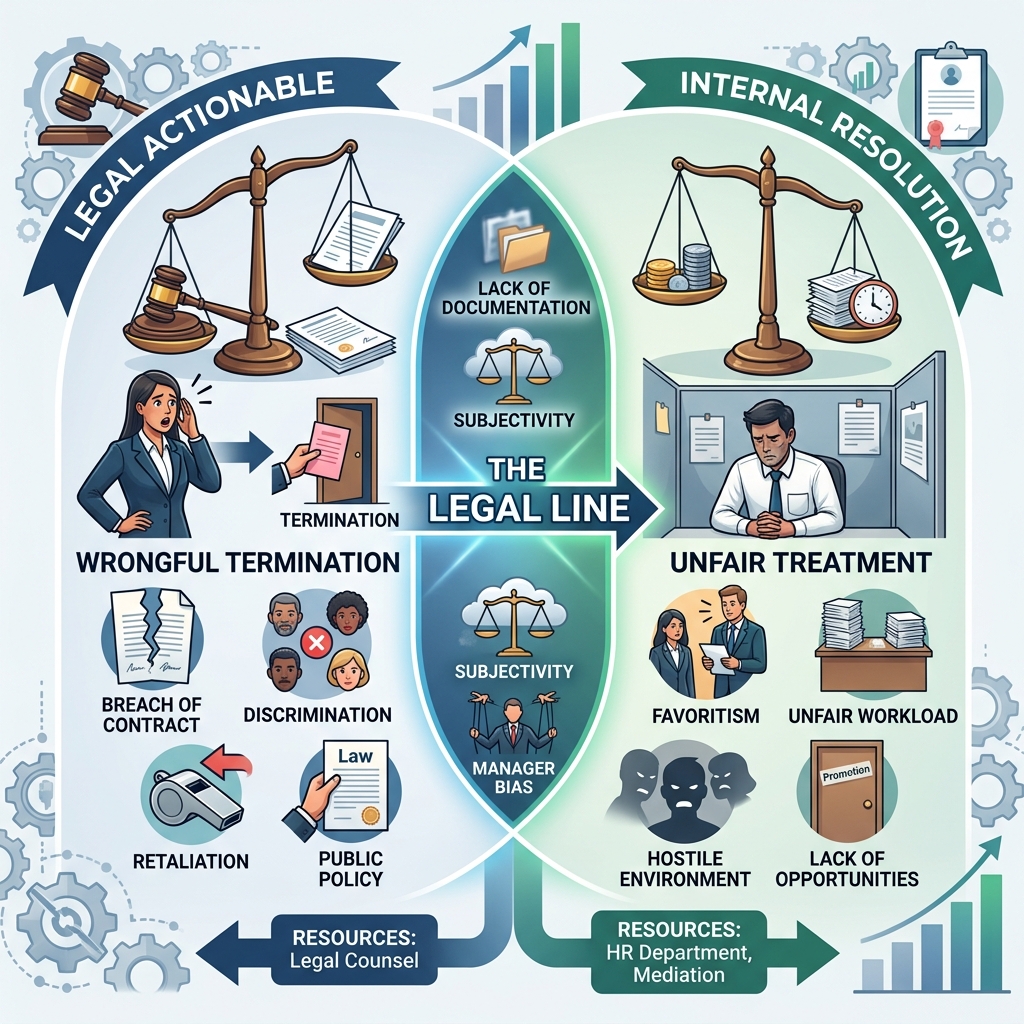
Many workers feel they have been treated unfairly when they lose a job or face hostility at work. Yet not every unfair situation is against the law. The crucial distinction in employment disputes is whether the conduct is merely unfair or legally qualifies as wrongful termination, meaning the firing violates a statute, public policy, or an employment contract.
This guide explains how employment laws typically draw that line, what kinds of behavior count as wrongful termination, and how employees can respond if they believe their rights have been violated. While this article is for general information and does not replace legal advice, it can help you frame your situation and know when to seek professional counsel.
Core Concepts: At-Will Employment and Legal Protections
In most U.S. states, employment is considered at-will. Under at-will rules, employers can generally terminate an employee:
- For a good reason
- For a bad reason
- Or for no stated reason at all
However, even in at-will systems, an employer cannot fire someone for a reason that is illegal under federal or state law, or in violation of a binding employment agreement. That is where the concept of wrongful termination comes in.
| Aspect | Typical At-Will Rule | Legal Limit |
|---|---|---|
| Reason for firing | No reason required | Cannot rely on discriminatory or retaliatory reasons |
| Process | Minimal formality | Must respect any contractual or policy requirements |
| Employee rights | Limited job security | Protected rights under labor, anti-discrimination, and whistleblower laws |
What Is Wrongful Termination?
Wrongful termination (sometimes called wrongful discharge) generally means an employer fired an employee for an illegal reason or in violation of a clear legal obligation. The focus is not simply that the decision was harsh, but that it broke the law.
Different jurisdictions phrase this slightly differently, but common wrongful termination theories include:
- Discriminatory firing based on protected characteristics such as race, sex, religion, national origin, disability, age, or pregnancy.
- Retaliation for reporting harassment, discrimination, unsafe conditions, wage violations, fraud, or other unlawful practices.
- Termination that violates public policy, such as firing someone for serving on a jury, voting, or refusing to commit an illegal act.
- Breach of contract, where an employer disregards a written or implied agreement about job security or termination procedures.
- Failure to follow binding internal termination policies, which in some cases can support a wrongful termination claim.
Official government guidance underscores that an employee may have been wrongfully terminated if they were fired due to discrimination, for exercising labor rights, for whistleblowing about safety, or for refusing to participate in illegal conduct. Many legal practitioners also treat breach of contract and violation of clear public policy as wrongful termination scenarios.
What Counts as Unfair Treatment?
Unfair treatment describes workplace behavior that feels biased, hostile, or unethical, but does not necessarily violate a specific law. This can include actions like:
- Favoritism in promotions or scheduling
- Harsh criticism or micromanagement that is not tied to a protected trait
- Unequal application of performance standards, without discriminatory intent
- Rude or disrespectful comments that are not based on protected characteristics
- Sudden changes in role or duties without clear explanation
While these behaviors may be poor management practices and can damage morale, they typically become legal issues only when they connect to protected rights, such as anti-discrimination law or contractual obligations. A firing may feel deeply unjust, but unless the employer broke a law or a binding agreement, it may not meet the legal definition of wrongful termination.
Key Legal Difference: Unfair vs Wrongful Termination
The central legal distinction is whether the employer’s decision crosses a defined legal boundary. In simple terms:
- Unfair termination: The employer’s choice seems unreasonable or harsh, but there is no violation of law or contract.
- Wrongful termination: The employer’s choice is not only unfair, it is illegal or contradicts a binding agreement.
| Feature | Unfair Treatment / Termination | Wrongful Termination |
|---|---|---|
| Legal violation | Typically none | Involves violation of law, public policy, or contract |
| Basis of claim | Perceived unfairness | Specific statutes, constitutional provisions, or contractual terms |
| Common examples | Harsh management, favoritism, personality conflicts | Discrimination, retaliation, breach of notice or job security terms |
| Available remedies | Often internal grievance or negotiation | Formal complaints, administrative claims, or lawsuits with potential compensation |
Common Legal Grounds for Wrongful Termination
1. Discrimination-Based Firing
Anti-discrimination laws prohibit employers from terminating employees because of certain protected characteristics. These often include race, color, national origin, sex, religion, age (above a specified threshold), disability, and in many instances pregnancy and genetic information.
Indicators of a potential discrimination-based wrongful termination claim can include:
- Derogatory comments about a protected trait near the time of firing
- Patterns where workers with similar protected characteristics are consistently treated worse
- Inconsistent explanations for the dismissal compared with company policies
- Sudden termination after the employee requests accommodations or leave related to disability or pregnancy
2. Retaliation for Protected Activity
Retaliation occurs when an employer penalizes an employee for engaging in a legally protected activity, such as:
- Reporting discrimination or harassment to management or a government agency
- Complaining about unsafe working conditions or violations of safety standards
- Raising concerns about wage and hour violations, such as unpaid overtime or minimum wage issues
- Participating in an investigation or lawsuit related to workplace misconduct
Employees who are dismissed shortly after making such reports may have grounds to allege wrongful termination based on retaliation. In the U.S., whistleblowers can often seek protection through agencies such as the Occupational Safety and Health Administration (OSHA), the Equal Employment Opportunity Commission (EEOC), or the National Labor Relations Board (NLRB), depending on the issue.
3. Violations of Public Policy
Some wrongful termination claims rely on the idea that the firing undermines a clear public policy. Courts and legislatures may recognize a claim when a worker is fired because they:
- Served on a jury or appeared as a witness
- Refused to commit illegal acts requested by the employer
- Exercised voting rights or other civic obligations
- Reported violations that affect public health or safety
In these cases, the termination is not just unfair; it conflicts with important societal values that the legal system seeks to protect.
4. Breach of Employment Contract
In some workplaces, employees have written contracts that limit when and how they can be fired, or provide specific notice requirements. In other settings, courts may recognize implied contractual terms based on employer policies or statements.
A termination can be considered wrongful when an employer:
- Fires an employee without the required notice period or payment in lieu of notice
- Ignores procedural steps promised in an employment contract or handbook
- Dismisses an employee despite an agreement for a fixed term of employment without valid cause
These situations often give rise to claims for damages based on contractual loss, such as missed salary during the notice period or other agreed benefits.
Jurisdictional Differences: Statutory vs Contractual Focus
The exact legal route for employees depends heavily on jurisdiction. For example:
- In some countries, unfair dismissal is a statutory concept focusing on whether the employer had a fair reason and followed a fair process, often codified in employment rights legislation.
- Wrongful dismissal may be treated primarily as a contract claim centered on breach of notice or other contractual terms.
- In many U.S. states, wrongful termination is framed around violation of public policy, anti-discrimination law, or labor statutes, sometimes as a “last resort” claim when no specific statute applies.
From an employee’s perspective, the labels vary, but the practical questions remain similar: did the employer follow the law, honor binding agreements, and respect protected rights?
Practical Steps if You Suspect Wrongful Termination
If you believe your firing crossed the line from unfair to wrongful, the actions you take early can shape your options later. Consider the following steps:
1. Document Events Carefully
- Write a timeline of key events leading up to the termination.
- Keep copies of performance reviews, emails, text messages, and written policies.
- Record dates of any complaints you made, and who received them.
- Note any witnesses who may have seen discriminatory or retaliatory behavior.
Detailed documentation helps lawyers and agencies assess whether the termination connected to a protected characteristic or activity.
2. Review Contracts and Policies
- Check your employment contract for clauses on notice, termination reasons, and disciplinary procedures.
- Read the employee handbook and internal policies on performance management and dismissal.
- Compare what the employer did to what the documents say should happen.
Any clear gap between promised procedures and actual practice may support a contract-based wrongful termination claim.
3. Identify the Appropriate Agency
Depending on the nature of the complaint, different agencies may have jurisdiction. For example in the U.S.:
- Discrimination or harassment: Equal Employment Opportunity Commission (EEOC)
- Unsafe conditions: Occupational Safety and Health Administration (OSHA)
- Collective action or union issues: National Labor Relations Board (NLRB)
- Wage and hour violations: U.S. Department of Labor and its Wage and Hour Division
Each agency has specific procedures and deadlines for filing a charge or complaint.
4. Consult an Employment Attorney
Employment law is complex, and the question of whether treatment is simply unfair or legally wrongful can turn on subtle details. Speaking with a qualified attorney can help you:
- Evaluate the strength of your claims
- Understand deadlines and procedural requirements
- Decide whether to pursue an internal resolution, administrative complaint, or lawsuit
- Estimate potential remedies such as back pay, reinstatement, or damages for emotional distress
Many lawyers offer initial consultations that focus on clarifying whether your situation likely meets the legal threshold for wrongful termination.
Potential Remedies in Wrongful Termination Cases
When a wrongful termination claim succeeds, available remedies depend on the applicable laws and the facts of the case. Common outcomes can include:
- Reinstatement to the former position, where feasible and appropriate.
- Back pay for lost wages and benefits from the date of termination to judgment.
- Front pay to cover future lost earnings when reinstatement is impractical.
- Contractual damages for breached notice periods or agreed benefits.
- Compensation for emotional distress in some discrimination or retaliation cases.
- Punitive damages where laws permit, in situations involving egregious or malicious misconduct.
By contrast, employees who experience unfair but lawful treatment may have limited formal remedies and may need to rely on internal grievance processes, negotiation, or decisions to seek alternative employment.
Frequently Asked Questions
Is every unfair firing a case of wrongful termination?
No. A firing may be unreasonable or harsh but still lawful. To qualify as wrongful termination, the employer usually must have violated a law, public policy, or contract, such as firing someone due to discrimination or in retaliation for protected activity.
Can an employer fire me for a false reason that is not discriminatory?
In many at-will jurisdictions, an employer can give an inaccurate or unjust explanation and still remain within the law, so long as the true reason is not discriminatory, retaliatory, or contrary to public policy. False reasons are often legally relevant when they hide an illegal motive.
What if the company did not follow its own handbook during my dismissal?
Failure to follow internal policies may support a claim, especially if the handbook is treated as part of the employment contract or if the deviation relates to protected rights. Whether this amounts to wrongful termination depends on local law and how courts view employer policies.
Do I need a lawyer before contacting a government agency?
You do not always need a lawyer to file an administrative complaint, but legal advice can help you choose the correct agency, meet deadlines, and clearly describe the basis of your claim. Some statutes require you to file with an agency such as the EEOC before pursuing a lawsuit.
How long do I have to act after being wrongfully terminated?
Deadlines vary by jurisdiction and type of claim. Some discrimination charges must be filed within months of the termination, and contract claims may have longer limitation periods. Because these time limits can be strict, it is important to seek information or legal counsel promptly.
References
- Wrongful termination — USA.gov. 2024-01-10. https://www.usa.gov/wrongful-termination
- What Are the Differences Between Unfair Dismissal and Wrongful Dismissal? — Franklins Solicitors. 2023-06-01. https://www.franklins-sols.co.uk/insights/blogs/employment/what-are-the-differences-between-unfair-dismissal-and-wrongful-dismissal/
- Unfair Dismissal vs. Wrongful Dismissal – Understanding the Key Differences — Shine Lawyers. 2022-11-15. https://sll.com.au/blog/understanding-the-differences-between-unfair-and-wrongful-dismissal/
- Wrongful termination—the difference between unfair and illegal — Early, Cassidy & Larey. 2023-03-20. https://www.elcmd.org/post/defining-wrongful-termination
- Wrongful Termination Lawyers — Morgan & Morgan. 2023-09-05. https://www.forthepeople.com/practice-areas/wrongful-termination-lawyers/
- Wrongful Termination vs. Unfair Dismissal — Working Now and Then. 2022-08-30. https://www.workingnowandthen.com/blog/wrongful-termination-unfair-dismissal/
Similar Articles








Read full bio of Sneha Tete




