
Workplace Cameras: What Employers Can Legally Monitor
A practical guide to workplace surveillance limits, privacy rules, and employee notice requirements.
Can Employers Use Cameras at Work?
In many workplaces, the answer is yes: employers can generally use video cameras to monitor business activity, protect property, and improve safety. Federal law does not create a blanket ban on workplace video surveillance, and employers often rely on cameras for theft prevention, incident review, and security management.
That said, the legality of surveillance is not unlimited. The most important issue is whether the monitoring stays within lawful boundaries, respects reasonable privacy expectations, and complies with any state rules on notice, consent, or restricted locations.
Why Employers Install Surveillance Systems
Workplace cameras are usually justified by ordinary business concerns rather than curiosity about employees’ private lives. Common reasons include protecting inventory, discouraging misconduct, documenting accidents, securing entrances, and keeping an eye on customer-facing areas.
Courts and regulators generally look more favorably on surveillance when the employer can point to a concrete business purpose. A camera system aimed at safety or loss prevention is easier to defend than one placed in a way that appears secretive, intrusive, or unrelated to work operations.
Where Cameras Are Usually Allowed
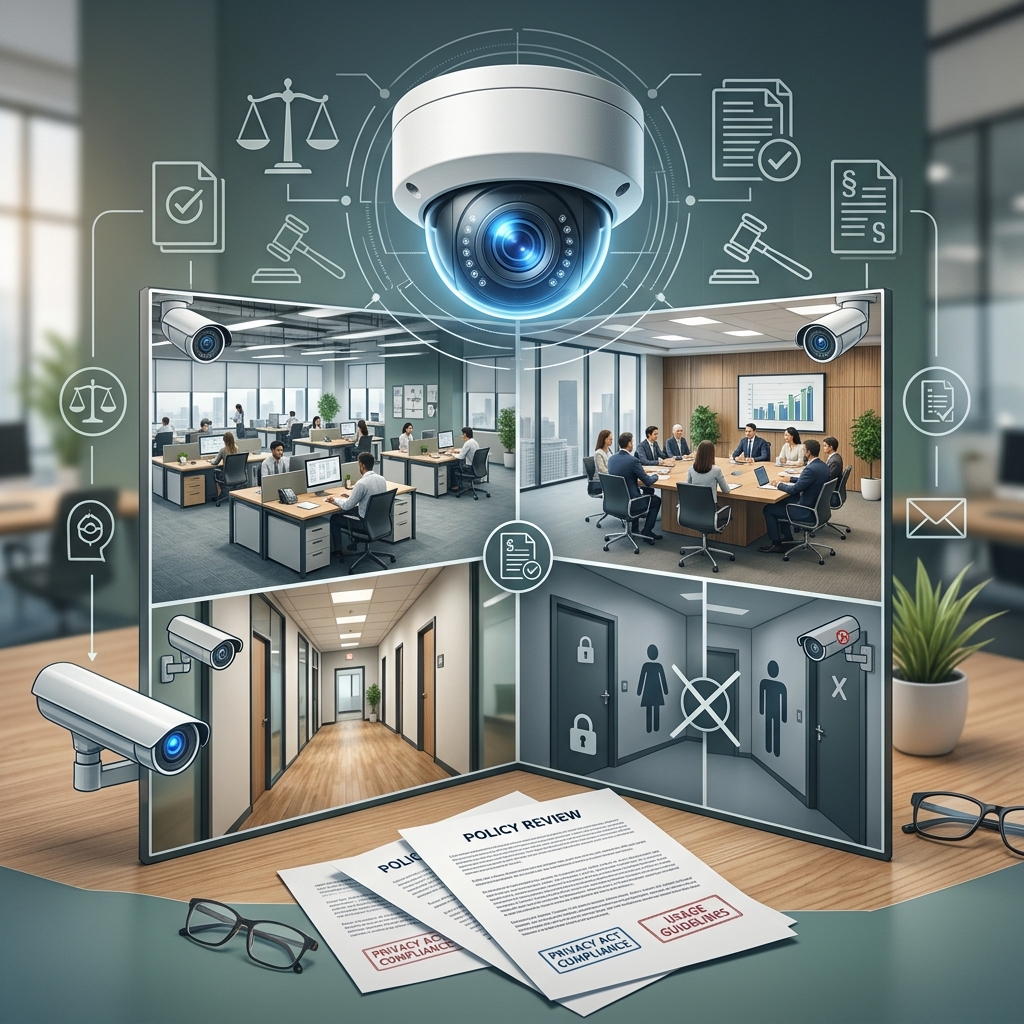
Video surveillance is most defensible in areas where people do not normally expect privacy. These often include lobbies, hallways, loading docks, parking lots, reception areas, entrances, and open workspaces.
Many employers also use cameras in warehouses, retail floors, and exterior perimeters. In these settings, the camera is typically serving a recognizable security function, and employees usually understand that the area is visible to others.
Where Surveillance Becomes Legally Risky
The biggest legal problems arise when a camera is aimed at a space tied to personal privacy. Bathrooms, locker rooms, changing areas, showers, and similar locations are almost always off-limits, even if the employer says the camera was installed for security.
Some states go further than the baseline privacy rules and protect break rooms, employee lounges, or other rest-and-comfort spaces. In those places, a camera may be unlawful even if it is visible and not hidden.
Another danger area is covert monitoring. Hidden cameras can raise serious privacy concerns, especially when the employer does not disclose them or uses them in a way that captures conduct employees reasonably believed would remain private.
Notice Matters More Than Many Employers Realize
Even when surveillance is allowed, employee notice is often central to its legality and defensibility. Many employers reduce legal risk by informing employees through handbooks, written policies, signage, or onboarding materials.
Some states require specific notice before video monitoring is used, and at least one state referenced in the source material requires employers to tell employees when cameras are operating in the workplace. Posting visible signs and placing cameras in obvious locations are common ways to show that the monitoring was not secret.
Audio Recording Creates a Separate Problem
Video-only surveillance and audio surveillance are not the same thing. Even where a camera is permitted, recording conversations can trigger separate wiretapping or consent rules.
Federal law generally allows recording with the consent of at least one party to the conversation, but several states require all-party consent. That means an employer may be able to film an area without sound while still violating the law if the system captures employee conversations without the required permission.
How Privacy Expectations Shape the Analysis
When a dispute arises, courts often balance two competing interests: the employer’s need to monitor and the employee’s reasonable expectation of privacy. If workers are being watched in an open, shared, work-related space, the employer usually has the stronger argument.
If the surveillance reaches into intimate, personal, or semi-private spaces, the privacy interest becomes much stronger. The more a camera resembles an effort to observe private behavior rather than work conduct, the more likely it is to be challenged.
Special Rules for Union and Protected Activity
Employers also need to avoid using cameras to interfere with protected labor activity. Secretly filming union meetings or related organizing efforts can violate federal labor law.
That principle matters because a camera that is otherwise acceptable in a break room or common area may become unlawful if it is deployed to target protected concerted activity rather than ordinary workplace operations.
Workplace Cameras and Remote or Digital Monitoring
Modern surveillance is not limited to video cameras. Employers also monitor company devices, email systems, internet use, and other digital activity, especially when the equipment belongs to the employer and is used for work purposes.
With remote work and bring-your-own-device arrangements, the question becomes more complicated. Employers may have broader control over company-owned devices, but they usually need clearer consent and stronger policies when monitoring personal devices used for work.
Practical Rules Employers Should Follow
A legally safer surveillance program is usually built around narrow purpose, transparency, and restraint. The following practices reduce risk:
- Use cameras for a clear business reason such as safety, security, or loss prevention.
- Avoid restrooms, locker rooms, changing areas, and other private spaces.
- Provide notice through policy documents or visible signage.
- Keep audio recording separate from video review and confirm consent rules first.
- Limit access to recordings to authorized personnel only.
- Review state law before installing cameras in break rooms, lounges, or other gray areas.
How Employees Can Respond to Overbroad Surveillance
Employees who believe cameras are being used unlawfully should first check the employer’s handbook, posted notices, and any state-specific privacy rules that may apply. In many cases, the most useful early step is documenting where the camera is located, whether it records sound, and whether the company disclosed it.
If the surveillance appears to invade a protected area or capture private conversations without consent, an employee may have grounds to raise the issue internally, seek advice, or pursue a complaint depending on the facts and the state involved.
Common Situations and Likely Outcomes
| Situation | General legal outlook |
|---|---|
| Camera in a lobby or warehouse | Usually permitted if tied to a legitimate business purpose. |
| Camera in a restroom or locker room | Almost always prohibited. |
| Visible camera in a break room | May be restricted or prohibited depending on state law. |
| Camera with audio in a conversation area | Audio consent rules may make it unlawful even if video is allowed. |
| Camera used to monitor union organizing | High legal risk and potentially unlawful. |
What the Law Is Really Trying to Balance
Workplace surveillance law tries to balance two legitimate interests: an employer’s need to protect its business and a worker’s right to a private life at work. That balance is usually easiest to defend when the camera is visible, the purpose is clear, and the footage stays away from private conduct.
Problems usually begin when monitoring becomes secret, invasive, or broader than necessary. A lawful camera system should answer a business problem, not create a climate of unnecessary suspicion.
Frequently Asked Questions
Can my employer watch me all day at work?
Not necessarily. Employers can often monitor activity in common work areas, but they still must respect privacy limits, state law, and the boundaries of any notice or consent requirements.
Do cameras have to be visible?
Visible cameras are generally safer from a legal standpoint because they give notice and reduce the risk of a privacy claim. Hidden cameras can be much harder to defend, especially if they are used in a sensitive area.
Can a boss record conversations with a camera?
Only if audio recording complies with the applicable consent law. Video alone may be allowed, but audio can trigger separate restrictions, including all-party consent rules in some states.
Are cameras allowed in employee break rooms?
That depends on the state and the exact location. Some states and workplace privacy rules restrict cameras in rest areas or employee lounges, even if the room is not as private as a restroom.
What if the camera is on company property but outside the building?
Outdoor areas such as parking lots, loading zones, and entrances are often easier to monitor because people typically have a lower expectation of privacy there.
Can employers monitor company laptops and phones too?
Yes, especially when the devices are employer-owned and used for work. Remote monitoring becomes more sensitive when a personal device is involved, and written consent is often important.
References
- Is It Legal To Install Cameras in the Workplace for Surveillance? — Super Lawyers. n.d. https://www.superlawyers.com/resources/employment-law-employee/is-it-legal-to-install-cameras-in-the-workplace-for-surveillance/
- Is It Legal to Have Security Cameras in the Workplace? — Rhombus Systems. n.d. https://www.rhombus.com/blog/is-it-legal-to-have-security-cameras-in-the-office-everything-you-need-to-know-about-workplace-surveillance-laws/
- Can Employers Use Video Cameras to Monitor Workers? — FindLaw. n.d. https://www.findlaw.com/employment/workplace-privacy/can-employers-use-video-cameras-to-monitor-workers.html
- Workplace Surveillance Rights — Workplace Fairness. n.d. https://www.workplacefairness.org/workplace-surveillance/
- California Laws on Workplace Cameras and Surveillance — YMS LLP. 2025-06-01. https://www.ymsllp.com/blog/2025/06/california-laws-on-workplace-cameras-and-surveillance/
- Workplace Monitoring: What’s Allowed, What’s Off Limits? — ADP. n.d. https://sbshrs.adpinfo.com/blog/workplace-monitoring-whats-allowed-whats-off-limits
Similar Articles








Read full bio of Sneha Tete




