
Unpaid Bathroom Breaks and the FLSA: What Employers Must Know
How a $1.75 million case over unpaid bathroom breaks reshaped understanding of rest periods under federal wage and hour law.
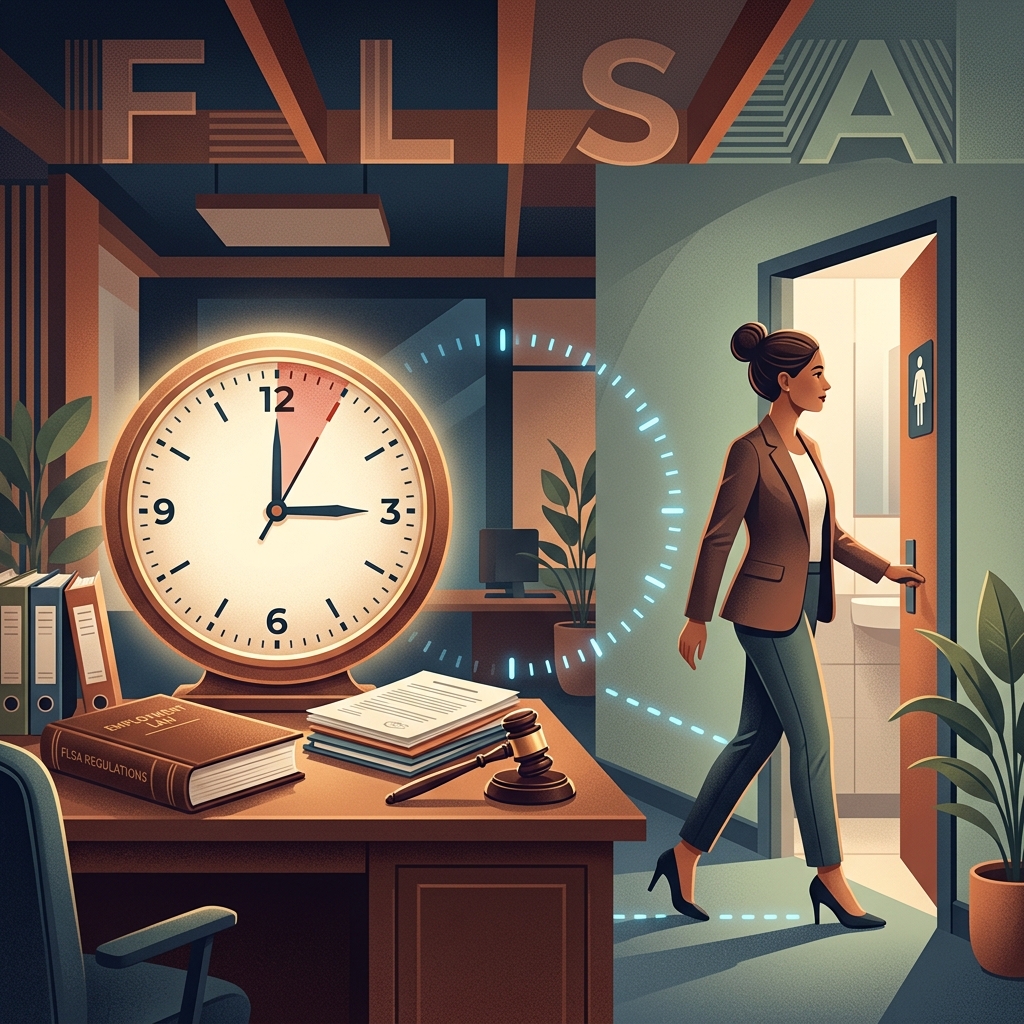
Short rest periods and bathroom breaks may seem like minor details of workplace life, but in the context of U.S. wage and hour law they carry significant legal and financial weight. A Pennsylvania marketing and publishing company learned this the hard way when it was ordered to pay at least $1.75 million in back wages and liquidated damages for treating brief breaks as unpaid time, causing employees to fall below the federal minimum wage.
This article explains how the Fair Labor Standards Act (FLSA)
Background: The Case That Put Unpaid Bathroom Breaks in the Spotlight
The enforcement action that drew national attention involved a telemarketing and publishing business operating call centers in Pennsylvania, New Jersey, and Ohio. According to the DOL, the company required many of its sales workers to log off and stop the clock whenever they stepped away from their workstation for bathroom visits, coffee, or other short personal breaks.
Because those minutes were carved out of paid time, some employees’ effective hourly pay dipped below the federal minimum wage of $7.25 per hour, especially for low-wage workers who took several short breaks during a shift. The DOL filed suit, and a federal court ultimately found that the company’s policy violated the FLSA’s rules on compensable break time, leading to an award covering:
- Back wages for break time that should have been paid
- An equal amount of liquidated damages (essentially a penalty matching unpaid wages)
- Relief for roughly 6,000 current and former employees across three states over several years
This outcome reflects a clear principle: when employers offer short rest breaks, the FLSA generally treats those breaks as compensable work time.
What the FLSA Says About Rest and Bathroom Breaks
The FLSA is the main federal statute governing minimum wage and overtime in the United States. It does not require employers to provide any breaks at all; however, when an employer chooses to allow brief rest periods, federal regulations dictate how those breaks must be treated for pay purposes.
Short Rest Periods Are Work Time
Under a key regulation, 29 C.F.R. § 785.18, rest periods of short duration—typically from 5 to about 20 minutes—are considered part of the employee’s hours worked and must be paid. The regulation explains that these short breaks:
- Are common in industry and promote employee efficiency
- Are customarily treated as working time
- May not be offset against other types of compensable waiting or on-call time
In the case described earlier, the DOL and the courts applied this regulation to bathroom and similar breaks and concluded that the company should have counted them as working time for minimum wage and overtime calculations.
Breaks Are Not Required, But Must Be Paid If Offered
Federal law takes a two-step approach:
- No federal duty to provide breaks: The FLSA does not require employers to schedule rest or bathroom breaks.
- Duty to pay for provided short breaks: If an employer allows short breaks of 20 minutes or less, those periods must be counted as paid working time for non-exempt employees.
As a result, an employer cannot avoid paying minimum wage or overtime by carving out bathroom or coffee breaks from paid hours, unless the break is long enough and structured in a way that qualifies as off-duty time under a different regulation—something the court rejected in the Pennsylvania case.
When Is Break Time Truly Off-Duty and Unpaid?
The FLSA distinguishes between short rest periods, which are paid, and certain longer breaks where the employee is completely relieved from duty. Another regulation, 29 C.F.R. § 785.16, explains that bona fide off-duty time is not compensable if the employee can use the time freely and is clearly told they may leave and need not return until a specified time.
However, in the enforcement case involving unpaid bathroom breaks, the employer tried unsuccessfully to rely on this off-duty rule. The court found that breaks of 20 minutes or less during the workday were not truly off-duty periods for FLSA purposes and therefore remained compensable.
| Type of break | Typical duration | FLSA treatment |
|---|---|---|
| Bathroom, coffee, quick rest | 5–20 minutes | Must be counted and paid as hours worked. |
| Meal period | Generally 30 minutes or more | May be unpaid if the employee is fully relieved of duties for the entire period. |
| Off-duty time (e.g., long unpaid break during split shift) | Longer, clearly defined | May be unpaid if the employee is free to leave and use the time as they wish. |
For employers, the practical message is straightforward: treat short breaks as paid time when calculating both minimum wage and overtime for non-exempt employees.
Minimum Wage Risks: How Unpaid Bathroom Breaks Create Violations
The DOL’s enforcement action against the Pennsylvania company illustrates how unpaid breaks can push hourly pay below the minimum wage. When a worker is paid, for example, a base rate close to the minimum wage, every unpaid minute of break time reduces the number of paid hours over which that wage is spread. If enough break time is left unpaid, the worker’s effective hourly rate can drop below the legal floor.
In the case at issue, the DOL alleged that employees “weren’t earning the minimum wage of $7.25 per hour” because they were required to clock out for bathroom and other short breaks even though they were otherwise working full shifts. Once those breaks were reclassified as compensable time, the company owed substantial back pay and liquidated damages.
Key Compliance Risks
- Low-wage workforce: The closer base wages are to the minimum, the easier it is for unpaid short breaks to trigger violations.
- Frequent short breaks: In environments like call centers, telemarketing, or customer service, employees often take multiple brief pauses, multiplying the impact of any unlawful unpaid-brake policy.
- Multi-state operations: When businesses operate in several states, they must account for federal rules as well as any state-specific break requirements.
- Liquidated damages exposure: Under the FLSA, employers can be liable for an amount equal to unpaid wages as liquidated damages, effectively doubling the financial impact of violations.
These risks underscore that policies around bathroom and rest breaks are not mere HR preferences; they are central to wage and hour compliance.
Federal Rules vs. State Rest-Break Requirements
While the FLSA sets the baseline for compensable time, some states go further by requiring employers to provide rest breaks. Several states, such as California and Washington, have statutes or regulations that mandate short rest periods during certain shifts and impose penalties when employers fail to provide or properly pay for them.
By contrast, federal law:
- Does not require rest breaks at all
- Requires payment for any short breaks an employer chooses to offer
- Requires that those paid breaks be included when computing overtime and total hours worked
Multi-state employers must therefore layer state-specific requirements on top of federal rules. The enforcement case involving the Pennsylvania company serves as a reminder that ignoring either set of obligations can result in substantial liability.
Designing Lawful, Practical Break Policies
Employers can reduce risk and promote employee well-being with clear, compliant policies on bathroom and other personal breaks. While specific language should be developed with legal counsel, several guiding principles emerge from case law and DOL guidance.
Core Elements of a Compliant Break Policy
- Pay for short breaks: Treat breaks of up to 20 minutes as paid time for non-exempt workers, whether they involve bathroom visits, coffee, or brief rest.
- Define meal periods: Clarify that unpaid meal breaks are of sufficient length (typically at least 30 minutes) and that employees are fully relieved of duties during that time.
- Consistent timekeeping: Configure clock-in/clock-out systems so that short breaks do not require logging off or stopping pay.
- Training for supervisors: Educate managers not to discourage lawful breaks and not to instruct employees to clock out for short personal breaks.
- Monitoring and auditing: Periodically review time records and payroll calculations to ensure break-related practices align with FLSA and state law.
Because break policies are intertwined with minimum wage and overtime, they should be incorporated into broader wage and hour compliance programs, including regular reviews of job classifications and timekeeping systems.
Lessons for Employers and Employees
The $1.75 million enforcement outcome offers lessons for both sides of the employment relationship.
For Employers
- Short unpaid breaks are not a harmless cost-saving measure; they can directly violate federal law and trigger substantial back pay and damages.
- Delay in coming into compliance can increase exposure. In the Pennsylvania case, the DOL noted that the employer’s refusal to change its policy during litigation contributed to the scale of owed wages and damages.
- Compliance with 29 C.F.R. § 785.18 is essential wherever non-exempt workers take short rest breaks.
For Employees
- Bathroom and other short breaks are generally treated as working time and should not reduce your paid hours if your employer allows such breaks.
- If you are required to clock out for frequent short breaks and you earn close to the minimum wage, your effective hourly rate may fall below legal requirements.
- Concerns about unpaid break policies can be raised internally or, when necessary, through external channels such as the DOL’s Wage and Hour Division, which investigates violations.
FAQs: Bathroom Breaks, Rest Periods, and Wage Law
Are employers required by federal law to provide bathroom breaks?
Under the FLSA, employers are not specifically required to provide bathroom or rest breaks. However, other federal regulations and workplace safety standards may effectively require reasonable access to restroom facilities, and if an employer allows short breaks, those breaks are generally paid.
Can an employer require workers to clock out for short bathroom breaks?
Requiring non-exempt employees to clock out for short bathroom breaks (5–20 minutes) conflicts with FLSA regulations that treat such rest periods as compensable work time. Policies that make bathroom breaks unpaid can result in minimum wage and overtime violations, as demonstrated by the $1.75 million enforcement action discussed above.
Do state laws ever require rest breaks?
Yes. Some states, such as California, Colorado, and Washington, require certain employers to provide paid rest breaks during shifts, in addition to meal periods. Employers operating in those jurisdictions must comply with both state requirements and the FLSA’s rules on compensable time.
What is the difference between a short rest break and a meal period?
A short rest break typically lasts between 5 and 20 minutes and must be counted as hours worked for non-exempt employees. A bona fide meal period generally lasts 30 minutes or more and may be unpaid if the employee is entirely relieved of work duties for the duration of the meal.
What happens if unpaid breaks cause wages to fall below the minimum wage?
If unpaid break policies result in workers effectively earning less than the applicable minimum wage, employers may owe back wages and liquidated damages under the FLSA. In the Pennsylvania case, this led to at least $1.75 million in liability, covering thousands of employees and several years of employment.
References
- Bathroom (Unpaid) Break: FLSA Foul Up — Goldberg Segalla. 2016-01-06. https://www.goldbergsegalla.com/blog/professional-liability-matters/employment-practices-liability/bathroom-unpaid-break-flsa-foul-up/
- Unpaid Bathroom Breaks Cost Call Center $1.75 Million — Sommers Schwartz, P.C. 2017-10-31. https://www.sommerspc.com/blog/2017/10/unpaid-bathroom-breaks-cost-call-center-1-75-million/
- Beware Unpaid Rest Breaks for Non-Exempt Employees — McNees Wallace & Nurick LLC. 2015-12-09. https://www.mcneeslaw.com/beware-unpaid-rest-breaks-non-exempt-employees/
- Pennsylvania Marketing Company Owes at Least $1.75M in Back Wages and Damages for Docking Employee Pay for Compensable Break Time — U.S. Department of Labor, Wage and Hour Division. 2016-01-04. https://www.dol.gov/newsroom/releases/whd/whd20160104
- Judge Fines Employer Who Ignored FLSA Bathroom Break Rules — HR Dive. 2016-01-05. https://www.hrdive.com/news/judge-fines-employer-who-ignored-flsa-bathroom-break-rules/411494/
Similar Articles








Read full bio of medha deb




