
Understanding Wisconsin Will Requirements
A practical guide to Wisconsin wills, legal requirements, and what happens if you die without a valid estate plan in place.
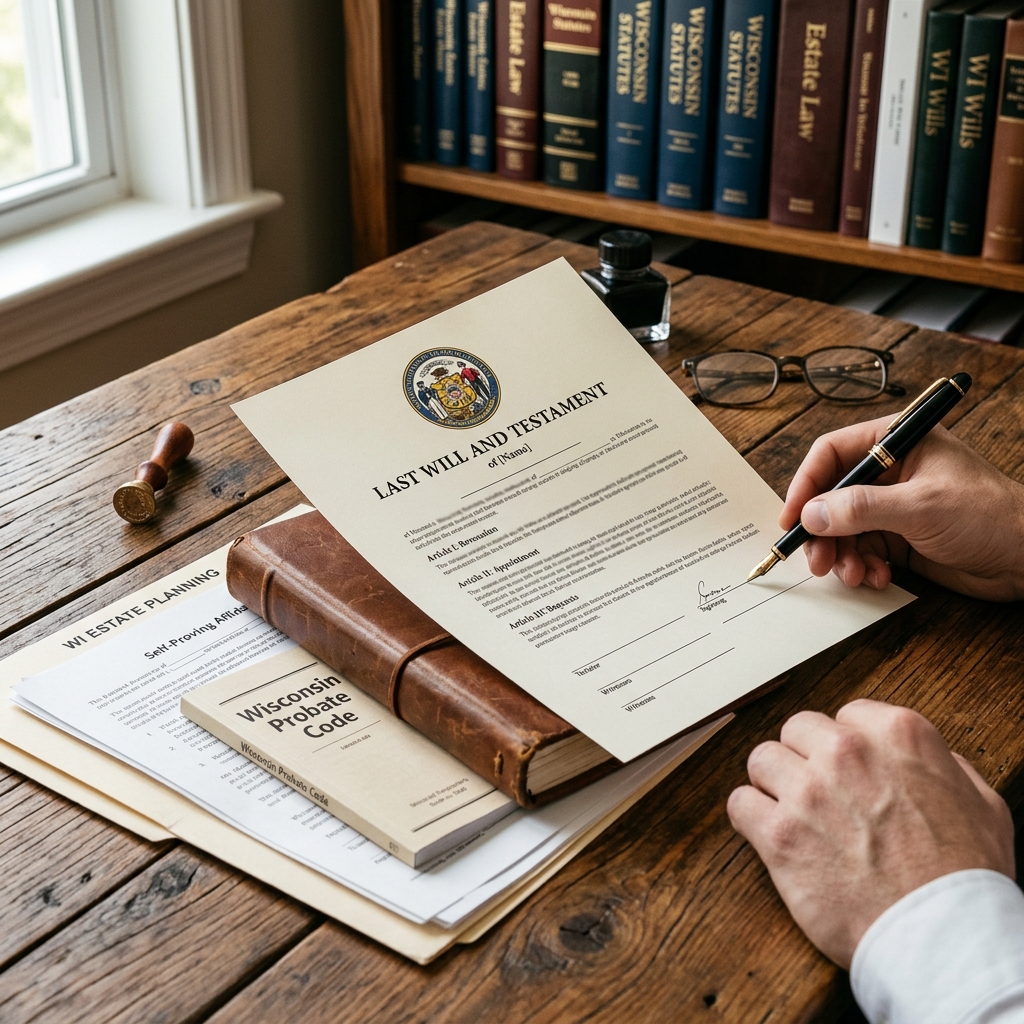
Creating a will in Wisconsin is one of the most effective ways to control what happens to your property and your loved ones after you die. A will allows you to decide who receives your assets, who manages your estate, and who cares for minor children, rather than leaving those decisions entirely to state law and the probate court.
This guide explains the essentials of Wisconsin will laws, including who can make a will, formal legal requirements, what happens without a will, and how to change or validate a will created in another state. It is meant for general information only and is not a substitute for legal advice.
1. What a Will Does in Wisconsin
A will, often called a last will and testament, is a written legal document that expresses a person’s wishes about how their property and other affairs should be handled after death. Under Wisconsin law, the person who makes the will is called the testator.
In Wisconsin, a properly drafted will can:
- Direct the distribution of property – You can specify which individuals, charities, or organizations receive particular assets or shares of your estate.
- Appoint a personal representative (executor) – You can choose a trusted person or institution to manage your estate and ensure your instructions are followed.
- Name guardians for minor children – You can indicate who should care for your children if you die while they are still under 18.
- Address debts and expenses – You can give instructions about paying debts, taxes, and final expenses from your estate.
- Provide for specific gifts – You may leave particular items, such as family heirlooms or sentimental property, to named individuals.
Although a will is powerful, it typically does not control assets that already pass by other means, such as life insurance proceeds with a named beneficiary, retirement accounts with beneficiary designations, or property held in certain types of trusts. A complete estate plan often includes beneficiary designations, trusts, and other tools alongside a will.
2. Who Can Make a Valid Will in Wisconsin?
Wisconsin law sets specific rules about who is legally permitted to make or revoke a will. As a starting point, state statutes provide that any person of sound mind who is 18 years of age or older may make and revoke a will.
To have the legal capacity to create a will in Wisconsin, the testator must:
- Be at least 18 years old (or otherwise legally emancipated).
- Be of sound mind, which generally means they understand the nature of making a will, the property they own, and who would reasonably be expected to inherit that property.
Capacity is important because a will can be challenged in court if someone claims the testator did not understand what they were doing due to mental incapacity, diminished cognition, or an illness at the time of signing. Courts will look at evidence of the person’s condition at or near the time the will was executed.
Voluntariness and Freedom from Undue Influence
In addition to capacity, a Wisconsin will must be made voluntarily. The will cannot be the product of coercion, threats, or undue influence by someone trying to benefit from the estate. If a court finds a will was signed because of pressure or manipulation, parts or all of the will can be invalidated.
- Not under duress – The testator’s decision must be free from physical threats or intimidation.
- Not the result of undue influence – A person in a position of trust must not dominate or control the testator’s decisions to obtain an unfair benefit.
Because of these requirements, many people choose to work with an attorney for drafting and execution, which can help provide evidence that the will was executed appropriately and consciously.
3. Formal Requirements for a Valid Will in Wisconsin
Even if the testator has capacity and acts voluntarily, a will must still comply with Wisconsin’s statutory execution rules to be recognized in probate court. These rules focus on the form of the document and how it is signed.
Core Legal Requirements
Under Wisconsin law and guidance from state institutions, a valid will generally must meet all of the following conditions:
- Written document – The will must be in writing. Wisconsin does not recognize oral (spoken) wills.
- Physical form – As of current law, electronic-only wills are not recognized; it must be a physical written document.
- Signed by the testator – The person making the will must sign it.
- Signed by at least two witnesses – Two competent witnesses must also sign the will.
- Witnesses see or acknowledge the signing – Witnesses typically sign after watching the testator sign, or after the testator acknowledges that the existing signature is theirs.
The Wisconsin Legislature codifies many of these requirements in state statutes, including the requirement that every will be in writing and executed with prescribed formalities. Courts rely heavily on these statutes when determining whether a will is valid during probate.
Role and Selection of Witnesses
Witnesses play a crucial role in validating Wisconsin wills. They help verify that the document was signed by the testator, that the testator appeared to understand what they were signing, and that the signing occurred under appropriate circumstances.
Key points about witnesses include:
- Number of witnesses – At least two witnesses must sign the will.
- Competence – Witnesses must be competent adults, generally meaning they understand the nature of witnessing a legal document.
- Disinterested witnesses recommended – Wisconsin commonly recommends that witnesses not be beneficiaries under the will to avoid conflicts of interest, even though the will may still be valid if they are.
- Presence – Witnesses either see the testator sign or hear the testator state that the signature already on the document is theirs.
Using neutral, disinterested witnesses can reduce the risk of a challenge later based on claims that a beneficiary manipulated the testator or improperly influenced the will’s creation.
Notarization and Self-Proving Affidavits
Wisconsin law does not require a will to be notarized to be valid; the core requirements concern writing, signing, and witnessing. However, many attorneys recommend adding a self-proving affidavit, which is a statement signed by the testator and witnesses in front of a notary.
A self-proving affidavit can help:
- Streamline probate – It may reduce the need for witnesses to testify in court about the circumstances of signing.
- Provide additional evidence of validity – It documents that the will was signed correctly and voluntarily.
4. What Happens If You Die Without a Will (Intestate Succession)
If a Wisconsin resident dies without a valid will, they are said to die intestate. In that situation, state law determines how their assets are distributed, and the court appoints someone to administer the estate.
Court-Appointed Personal Representative
When there is no will, the probate court designates a personal representative (sometimes called an administrator) to manage the estate. This person pays debts and taxes, gathers assets, and distributes property under Wisconsin’s intestate succession rules.
Distribution Rules Without a Will
Wisconsin statutes and public guidance describe how property is distributed among surviving family members when there is no will. While specific outcomes depend on the family situation, the general structure is as follows:
| Family Situation | General Distribution Pattern |
|---|---|
| Surviving spouse or registered domestic partner and children only from that relationship | The spouse or partner typically receives the entire estate. |
| Surviving spouse or partner and children from a prior relationship | The spouse or partner usually receives a portion of marital and individual property, with the remainder divided among all children. |
| No spouse or partner, but surviving children or descendants of children | The estate is distributed among the children or their descendants. |
| No spouse, partner, or descendants of children | Property passes to other relatives in a statutory order: parents, then siblings and their descendants, then grandparents and descendants of grandparents. |
| No identifiable relatives | Assets may ultimately pass to the state. |
Because these default rules may not reflect an individual’s wishes, Wisconsin residents often create wills to ensure that specific people or charities receive property in desired proportions.
5. Changing or Updating a Wisconsin Will
Life circumstances change—marriage, divorce, births, deaths, and financial shifts can all affect estate planning. Wisconsin allows testators to update their wills in more than one way so that documents remain current.
Option 1: Creating a New Will
The most straightforward method to change an estate plan is to draft a new will. When properly executed, a newer will can expressly revoke all prior wills and codicils, thereby replacing earlier versions.
Advantages of a new will include:
- Clarity – A single, updated document avoids confusion about multiple amendments.
- Comprehensive changes – Major adjustments to beneficiaries, executors, or distributions can all be incorporated.
Option 2: Using a Codicil
A codicil is a separate legal document that amends specific portions of an existing will without replacing the entire document. Wisconsin requires a codicil to follow the same formal execution requirements as a will, meaning it must be in writing and properly signed and witnessed.
Codicils may be useful when:
- Only minor changes are needed, such as updating a beneficiary’s name or changing the personal representative.
- The overall structure of the will remains appropriate and does not need complete revision.
However, using multiple codicils over time can be confusing for both the court and family members. Because of this, many estate planning professionals recommend drafting a new will when making significant or numerous changes.
6. Wills Created in Other States and Their Validity in Wisconsin
People move across state lines frequently, raising the question of whether an existing will remains valid after relocation. Guidance from Wisconsin legal organizations indicates that an out-of-state will can be recognized in Wisconsin if it complies with the law of particular places.
Generally, a will is considered valid in Wisconsin if it meets the legal requirements of at least one of the following:
- Wisconsin law
- The law of the place where the will was properly signed
- The law of the place where the testator lived when the will was properly signed
Although this can help avoid the need to rewrite a will immediately after moving, it is still wise to have an attorney review an existing will once you become a Wisconsin resident. Local counsel can confirm that your will works effectively with Wisconsin’s probate rules and your current circumstances.
7. Practical Steps to Create a Will in Wisconsin
Several practical pathways exist for drafting a Wisconsin-compliant will, ranging from full legal representation to more do-it-yourself approaches. The key is ensuring strict adherence to legal requirements so the will stands up in court.
Common Approaches
- Working with an attorney – An estate planning lawyer can ask detailed questions about your property, family situation, and goals, draft a tailored will, and supervise proper signing and witnessing.
- Using approved forms or templates – Educational resources and legal form repositories may provide standard will templates designed for Wisconsin law.
- Online tools and apps – Some highly reviewed digital tools can help create a will, but users must still follow Wisconsin’s requirements for printing, signing, and witnessing.
Information Often Included in a Will
While individual documents will differ, a typical Wisconsin will may include:
- Testator’s full name and address.
- Appointment of a personal representative (executor).
- Identification of beneficiaries and their relationship to the testator.
- Specific bequests of property or money.
- Instructions for distribution of the remainder of the estate (the residuary estate).
- Guardianship provisions for minor children.
- Signatures of the testator and two witnesses, and possible self-proving affidavit.
Regardless of the method chosen, careful attention to Wisconsin’s statutory rules is crucial to avoid unintended invalidity or disputes among heirs.
8. Frequently Asked Questions About Wisconsin Wills
FAQ 1: Do I need a lawyer to make a valid will in Wisconsin?
Wisconsin law does not require you to use a lawyer to create a will. However, because statutes impose specific requirements and estate situations can be complex, many people rely on attorneys or qualified legal forms to reduce the risk of errors and disputes.
FAQ 2: Are handwritten wills valid in Wisconsin?
Handwritten wills can be valid if they meet all Wisconsin requirements: they are in writing, signed by the testator, and signed by at least two witnesses. Oral wills and purely electronic wills are not recognized, and digital signatures alone are not sufficient.
FAQ 3: Must my will be notarized?
Notarization is not required for validity. A will becomes legally effective based on proper writing, signing, and witnessing. Nonetheless, adding a notarized self-proving affidavit can make probate smoother by providing additional proof of valid execution.
FAQ 4: How often should I review my will?
Many estate planning resources recommend reviewing your will after major life events—such as marriage, divorce, the birth or adoption of a child, or significant changes in assets—and periodically even without major changes. If updates are needed, you can create a new will or add a codicil, following Wisconsin’s formal requirements each time.
FAQ 5: What happens to my estate if I have no spouse, partner, or children?
Without a will, Wisconsin intestate laws direct your estate to other relatives in an ordered list: parents first, then siblings and their descendants, followed by grandparents and their descendants. If no relatives can be found, property may eventually pass to the state.
References
- Wisconsin Legislature: Chapter 853 – Wills — Wisconsin Legislature. 2023-01-01. https://docs.legis.wisconsin.gov/document/statutes/853
- Capacity to make or revoke a will; execution formalities — Wisconsin Legislature, Stat. 853.01 & 853.03. 2023-01-01. https://docs.legis.wisconsin.gov/document/statutes/853.03
- Wills/Estate Planning — State Bar of Wisconsin. 2022-06-15. https://www.wisbar.org/forPublic/INeedInformation/pages/wills-estate-planning.aspx
- Trusts and Wills — Wisconsin State Law Library. 2021-09-10. https://wilawlibrary.gov/topics/estate/wills.php
- What is a Will? Why Is It Important To Have One? — University of Wisconsin-Madison Division of Extension. 2022-03-01. https://finances.extension.wisc.edu/articles/what-is-a-will-why-is-it-important-to-have-one/
- What makes a will valid in Wisconsin? — Krause Estate Planning & Elder Law Firm. 2023-05-12. https://estateplanningpeople.com/blog/what-makes-a-will-valid-in-wisconsin/
- What Are the Legal Requirements for Signing a Will in Wisconsin? — Peterson, Berk & Cross, S.C. 2023-02-20. https://www.pbclaw.com/what-are-the-legal-requirements-for-signing-a-will-in-wisconsin/
Similar Articles








Read full bio of medha deb


