
Understanding U.S. State Legal Holiday Laws
A practical guide to how federal and state legal holidays affect workplaces, pay, and employee rights across the United States.
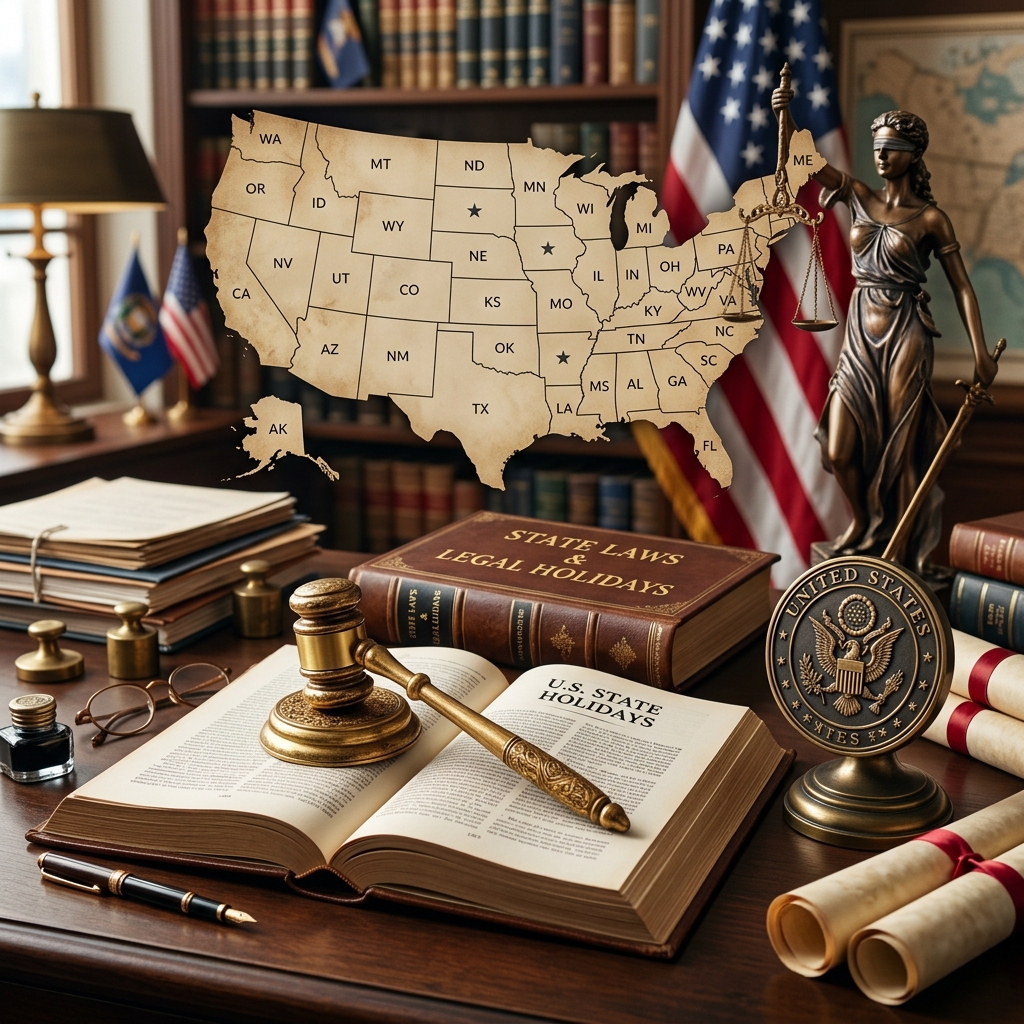
In the United States, holidays might seem simple on the surface—government offices close, schools shut down, and many workers enjoy a day off. In reality, the rules that determine whether a day is a legal holiday, whether employees must be paid, and which workplaces must close, vary significantly between the federal government and individual states. This guide explains how legal holidays are defined, how state laws interact with federal rules, and what both employers and employees need to know about time off and holiday pay.
Federal Holidays vs. State Legal Holidays
The starting point for understanding state legal holiday laws is the distinction between federal holidays and state holidays. Federal holidays are designated by Congress in federal law and primarily affect federal government operations and employees. State legal holidays, by contrast, are created through state statutes or regulations and can impose different obligations on state agencies, courts, and sometimes private employers.
| Type of Holiday | Who Sets It? | Main Impact |
|---|---|---|
| Federal holiday | U.S. Congress | Affects federal government agencies and employees nationwide; widely observed by many private employers but not legally mandated. |
| State legal holiday | State legislature or state-level authority | Affects state government offices, courts and, in some states, may influence school schedules or special rules for private workplaces. |
| Local or regional holiday | County, city, or special district | Applies to local government bodies and, occasionally, certain local businesses. |
There are currently 11 federal holidays recognized under federal law, including New Year’s Day, Memorial Day, Independence Day, Labor Day, Thanksgiving Day, and Christmas Day. Many of these dates are also treated as legal holidays by individual states, but states can add their own observances and may attach different consequences to those days.
How Federal Holiday Law Works
Federal holidays are codified in Title 5 of the United States Code and apply primarily to federal government employees. On those days, federal offices generally close and covered employees receive a paid day off or an alternative day of leave when holidays fall on weekends.
Common features of federal holidays include:
- Paid time off for federal employees: Most full-time federal workers receive pay for federal holidays even when they do not work on those days.
- Closure of federal offices: Agencies, federal courts, and many government facilities close or operate on limited schedules.
- No automatic rule for private employers: Federal law does not require private companies to close or provide paid time off on federal holidays.
Although federal law does not dictate private-sector practices, many large employers voluntarily follow the federal holiday calendar. Research indicates that virtually all large companies close and provide paid time off on the major holidays such as New Year’s Day, Independence Day, Labor Day, Thanksgiving, and Christmas.
State Legal Holidays: What They Typically Cover
Each state maintains its own list of legal or public holidays. These dates are used for a variety of purposes, including court scheduling, government office closures, and recognition of historical or cultural events.
State legal holiday statutes commonly address:
- Closure of state government offices: Agencies and departments usually close or operate on reduced hours.
- Court schedules: State courts may not hold sessions or may treat legal holidays differently for filing and deadline purposes.
- School calendars: Some holidays are built into public school schedules or trigger automatic school closures.
- Recognition of regional events: States often create unique holidays such as Patriots’ Day in Massachusetts and Maine, Pioneer Day in Utah, or Cesar Chavez Day in states with strong connections to labor and civil rights movements.
Importantly, many state legal holiday laws focus on government operations rather than private sector requirements. Unless a state’s statute explicitly regulates private employers, a legal holiday designation by itself usually does not guarantee private employees a paid day off.
Do Employers Have to Offer Paid Holidays?
One of the most common questions is whether employers are legally required to provide paid time off for holidays. At the federal level, the answer is straightforward: the Fair Labor Standards Act (FLSA) does not require payment for time not worked, including holidays. This means private employers generally are not required under federal law to offer paid holidays, holiday premiums, or extra pay for working on a holiday.
Key points regarding holiday pay obligations:
- No federal requirement for paid holidays: Federal wage and hour law does not mandate paid time off for any holiday.
- State exceptions are limited: Some states have specific rules for certain industries or retail operations on particular holidays, but broad statewide requirements for paid holiday leave are uncommon.
- Company policy controls: Most private employers decide which holidays to observe and whether to provide pay or premium rates based on internal policies or collective bargaining agreements.
Nonetheless, offering paid holidays is standard practice, especially among large employers. Studies and labor market analyses consistently show that major private companies typically close and provide pay on core holidays such as New Year’s Day, Memorial Day, Independence Day, Labor Day, Thanksgiving, and Christmas, even though they are not required by federal law to do so.
Common State-Level Variations
While federal law sets the baseline, state legal holiday laws introduce significant variation. Some states have more extensive holiday calendars and may recognize occasions not observed at the federal level. Others adopt alternative names or frameworks for federal holidays.
Examples of state differences include:
- Additional cultural or regional holidays: Certain states recognize days like Cesar Chavez Day (in California, Texas, and Arizona), Patriots’ Day (in Massachusetts and Maine), Pioneer Day (in Utah), and Election Day as legal holidays or days with special rules.
- Alternative holiday names: Some states observe Indigenous Peoples’ Day instead of or alongside Columbus Day, reflecting evolving perspectives on historical commemoration.
- Different treatment of federal holidays: A federal holiday may be treated as a full legal holiday, partial holiday, or ordinary business day depending on the state’s statutes and regulations.
When a day is classified as a legal holiday in a particular state, that classification usually affects how government-related deadlines are calculated. For example, statutory filing deadlines that land on a legal holiday may roll forward to the next business day. State legal holiday definitions also influence banking schedules, public school calendars, and administrative office hours.
Industry-Specific and Retail Holiday Rules
Some states use legal holidays to regulate particular industries. Retail scheduling, alcohol sales, and public safety operations are common areas where states may impose restrictions or special requirements.
Potential state-level rules that can affect private employers include:
- Limitations on holiday retail operations: Certain jurisdictions restrict large retail stores from opening on specific holidays, such as Thanksgiving or Christmas, or require reduced hours.
- Special pay rules in limited sectors: A small number of states and localities require premium pay or compensatory time when employees in designated industries work on certain holidays.
- Licensing and sales restrictions: Some states regulate sales of specific goods—such as alcoholic beverages—on legal holidays.
These rules are highly state-specific, so employers should carefully review applicable statutes and consult legal counsel or state labor agencies for guidance on holiday operations in each location where they operate.
How Employers Typically Structure Holiday Benefits
Because federal law leaves substantial flexibility to private employers, holiday practices are primarily shaped by business policy, collective bargaining agreements, and competitive labor market norms. Many employers develop written policies that specify which holidays are recognized and how employees are compensated.
Common employer approaches include:
- Standard holiday calendars: Recognizing major federal holidays such as New Year’s Day, Memorial Day, Independence Day, Labor Day, Thanksgiving, and Christmas, with paid time off for eligible employees.
- Floating or personal holidays: Allocating flexible days that employees can use for religious or cultural observances not on the company calendar.
- Holiday premium pay: Offering extra pay (such as time-and-a-half) to employees who work on designated holidays, even when not legally required.
- Shift adjustments and alternate days: Providing an alternate day off if a holiday falls on a non-working day or on an employee’s scheduled day off.
Employers also consider operational needs. Essential services—such as healthcare, transportation, and critical infrastructure—often require staffing on holidays, leading to reliance on differential pay, rotating holiday schedules, or negotiated agreements with unions.
Employee Rights and Practical Tips
Employees often assume that a legal holiday automatically entitles them to time off or extra pay, but the reality depends on a combination of federal law, state law, and employer policy. Understanding the framework can help workers advocate for themselves and know when to seek legal advice.
Practical tips for employees include:
- Review your employment contract and handbook: Many holiday rights arise from written policies, collective bargaining agreements, or contracts rather than statutory mandates.
- Check state law for special provisions: Some states may provide limited protections or rights in particular sectors or for specific holidays, especially for public employees.
- Clarify overtime and premium pay: Overtime under the FLSA is based on hours worked, not on whether a day is a holiday. Holiday premium pay is usually a matter of employer policy unless a state-specific law applies.
- Consider religious or cultural observances: Even when a holiday is not on the employer calendar, employees may have rights under federal and state anti-discrimination laws to request reasonable accommodations for sincerely held religious beliefs.
When disputes arise—for example, over promised holiday pay or denial of agreed time off—employees may seek guidance from state labor departments, legal aid organizations, or employment law attorneys. Documentation of employer policies and past practices is often critical in resolving such issues.
Emerging Trends: New Holidays and Changing Observances
Holiday law and practice continue to evolve. One major recent development is the designation of Juneteenth National Independence Day as a federal holiday, commemorating the end of slavery for Black Americans. Juneteenth became a recognized federal holiday in 2021, and within the first years of observance, a growing share of private employers began offering paid time off for the day.
Other trends include:
- Increasing recognition of Indigenous Peoples’ Day: A number of states and local governments have shifted focus from Columbus Day to holidays that honor Indigenous communities and histories.
- Greater flexibility in holiday scheduling: Employers are adopting more inclusive holiday policies that allow employees to choose observances aligned with their traditions and beliefs.
- Attention to voter participation: Some states treat Election Day as a holiday or provide time-off rules to facilitate voting, recognizing the importance of civic engagement.
These developments illustrate how legal holidays can reflect changing social values and priorities. For employers and employees, they also underscore the need to stay informed about evolving laws and company practices.
FAQs About State Legal Holiday Laws
Are private employers required to close on legal holidays?
In most situations, private employers are not legally required to close on federal or state legal holidays. Federal law does not mandate closures or paid time off, and state legal holiday statutes often focus on government operations rather than private businesses. However, specific state or local rules may apply to certain industries, so employers should review applicable laws.
Do employees have a right to extra pay for working on a holiday?
Under the Fair Labor Standards Act, employees are entitled to overtime pay when they work more than 40 hours in a workweek, but federal law does not require higher pay simply because work occurs on a holiday. Holiday premium pay is typically governed by employer policy or collective bargaining agreements, unless a particular state law requires higher rates in specified circumstances.
What is the difference between a legal holiday and a company holiday?
A legal holiday is established by statute or official government action and primarily affects government offices, courts, and statutory deadlines. A company holiday is a day that an employer chooses to recognize, often by closing operations or awarding paid time off. Company holidays may follow the legal calendar but are not necessarily identical.
Do state legal holidays affect court deadlines?
Yes. State legal holiday definitions are significant for court systems and legal practice. Deadlines for filing documents or performing required actions that fall on a legal holiday are often extended to the next business day by rule or statute. Lawyers and litigants must pay close attention to how each jurisdiction defines and treats legal holidays.
How can employers ensure compliance with holiday-related rules?
Employers should maintain up-to-date, written holiday policies; review federal and state wage and hour laws; monitor industry-specific regulations; and consult legal counsel when expanding into new jurisdictions. Regularly updating employee handbooks and training managers on holiday scheduling and pay practices can help reduce risk and ensure consistent application.
References
- American holidays — U.S. General Services Administration / USA.gov. 2024-01-05. https://www.usa.gov/holidays
- Federal holidays in the United States — U.S. Code Title 5, summarized by Wikipedia. 2023-11-10. https://en.wikipedia.org/wiki/Federal_holidays_in_the_United_States
- Public holidays in the United States — Summary of U.S. public holiday practices. 2023-08-15. https://en.wikipedia.org/wiki/Public_holidays_in_the_United_States
- Public Holidays in the USA in 2025: Federal and State Observances Explained — TimeOff.Management Blog. 2024-06-01. https://timeoff.management/blog/public-holidays-in-the-usa-in-2025-federal-and-state-observances-explained
- U.S. Paid Holidays by Law: a Guide for HR and Comms Leaders — Pyn. 2022-09-20. https://www.pynhq.com/library/moment/paid-holidays-by-law-in-the-united-states/
Similar Articles








Read full bio of Sneha Tete




