
Understanding Section 230: Free Speech, Liability, and the Future of Online Platforms
How Section 230 shields online services, shapes content moderation, and influences the future of digital free expression.
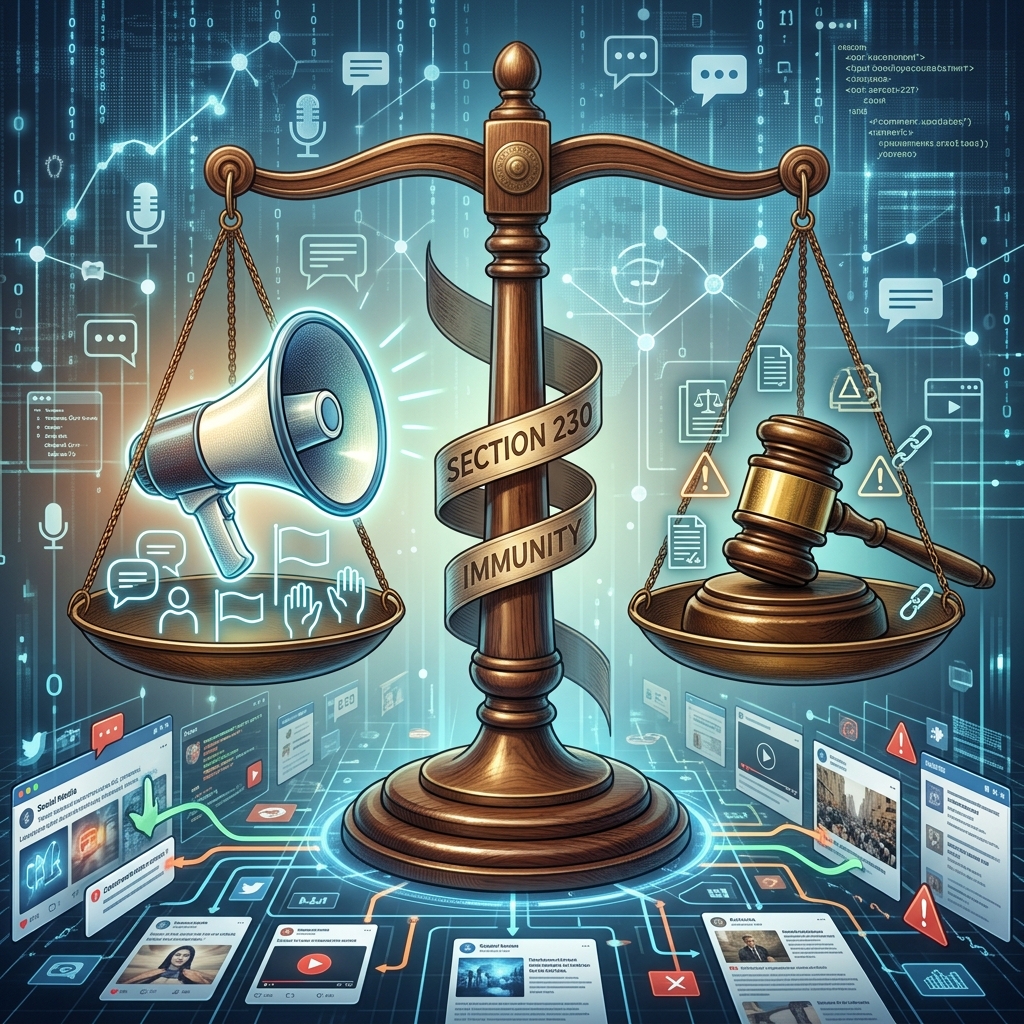
Section 230 of the Communications Decency Act is one of the most important and most contested laws governing how speech works on the internet. It both shields online services from being sued over most user content and encourages them to moderate harmful material, making it central to debates about free expression, safety, and platform power.
What Section 230 Is and Where It Comes From
Section 230 is a provision in the federal Communications Act, originally enacted in 1996 as part of the broader Communications Decency Act. Its core purpose was to support the early growth of the internet by making clear that online services are generally not legally responsible for most of what users say or share on their platforms.
At the heart of Section 230 are two key legal protections:
: Online services and their users are not treated as the “publisher or speaker” of information posted by someone else. - Protection for moderation: Services can remove or restrict access to certain objectionable material in good faith, without incurring civil liability simply for moderating content.
These protections were designed to encourage innovation and allow the internet to function as an open forum, while still permitting platforms to remove harmful material when they choose to do so.
Key Terms in Section 230 Explained
| Term | Meaning under the statute | Practical example |
|---|---|---|
| Interactive computer service | Any service, system, or access software provider that allows multiple users to access a computer server, including internet services, websites, social networks, and systems operated by libraries or educational institutions. | A social media platform, web forum, or library-provided Wi‑Fi network. |
| Information content provider | A person or entity that creates or develops the content displayed online. | A user who writes a post or uploads a video. |
| Publisher or speaker | The legal role associated with responsibility for the content, such as a newspaper publishing an article or a speaker making a statement. | Traditionally, a newspaper is the publisher of articles it prints; Section 230 says a hosting platform is not the publisher of user posts. |
| Good faith moderation | Actions taken honestly and reasonably to restrict access to material considered obscene, violent, harassing, or otherwise objectionable. | Removing hate speech or blocking spam accounts based on a platform’s policies. |
The Two Core Protections: Sections 230(c)(1) and 230(c)(2)
Section 230(c)(1): Shielding Platforms from Liability for User Content
Section 230(c)(1) states that no provider or user of an interactive computer service shall be treated as the publisher or speaker of information provided by another information content provider. This has been interpreted by courts to grant broad immunity to online services when they host content created by third parties.
In practice, this provision means:
- Users are largely responsible for their own posts, comments, and uploads.
- Platforms generally cannot be sued as if they had written or endorsed that user content, in most civil cases.
- Services can host vast quantities of user-generated material without being required to pre-screen everything for legal risk.
Courts typically apply a three-part test to determine whether Section 230 immunity applies:
- The defendant must be an interactive computer service.
- The claim must treat the defendant as a publisher or speaker of the content at issue.
- The content must be provided by another information content provider, not created or developed by the defendant itself.
Section 230(c)(2): Encouraging Good Faith Content Moderation
Section 230(c)(2) provides separate protection for actions taken to limit access to certain categories of content, including material considered obscene, excessively violent, or otherwise objectionable, whether or not it is constitutionally protected.
This provision allows platforms to:
- Remove or restrict harmful or unwanted content without being treated as legally responsible for having done so.
- Offer tools that let users or other providers filter or block such material.
- Develop moderation policies that reflect their own community standards.
By combining immunity for hosting content with protections for removing content, Section 230 seeks to balance free expression with safety and the ability of platforms to manage their services.
How Section 230 Supports Free Expression Online
Section 230 is often described as the legal backbone of modern social media and user-generated content sites. By protecting intermediaries—such as platforms, forums, and service providers—it reduces the legal risk of hosting diverse opinions and information. This in turn makes it possible for users to speak, organize, and share experiences at scale.
From a free speech perspective, the law:
- Prevents chilling effects: Without Section 230, platforms might avoid hosting controversial or unpopular views for fear of lawsuits over users’ statements.
- Enables small and medium services: Startups and non-profit projects can operate without the same legal resources as large media companies, because they are not treated as publishers of user content.
- Allows targeted moderation: Sites can remove harmful material without automatically assuming legal responsibility for everything else they host.
These features help ensure that online spaces function more like open forums or common carriers of information than traditional publishers, at least from the perspective of civil liability.
Important Limits and Exceptions to Section 230
Section 230 immunity is broad, but it is not absolute. The statute itself and subsequent legal interpretation place important limits on when platforms are protected.
Statutory Exceptions
Section 230 does not shield platforms from:
- Federal criminal law: The statute explicitly preserves enforcement of federal criminal statutes, meaning platforms can still be prosecuted where applicable.
- Intellectual property claims: Claims based on copyright or certain other intellectual property laws are generally not covered by Section 230 immunity.
- Specific federal statutes: Congress has, at times, enacted targeted laws that modify or limit Section 230 in defined contexts.
In addition, Section 230 does not protect platforms from suits over material that is independently unlawful, such as child sexual abuse material, which is prohibited by other federal and state statutes.
When a Platform Becomes a Content Provider
If a service itself creates or materially develops the harmful content at issue, it may be considered an information content provider for that content and lose Section 230 protection as to those particular statements.
Examples include:
- Writing a defamatory article directly.
- Altering user content in a way that adds unlawful elements.
- Publishing proprietary editorial material rather than hosting user submissions.
In such cases, the platform is treated like any other speaker or publisher and may be subject to ordinary liability rules.
Algorithms, Recommendations, and Section 230
Modern platforms rely heavily on algorithms to organize and recommend user content. Courts have generally been asked to decide whether Section 230 immunity applies when harmful content is promoted through automated recommendations rather than simply hosted.
Recent cases have tended to reaffirm that platforms remain protected under Section 230 even when their algorithms recommend or sort third-party material, so long as the underlying content was created by users rather than by the service itself.
Key points regarding algorithms include:
- Recommendations typically rely on ranking and personalization of existing user content.
- Courts have treated these processes as part of publishing functions covered by Section 230, at least in many contexts.
- Some policy proposals question whether algorithmic amplification should be treated differently, but legal doctrine remains focused on who created the content and whether the claim targets publishing activity.
Separately, the First Amendment protects platforms’ own editorial choices, including algorithmic decisions, as a form of speech or expressive conduct, although that question is still being developed in constitutional law.
Why Section 230 Matters for Libraries, Schools, and Small Services
Section 230’s definition of “interactive computer service” explicitly includes systems operated by libraries and educational institutions. This means that entities beyond large social media companies rely on the law to support their public missions.
For example, libraries and schools may:
- Provide public Wi‑Fi and computer terminals.
- Host discussion boards or local community forums.
- Offer digital repositories and collaborative research spaces.
Thanks to Section 230, these institutions can allow community members to share information and engage in public discourse without assuming liability for every statement that users make, while still applying moderation policies to remove harmful material.
Ongoing Debates and Proposals to Reform Section 230
As the role of major platforms has grown, Section 230 has come under renewed scrutiny. Lawmakers and regulators are considering whether the current balance between immunity, moderation, and accountability remains appropriate in an era of pervasive social media, targeted advertising, and algorithmic feeds.
Concerns Raised by Critics
Common criticisms of the current framework include arguments that:
- Platforms may not have sufficient incentives to remove harmful content, such as disinformation or harassment, because they face limited liability.
- Large services wield significant power over public discourse, yet are shielded from many legal consequences for how they design and manage their systems.
- Victims of online harms sometimes have limited recourse when the responsible individuals are difficult to identify, while platforms remain legally protected.
Reform Ideas and Legal Proposals
Policy discussions have included proposals to:
- Narrow immunity where platforms knowingly facilitate unlawful conduct.
- Condition certain protections on reasonable content moderation practices.
- Create new obligations for transparency around algorithms and enforcement decisions.
- Introduce sunset provisions or comprehensive reviews to re-evaluate the law in light of technological change.
Some proposals have suggested terminating or significantly modifying Section 230 by a specified date, which would require Congress to adopt a new standard of liability for online services or risk substantial legal uncertainty.
Parents, Users, and Practical Implications
Section 230 also interacts with practical choices that individual users and parents make regarding online safety. The statute encourages providers to inform customers about parental control tools that can help limit access to harmful material for minors.
In practical terms, this means:
- Platforms often offer filtering, blocking, and reporting tools for users.
- Parents can use hardware, software, or service-based controls to manage what children see online.
- Users and families remain central decision-makers in how they engage with online content.
At the same time, Section 230 does not relieve platforms of all responsibility; they must comply with applicable criminal laws, intellectual property rules, and other specific obligations established by Congress or regulators.
Frequently Asked Questions About Section 230
Does Section 230 mean platforms can never be sued?
No. Section 230 primarily protects against certain civil claims that treat platforms as publishers of user content, but it does not shield services from federal criminal law or intellectual property claims, and it does not apply when the service itself creates the harmful content.
Is Section 230 a free speech law or a liability rule?
Section 230 is a liability rule that indirectly supports free speech. By limiting when platforms can be sued over user content, it reduces the incentive to over-censor lawful expression and encourages the maintenance of open forums.
Does Section 230 force platforms to host any content?
No. The law does not require services to carry specific speech. Instead, it gives them protection when they choose to moderate or remove content they consider objectionable, as long as they act in good faith.
Are algorithms treated differently under Section 230?
Courts have generally continued to apply Section 230 to platforms even when they use algorithms to recommend third-party content, so long as the claims still target the hosting or publishing of that content rather than separate unlawful conduct.
Could changing Section 230 affect small websites and community forums?
Yes. Any significant reduction in immunity could increase legal risk not only for large social media platforms but also for small websites, non-profits, libraries, and educational institutions that host user-generated content, potentially leading some to restrict or close interactive features.
References
- 47 U.S. Code § 230 – Protection for private blocking and screening of offensive material — Legal Information Institute, Cornell Law School. 2024-01-01. https://www.law.cornell.edu/uscode/text/47/230
- Section 230 — Electronic Frontier Foundation. 2023-06-01. https://www.eff.org/issues/cda230
- Section 230 — Wikipedia (summarizing statutory text and case law; underlying citations to official and academic sources). 2024-03-01. https://en.wikipedia.org/wiki/Section_230
- Section 230 and Libraries — Association of Research Libraries. 2022-09-15. https://www.arl.org/section-230/
- Section 230 of the Communications Decency Act Under Fire Once Again — Wood, Smith, Henning & Berman LLP. 2024-05-10. https://www.wshblaw.com/publication-section-230-of-the-communications-decency-act-under-fire-once-again
- The Future of Section 230: What Does It Mean For Consumers? — National Association of Attorneys General. 2023-11-01. https://www.naag.org/attorney-general-journal/the-future-of-section-230-what-does-it-mean-for-consumers/
- Department of Justice’s Review of Section 230 of the Communications Decency Act of 1996 — U.S. Department of Justice. 2020-06-17. https://www.justice.gov/archives/ag/department-justice-s-review-section-230-communications-decency-act-1996
Similar Articles








Read full bio of Sneha Tete


