
Understanding Open Carry Laws Across the United States
A practical, state-by-state overview of open carry rules, permits, restrictions, and key safety considerations for gun owners.
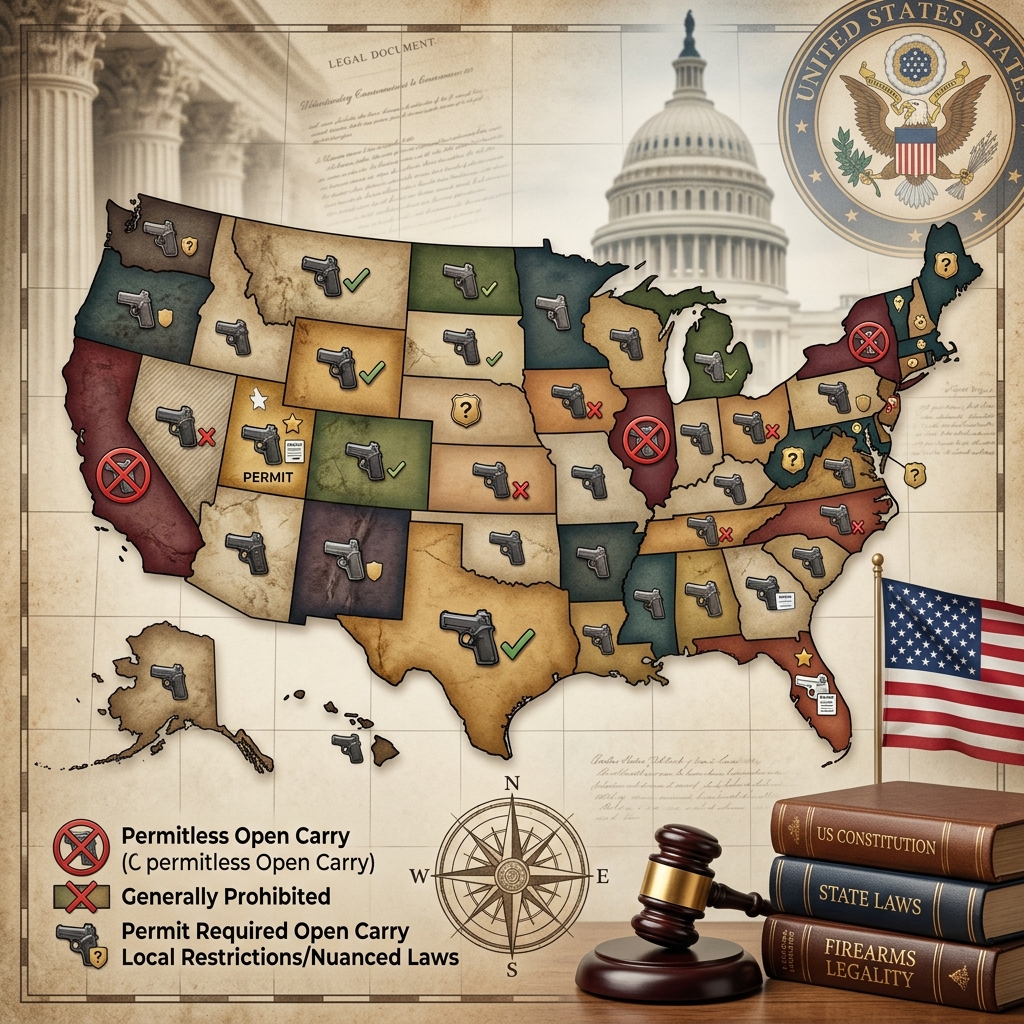
Open carry laws govern when and where people may visibly carry firearms in public, and these rules differ dramatically from one state to another. While most states allow some form of open carry, a handful either prohibit it outright or require a permit and impose significant restrictions. This article explains the main approaches states take to open carry, highlights where permits are needed or open carry is banned, and offers guidance for staying compliant and safe.
What Does “Open Carry” Mean?
Open carry generally refers to visibly carrying a firearm in public—typically a handgun in a holster that is not concealed under clothing. Long guns such as rifles and shotguns can also be carried openly, though many states treat them differently from handguns and impose separate rules. In contrast, concealed carry involves carrying a firearm in a way that is not apparent to ordinary observers, usually under clothing or in a bag.
- Visible firearm: The weapon is plainly observable to a typical person in public.
- Public location: Sidewalks, streets, stores, parks, and other common areas, as opposed to private property.
- Handguns vs. long guns: States often regulate handguns more strictly than rifles and shotguns for open carry.
Although the basic concept is straightforward, the legal details—such as whether a permit is required, which firearm types are covered, and where carry is allowed—are highly state-specific.
Major Policy Models: How States Regulate Open Carry
Broadly, states fall into three main categories in terms of open carry policy.
- Permitless open carry: Open carry is generally allowed for eligible adults without a carry permit.
- Licensed or conditional open carry: Open carry is allowed only with a permit or subject to substantial conditions.
- Non-permissive states: Open carry of handguns in public is largely prohibited.
Within each category, states may add more layers, such as bans in specific locations, restrictions on long guns, or allowing local governments to adopt stricter rules.
Permitless Open Carry States
Most U.S. states now allow adults who are legally permitted to possess firearms to openly carry handguns without requiring a specific carry license. These systems are often referred to as permitless carry or constitutional carry.
Common features include:
- No general state permit requirement to openly carry a handgun.
- Minimum age requirements, often 18 or 21, based on state and federal law.
- Prohibitions for people barred from possessing firearms (e.g., certain criminal convictions).
- Location-based restrictions, such as bans in schools or government buildings.
States like AlabamaIndiana
Licensed or Conditional Open Carry States
A smaller group of states allows open carry but only under specific conditions, such as obtaining a license, limiting open carry to certain firearm types, or restricting open carry in particular public places.
Typical approaches include:
- License required for handguns: States like HawaiiMassachusetts
- Different rules for long guns: Some states permit open carry of long guns while tightly regulating handguns, or vice versa.
- Location-based limits: Open carry may be legal in much of the state but restricted in specific cities or sensitive locations.
These states often tie open carry to existing concealed carry permits, meaning the same license authorizes both concealed and open carry in certain circumstances.
States That Significantly Restrict or Ban Open Carry
A few jurisdictions largely ban open carry of handguns in public, either through statewide prohibitions or extensive restrictions that effectively prevent most public open carry.
Notable characteristics:
- General prohibition on open carry of handguns in public spaces.
- Narrow exceptions, such as on private property or for certain licensed activities.
- Separate rules for long guns that may still allow some forms of open carry.
States such as CaliforniaIllinoisNew York have some of the most restrictive policies, and are frequently cited as jurisdictions that do not allow typical public open carry of handguns.
Comparing Approaches: Permits, Prohibitions, and Local Control
The following table gives a high-level view of how many states fall into each category based on public open carry of handguns.
| Category | General Description | Approximate Number of States* |
|---|---|---|
| Permitless open carry | Handgun may be carried openly without a state carry license, subject to eligibility and location rules. | Majority of states (around two dozen or more). |
| Licensed / conditional open carry | Open carry allowed only with a permit or under specific conditions (e.g., long guns only, limited locations). | Roughly 10–15 states. |
| Highly restrictive / generally prohibited | Public open carry of handguns largely banned, with limited exceptions. | A small group of states plus D.C. |
*State counts are approximate because laws change, and some states use complex location-based or firearm-type distinctions.
Handguns vs. Long Guns: Different Rules, Different Risks
Open carry laws often treat handguns and long guns differently, reflecting distinct policy concerns and historical practices.
Handgun Open Carry
Handguns are more commonly carried for personal defense and therefore are the primary focus of most open carry statutes.
- Many states allow permitless open carry of handguns, subject to age and eligibility requirements.
- Several states require a license to openly carry a handgun or restrict handgun open carry altogether.
- Openly carried handguns may be subject to additional rules in certain cities or sensitive locations.
Open Carry of Rifles and Shotguns
Long guns are sometimes treated more permissively, but not always. According to policy analyses, some states specifically restrict open carry of long guns.
- Four states and the District of Columbia generally ban open carrying of long guns in public.
- Several other states impose regulations such as requiring long guns to be unloaded when carried openly, or limiting carry in certain cities.
- In many states, openly carrying a long gun in public is legal, but still subject to location and conduct restrictions.
Because long guns can be more visible and intimidating in public spaces, some jurisdictions have moved to restrict open carry of rifles and shotguns to reduce risks and public alarm.
Location-Based Restrictions: Where Open Carry Is Commonly Banned
Even in states that broadly authorize open carry, lawmakers often exclude certain locations because of safety and security concerns.
Commonly restricted locations include:
- Schools and childcare facilities: Many states prohibit firearms on K–12 school grounds, with limited exceptions.
- Government buildings: Courthouses, legislative chambers, and administrative offices frequently ban open carry.
- Places serving alcohol: Bars, nightclubs, and some restaurants may be off-limits or subject to special rules.
- Public transportation: Some states restrict carrying firearms on buses, trains, and transit systems.
- Specific cities or dense urban areas: A few states allow local governments to impose tighter rules in populous cities.
Violating location-based bans can lead to criminal charges even if open carry is generally lawful elsewhere in the state. Gun owners must pay attention not only to state statutes but also to posted signs and local ordinances where applicable.
State Preemption and Local Variations
Another important factor is whether a state preempts local firearm regulations. Preemption laws prevent cities and counties from enacting their own gun rules that are stricter than state law.
Key points:
- Some states have strong preemption, creating uniform open carry rules statewide.
- Other states allow local governments to regulate firearms more strictly than state law, leading to patchwork rules.
- In states without comprehensive preemption, carrying openly in one county may be legal but restricted or prohibited in a neighboring city.
This variability makes it essential for gun owners to research not just state statutes but also local codes and city ordinances, especially in states known for complex or locally driven firearm regulations.
Eligibility, Age Limits, and Background Restrictions
Open carry privileges are also shaped by who is legally eligible to possess firearms. Federal and state laws both play a role.
Federal Baseline
Under federal law, certain individuals are prohibited from possessing firearms at all, including some people with felony convictions, specific domestic violence offenses, or certain mental health adjudications. States must honor these federal restrictions.
State-Specific Requirements
States may go beyond federal law and impose additional conditions:
- Minimum age: Many states set 18 or 21 as the minimum age to carry handguns, whether openly or concealed, particularly where permitless carry is allowed.
- Permit screening: In licensed open carry states, background checks and sometimes training requirements are part of the permit process.
- Special rules for veterans or active-duty service members: Some states allow younger service members or veterans to carry under different age thresholds.
Because eligibility criteria can be detailed, anyone considering open carry should review state statutes or consult authoritative legal resources before carrying in public.
Practical Safety and Legal Compliance Tips
Even where open carry is legal, carrying a firearm visibly in public demands careful attention to safety, public perception, and legal risk.
- Study current law: Laws change frequently. Check updated state statutes or authoritative summaries rather than relying on outdated information.
- Understand local rules: In states allowing local regulation, verify city and county ordinances before carrying.
- Use secure holsters: A sturdy holster that retains the firearm helps prevent accidental drops and unauthorized grabs.
- Avoid confrontational behavior: Brandishing or using a firearm to intimidate others may be illegal even if open carry itself is allowed.
- Know sensitive locations: Memorize or keep a list of common places where firearms are restricted, and watch for posted prohibitions.
Responsible open carry also involves awareness of how others may react; even legal conduct can cause alarm if not handled calmly and carefully.
Frequently Asked Questions About Open Carry
Is open carry legal in most U.S. states?
Yes. Most states allow some form of open carry of handguns, either without a permit or with a license requirement, although the details differ widely.
Which states generally prohibit open carry of handguns?
Only a small number of states significantly restrict or broadly prohibit open carry of handguns in public, often including jurisdictions such as California, Illinois, New York and the District of Columbia. Some states have also recently adopted bans or strong limitations on open carry.
Do I need a permit to open carry?
In many states, no permit is required to openly carry a handgun for eligible adults, but other states insist on a license or impose conditions like limiting open carry to long guns. Always consult your state’s statutes for current requirements.
Are long guns treated differently from handguns?
Often, yes. Some states regulate open carry of long guns more strictly than handguns, while others focus mainly on handguns and leave long guns relatively less regulated. Policy analyses highlight that several states and D.C generally ban open carry of long guns in public.
Can cities or counties restrict open carry even if the state allows it?
In some states, local governments can adopt firearm ordinances that are stricter than state law; in others, state preemption blocks this. Where local regulation is allowed, open carry rules may vary from one jurisdiction to another.
How can I stay up to date on open carry laws?
Because firearm laws change frequently, the best approach is to review current state statutes, authoritative legal summaries, and official or well-established policy resources before carrying a firearm openly.
References
- Open Carry in the United States — Wikipedia (summary of legal landscape, referencing statutes and case law). 2025-06-01. https://en.wikipedia.org/wiki/Open_carry_in_the_United_States
- Open Carry Laws by State: 2026 Complete List — Tactical U Training. 2026-07-01. https://www.tacticalu.com/open-carry-laws-by-state-2025-complete-list/
- Open Carry Regulated — Everytown Research & Policy. 2024-04-15. https://everytownresearch.org/rankings/law/open-carry-regulated/
- Open Carry — Giffords Law Center to Prevent Gun Violence. 2024-03-20. https://giffords.org/lawcenter/gun-laws/policy-areas/guns-in-public/open-carry/
- Permitless Carry States — Handgunlaw.us (PDF overview of state permitless carry statutes). 2024-07-01. https://www.handgunlaw.us/documents/Permitless_Carry_States.pdf
Similar Articles








Read full bio of Sneha Tete




