
Understanding John Doe Warrants in Criminal Cases
A detailed, plain‑language guide to how John Doe warrants work, when they are used, and what they mean for criminal investigations and prosecutions.
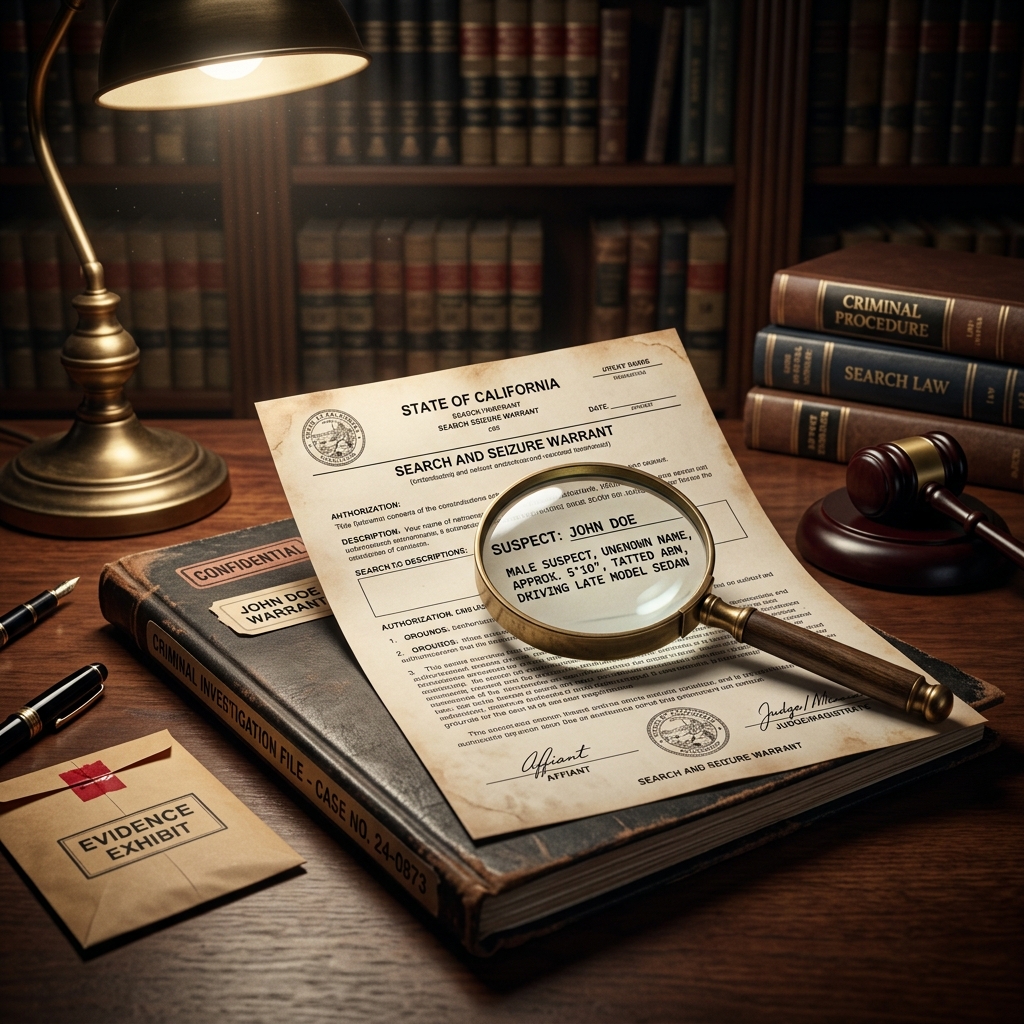
When police believe they know who committed a crime but do not yet know that person’s legal name, a traditional arrest warrant is not always possible. In those situations, courts in some jurisdictions use a special tool called a John Doe warrant to keep the case alive and allow future prosecution.
This article explains what John Doe warrants are, why they matter, how they interact with DNA evidence and statutes of limitations, and what they mean for both victims and suspects in criminal cases.
Core Concept: What Is a John Doe Warrant?
A John Doe warrant is an arrest warrant issued for an unidentified suspect in a criminal case, where the person’s identity is known only through a description or other specific identifying information rather than a legal name.
- Purpose: Enable law enforcement to formally charge and later arrest a suspect whose name is unknown but who is sufficiently described.
- Label: The warrant typically lists the suspect as “John Doe” (or “Jane Doe”), followed by a detailed descriptor, such as a physical description or a DNA profile.
- Scope: Used primarily in criminal law investigations, especially serious offenses like sexual assaults or violent crimes.
Instead of a full legal name, the warrant must still identify the suspect with enough particularity that officers can reasonably determine whether they have arrested the correct individual.
How John Doe Warrants Differ from Standard Arrest Warrants
Traditional arrest warrants identify the suspect by name and may include additional details such as date of birth, physical characteristics, or last known address. John Doe warrants flip this structure: they start from the description and treat the name as unknown.
| Feature | Standard Arrest Warrant | John Doe Warrant |
|---|---|---|
| Identification of suspect | By legal name plus descriptors | By descriptor (e.g., DNA profile or detailed physical description) instead of a name |
| When used | Suspect’s name is known to investigators | Name is unknown, but evidence ties a particular person to the crime |
| Statute of limitations impact | Issuance usually starts prosecution and tolls limitations for that named person | Can start prosecution and toll limitations using a description such as a DNA profile |
| Legal availability | Generally available in all criminal jurisdictions | Recognized in some states; not authorized under federal criminal law in the same way |
Using DNA Profiles in John Doe Warrants
Modern forensic science has transformed how John Doe warrants are drafted. Instead of relying solely on physical descriptions or witness memory, many jurisdictions now use a DNA profile as the core identifier in a John Doe warrant.
A DNA-based John Doe warrant generally follows this logic:
- Biological evidence (such as semen, blood, or saliva) is collected from a crime scene.
- Forensic laboratories develop a unique DNA profile from that evidence.
- The profile is uploaded to national or state databases, such as CODIS in the United States, to search for matches.
- If no match is found and the statute of limitations is approaching, prosecutors may file a complaint identifying the suspect only by this DNA profile.
- Based on that complaint, a court issues a John Doe warrant describing the suspect through the genetic profile.
Because DNA markers are highly specific to one individual, courts in several states have held that identifying a suspect by DNA satisfies the constitutional requirement that warrants describe the person to be arrested with adequate particularity.
Statutes of Limitations and Why Timing Matters
Most crimes must be prosecuted within a particular time frame after they occur, known as the statute of limitations. If prosecutors do not begin a case before this deadline, they generally lose the power to bring charges.
Issuing an arrest warrant often marks the official start of a criminal prosecution. For John Doe warrants, this timing is critical: filing a complaint and obtaining the warrant can toll (stop) the statute of limitations, even though the suspect’s name is not yet known.
Key timing functions of John Doe warrants in many jurisdictions include:
- Stopping the clock: Once the warrant is issued, the statute of limitations for that offense is usually paused or satisfied, preventing the case from expiring.
- Preserving jurisdiction: Prosecutors retain the authority to pursue the case years later, when the suspect is finally identified.
- Demonstrating diligence: The warrant can serve as evidence that investigators acted promptly when they obtained an offender profile, such as a DNA match, even if they could not locate the individual.
Courts such as the California Supreme Court have upheld the validity of John Doe DNA warrants in satisfying statutes of limitations, reasoning that a DNA profile can be as precise as a name for identifying a unique person.
Common Situations Where John Doe Warrants Are Used
John Doe warrants are not used in every case involving an unidentified suspect. They are more common where the crime is serious, the evidence is strong, and the statute of limitations is a pressing concern.
Cold Case Sexual Assaults
One of the most prominent uses of John Doe warrants is in cold case sexual assault investigations.
- Evidence kits are tested years after the assault.
- A probative DNA profile is generated and uploaded to CODIS.
- No database hit occurs, and the original statute of limitations is close to expiring.
- Prosecutors file a John Doe complaint identifying the suspect by DNA to request an arrest warrant.
This process allows authorities to continue investigating and to bring charges if a match is found later, even if many years have passed.
Serious Violent Offenses
John Doe warrants may also be used for other serious crimes, such as homicides and aggravated assaults, especially when forensic evidence clearly links one unknown individual to the crime.
- Strong physical or genetic evidence exists tying one person to the offense.
- Witness descriptions are limited or unreliable.
- The jurisdiction wishes to maintain the ability to prosecute whenever the suspect is eventually identified.
Legal Requirements and Limitations
Even though the suspect’s name is unknown, a John Doe warrant must still comply with general constitutional and statutory rules governing arrest warrants.
Probable Cause and Particularity
To issue any arrest warrant, a court must find probable cause that the described person committed the crime. For John Doe warrants:
- The complaint or supporting documents must present evidence linking the unidentified individual to the offense.
- The description (such as DNA profile, detailed physical features, photographs, or addresses) must be specific enough to identify the correct person with reasonable certainty.
- Information about how the profile or description was obtained is usually included.
Courts have generally upheld DNA-based descriptions as meeting the particularity requirement, because a genetic profile can uniquely distinguish one person from all others.
Variation Across Jurisdictions
John Doe warrants are largely a creation of state law and judicial interpretation. As a result, practices differ:
- Some states explicitly recognize John Doe warrants by statute or case law.
- Federal criminal procedure does not authorize the same type of name‑less arrest warrant; similar concepts may appear under different mechanisms.
- In a few jurisdictions without statutes of limitations, John Doe warrants still serve to demonstrate diligence and answer constitutional challenges based on delay.
Because of these differences, whether a John Doe warrant is available or appropriate in a given case depends on local law and precedent.
Benefits and Risks of John Doe Warrants
John Doe warrants offer important advantages to the criminal justice system, but they also raise policy and fairness concerns, especially when used to extend statutes of limitations.
Key Benefits
- Preserving victim access to justice: Victims of crimes, particularly sexual assaults, may see charges brought years later once the offender is identified, rather than losing their case to a technical deadline.
- Leveraging forensic science: DNA‑based warrants ensure that advances in forensic techniques can be used to hold offenders accountable even if the investigation started with limited information.
- Documenting diligence: Filing a John Doe complaint shows that prosecutors acted when they obtained an offender profile, countering arguments that long delays violate due process.
Potential Concerns
- Statute of limitations policy: Critics argue that using John Doe DNA indictments or warrants to toll limitations may undermine the purpose of having deadlines, which include preventing stale claims and protecting defendants from faded evidence.
- Quality of the underlying evidence: If a warrant is based solely on forensic evidence that is later questioned, it may raise issues about probable cause and reliability.
- Fair notice to defendants: Defendants who are identified many years after a crime may have difficulty locating witnesses or evidence in their favor, even though the prosecution preserved its case with a John Doe warrant.
Courts and legislatures continue to debate how far John Doe warrants should extend and how to balance victims’ rights with defendants’ procedural protections.
Practical Steps When a John Doe Warrant Is Issued
Once a John Doe warrant has been issued, it remains in effect until the suspect is identified and the case proceeds, or until a court vacates it.
For Prosecutors and Law Enforcement
- Continue to run the DNA profile or descriptive information through databases and follow investigative leads.
- Update the warrant and underlying complaint promptly once the suspect’s name becomes known, substituting the real identity for “John Doe”.
- Maintain records showing efforts to solve the case, which may be important in later hearings on delay or due process.
For Defendants Eventually Identified
- They may face charges long after the crime occurred, based on an earlier warrant that preserved the prosecution.
- Defense counsel may challenge the validity of the warrant or the adequacy of the description, depending on local law and the facts of the case.
- Issues such as faded memories, lost physical evidence, or unavailable witnesses may play a central role in litigation over fairness and due process.
Frequently Asked Questions About John Doe Warrants
Are John Doe warrants allowed everywhere?
No. John Doe warrants are recognized in some state systems but are not authorized in the same form under federal criminal law. Their availability depends on state statutes and judicial decisions.
Can a DNA profile alone identify a suspect for warrant purposes?
In several jurisdictions, courts have held that a unique DNA profile can satisfy the requirement that a warrant describe the suspect with particularity, allowing issuance of a John Doe warrant based solely on genetic information.
Do John Doe warrants permanently stop the statute of limitations?
They generally start the prosecution and either stop or satisfy the statute of limitations for that offense, but how long the effect lasts and what conditions apply is governed by each jurisdiction’s laws.
What happens when the suspect’s identity is finally discovered?
Prosecutors typically amend the complaint or indictment to replace “John Doe” with the suspect’s true name, and the case proceeds like any other criminal prosecution, with the earlier warrant forming part of the record.
Are John Doe warrants only used in sexual assault cases?
No. Although they are heavily discussed in the context of cold case sexual assaults, John Doe warrants can be used in other serious offenses where strong evidence exists but the suspect’s name is not known.
References
- What is John Doe Warrant? — LSD.Law. 2024-01-10. https://lsd.law/define/john-doe-warrant
- John Doe Warrant: Understanding Its Legal Definition — USLegal. 2023-05-01. https://legal-resources.uslegalforms.com/j/john-doe-warrant
- Using John Doe Warrants and Forensic Genetic Genealogy to Keep Justice Within Reach — Othram. 2021-08-12. https://othram.com/research/editorial/using-john-doe-warrants-and-forensic-genetic-genealogy-to-keep-justice-within-reach
- John Doe DNA Warrants and the Statute of Limitations — Stanford Law School. 2010-02-07. https://law.stanford.edu/2010/02/07/john-doe-dna-warrants-and-the-statute-of-limitations/
- Understanding the Use of John Doe Arrest Warrants in Prosecuting Cold Case Sexual Assault for Law Enforcement — RTI International (SAKI Initiative). 2018-09-01. https://sakitta.rti.org/toolkit/docs/Understanding-the-Use-of-John-Doe-Arrest-Warrants-in-Prosecuting-Cold-Case-Sexual-Assault-for-Law-Enforcement.pdf
- Understanding the Use of John Doe Arrest Warrants in Cold Case Sexual Assault for Prosecutors — SAKI Toolkit. 2018-09-01. https://www.sakitta.org/toolkit/docs/Understanding-the-Use-of-John-Doe-Arrest-Warrants-in-Prosecuting-Cold-Case-Sexual-Assault%20for-Prosecutors.pdf
- DNA – A Prosecutor’s Practice Notebook: John Doe Warrant — National Institute of Justice (Archived). 2000-11-01. https://nij.ojp.gov/nij-hosted-online-training-courses/dna-prosecutors-practice-notebook-inventory/special-case-circumstances/methods-preserve-jurisdiction/john-doe-warrant
Similar Articles








Read full bio of medha deb




