
Understanding the IRS Mailbox Rule and Lost Tax Returns
How the IRS mailbox rule works, what happens when returns go missing, and practical steps to protect yourself from late-filing disputes.
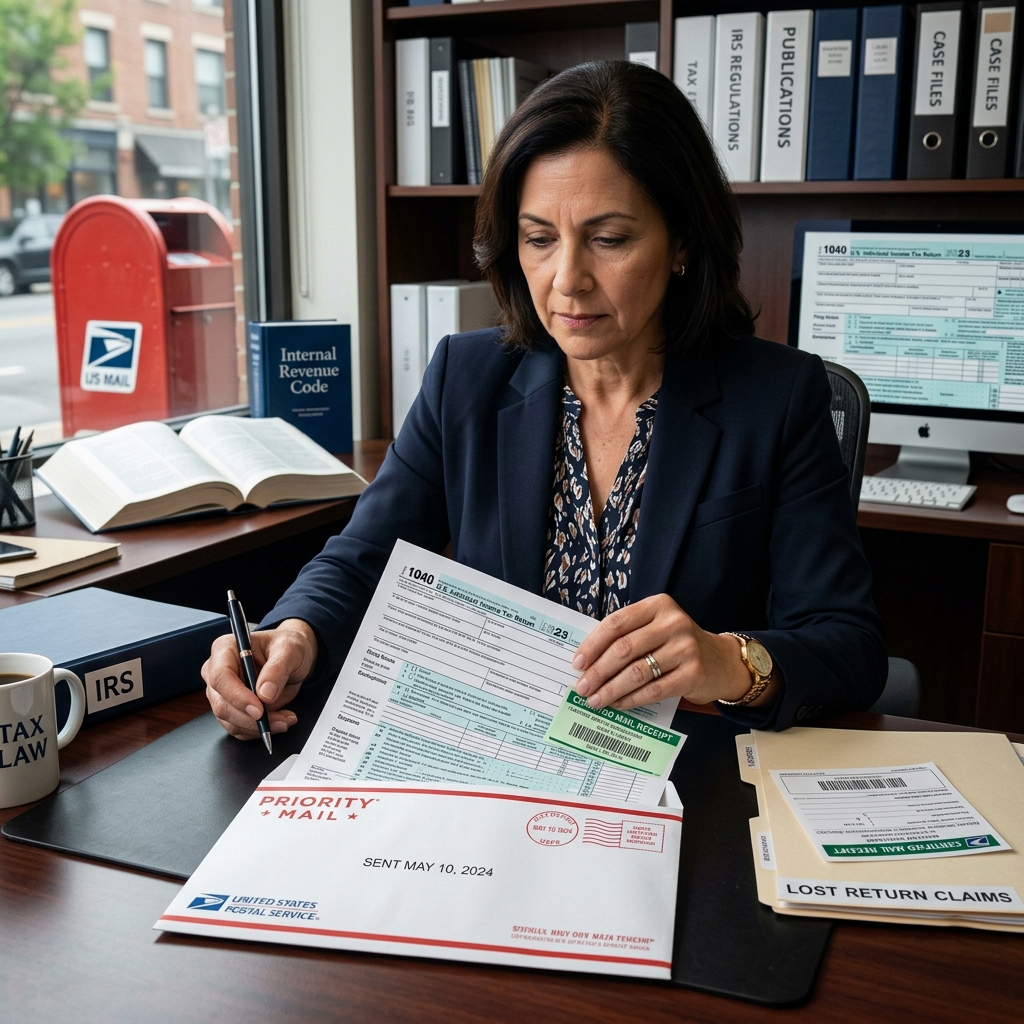
The
IRS mailbox rule
plays a crucial role in determining whether a tax return, payment, or claim is treated as filed on time, especially when there are delays or disputes about delivery. For taxpayers who rely on the mail and later hear that the IRS never received their documents, knowing how this rule works can be the difference between owing penalties and being fully compliant.This article explains the legal framework behind the mailbox rule, what happens when returns are lost or delayed, how courts have interpreted the rule, and what practical steps taxpayers can take to protect themselves.
What Is the IRS Mailbox Rule?
Under Internal Revenue Code
§ 7502
, commonly called the mailbox rule, a tax return or payment sent through the U.S. Postal Service is treated as filed or paid on the date of thepostmark
if certain conditions are met. Even if the IRS receives the envelope after the due date, the filing is considered timely as long as the postmark date is on or before the deadline.In simple terms, the rule answers the question: When does mailing count as filing? If you properly address, stamp, and mail your tax return, the postmark date generally becomes the legal filing date, not the date the IRS opens and processes the envelope.
Key legal elements of the mailbox rule
- The document must be mailed in an envelope with sufficient postage.
- The envelope must be properly addressed to the correct IRS office.
- A U.S. Postal Service postmark (or certain private delivery service markings) establishes the filing date.
- The document must ultimately be delivered to the IRS for § 7502 to apply.
Because of these requirements, the mailbox rule both protects taxpayers from postal delays and imposes responsibilities on them to prove when and how they mailed their documents.
Statutory vs. Common-Law Mailbox Rule
Before Congress enacted
IRC § 7502
, courts used a common-law principle: if a taxpayer could prove that a document was properly mailed, a presumption arose that it was delivered in due course. This was sometimes called the common-law mailbox rule.However, Treasury regulations now state that § 7502 provides the
exclusive means
of showing that a document was delivered to the IRS and that it was timely filed, unless there is direct proof of actual delivery (such as IRS records). In other words, traditional common-law presumptions generally no longer apply on their own.Important regulatory clarification
Regulations under § 7502 explain that:
- Evidence other than that permitted by § 7502 (such as ordinary testimony about mailing) does not create a presumption of delivery.
- Registered or certified mail and certain designated delivery services can serve as prima facie evidence of delivery.
- Without such evidence, taxpayers may struggle to prove that a document ever reached the IRS if the agency denies receiving it.
Court decisions such as Baldwin v. United States have echoed this regulatory approach, emphasizing that taxpayers must rely on § 7502 and the methods it recognizes to prove timely filing where the IRS disputes delivery.
How the Mailbox Rule Works in Practice
To better understand how the rule operates, it helps to break filing situations into distinct steps: mailing, postmarking, delivery, and IRS processing.
| Stage | What Happens | Legal Significance Under § 7502 |
|---|---|---|
| Mailing | Taxpayer drops the envelope at a post office or mailbox. | Mailing alone does not prove timely filing without a reliable postmark or approved delivery method. |
| Postmark | Postal equipment or staff apply a date stamp to the envelope. | The postmark date is treated as the filing date if delivery ultimately occurs and all conditions of § 7502 are met. |
| Delivery | The envelope reaches the IRS’s designated address. | § 7502 applies only if the document is actually delivered; if it never arrives, the taxpayer must independently prove delivery. |
| Processing | The IRS opens, logs, and inputs the return into its systems. | Processing date does not control timeliness; the postmark does, if § 7502 applies. |
This distinction matters because taxpayers sometimes confuse the date the IRS “receives” or processes the return with the legal filing date. Under the mailbox rule, delays inside the IRS generally do not harm taxpayers who mailed on time.
Problems When the IRS Says Your Return Was Not Received
Conflicts often arise when the IRS claims it never received a mailed return or payment, yet the taxpayer insists it was sent on time. In these situations, the burden of proof matters greatly.
Who has the burden of proof?
If the IRS has no record of your filing, you will usually need to show:
- That you prepared the return or document you claim to have filed.
- That you placed it in the mail with correct postage and address.
- That reliable evidence of mailing exists, such as a registered or certified mail receipt.
Without this documentation, disputes may be resolved in favor of the IRS, particularly because the regulations restrict what counts as prima facie evidence of mailing and delivery.
Limitations of ordinary proof
Taxpayers often try to rely on:
- Personal recollection of mailing a return.
- Internal office logs or notes.
- Postage meter records or unofficial stamps.
However, regulations under § 7502 state that such evidence generally does not create a legal presumption of delivery or timely filing, making it harder to succeed in disputes that hinge on whether the IRS ever received the document.
The Role of Registered, Certified, and Private Delivery Services
To address the risk of lost mail and disputed deliveries, § 7502(c) gives taxpayers a stronger way to show both the existence and timing of mailing. When properly used, registered or certified mail and certain private delivery services can serve as
prima facie evidence
of delivery to the IRS.Approved methods that strengthen your position
- Certified mail: Provides a mailing receipt and, optionally, a return receipt showing delivery date.
- Registered mail: Offers enhanced tracking and security, plus documentation of mailing.
- Designated private delivery services: Certain services, such as approved overnight carriers, are treated similarly to U.S. mail for purposes of § 7502.
These methods create a clear paper trail and make it substantially easier to demonstrate both that a document was mailed by the deadline and that it reached the IRS.
New Postal Service Rules and Their Impact
Recent changes in U.S. Postal Service practices have created additional uncertainty for taxpayers who rely on postmarks as proof of timely filing. The Postal Service has clarified that:
- Not every piece of mail will receive a visible or legible postmark.
- Postmarks may be applied at processing centers after collection, not necessarily on the date the taxpayer drops the mail.
- A postmark only proves that mail was in the Postal Service’s possession on that date, not the exact moment or location of deposit.
Because § 7502 relies heavily on the postmark date, these operational changes make it riskier to assume that dropping a return in a mailbox on the last day will automatically produce an accurate postmark. As a result, tax advisers increasingly recommend using methods that generate independent proof of mailing and delivery.
Electronic Filing and the Mailbox Rule
Electronic filing has become the default for many taxpayers, but the statutory mailbox rule does not fully cover electronic submissions in the same way it covers mailed documents.
Currently:
- The mailbox rule applies to certain documents filed electronically through authorized electronic return transmitters.
- For other time-sensitive documents and payments submitted electronically, § 7502 does not clearly provide equivalent protections, which can cause uncertainty.
The National Taxpayer Advocate has repeatedly recommended amending § 7502 to treat electronic submissions and payments as timely if transmitted by midnight on the due date, even if the IRS processes them later. Legislative proposals such as the Electronic Filing and Payment Fairness Act seek to codify this approach and extend consistent mailbox rule treatment to electronic methods.
Practical Steps to Protect Yourself
Given the legal framework and practical risks, taxpayers can significantly reduce their exposure to disputes by adopting a few disciplined filing habits.
Best practices for mailing returns and payments
- Do not wait until the last day. Aim to mail important IRS documents at least several days before the deadline to avoid postal delays.
- Use certified or registered mail. These services produce receipts and often delivery confirmations, which support your position under § 7502(c).
- Get a hand-stamped postmark. When possible, go to a post office counter and request a manual, legible postmark on your envelope.
- Keep copies of everything. Retain copies of returns, claims, and payments, along with mailing receipts and tracking information.
- Confirm the correct IRS address. Use official IRS instructions or notices to ensure you are mailing to the correct location.
Best practices for electronic filing
- Use approved electronic platforms or transmitters when filing returns.
- Save electronic confirmations, including transmission time and date, and any IRS acknowledgment codes.
- Check your IRS account transcripts periodically to confirm that filings and payments are properly recorded.
These measures may seem minor when everything goes smoothly, but they become critical if the IRS later claims a document was late or never arrived.
Frequently Asked Questions
1. If my envelope is postmarked on the due date but arrives late, is my return still timely?
Yes, if the envelope is properly addressed and has sufficient postage, § 7502 generally treats the return as filed on the postmark date, even if the IRS receives it after the deadline.
2. What if the IRS says it never received my return?
If the IRS has no record of your filing, the burden usually falls on you to prove mailing and delivery. Using certified or registered mail or an approved private delivery service can provide strong evidence. Without such documentation, it can be very difficult to prevail in a dispute.
3. Does the mailbox rule apply to electronic payments?
Under current law, the statutory mailbox rule does not clearly apply to most electronic payments, except in limited circumstances involving certain electronic return transmitters. Advocacy groups have urged Congress to expand § 7502 so that timely electronic transmissions are treated similarly to timely mailings.
4. Are postage meter stamps treated like official postmarks?
Postage meter markings or office stamps generally do not carry the same legal weight as official Postal Service postmarks. They may create a rebuttable presumption of timely mailing, but the IRS can challenge that presumption, especially if delivery appears significantly delayed.
5. Should I always use certified mail for IRS filings?
While not legally required, using certified or registered mail for important, time-sensitive IRS documents is strongly recommended. It provides documented proof of mailing and, often, delivery—which can be critical if there is any later dispute.
References
- NTUF Works to Protect the Mailbox Rule — National Taxpayers Union Foundation. 2017-04-14. https://www.ntu.org/foundation/detail/ntuf-works-to-protect-the-mailbox-rule
- TAS Act: Timely Submitted Payments and Electronic Documents — Taxpayer Advocate Service, IRS. 2025-04-03. https://www.taxpayeradvocate.irs.gov/news/nta-blog/tas-act-timely-submitted-payments-and-electronic-documents/2025/04/
- Taxpayer Cannot Use Common-Law Mailbox Rule to Prove Timely Filing of a Refund Claim — Current Federal Tax Developments. 2023-09-23. https://www.currentfederaltaxdevelopments.com/blog/2023/9/23/taxpayer-cannot-use-common-law-mailbox-rule-to-prove-timely-filing-of-a-refund-claim
- The New Mailbox Rule — United Community Bank. 2016-12-01. https://ucbbank.com/plan/wealth-management-library/tax-planning/new-mailbox-rule
- Pond Muddies the Waters of the Mailbox Rule — The Tax Adviser (AICPA). 2024-04-01. https://www.thetaxadviser.com/issues/2024/apr/pond-muddies-the-waters-of-the-mailbox-rule/
- Signed, Sealed, But Not Delivered? Don’t Wonder About Taxes Under New Postal Service Rules — Nossaman LLP. 2016-12-13. https://www.nossaman.com/newsroom-insights-signed-sealed-but-not-delivered-dont-wonder-about-taxes-under-new-postal-service-rules
- Treat Electronically Submitted Tax Payments and Documents as Timely if Submitted by the Due Date — Taxpayer Advocate Service, IRS, Purple Book Recommendation. 2023-01-11. https://www.taxpayeradvocate.irs.gov/wp-content/uploads/2024/01/ARC23_PurpleBook_02_ImproveFiling.pdf
Similar Articles








Read full bio of Sneha Tete




