
Understanding Divorce From Bed and Board
Learn how divorce from bed and board works, when it’s available, and how it compares to legal separation and absolute divorce in modern family law.
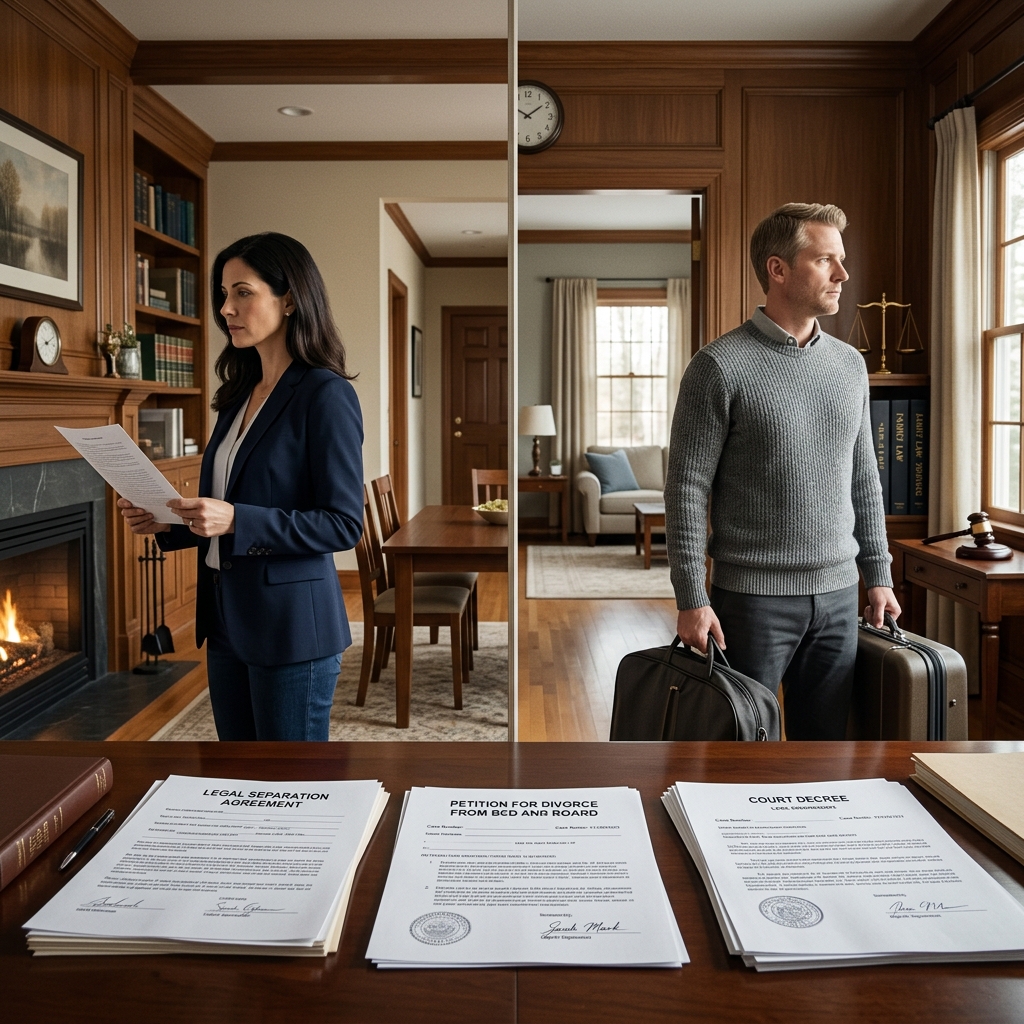
Despite its name, a divorce from bed and board is not a full divorce that completely ends a marriage. Instead, it is a form of court-ordered separation that allows spouses to live apart, resolve financial issues, and set custody and support arrangements while remaining legally married.
Only a few U.S. states still recognize this old legal term, but where it exists, it can be an important tool for spouses who need legal protection and structure without immediately dissolving the marriage bond.
What Is Divorce From Bed and Board?
A divorce from bed and board (often called a limited divorce) is a judge-issued order that formally separates spouses. It typically:
- Allows spouses to live in separate homes under a court-sanctioned arrangement.
- Provides a legal framework for dividing property and debts.
- Authorizes orders for child custody, visitation, and child support.
- Permits the court to order spousal support (alimony).
However, the marriage itself is not dissolved. The spouses remain legally married and, in most jurisdictions that recognize this status, they are not free to remarry until they obtain an absolute divorce.
Where Is This Type of Divorce Still Used?
The phrase “divorce from bed and board” is considered old-fashioned and appears in statutes in only a small number of states. According to modern family law sources, among the states that still explicitly use this terminology are:
- New Jersey, where divorce from bed and board operates as a formal, court-ordered legal separation.
- North Carolina, where it is a fault-based remedy available under specific statutory grounds.
- Virginia, where similar limited divorce and separation concepts appear in the domestic relations code.
In other states, comparable mechanisms may exist under different terms, such as “legal separation” or “limited divorce,” but not all jurisdictions recognize a distinct bed and board status.
Key Legal Characteristics
| Feature | Divorce From Bed and Board | Absolute Divorce | Legal Separation (General) |
|---|---|---|---|
| Marital Status | Still legally married; only separated. | Marriage fully dissolved; spouses become single. | Still married but separated, usually by court order. |
| Right to Remarry | Generally not allowed until an absolute divorce is granted. | Each spouse may remarry freely once the divorce is final. | Typically not allowed, because the marriage remains intact. |
| Fault Requirement | Often fault-based, requiring proof of misconduct (e.g., cruelty, abandonment). | May be fault-based or no-fault, depending on state law. | Varies; some states allow no-fault legal separation. |
| Property Division | Court can divide marital property and debts. | Court or agreement distributes property as part of final divorce. | Often similar to limited divorce; may divide property. |
| Custody & Support Orders | Yes, courts can order custody, visitation, child support, and sometimes alimony. | Yes, as part of the divorce judgment. | Yes, in most jurisdictions with legal separation. |
Grounds for Divorce From Bed and Board
In states like North Carolina, a divorce from bed and board is fault-based and available only when one spouse can prove specific misconduct by the other. The statutory grounds in North Carolina’s law illustrate the typical types of behavior that justify this remedy:
- Abandonment of the family: Leaving the spouse and/or children without justification and with no intention to resume the marital relationship.
- Maliciously turning the other spouse out of doors: Forcing the other spouse to leave the marital home without legitimate cause.
- Cruel or barbarous treatment endangering life: Physical abuse or violence that puts the spouse’s safety at serious risk.
- Indignities that render life intolerable: Severe mistreatment, humiliation, or emotional abuse that makes continuing to live together unreasonable.
- Excessive use of alcohol or drugs: Substance abuse so extreme that it makes the other spouse’s condition intolerable and life burdensome.
- Adultery: Sexual relations with someone other than the spouse.
These grounds show that divorce from bed and board is aimed at protecting an injured spouse from serious wrongdoing, while still stopping short of dissolving the marital bond.
How the Court Process Works
The procedure for obtaining a divorce from bed and board resembles a simplified divorce case, though specifics vary by state. Generally, the process includes:
- Filing a complaint or petition in the appropriate family court, alleging one or more statutory grounds.
- Serving the other spouse with official notice of the action and the allegations.
- Evidence gathering (documents, witness testimony, police reports, medical records) to prove the claimed fault.
- Hearing or trial, where a judge reviews the evidence and decides whether the legal grounds are satisfied.
- Issuance of a decree of divorce from bed and board if the court finds fault and grants the requested relief.
Once the decree is entered, its orders on occupancy of the home, financial arrangements, and parenting responsibilities are binding and enforceable, just like orders in a standard divorce or legal separation case.
Legal Effects on Property, Finances, and Benefits
A divorce from bed and board can reshape the couple’s legal and financial relationship in significant ways, even though it does not dissolve the marriage.
Property Rights
- Courts may classify and divide marital property and debts between spouses, similar to an absolute divorce.
- In some states (e.g., New Jersey), property held as tenancy by the entirety—a form of joint ownership limited to married couples—may automatically convert to a tenancy in common, reflecting the new separated status.
- Once the decree is entered, spouses typically stop creating new marital property together, which can simplify later financial disputes.
Support Obligations
- The court can order child support based on guidelines and the child’s best interests.
- Spousal support may be awarded to a financially dependent spouse, especially where fault has caused economic harm.
Health Insurance, Pensions, and Taxes
The impact on benefits and tax status depends on the jurisdiction and the specific plan or statute:
- In some systems, a dependent spouse can remain on the employed spouse’s health insurance after a divorce from bed and board because the marital status technically continues.
- Certain pension survivor benefits may remain intact while the parties are still legally married, even though they are separated by court order.
- For federal tax purposes, the Internal Revenue Service often treats couples subject to divorce from bed and board as legally separated, which can affect filing status and property transfer rules.
Inheritance and Estate Rights
- In some states, divorce from bed and board can terminate spouses’ automatic inheritance rights from one another, similar to what happens after a final divorce.
- Existing wills leaving property to the other spouse may be invalidated or treated differently once the decree is entered.
Divorce From Bed and Board vs. Legal Separation
Although terminology varies, divorce from bed and board is functionally similar to a formal legal separation recognized in many jurisdictions.
- Both are mechanisms that allow spouses to live apart under court supervision while remaining married.
- Both can address property division, debt allocation, and support.
- Both usually require separate residences and may be used as a step toward a future absolute divorce.
However, some differences can exist:
- In states that still use the bed and board terminology, the process is often explicitly fault-based, whereas some legal separation statutes allow no-fault separation.
- Procedural rules, waiting periods, and tax consequences may differ between a statutory legal separation and a divorce from bed and board.
Divorce From Bed and Board vs. Absolute Divorce
The most important distinction is that a divorce from bed and board does not dissolve the marriage, while an absolute divorce does.
- After a divorce from bed and board, the spouses are still married in the eyes of the law; they cannot generally remarry and may retain certain marital benefits.
- After an absolute divorce, each spouse is free to remarry and the marital relationship is completely ended.
- Both procedures can address finances and parenting, but an absolute divorce is the final step when spouses intend permanent separation.
In some states, spouses may use a divorce from bed and board as a transitional step: first obtaining the limited divorce for protection and clarity, then later filing for absolute divorce after meeting any required separation periods.
Reasons Couples Choose Divorce From Bed and Board
There are several reasons a couple might choose a divorce from bed and board rather than immediately seeking an absolute divorce:
- Safety and protection for an injured spouse in cases involving abuse, extreme substance use, or serious misconduct.
- Religious or personal objections to full divorce, where remaining legally married holds personal significance but living together is no longer viable.
- Financial planning, including preservation of certain benefits (such as health coverage or pension rights) that might be lost upon absolute divorce.
- Trial separation with legal structure, giving spouses time apart under court rules before deciding whether to end the marriage permanently.
Potential Limits and Risks
Although divorce from bed and board can be useful, it is not suitable for every situation.
- It is only available in a small number of states; many spouses must rely instead on legal separation or direct divorce filings.
- Because it is often fault-based, it may require airing sensitive allegations and evidence in court, which can be emotionally and financially costly.
- Remaining legally married can complicate future relationships and long-term financial planning.
- Different legal consequences across states mean that spouses must obtain advice specific to their jurisdiction.
Frequently Asked Questions
Is divorce from bed and board the same as a real divorce?
No. A divorce from bed and board is more accurately described as a legal separation ordered by a court. It allows spouses to live apart and reorder their rights and duties, but it does not end the marriage or permit them to remarry.
Can spouses later reconcile after a divorce from bed and board?
Yes. In many jurisdictions, reconciliation effectively ends the separation status. Once spouses resume living together and acting as a married couple, the legal effects of the bed and board decree can be terminated or become moot, and they regain rights previously limited by the order.
Do all states recognize divorce from bed and board?
No. Only a few states still use this terminology in their statutes, such as North Carolina, New Jersey, and Virginia. Other states may offer similar remedies under different names, and some rely exclusively on legal separation or absolute divorce.
Is proof of fault always required?
Where divorce from bed and board is specifically defined by statute, it is commonly a fault-based remedy, requiring proof of misconduct such as abandonment, cruelty, substance abuse, or adultery. However, some states with separate legal separation procedures allow no-fault separation, so it is essential to check local laws.
How does this affect children?
Courts issuing a divorce from bed and board can enter orders about child custody, visitation, and support, focused on the child’s best interests. From the court’s perspective, these issues are handled similarly to how they would be in a traditional divorce, even though the parents remain legally married.
References
- What’s a divorce from bed and board? — WomensLaw.org. 2023-05-10. https://www.womenslaw.org/laws/nc/divorce/whats-divorce-bed-and-board
- Divorce From Bed and Board vs. Legal Separation and Absolute Divorce — DivorceNet (Nolo). 2022-11-01. https://www.divorcenet.com/resources/divorce-from-bed-and-board.html
- 50-7. Grounds for divorce from bed and board. — North Carolina General Assembly. 1985-01-01 (current through latest session). https://www.ncleg.gov/EnactedLegislation/Statutes/PDF/BySection/Chapter_50/GS_50-7.pdf
- What Is a Divorce From Bed and Board in North Carolina? — New Direction Family Law. 2023-02-15. https://newdirectionfamilylaw.com/bed-and-board/
- New Jersey Divorce from Bed and Board — Weinberger Law Group. 2022-08-30. https://www.weinbergerlawgroup.com/divorce/bed-board/
- Bed and Board Divorce: Understanding Its Legal Definition — US Legal Forms Legal Resources. 2021-07-01. https://legal-resources.uslegalforms.com/b/bed-and-board-divorce
- The Types of Divorce in My State — Super Lawyers. 2023-03-10. https://www.superlawyers.com/resources/divorce/types-of-divorce-in-my-state/
Similar Articles








Read full bio of Sneha Tete


