
Understanding Default Divorce: Process, Risks, and Practical Steps
Learn how default divorces work, when courts allow them, and what both spouses should know before moving forward.
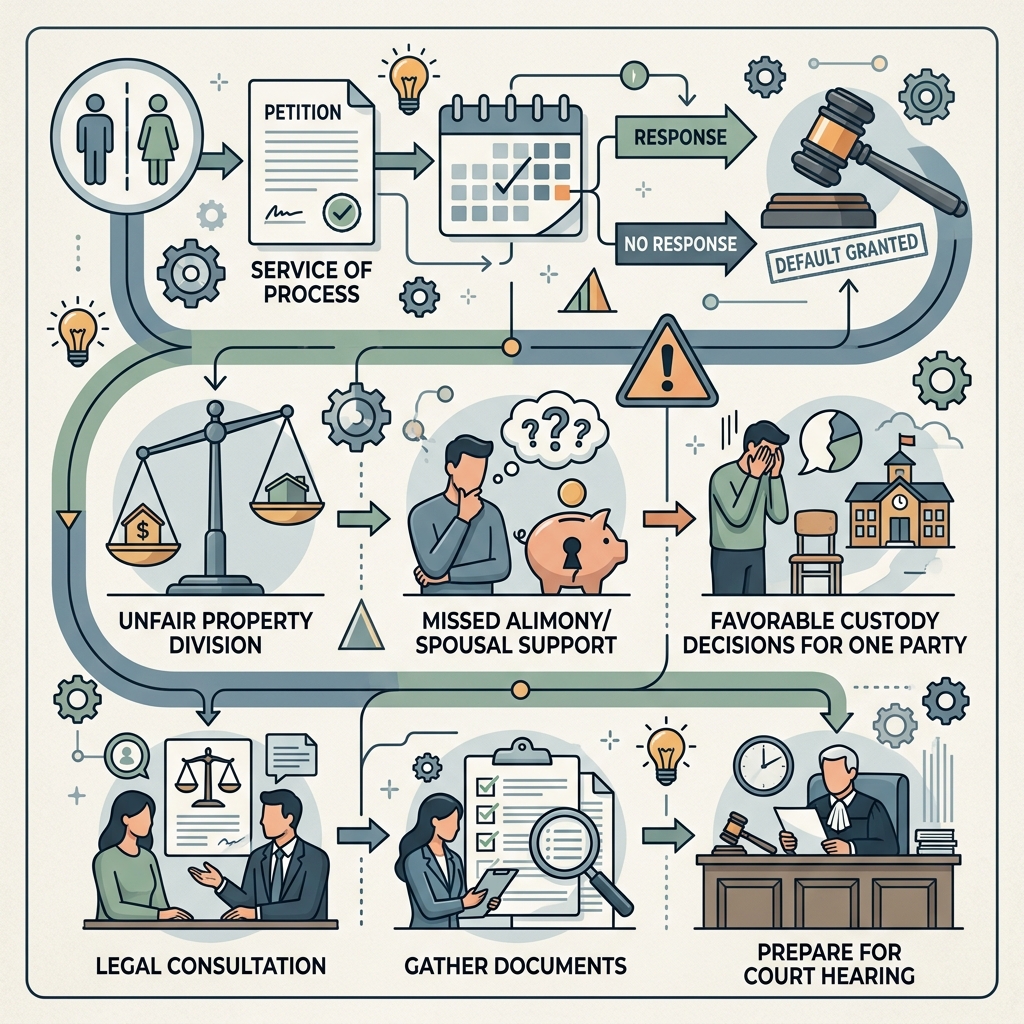
When one spouse files for divorce and the other does nothing in response, the court may still move the case forward. In many states, this situation can result in a default divorce, where the judge issues orders based primarily on the filing spouse’s requests.
This article explains what default divorce is, the legal steps usually involved, why some people choose this route, and what both spouses should understand before deciding to respond—or not respond—to divorce papers.
What Is a Default Divorce?
A default divorce occurs when the spouse who receives the divorce petition fails to respond within the time allowed by law, and the filing spouse asks the court to proceed without the other side’s participation.
- Filing spouse: Submits a divorce petition and related documents to the court.
- Responding spouse: Is properly served with the papers but does not file an answer or appear in time.
- Default judgment: The court issues a divorce decree based largely on the filing spouse’s proposed terms, subject to state law and judicial review.
Importantly, default does not mean the case is automatically finished as soon as the deadline to respond passes. The filing spouse must still complete specific procedures, and the judge must sign a formal judgment ending the marriage.
How Default Divorce Fits into the Broader Divorce Process
Default divorce is not a separate type of divorce in the way that contested or uncontested divorces are; it is a procedural outcome when one party does not participate. Most divorce systems follow a similar sequence:
| Step | Typical Action | Relevance to Default |
|---|---|---|
| 1. Filing | One spouse files a petition or complaint for divorce with the court. | Starts the case and sets deadlines for response. |
| 2. Service | Papers are formally delivered to the other spouse using a method allowed by law. | Default is only possible after valid service. |
| 3. Waiting period | Responding spouse is given a set number of days to file an answer or appearance. | If no response is filed by the deadline, default may be requested. |
| 4. Response or default | Responding spouse either participates or fails to act. | Failure to respond allows the court to consider a default judgment. |
| 5. Final judgment | Judge signs a divorce decree resolving property, support, and children’s issues. | In a default case, the judgment is based largely on the filing spouse’s proposals. |
Common Steps in a Default Divorce
Although details vary by state, many default divorce procedures include the following elements.
1. Filing and Serving the Divorce Papers
The process begins when one spouse submits a divorce petition to the court and then ensures that the other spouse is formally served with the documents.
- Using a sheriff, process server, or other accepted method of service.
- Providing proof of service to the court, often through a signed form or affidavit.
- If the spouse cannot be located, some states allow alternative methods, such as publishing a notice in a newspaper, but usually only after showing diligent efforts to find the spouse.
2. Waiting for a Response
Once service is complete, the law gives the responding spouse a specific time window—often between 20 and 30 days, depending on the jurisdiction—to file a response.
- In some states, the deadline to respond may be tied to court rules or statutory timelines (for example, 30 days in California or Illinois).
- Other jurisdictions impose an additional “cooling-off” or waiting period before any divorce can be finalized, such as the 60-day delay often required in Texas.
If the responding spouse files an answer or appears in court, the case no longer qualifies as a pure default; it becomes a contested or uncontested divorce depending on whether the spouses agree on terms.
3. Requesting Entry of Default
If the response deadline passes with no answer, the filing spouse may ask the court to enter default against the other party.
- Submitting a formal request for default, often on a standardized court form.
- Confirming that service was properly completed and that no response has been filed.
- Supplying proposed orders for property division, support, and child-related issues, sometimes in a draft judgment form.
The request for default is a critical step. Without it, the court may leave the case open but inactive rather than automatically issuing a judgment.
4. Default Hearing (If Required)
Many courts schedule a hearing before granting a default divorce, although some allow the judge to sign papers without an appearance if the paperwork is complete and the issues are straightforward.
- The judge may ask the filing spouse questions to confirm details about finances, property, and children.
- Courts often verify that requested orders comply with state law, especially those involving child support and custody.
- In some states or counties, default hearings can be waived if the case is simple and there are no children or complex assets.
5. Final Default Judgment and Notice
If the judge grants the request, the court issues a written divorce decree. This judgment ends the marriage and sets legally binding terms for property, support, and parenting arrangements.
- The filing spouse typically prepares the proposed judgment in advance, listing the specific orders requested.
- After the judge signs, the court usually sends notice of the judgment to both spouses, sometimes requiring the filing spouse to mail a copy to the respondent’s last known address.
The divorce is not legally final until the judgment is entered on the court’s records. Until then, the parties remain legally married.
Pros and Cons of Default Divorce
Default divorce can offer advantages, but it also carries significant risks—especially for the spouse who chooses not to participate.
Potential Advantages
- Forward movement when one spouse refuses to engage: A default judgment allows the filing spouse to complete the divorce even if the other party avoids communication or simply ignores the process.
- Procedural simplicity: There is often less negotiation and fewer court appearances than in a contested divorce, which can reduce emotional strain.
- Control over proposed terms: The filing spouse has greater influence over the initial set of orders included in the proposed judgment, though the judge must still ensure compliance with law, particularly for children and support.
Key Drawbacks and Risks
- Lack of input from the non-responding spouse: The court generally decides based on the filing spouse’s forms and legal standards, without considering the other spouse’s side of the story.
- Possible unfair outcomes: If the non-responding spouse has significant claims regarding property, support, or parenting, those interests may not be fully represented.
- Limited ability to change orders later: Although some default judgments can be challenged or modified, it can be difficult and time-sensitive, requiring specific legal grounds such as improper service or fraud.
Default Divorce and Financial, Property, and Parenting Orders
A default judgment does more than end the marriage; it typically resolves financial and family issues as well. Courts can issue orders on:
- Division of assets and debts: Allocation of marital property, bank accounts, real estate, and liabilities.
- Spousal support (alimony): Monthly payments from one spouse to the other, when allowed by state law.
- Child custody and parenting time: Which parent has decision-making authority and how children divide their time between households.
- Child support: Financial support for minor children, often calculated using state guidelines and subject to judicial review to protect the child’s interests.
Judges must still follow applicable statutes and guidelines, even in a default case. For example, courts generally cannot approve child support orders that fall far outside statutory formulas without strong justification.
What Happens If You Do Not Respond to Divorce Papers?
Choosing not to respond to a divorce petition can have long-term consequences. According to official court self-help guidance, if you do not file a response within the required time and your spouse requests default, the judge may issue orders based mainly on your spouse’s proposals.
Before deciding not to participate, consider the following:
- Read all documents carefully: Understand what your spouse is asking for concerning money, property, and children.
- Assess whether you agree: If you disagree with any part of the requested orders, filing a response allows you to present your position to the court.
- Recognize that silence is not neutral: Failing to respond effectively hands decision-making power to your spouse and the judge, with limited opportunity to shape the outcome later.
Can a Default Divorce Judgment Be Challenged?
In some situations, a spouse who lost by default may be able to ask the court to set aside or modify the judgment. Law office guidance notes that unfair or improperly entered default judgments can sometimes be invalidated through specific legal motions.
Common grounds to challenge a default judgment may include:
- Improper service: The spouse never received legally valid notice of the case.
- Excusable neglect or mistake: There was a serious reason for failing to respond, such as hospitalization or misunderstanding of court notices, recognized by the relevant procedural rules.
- Fraud or misrepresentation: The filing spouse misled the court about key facts to obtain the judgment.
Rules and deadlines for challenging a default judgment differ from state to state, and missing those deadlines can permanently limit options. Legal advice is usually essential if a party wishes to overturn an existing decree.
Practical Tips for Spouses Facing a Potential Default Divorce
Whether you are the filing spouse or the one served with papers, taking a few practical steps early can reduce risk and confusion.
If You Are Filing for Divorce
- Follow service rules precisely: Courts generally will not grant default unless you can show proper service using an approved method.
- Keep records: Maintain copies of all filings, proof of service, and any correspondence with your spouse.
- Prepare realistic proposed orders: Judges are more likely to approve default judgments that align with state law and appear fair, particularly in cases involving children.
- Consider negotiation when possible: If your spouse engages late, you may be able to convert the case to an uncontested divorce instead of default, which can reduce appeals or future conflict.
If You Have Been Served with Divorce Papers
- Check response deadlines: Look at the summons or court information to find the last date to file an answer or appearance.
- Seek legal information promptly: Official self-help sites and legal aid organizations often offer basic guidance about your options.
- Do not ignore notices: Even if you hope for reconciliation, failing to respond can result in binding orders that are difficult to change later.
- Document any obstacles: If illness, language barriers, or other serious issues make it hard to respond, keep records; they may be relevant if you need to ask for extra time or later challenge a default.
Frequently Asked Questions About Default Divorce
1. Does default divorce mean my spouse automatically gets everything they ask for?
Not automatically. The judge reviews any proposed orders for consistency with state law and may require changes, especially for child-related issues and support. However, when there is no response, the court relies heavily on the filing spouse’s version of events and requested terms.
2. How long do I have to respond before default can be requested?
Response deadlines vary by jurisdiction. Many states require a response within about 20–30 days after service, while some states also impose broader waiting periods before any divorce can be finalized. Check your local rules or court information to confirm the exact timeframe.
3. Can I participate after a default has been entered?
Once default is officially entered, your ability to participate may be limited. You might still attend hearings or request to set aside the default under specific rules, but you will usually need legal grounds and must act quickly according to local deadlines.
4. Is default divorce the same as an uncontested divorce?
No. In an uncontested divorce, both spouses participate and agree on the terms, even though there may be little or no courtroom conflict. In a default divorce, one spouse does not respond at all, and the judge decides based on one side’s filings and the law.
5. What if I genuinely cannot locate my spouse to serve papers?
Courts generally require proof that you made diligent efforts to find your spouse using normal methods. If those efforts fail, some states allow alternative service, such as publication or posting, but usually only with court approval. Default may be possible later if the spouse still does not appear.
References
- Default in a divorce or legal separation — California Courts Self-Help. 2023-08-01. https://selfhelp.courts.ca.gov/divorce/default
- How to finish your divorce in a default — California Courts Self-Help. 2023-08-01. https://selfhelp.courts.ca.gov/divorce/finalize-divorce/default
- Default divorce | Wex — Legal Information Institute, Cornell Law School. 2022-05-10. https://www.law.cornell.edu/wex/default_divorce
- What Is a Default Judgment in Divorce? — Erlich Law Office. 2023-04-15. https://erlichlegal.com/blog/what-is-a-default-judgment-in-a-divorce/
- Default Divorce in Texas — Hunt Law Firm, PLLC. 2022-11-10. https://www.familylawyerkaty.com/family-law/divorce/default-divorce/
Similar Articles








Read full bio of medha deb


