
Understanding Computer Crime Laws in Washington, D.C.
A practical guide to computer crime laws in Washington, D.C., how they interact with federal statutes, and what individuals and businesses need to know.
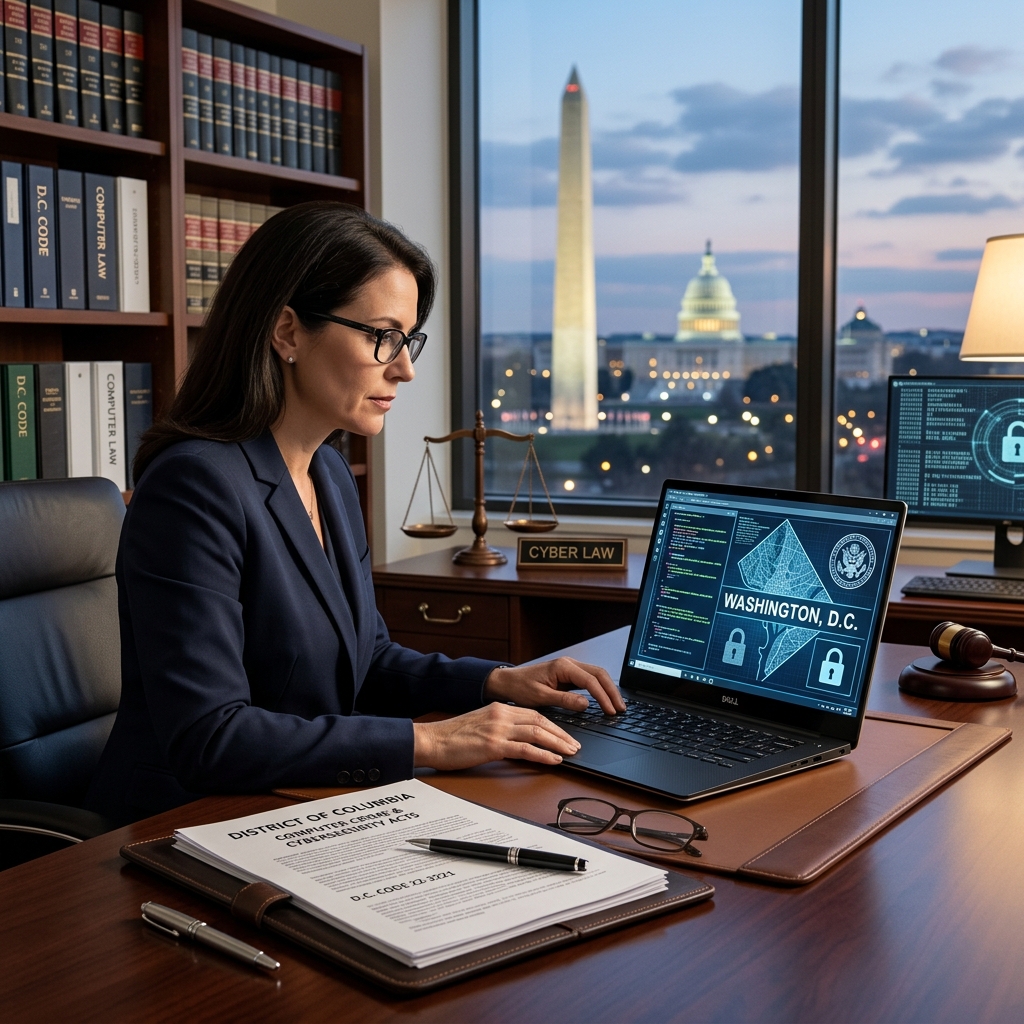
Computer technology is woven into nearly every aspect of life in the District of Columbia. From banking and health care to government operations and personal communications, computers and networks store and transmit highly sensitive information. Misusing these systems does not just raise ethical or contractual issues; in many cases, it constitutes a serious criminal offense under federal law and related District rules.
This article explains how computer crimes are treated in Washington, D.C., why federal law plays a dominant role, what types of conduct are commonly prosecuted, and what individuals and organizations should consider to reduce legal risk. The focus is on the interaction between local practice and federal statutes such as the Computer Fraud and Abuse Act (CFAA), codified at 18 U.S.C. § 1030.
1. Why Computer Crimes in D.C. Are Often Federal Cases
Although the District of Columbia has its own criminal code, many computer-related offenses in D.C. are investigated and prosecuted by federal authorities rather than solely by local prosecutors. This emphasis reflects several factors:
- High federal presence: D.C. is home to federal agencies, critical infrastructure, and national security targets, so computer offenses frequently touch federal interests.
- Interstate and international activity: Online conduct routinely crosses state and national borders, making federal jurisdiction particularly appropriate.
- Specialized statutes: Federal cybercrime laws, especially the CFAA, are specifically designed to address unauthorized access, damage to computers, and related fraud.
- Access to federal investigative tools: Federal authorities may have broader tools for digital forensics, cross-border data requests, and coordination with other jurisdictions.
As a result, conduct that might be handled as a purely state offense elsewhere is often treated as a federal computer crime when it occurs within or affects systems in the District of Columbia.
2. Core Concepts: What Counts as a “Computer Crime”?
Computer crimes generally involve using a computer, network, or digital service as a tool or target of unlawful activity. In the D.C. context, common categories include:[10]
- Unauthorized access: Accessing a computer, system, or account without permission, often referred to as “hacking” or “trespass” in a computer system.
- Data interference or damage: Intentionally introducing malware, deleting files, corrupting data, or otherwise impairing the integrity or availability of information.
- Computer-based fraud: Using computers to carry out schemes to defraud, such as phishing, fake websites, or identity theft operations.
- Service theft: Obtaining digital services, subscription content, or information services without paying or without authorization, such as using stolen credentials to access paid platforms.
- Digital extortion: Threatening to damage systems or release data unless payment is made, often seen in ransomware incidents.
While these categories are broadly recognized across the United States, their precise legal treatment in D.C. often turns on how federal statutes and local rules define key terms such as authorization, damage, and fraud.
3. The Computer Fraud and Abuse Act (CFAA) as the Primary Tool
The CFAA is the foundational federal statute used to prosecute computer-related crimes in D.C. and nationwide. Originally enacted in 1986 and amended multiple times, it targets unauthorized access to computers, damage to computer systems, and certain forms of computer-enabled fraud.
The law applies to “protected computers,” a term that extends broadly to computers used in or affecting interstate or foreign commerce or communication – a category that typically includes most Internet-connected devices and networks.
| Offense Type (Simplified) | Statutory Section | Illustrative Max Sentence |
|---|---|---|
| Obtaining national security information via unauthorized access | 18 U.S.C. § 1030(a)(1) | Up to 10 years (enhanced in some circumstances) |
| Accessing a computer and obtaining information without authorization | 18 U.S.C. § 1030(a)(2) | Typically up to 1 or 5 years, depending on context |
| Trespassing in a government computer | 18 U.S.C. § 1030(a)(3) | Up to 1 year, with possible enhancements |
| Accessing a computer to defraud and obtain value | 18 U.S.C. § 1030(a)(4) | Up to 5 years, higher for repeat offenses |
| Intentionally damaging a computer by transmitting harmful code | 18 U.S.C. § 1030(a)(5)(A) | Up to 10 years in serious cases |
| Trafficking in passwords or similar access credentials | 18 U.S.C. § 1030(a)(6) | Generally up to 1 year, with possible enhancements |
| Extortion involving computers, such as threats to damage or disclose data | 18 U.S.C. § 1030(a)(7) | Up to 5 years in many cases |
The CFAA also makes attempts and conspiracies to commit covered offenses criminal, even if the underlying harm does not fully occur. In practice, this means that investigative steps toward a hacking incident or ransomware scheme can be prosecuted, not only completed attacks.
4. Key Legal Concepts: “Without Authorization” and “Exceeds Authorized Access”
Many CFAA charges hinge on whether the defendant accessed a computer “without authorization” or “exceeded authorized access.” These phrases have generated extensive legal debate, and the way they are interpreted is critical to understanding what conduct is criminal.
4.1 What “Without Authorization” Generally Means
Courts and legal commentators generally describe access without authorization as access to a computer or account by a person who has no permission from the relevant system owner or controller. In other words, if a person has never been granted access or has been clearly denied access, entering the system anyway likely qualifies as access without authorization.
The U.S. Department of Justice (DOJ) has issued charging policies emphasizing that prosecutors should only pursue “without authorization” cases when the defendant:
- Was not authorized to access the protected computer under any circumstances;
- Knew of the facts that made their access unauthorized; and
- Used the unauthorized access to obtain or alter information, not merely to misuse information they lawfully obtained.
These policies aim to focus prosecution on conduct resembling traditional hacking and avoid criminalizing ordinary online behavior such as violating typical website terms of service.
4.2 Exceeding Authorized Access
The CFAA also covers situations where a person has some legitimate access but exceeds authorized access by using that access to reach information they are not permitted to obtain or modify.
DOJ guidance instructs prosecutors not to bring “exceeds authorized access” cases based solely on violations of private contracts or policies, except where those agreements completely prohibit access to specific files or areas in all circumstances.
In practice, this means the focus is on accessing restricted segments of a system – for example, a database containing confidential records that a user is not allowed to open – rather than on how a user later uses information that they were authorized to view at the time of access.
5. Examples of Common Computer Crimes Relevant to D.C.
While every case turns on specific facts, several types of computer-related conduct frequently trigger criminal investigation in or affecting Washington, D.C.:[10]
- Unauthorized account access: Logging into someone else’s email, social media, or cloud storage without permission, especially to obtain personal or financial data.
- Malware and viruses: Creating, spreading, or using programs designed to damage, spy on, or disrupt computer systems, including corporate or government networks.
- Data theft and misuse: Copying, transferring, or selling proprietary data, health records, or classified information obtained through unauthorized access.
- Phishing and online fraud: Operating or supporting schemes that trick victims into revealing passwords, bank details, or other sensitive data for monetary gain.
- Credential trafficking: Selling or distributing passwords, access tokens, or login details that enable unauthorized access to protected systems.
- Digital extortion and ransomware: Demanding payment in exchange for decrypting data or refraining from releasing stolen information.
When such conduct affects federal systems, interstate communications, or protected computers, it often falls squarely within the CFAA and related federal statutes applied to D.C. defendants.
6. Interaction with Other Laws: Wiretapping and Digital Communications
Computer crime enforcement in D.C. does not occur in isolation. Other statutes may apply, especially where digital recordings, electronic communications, or audio and video streams are involved. For example, the District’s rules on interception and disclosure of wire or oral communications can create criminal liability for unauthorized recording or sharing of certain electronic communications, including digital photos or videos taken without consent.
These laws, while not strictly “computer crimes” in the CFAA sense, often intersect with computer use because digital devices facilitate recording, storage, and transmission of sensitive material. Violations may be treated as felonies, with potential prison terms and substantial fines.
7. Penalties and Sentencing Considerations
Penalties for computer crimes associated with the CFAA and related statutes range from relatively short terms to long federal prison sentences, depending on the nature and impact of the offense. Factors that typically influence the severity of punishment include:
- Scope of damage: The financial loss, number of affected victims, and severity of system disruption.
- Target type: Whether the conduct impacted government systems, critical infrastructure, national security information, or vulnerable populations.
- Intent and planning: Evidence of deliberate planning, use of sophisticated tools, or coordination with co-conspirators.
- Prior criminal history: Repeat offenders may face enhanced sentencing or higher recommended guideline ranges.
- Cooperation and remediation: Steps taken to mitigate harm or assist investigators can affect plea negotiations and sentencing outcomes.
In serious national security or major financial fraud cases, penalties can reach or exceed a decade of imprisonment. Lesser offenses, especially those involving minimal damage or first-time defendants, may result in shorter terms, probation, or alternative sanctions. Federal sentencing guidelines play a significant role in how judges assess each case.
8. Compliance and Risk-Reduction Strategies for Individuals and Organizations
Given the potential consequences of violating computer crime laws in D.C., individuals and organizations should adopt structured strategies to reduce their risk of both being victimized and unintentionally committing offenses. Helpful measures include:
- Clear access policies: Establish and communicate who is authorized to access which systems and data, with written rules and technical controls to reinforce limitations.
- Training on acceptable use: Educate employees and contractors about appropriate system use, emphasizing that unauthorized access or data manipulation can be a crime.
- Strong authentication: Use robust password practices, multi-factor authentication, and account monitoring to prevent unauthorized logins.
- Incident response planning: Develop a plan for detecting, reporting, and responding to suspected intrusions, so evidence can be preserved and law enforcement engaged appropriately.
- Legal review of monitoring practices: When organizations monitor employee or user activity, they should ensure compliance with privacy and communications laws, including any wiretapping or consent rules.
For individuals, a key practical rule is to avoid accessing accounts, devices, or data that they know they are not authorized to use, even if technical barriers are minimal or absent. The lack of a password or firewall does not necessarily signal legal permission.
9. Frequently Asked Questions (FAQs)
9.1 Are all computer crimes in Washington, D.C. federal offenses?
No. While many significant computer crimes in D.C. are prosecuted under federal statutes like the CFAA, local law can also play a role. However, because D.C. is the seat of the federal government and many cyber incidents affect interstate or national systems, federal prosecution is common.
9.2 Does violating a website’s terms of service make me a criminal under the CFAA?
Generally, federal charging policy discourages treating ordinary terms-of-service violations as CFAA crimes. DOJ guidance states that prosecutors should not bring “exceeds authorized access” cases based solely on contractual or policy violations, except in narrow circumstances where access to certain files or areas is entirely prohibited. That said, conduct involving hacking or accessing restricted data can still be criminal.
9.3 What does “protected computer” mean in federal law?
A “protected computer” under the CFAA typically includes any computer used in or affecting interstate or foreign commerce or communication, which in practice covers most Internet-connected devices and business systems. Computers owned or used by the federal government are also considered protected.
9.4 Can attempts to hack a system be prosecuted even if no damage occurs?
Yes. The CFAA makes attempts and conspiracies to commit covered offenses criminal. A person can face charges for taking substantial steps toward unauthorized access or damage, even if the attack fails or is stopped early.
9.5 Are digital recordings and secret photographs covered by computer crime laws?
They may be covered by related statutes rather than the CFAA. For example, D.C. has laws addressing interception and disclosure of wire and oral communications that can apply to digital recordings and photographs taken without informed consent. Violations can result in felony charges.
References
- District of Columbia Computer Crimes Laws — FindLaw. 2023-01-10. https://www.findlaw.com/state/dc-law/district-of-columbia-computer-crimes-laws.html
- District of Columbia: Statutory Criminal Law — Without My Consent. 2014-06-01. https://withoutmyconsent.org/50state/state-guides/district-of-columbia/statutory-criminal-law/
- Computer Fraud and Abuse Act (CFAA) — National Association of Criminal Defense Lawyers. 2021-05-01. https://www.nacdl.org/Landing/ComputerFraudandAbuseAct
- 9-48.000 – Computer Fraud and Abuse Act — U.S. Department of Justice, Justice Manual. 2022-05-19. https://www.justice.gov/jm/jm-9-48000-computer-fraud
- Computer Crime Statutes — National Conference of State Legislatures. 2023-07-12. https://www.ncsl.org/technology-and-communication/computer-crime-statutes
- Cybercrime and the Law: Primer on the Computer Fraud and Abuse Act (CFAA) — Congressional Research Service. 2024-03-21. https://www.congress.gov/crs-product/R47557
- Norms of Computer Trespass — Columbia Law Review. 2016-03-01. https://columbialawreview.org/content/norms-of-computer-trespass/
Similar Articles








Read full bio of Sneha Tete




