
Understanding Common Misdemeanor Charges
A practical guide to misdemeanor classifications, examples, penalties, and legal options for defendants in the U.S.
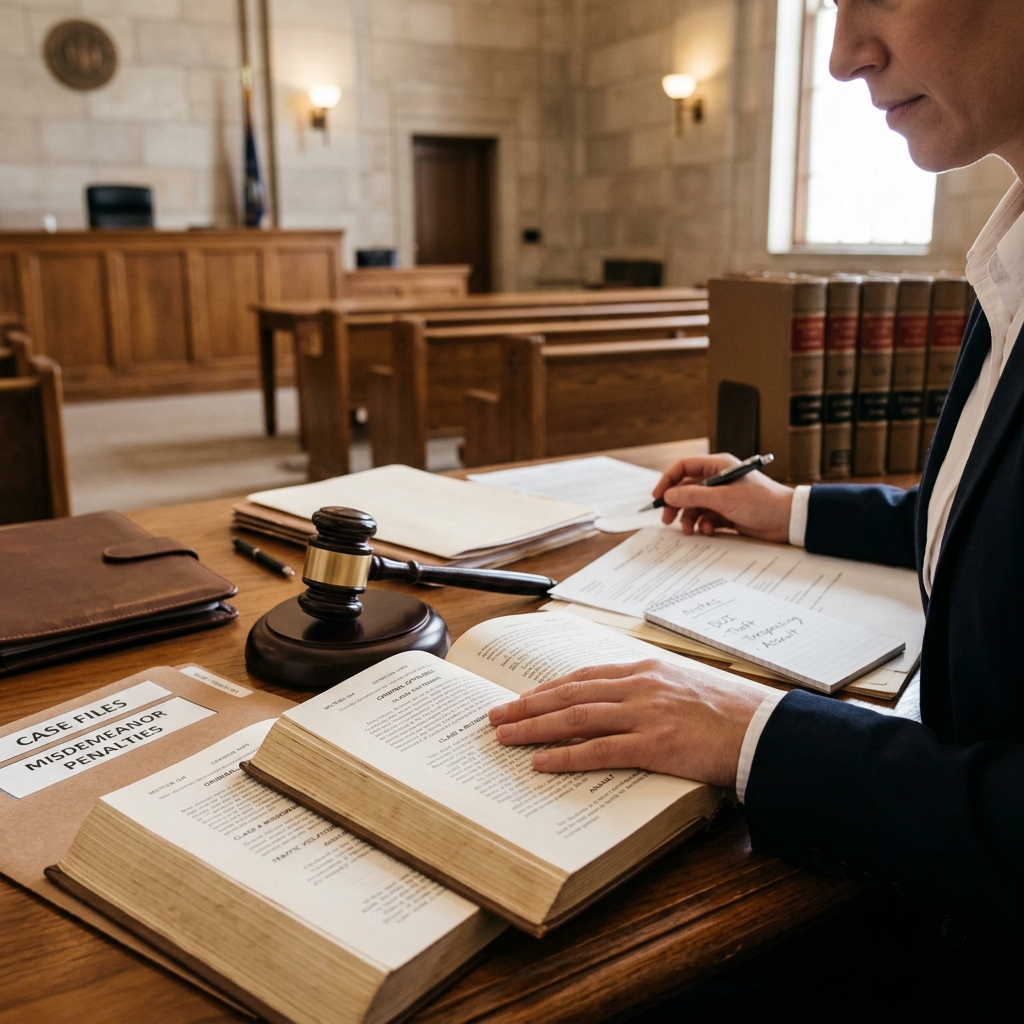
Misdemeanor charges are frequently described as “minor” crimes, but their impact on a person’s life can be anything but minor. A misdemeanor conviction can influence employment, professional licensing, immigration status, housing opportunities, and future court outcomes. This guide explains how misdemeanors are classified, typical examples, potential penalties, and what to consider if you are facing one of these charges.
What Is a Misdemeanor?
In U.S. criminal law, a misdemeanor is generally defined as an offense punishable by a maximum of one year in a local or county jail, rather than in state or federal prison. It is more serious than a simple civil infraction (such as a routine traffic ticket) but less serious than a felony, which can lead to longer prison terms or even life sentences.
Although states use slightly different wording, several consistent features appear:
- Maximum jail time is limited – Most states cap misdemeanor incarceration at one year or less in a county or municipal facility.
- Lower fines than felonies – Financial penalties are typically hundreds or low thousands of dollars, instead of the much higher fines associated with serious felonies.
- Handled in lower courts – Misdemeanor cases often proceed in county, municipal, or district courts, rather than felony trial courts.
- Still a criminal record – A misdemeanor conviction appears on criminal background checks and can carry lasting consequences.
Because the main dividing line between misdemeanors and felonies is the maximum potential sentence, some relatively serious conduct can still be classified as a misdemeanor if the legislature has chosen to cap punishment at or below one year.
How Misdemeanors Are Classified
States use several different systems to organize misdemeanor offenses. While the details vary, the goal is similar everywhere: to distinguish less serious misdemeanors from those that are closer to felonies in severity.
Degree-Based Classifications
Many jurisdictions classify misdemeanors by degree, such as first-degree and second-degree. These labels help courts and defendants quickly understand the maximum penalty associated with a charge.
| Classification Example | Typical Maximum Jail | Typical Maximum Fine | Illustrative Offenses |
|---|---|---|---|
| First-degree misdemeanor | Up to 1 year in county jail | Often up to $1,000 | DUI, battery, domestic assault, stalking, some drug possession |
| Second-degree misdemeanor | Up to 60–90 days in jail | Often up to $500–$1,000 | Disorderly conduct, loitering, simple assault, minor theft, driving without a license |
| Gross or aggravated misdemeanor | Up to 1 year in jail | Often higher fines, up to several thousand dollars | Repeat DWI, larger value theft, certain domestic violence offenses |
| Petty misdemeanor | Usually no jail time | Modest fines (e.g., a few hundred dollars) | Minor public order violations, low-level traffic or ordinance offenses |
Some states additionally use letter-based classes (such as Class A, B, or C misdemeanors), where Class A typically indicates the most serious misdemeanor level. The specific numeric or alphabetic scheme matters less than understanding what the classification means for maximum penalties.
Normal, Petty, and Gross Misdemeanors
Another common way to organize these offenses separates them into three broad categories: normal, petty, and gross misdemeanors.
- Normal misdemeanors – These are the standard criminal misdemeanors, punishable by up to one year in jail and a range of fines. Examples include simple assault, minor theft, and vandalism.
- Petty misdemeanors – These tend to be the least serious. In some states they are treated more like civil infractions, carrying fines but no jail time. They usually involve minor violations of traffic rules or local ordinances.
- Gross misdemeanors – More serious than normal misdemeanors but still not felonies, these often involve repeat offenses or conduct close to the felony threshold, such as second-offense impaired driving or higher-value theft.
Because these labels differ across states, it is important to check local law rather than assuming a particular term (like “gross misdemeanor”) always carries the same penalty.
Common Types of Misdemeanor Charges
Although there are dozens of specific misdemeanor offenses, many fall into a few recurring categories. Understanding these categories can make it easier to assess your legal risk and potential defenses.
Property and Theft-Related Misdemeanors
Property crimes are one of the most frequent sources of misdemeanor charges. The severity usually depends on the value of the property and whether force or weapons were involved.
- Petty or petit theft – Taking property of relatively low value, such as shoplifting inexpensive items from a store.
- Retail theft / shoplifting – Concealing merchandise, switching price tags, or otherwise trying to avoid paying full price.
- Vandalism – Damaging or defacing property, including graffiti or breaking windows.
- Theft under a statutory amount – Some states set explicit dollar ceilings (e.g., theft under $500 or under $1,500) that keep the offense within misdemeanor territory rather than elevating it to a felony.
Even lower-value property offenses can carry consequences beyond fines and short jail terms, including restitution obligations and civil liability to the victim or business.
Assault, Battery, and Public Order Offenses
Many interpersonal conflicts and disturbances also fall into the misdemeanor category, especially where there is limited injury or property damage.
- Simple assault or battery – Physical contact or attempted contact that causes minor injury or none at all, without using a deadly weapon.
- Domestic assault (lower-level) – Some jurisdictions treat less severe domestic incidents as misdemeanors, reserving felony charges for more serious harm or repeat conduct.
- Disorderly conduct – Causing a public disturbance through fighting, unreasonable noise, abusive language, or public intoxication.
- Harassment or stalking (less severe) – Certain harassment or stalking behaviors may be misdemeanors when threats or injury are limited.
Public order offenses are often discretionary; circumstances, prior history, and the officer’s judgment significantly influence whether a person is warned, cited, or arrested.
Driving and Traffic-Related Misdemeanors
Not all traffic violations are misdemeanors. Many are treated as infractions. Still, several driving-related behaviors are criminalized at the misdemeanor level because of the potential risk to public safety.
- Driving under the influence (DUI / DWI) – first offense – Frequently charged as a misdemeanor when no serious injury or death occurs.
- Driving with a suspended license – Operating a vehicle after your license has been suspended can be treated as a first-degree misdemeanor in some jurisdictions.
- Reckless driving – Driving in a manner that demonstrates reckless disregard for the safety of others may be criminally charged.
- Hit-and-run (minor property damage) – Leaving the scene of a minor accident can be a misdemeanor, while serious injury or death may trigger felony charges.
Although these offenses often carry shorter terms of incarceration than felonies, they can result in driver’s license suspensions, mandatory education programs, increased insurance costs, and strict probation conditions.
Drug-Related Misdemeanors
Drug laws vary widely across states and are evolving rapidly. Still, possession of small amounts of controlled substances, or certain drug-related behaviors, are frequently categorized as misdemeanors.
- Possession of small quantities of controlled substances – Non-cannabis controlled substances in small amounts may be treated as misdemeanors in some jurisdictions.
- Possession of limited cannabis – A number of states treat possession of less than a specified weight (for example, under 20 grams) as a misdemeanor rather than a felony.
- Possession of drug paraphernalia – Items used to consume or distribute controlled substances can carry separate misdemeanor charges.
Convictions for drug-related misdemeanors can have significant consequences in areas such as employment screening and immigration, even where the penalties seem modest.
Other Frequent Misdemeanor Categories
Beyond the major groups above, many other behaviors can trigger misdemeanor charges, including:
- Trespassing – Entering or remaining on property without permission.
- Loitering – Remaining in a place without an apparent lawful purpose when prohibited by statute.
- Prostitution or solicitation – In some states, these are classified as misdemeanors with escalating penalties for repeat offenses.
- Resisting or obstructing an officer – Nonviolent interference with law enforcement duties.
- False police reports – Knowingly providing false information to law enforcement.
Although each of these offenses has specific elements that the prosecution must prove, they share the characteristic of being punishable by relatively limited jail terms and fines compared to felonies.
Typical Penalties for Misdemeanor Convictions
While penalties differ by state and by offense, several patterns appear across U.S. jurisdictions.
- Jail time – Normal misdemeanors can lead to up to one year in county jail, while lower categories (such as petty misdemeanors) may carry no jail time at all.
- Fines – Courts can impose monetary penalties ranging from a few hundred dollars to several thousand, depending on the classification.
- Probation – Many defendants receive supervised probation instead of, or in addition to, jail. Conditions may include counseling, drug testing, and restrictions on travel or associations.
- Community service – Judges may order community service in lieu of part of the fine or jail time.
- Restitution – In property and financial cases, courts often require payment to victims to compensate for losses.
In some jurisdictions, specific classes of misdemeanors have clearly defined maximum penalties. For example, a Class A misdemeanor may carry up to nine months in jail and a $10,000 fine, while Class B and Class C misdemeanors carry progressively shorter maximum jail terms and lower fines.
Importantly, the maximum penalty is not the same as the typical sentence. Many misdemeanor defendants—especially first-time offenders—receive reduced or alternative sentences, but this depends heavily on the facts of the case and local practice.
Collateral Consequences of Misdemeanor Convictions
Even when the direct punishment seems limited, misdemeanor convictions can create ongoing challenges. These collateral consequences can sometimes be more serious than the short-term penalty.
- Criminal record – Misdemeanor convictions are part of an individual’s record and can be discovered through background checks.
- Employment and licensing – Employers and licensing boards may view certain misdemeanors—especially theft, violence, or dishonesty—as red flags.
- Housing – Landlords often use criminal history in screening tenants, and repeated misdemeanors can affect housing options.
- Immigration – For non-citizens, some misdemeanors can influence immigration outcomes, including visas or permanent residency, depending on federal law and case-specific analysis.
- Future sentencing – Prior misdemeanor convictions can be considered by courts when sentencing new offenses, possibly leading to harsher punishment.
Because of these long-term effects, many defendants seek options such as diversion programs, deferred adjudication, or expungement where available under state law.
Frequently Asked Questions About Misdemeanors
Are misdemeanors always less serious than felonies?
Yes, by definition misdemeanors carry a maximum of one year or less in local jail, while felonies are punishable by more than one year in state or federal prison or, in the most serious cases, by life imprisonment or death. However, some misdemeanors—especially gross or aggravated misdemeanors—may still involve significant harm and serious consequences.
Can a misdemeanor be upgraded to a felony?
In some situations, the same basic conduct can be charged as either a misdemeanor or a felony, depending on factors such as the value of property involved, presence of a weapon, level of injury, or prior convictions. Legislatures often set thresholds at which an offense moves from misdemeanor to felony status.
Will a misdemeanor conviction always result in jail time?
No. Many misdemeanor cases are resolved through fines, probation, or diversion programs, particularly for first-time offenders and less serious charges. Courts may suspend jail sentences or allow them to be served through alternatives like community service. Nonetheless, jail remains a possible penalty, and defendants should take charges seriously.
Is a petty misdemeanor considered a crime?
In some states, petty misdemeanors are not formally classified as crimes and are treated more like civil violations, carrying fines but no incarceration. In others, petty misdemeanors remain criminal in nature but carry limited penalties. The classification and consequences depend entirely on state law.
Do I need a lawyer for a misdemeanor charge?
While some people choose to handle low-level offenses on their own, legal representation is often important even for misdemeanors because of the potential long-term consequences and the complexity of local procedures. A qualified criminal defense attorney can evaluate the evidence, identify defenses, negotiate with prosecutors, and explain options such as diversion or plea agreements.
Key Takeaways for Defendants
If you are facing a misdemeanor charge, several practical points are worth keeping in mind:
- Understand the classification – Learn whether your charge is petty, normal, gross, or a specific degree or class; this determines the maximum penalty and the judge’s options.
- Review the alleged conduct carefully – Small factual differences, such as the value of property or extent of injury, can change a case from misdemeanor to felony or vice versa.
- Ask about diversion or alternative sentencing – Programs that allow dismissal upon completion of conditions can reduce long-term impact.
- Consider collateral consequences – Think beyond the immediate sentence to future employment, housing, and legal issues.
- Seek legal advice promptly – Early consultation with counsel can improve negotiation options and help prevent avoidable mistakes.
Misdemeanors occupy a middle ground in the criminal justice system: less serious than felonies, yet substantial enough to affect a person’s life for years. Understanding classifications, typical penalties, and available options can help defendants and their families make informed decisions.
References
- Misdemeanor vs. Felony in Florida: Differences in Classification and Penalties — DeMichael & DeMichael, PLLC. 2023-05-10. https://www.demichaellaw.com/blog/types-of-criminal-offenses-in-florida-misdemeanors-vs-felonies/
- Wisconsin Misdemeanor Classes & Penalties — Grieve Law. 2022-09-01. https://www.grievelaw.com/penalties/wisconsinmisdemeanor/
- Criminal Offense Levels — Minnesota House Research Department. 2021-01-05. https://www.house.mn.gov/hrd/issinfo/cr-offn.aspx
- Felony or Misdemeanor — Maryland People’s Law Library. 2020-06-15. https://www.peoples-law.org/felony-or-misdemeanor
- Different Types of Misdemeanors — Brown Kiely, LLP. 2022-03-18. https://brownkielylaw.com/different-types-of-misdemeanors/
- What Are Misdemeanor Crimes? Types & Legal Penalties — DCD Law. 2021-02-11. https://dcdlaw.com/blog/what-are-misdemeanor-crimes-types-consequence/
- What Is a Criminal Misdemeanor? — SBBL Law. 2022-07-20. https://sbbllaw.com/blog/what-is-a-criminal-misdemeanor/
Similar Articles








Read full bio of Sneha Tete




