
Three Constitutional Protections in Criminal Cases
A practical guide to the constitutional rights that shape police conduct, charging decisions, and criminal trials.
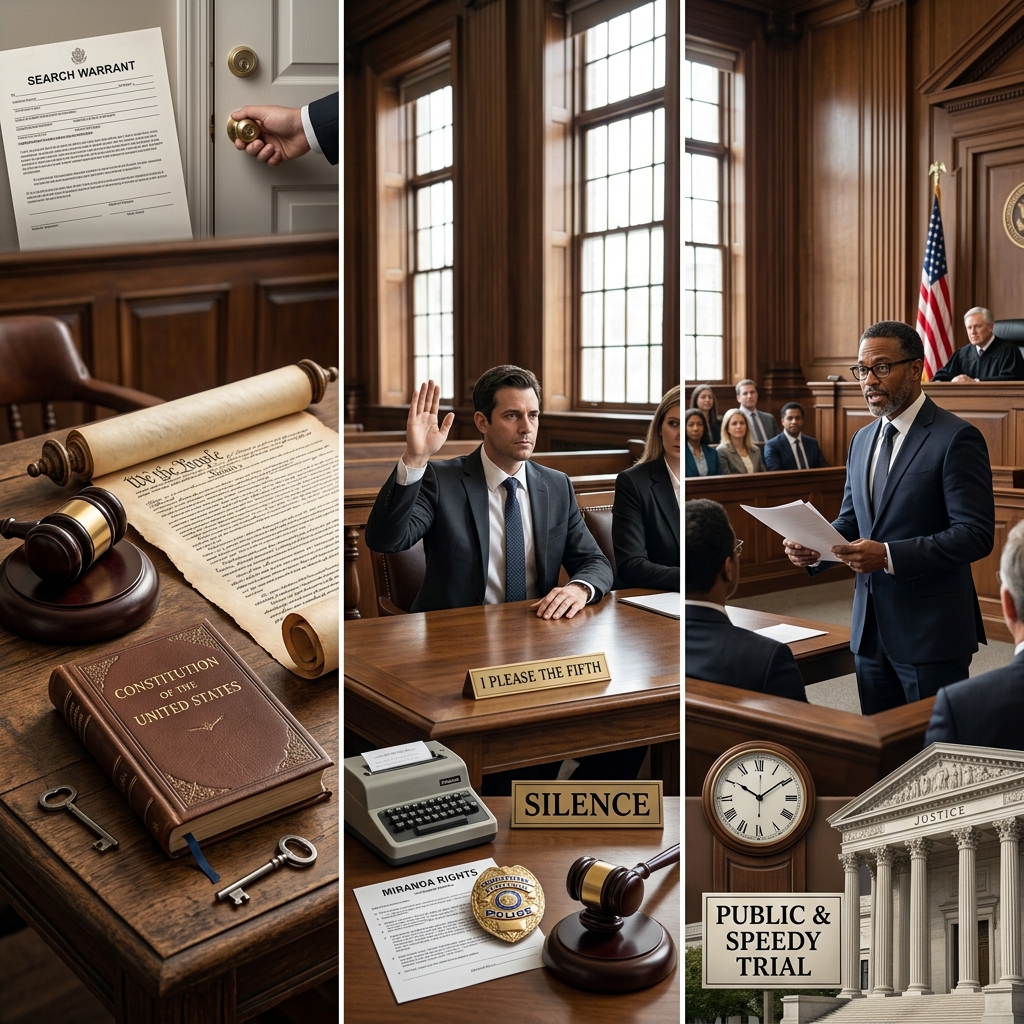
The U.S. Constitution places important limits on government power in criminal cases. Among the most significant protections are the rules governing searches and seizures, the privilege against self-incrimination, and the rights that apply once a person has been charged with a crime. These safeguards are central to the fairness of the criminal justice system and are among the most commonly invoked constitutional protections in court.
Although many constitutional amendments matter in criminal law, three provisions stand out because they shape what police can do, how prosecutors build cases, and what rights defendants have at trial. Together, the Fourth, Fifth, and Sixth Amendments form the backbone of criminal procedure in the United States.
Why constitutional rights matter in criminal proceedings
Criminal cases involve a strong imbalance of power. The government can investigate, arrest, charge, and punish, while the accused faces the possible loss of liberty, property, and reputation. The Bill of Rights responds to that imbalance by setting constitutional boundaries on official action.
These protections are not abstract legal ideas. They influence everyday law enforcement decisions, including whether officers may search a home, whether a suspect must answer questions, and whether a court can proceed with a trial. They also help ensure that criminal prosecutions remain grounded in due process and fundamental fairness.
The Fourth Amendment: limits on searches and seizures
The Fourth Amendment is the starting point for understanding constitutional privacy in criminal cases. It protects people against unreasonable searches and seizures and generally requires a warrant supported by probable cause before the government may search a person, home, papers, effects, or other protected property interests.
This amendment matters because it prevents law enforcement from gathering evidence through arbitrary intrusions. A valid warrant must usually be based on sworn facts that show a fair likelihood that evidence of a crime will be found in the place to be searched.
- Probable cause means a reasonable basis for believing that evidence or contraband is present.
- Particularity means the warrant must describe the location and items with enough specificity to avoid broad fishing expeditions.
- Reasonableness is the constitutional standard that courts use to evaluate whether a search or seizure was lawful.
The Fourth Amendment does not prohibit every search. Instead, courts examine whether the government acted reasonably under the circumstances. Certain exceptions may allow warrantless searches, but those exceptions are limited and closely reviewed because the Constitution treats the warrant requirement as the default rule.
In criminal practice, Fourth Amendment issues often determine whether key evidence can be used at trial. If police obtain evidence through an unconstitutional search, a defendant may ask the court to exclude that evidence under the exclusionary rule. This makes the amendment a powerful tool for enforcing constitutional boundaries.
How Fourth Amendment disputes arise
Common disputes include traffic stops, home searches, digital device searches, and arrests made without enough factual support. Courts also examine whether a person gave valid consent, whether a search exceeded the scope of a warrant, and whether officers acted within recognized emergency exceptions.
Because search and seizure law is fact-specific, small details can matter. The location searched, the officers’ knowledge at the time, and the manner in which the search was carried out may all affect whether the evidence survives a constitutional challenge.
The Fifth Amendment: protection against compelled self-incrimination
The Fifth Amendment is best known for the principle that a person cannot be forced to testify against themselves in a criminal case. It also includes protections against double jeopardy and guarantees due process.
The self-incrimination rule is especially important during police questioning and courtroom testimony. A defendant cannot be compelled to provide statements that would expose them to criminal liability, and the government may not punish someone simply for refusing to incriminate themselves.
- Self-incrimination protects a person from being forced to provide testimonial evidence against themselves.
- Double jeopardy generally prevents repeated prosecutions for the same offense after acquittal or conviction.
- Due process requires fair procedures before the government deprives someone of life, liberty, or property.
In real-world cases, Fifth Amendment issues often appear when police question a suspect and when prosecutors rely on statements made outside court. A defendant may challenge whether they were properly advised of their rights, whether a statement was voluntary, or whether the government is trying to use evidence that was improperly obtained.
The Fifth Amendment also shapes charging decisions. For serious offenses, it recognizes grand jury review in federal practice, reinforcing the idea that the government should not proceed with criminal accusations without meaningful procedural safeguards.
Why the privilege matters beyond silence
The privilege against self-incrimination is not only about refusing to speak. It also protects the fairness of the adversarial system. Criminal prosecutions are supposed to rest on evidence gathered by the government, not on compelled admissions extracted from the accused.
That principle helps preserve the presumption of innocence. By limiting coercive questioning and forced testimony, the Constitution places responsibility on the state to prove guilt through lawful evidence.
The Sixth Amendment: rights that protect the trial process
Once criminal charges are filed, the Sixth Amendment becomes one of the most important sources of defense rights. It guarantees a speedy and public trial, an impartial jury, notice of the accusation, the ability to confront adverse witnesses, compulsory process for favorable witnesses, and the assistance of counsel.
These rights are designed to make trials reliable and transparent. They also protect against delay, secrecy, and one-sided presentations by the prosecution.
| Right | What it does | Why it matters |
|---|---|---|
| Speedy trial | Limits unreasonable delay after charges are filed | Helps prevent prolonged anxiety, lost evidence, and stale prosecutions |
| Public trial | Allows public scrutiny of the proceedings | Promotes transparency and discourages unfair practices |
| Confrontation | Lets the accused challenge witnesses face to face | Improves reliability through cross-examination |
| Counsel | Guarantees legal representation | Helps ensure the defendant can defend effectively |
The right to counsel is one of the most practical protections in the Constitution. Most defendants cannot navigate criminal procedure on their own, and the presence of a lawyer helps ensure that motions, negotiations, and trial strategy are handled competently.
The confrontation right is equally significant. Courts have long treated cross-examination as a core method for testing credibility. When a witness accuses the defendant, the defense generally has the opportunity to challenge the story in open court.
Speed, openness, and fairness
The Sixth Amendment reflects the idea that justice delayed can become justice denied. Excessive delay can make it harder for the defense to find witnesses, preserve evidence, or maintain a meaningful defense strategy.
Public proceedings also serve an accountability function. When trials are open, judges, lawyers, media, and the public can observe how justice is administered. That visibility helps reinforce trust in the system and reduces the risk of hidden misconduct.
How these amendments work together
The Fourth, Fifth, and Sixth Amendments are often discussed separately, but criminal cases usually involve all three. A police search may trigger Fourth Amendment issues, a suspect interview may raise Fifth Amendment concerns, and the prosecution may later face Sixth Amendment challenges at trial.
That overlap is one reason criminal procedure is so fact-intensive. A case may turn on whether officers had lawful grounds to search, whether a statement was voluntary, and whether the defense received adequate opportunity to confront the evidence in court.
These constitutional protections also influence plea negotiations. Even when a case does not go to trial, the defense may still evaluate whether evidence was lawfully obtained and whether the accused understood the rights at stake before making decisions.
Common misconceptions about criminal constitutional rights
Many people assume these protections only matter during trial, but they begin much earlier. Fourth Amendment rules apply during investigation, Fifth Amendment rights can apply during interrogation, and Sixth Amendment rights attach once formal prosecution begins.
- Not every police interaction is a violation; the legality depends on the facts and the governing exception.
- Remaining silent does not automatically end an investigation, but it can protect against compelled statements.
- A fair trial is not just about the verdict; it also depends on the process used to reach it.
Another common misunderstanding is that constitutional rights are optional or technical. In reality, they are enforceable guarantees. Courts regularly review whether officials complied with these limits, and violations can affect the admissibility of evidence or the outcome of a case.
Frequently asked questions
What are the most important constitutional amendments in criminal law?
The Fourth, Fifth, and Sixth Amendments are among the most important because they govern searches, self-incrimination, and the fairness of criminal trials.
Can police search without a warrant?
Sometimes, but only under recognized legal exceptions. The general rule is that a search should be supported by a warrant based on probable cause, especially when private spaces are involved.
What does the right to remain silent protect?
It protects against compelled self-incrimination. A person generally cannot be forced to provide testimonial evidence that could be used to prove guilt.
Why is the right to counsel so important?
Criminal procedure is complex, and legal representation helps protect the accused from unfair or mistaken outcomes. The Sixth Amendment guarantees assistance of counsel at critical stages of prosecution.
Do these rights apply in state court?
Yes. The protections recognized in these amendments were extended to state criminal prosecutions through incorporation under the Fourteenth Amendment.
References
- Criminal Justice provisions in the Bill of Rights — EBSCO Research Starters. 2025-01-01. https://www.ebsco.com/research-starters/law/criminal-justice-provisions-bill-rights
- U.S. Constitutional Amendments — FindLaw. 2025-01-01. https://constitution.findlaw.com/amendments.html
- The United States Bill of Rights: First 10 Amendments to the Constitution — American Civil Liberties Union. 2025-01-01. https://www.aclu.org/documents/united-states-bill-rights-first-10-amendments-constitution
- Constitutional Rights in Criminal Law Proceedings — Justia. 2025-01-01. https://www.justia.com/criminal/procedure/other-constitutional-rights/
- Amendment 6 – “The Rights of the Defendant” — Ronald Reagan Presidential Library. 2025-01-01. https://www.reaganlibrary.gov/education/lesson-plans/high-school/constitutional-amendments/constitutional-amendments-amendment-6
- Sixth Amendment — Cornell Law School, Legal Information Institute. 2025-01-01. https://www.law.cornell.edu/constitution/sixth_amendment
Similar Articles








Read full bio of Sneha Tete




