
Employee Monitoring In 2025: Risks, Laws, And Best Practices
How workplace surveillance can protect business interests while creating legal and cultural risk.
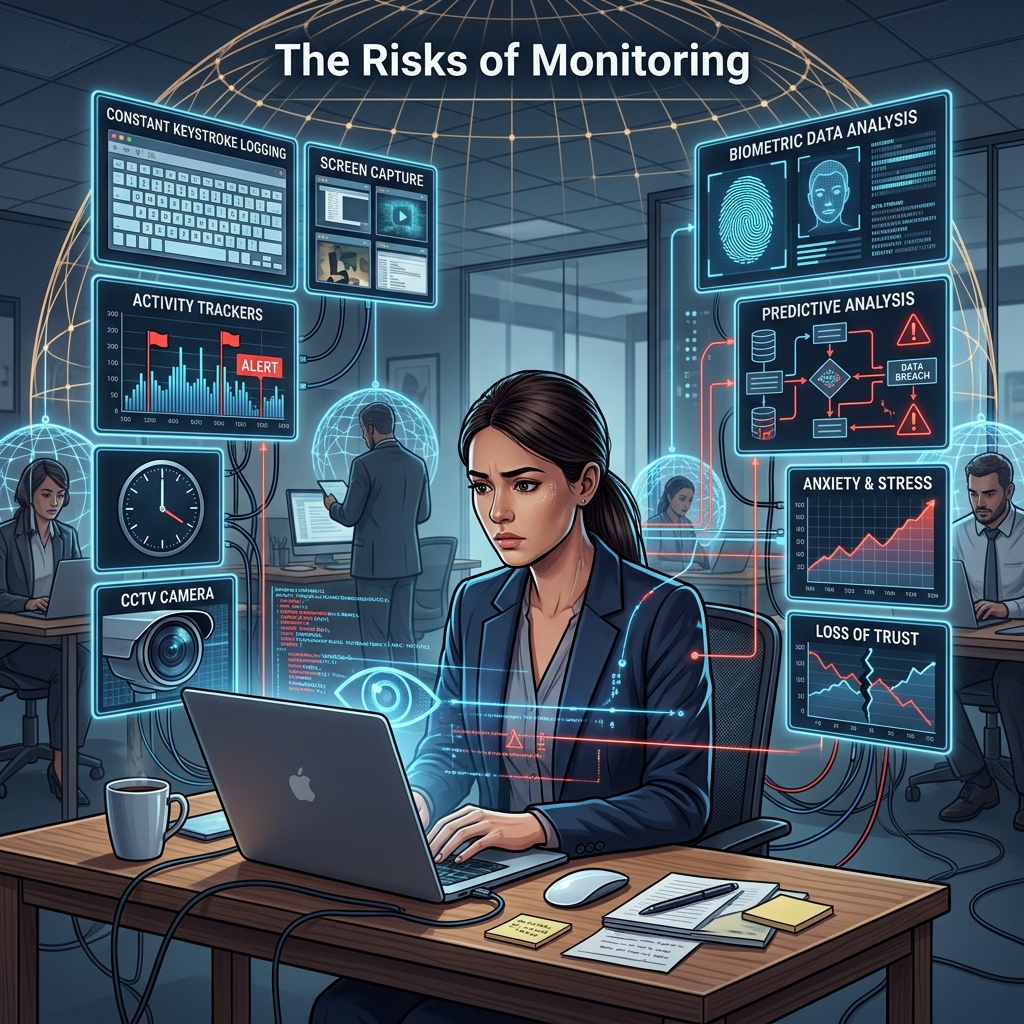
Employee monitoring can help organizations protect data, improve security, and support compliance, but it also creates legal, operational, and cultural risks when it is excessive or poorly disclosed. Employers that rely on surveillance tools should understand both the limits of the law and the practical effects that monitoring can have on trust, morale, and retention.
Why employers monitor workers
Companies usually do not adopt monitoring tools simply to watch employees for its own sake. The most common reasons are tied to business operations, such as preventing theft, protecting confidential information, tracking productivity, and maintaining secure access to systems. In many workplaces, especially those handling sensitive data, monitoring may also be used to identify unusual activity before it becomes a larger security incident.
That business rationale matters because monitoring is most defensible when it is connected to a legitimate purpose. A narrowly tailored system that focuses on company-owned devices, network activity, or restricted areas is generally less risky than broad surveillance that captures personal communications or off-duty conduct.
Where legal trouble begins
The law does not give employers unlimited authority to watch everything workers do. Risk increases when monitoring is hidden, overly broad, or applied in a way that looks retaliatory or discriminatory. Even when a company owns the equipment, employees may still have privacy expectations depending on the setting, the type of data involved, and the notice they received.
Common legal concerns include invasion-of-privacy claims, unauthorized interception of communications, recordkeeping violations, and disputes over whether workers were properly informed. In some situations, monitoring can also create problems under labor law if it interferes with protected organizing or other concerted activity.
Main legal and compliance issues
| Issue | Typical risk | Why it matters |
|---|---|---|
| Electronic communications | Interception or access without proper authorization | Email, chat, and messaging tools may be monitored only within legal limits |
| Privacy expectations | Monitoring in private spaces or of personal activity | Bathrooms, locker rooms, and similarly private areas raise significant concerns |
| Labor relations | Surveillance that chills organizing or complaints | Monitoring can become unlawful if it discourages protected activity |
| Data protection | Collecting more information than needed | Captured data can be sensitive and must be protected from misuse |
| Consistency | Selective monitoring of certain employees only | Uneven treatment can lead to discrimination or retaliation claims |
Privacy concerns go beyond the law
Even lawful monitoring can damage the employment relationship if workers feel they are being treated as suspects rather than professionals. Constant tracking can create a workplace atmosphere of distrust, anxiety, and disengagement. Employees who believe every message, movement, or pause is being recorded are often less willing to communicate openly or take initiative.
That cultural cost can be just as important as legal risk. A company that uses surveillance to solve short-term concerns may end up facing higher turnover, lower morale, and weaker collaboration. For that reason, workplace monitoring should be viewed as a governance issue, not just a technology decision.
What makes monitoring more defensible
Monitoring is easier to justify when it is transparent, limited, and tied to a specific business purpose. Employers reduce their exposure when they explain what is being collected, why it is necessary, who can access it, and how long it will be kept. Employees are much more likely to accept monitoring when the rules are clear and consistently enforced.
Proportionality also matters. A company that wants to prevent data leaks may need to review network activity or device logs, but that does not automatically justify reading every private message or tracking every minute of an employee’s day. The more intrusive the system, the more carefully the employer must be able to explain why less invasive measures would not work.
Common forms of monitoring and their risks
- Email and chat review: Helpful for security and compliance, but risky when workers are not told how messages are reviewed or when personal content is swept into routine oversight.
- Video surveillance: Often used in retail, warehouses, and public work areas, but generally inappropriate in bathrooms, locker rooms, and other private spaces.
- Internet and application tracking: Useful for protecting systems and managing bandwidth, though it can easily become overly detailed if it captures every browsing decision.
- Location and GPS tools: Can support logistics and safety, but may feel intrusive if used after work hours or outside business needs.
- Keystroke or screen capture tools: These are among the most controversial because they may reveal far more than productivity data and can quickly undermine trust.
How notice and policy design reduce risk
A written policy is one of the most important protections an employer can have. The policy should describe what types of monitoring occur, the systems or devices covered, who may access the data, and whether employees have any privacy expectations on company equipment. Clear notice gives workers a chance to understand the rules before they use the tools being monitored.
Good policy design also prevents confusion. If the company allows limited personal use of work devices, the policy should say how that use will be treated. If managers can access monitoring results, the policy should explain when and why. If data is stored, the retention period should be defined. Ambiguity often creates more risk than the monitoring itself.
Special attention for sensitive workplaces
Some environments require more caution than others. Employers handling medical information, financial data, legal files, or other sensitive records need stronger access controls and tighter oversight. In these settings, monitoring may be justified for security reasons, but the employer must still avoid collecting more information than it needs.
Public-facing or highly regulated workplaces may also face extra scrutiny from workers, regulators, or the public. If monitoring tools are used in safety-sensitive settings, employers should be able to show that the tools are linked to a legitimate operational purpose and not simply used to pressure employees.
Best practices for reducing employee monitoring risk
- Set a clear purpose: Use monitoring only for defined business reasons such as security, safety, or compliance.
- Provide written notice: Tell employees what is monitored, when it happens, and how the information will be used.
- Limit collection: Gather only the information needed to achieve the stated purpose.
- Restrict access: Allow only authorized personnel to review monitoring data.
- Protect retention: Keep data only as long as necessary and delete it according to policy.
- Apply rules consistently: Use the same standards across similar roles to reduce claims of unfair treatment.
- Review regularly: Reassess monitoring tools as laws, technology, and business needs change.
When monitoring crosses the line
Monitoring can become problematic when it is targeted at a worker for reasons unrelated to business needs. For example, constant surveillance of one employee after a complaint, request for leave, or union-related activity can appear retaliatory. Likewise, hidden cameras or digital tracking in spaces where privacy is expected can create immediate legal exposure.
Employers should also be careful about using monitoring data for purposes that were never disclosed. A system installed to protect network security should not quietly become a tool for discipline without notice, and data collected for one reason should not be repurposed casually. Unexpected uses often create the strongest claims.
Building a healthier monitoring culture
The most effective monitoring programs are not the most aggressive ones. They are the ones that are transparent, proportionate, and tied to a clear business need. Employers that involve legal, HR, IT, and compliance teams early are more likely to choose tools that protect the company without creating unnecessary friction.
A balanced approach helps workers understand that monitoring is meant to secure the workplace rather than micromanage behavior. When employees see that policies are consistent and limited, they are more likely to view oversight as part of ordinary operations instead of an intrusion.
Frequently asked questions
Can employers monitor company email and internet use?
Yes, employers often can monitor company systems, but the practice should still comply with applicable laws, internal policies, and notice requirements. The safest approach is to explain the scope of monitoring in advance.
Is workplace video surveillance always legal?
No. Video surveillance may be acceptable in public or shared work areas, but it is generally inappropriate in bathrooms, locker rooms, and other locations where employees have a strong expectation of privacy.
Can monitoring affect labor rights?
Yes. Surveillance that discourages organizing, complaints, or other protected concerted activity can create labor-law problems. Employers should avoid monitoring practices that could reasonably be seen as intimidating.
What is the safest way to introduce monitoring?
The safest approach is to use a written policy, give clear notice, limit data collection, and make sure access to the information is restricted. Employers should also review the policy regularly to ensure it still matches current law and business needs.
Why is transparency so important?
Transparency reduces surprise, supports trust, and helps show that monitoring serves a legitimate purpose rather than an improper one. It is one of the strongest ways to reduce legal and workplace risk at the same time.
References
- Employee Monitoring Laws: What Every Employer Should Know — MWH Law Group. 2024-05-01. https://mwhlawgroup.com/employee-monitoring-laws-what-every-employer-should-know/
- Electronic Workplace Monitoring: Privacy, Compliance, and Risk Management Considerations for Employers — Nelson Mullins. 2024-04-15. https://www.nelsonmullins.com/insights/blogs/the-hr-minute/employee-privacy/electronic-workplace-monitoring-privacy-compliance-and-risk-management-considerations-for-employers
- Workplace Privacy — California Department of Justice. 2024-01-01. https://oag.ca.gov/privacy/workplace-privacy
- Privacy in Employment — Justia. 2024-01-01. https://www.justia.com/employment/hiring-employment-contracts/privacy-in-employment/
- Employee Monitoring in the U.S. and Canada: What Employers Need to Know — International Association of Privacy Professionals. 2024-03-20. https://iapp.org/news/a/employee-monitoring-in-the-us-and-canada-what-employers-need-to-know
Similar Articles








Read full bio of medha deb




