
How the Supreme Court Tightened Limits on Warrantless Car Searches
A detailed look at how a recent Supreme Court ruling reshapes the automobile exception and strengthens Fourth Amendment protections for drivers.
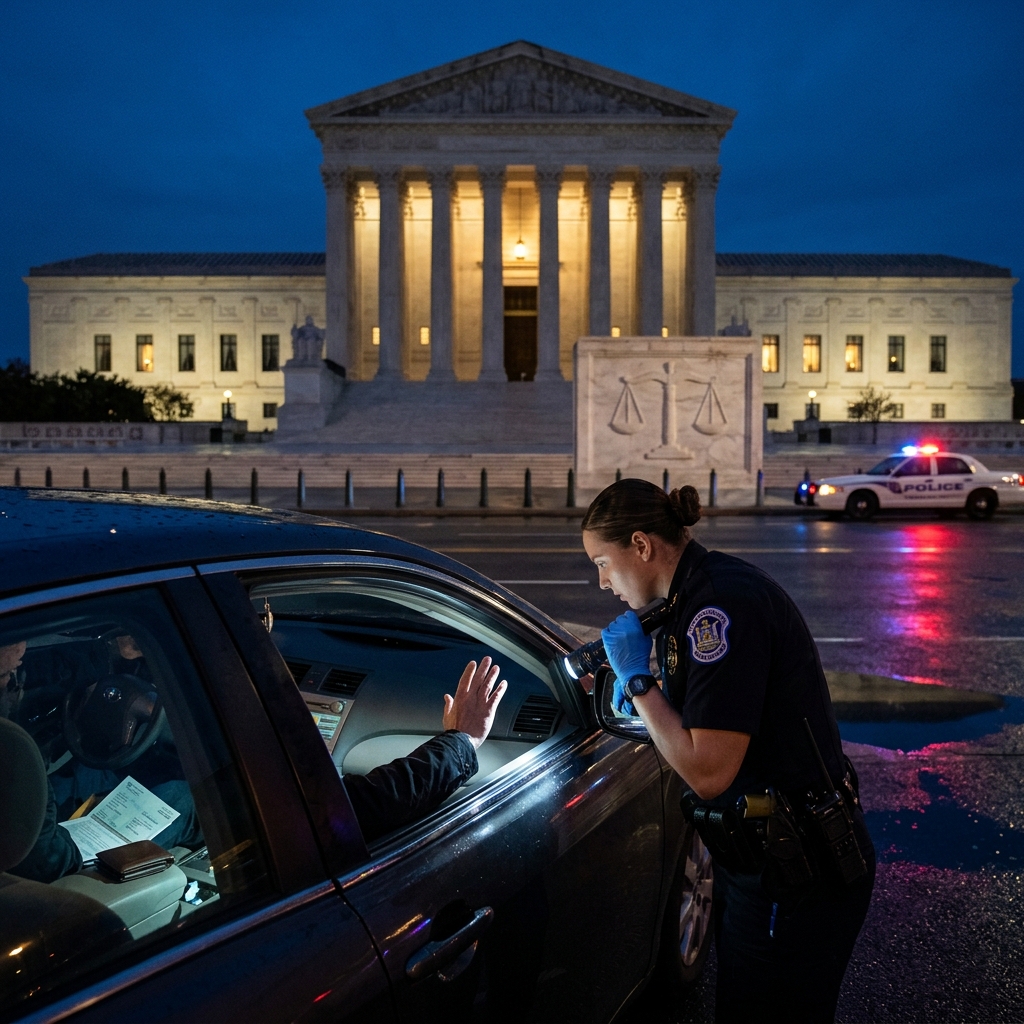
The United States Supreme Court has long treated automobiles differently from homes under the Fourth Amendment, allowing police to search cars without a warrant in many situations. But a recent decision, produced by an unusually configured majority of Justices, places meaningful new limits on when officers may search a vehicle without first going to a judge. This shift narrows the automobile exception and modestly rebalances power between law enforcement and drivers.
This article explains what the automobile exception is, how the Court’s new ruling changes it, and what the decision means for drivers, criminal defendants, and police officers going forward.
Background: Why Cars Have Their Own Fourth Amendment Rule
The Fourth Amendment protects people against “unreasonable searches and seizures” and typically requires police to obtain a warrant based on probable cause before searching property. Historically, homes were given the highest level of protection, while vehicles came to occupy a distinct, more permissive category.
The modern automobile exception originates in the Supreme Court’s 1925 decision in Carroll v. United States, where the Court held that officers may search a vehicle without a warrant if they have probable cause to believe it contains evidence of a crime or contraband. The Court justified this rule in part because vehicles are inherently mobile and can be quickly moved out of the jurisdiction if officers wait for a warrant.
Over the decades, the Court reaffirmed and expanded the automobile exception, allowing warrantless searches when officers had probable cause even if the car had been impounded, as in United States v. Johns, and in a range of other circumstances where the vehicle was deemed “readily mobile.”
Traditional justifications for the automobile exception
- Mobility: Vehicles can be driven away quickly, making it impractical to secure a warrant in time.
- Reduced expectation of privacy: Cars travel on public roads, are heavily regulated, and often contain visible interiors, which reduces the privacy interest as compared to a home.
- Officer safety and evidence preservation: Traffic stops can be volatile, and officers may need to act swiftly to prevent access to weapons or destruction of evidence.
These justifications led many courts to treat the automobile exception as a broad authorization for warrantless vehicle searches whenever probable cause existed, often without requiring an additional showing of urgency beyond the inherent mobility of cars.
The Case: An Unusual Majority Reins in Car Searches
The decision that inspired this discussion involved a traffic stop that escalated into a significant Fourth Amendment dispute. Officers stopped a vehicle, developed suspicions it contained evidence of a crime, and conducted a comprehensive search without obtaining a warrant. The key question was whether the automobile exception allowed that search on the facts presented.
What makes the ruling noteworthy is not just the outcome—limiting the use of the automobile exception—but also the composition of the majority. Justices from different ideological camps joined together, while some of their usual allies dissented. That alignment underscores how search-and-seizure cases can scramble typical voting blocs and reflect deeper, cross-cutting concerns about privacy, policing, and constitutional text.
Core holding of the decision
The Court held that the automobile exception does not provide a blanket license to search any car whenever officers have reason to suspect evidence might be found. Instead, the majority emphasized that:
- The vehicle must be genuinely readily mobile, not effectively disabled or secured beyond practical use.
- The scope of the search must be truly tied to the probable cause that justifies it.
- Where officers have ample time and opportunity to seek a warrant without undermining law enforcement interests, they may be required to do so.
In practical terms, the Court signaled that the automobile exception is rooted in specific justifications—mobility and diminished privacy—and cannot be stretched into a general convenience rule for police.
Mobility as a Real, Not Hypothetical, Requirement
One of the most significant aspects of the ruling is its insistence that mobility is not just a historical rationale, but an actual condition for invoking the automobile exception. Several modern decisions had suggested that once an object is classified as a vehicle, its theoretical ability to move sufficed to justify a warrantless search, even when the car was immobilized or impounded.
Recent state-level decisions had already begun pushing back on this logic. For example, the North Carolina Supreme Court held in a 2023 case that the automobile exception did not apply where the vehicle was partially submerged in a ditch and clearly not drivable. That court described mobility as a “fundamental prerequisite” for a warrantless vehicle search.
The Supreme Court’s new ruling moves federal doctrine closer to this more concrete approach. Rather than treating mobility as an abstract label, the Court asks whether the vehicle can realistically be moved or used in a way that threatens loss of evidence.
When is a vehicle “readily mobile”?
The decision suggests several factors relevant to whether a car is readily mobile for Fourth Amendment purposes:
- Whether the engine starts and the car can be driven away without significant repair.
- Whether the vehicle is already in police custody in a secure location.
- Whether officers have effectively disabled the vehicle (for example, by impounding it or blocking it in).
- How much time has passed between the initial stop or seizure and the search itself.
If the answer to these questions shows that the practical risk of the car being driven off is minimal, the majority reasons that the classic urgency underlying the automobile exception is weakened, and a warrant may be required.
Narrowing the Scope: Probable Cause and Search Limits
The automobile exception has always required probable cause—specific, objective facts leading a reasonable officer to believe that evidence of a crime is in the vehicle. The Court’s new decision reemphasizes that this is a substantive standard, not a loose hunch.
Targeted searches, not fishing expeditions
Under the ruling, even when the automobile exception applies, the search must be confined to places where the suspected evidence could reasonably be found. This flows from the general rule that probable cause and scope are tightly linked in Fourth Amendment law.
For example:
- If probable cause relates to a small item (like pills), officers may search containers and compartments large enough to hold such items, but not places where they clearly could not be found.
- If probable cause concerns a large object (like a stolen bicycle), looking inside a small glove compartment would be unjustified.
The decision criticizes overbroad vehicle searches where officers effectively treat the automobile exception as an invitation to examine every square inch of a car without regard to the nature of the object sought.
Interaction with Other Warrant Exceptions
The automobile exception is not the only path allowing warrantless vehicle searches. The Court’s ruling takes care to distinguish, but not eliminate, other recognized exceptions and doctrines that can justify a car search in appropriate circumstances.
| Exception / Doctrine | Typical Use in Vehicle Context | Key Limitation |
|---|---|---|
| Automobile exception | Search based on probable cause that evidence is in a readily mobile vehicle. | Requires true mobility and probable cause; scope limited to places evidence could be. |
| Search incident to arrest | Limited search of vehicle when occupant is lawfully arrested. | Must be near time and place of arrest and within reach of arrestee or related to evidence of the offense. |
| Consent | Driver or owner voluntarily allows search. | Consent must be voluntary; person may limit scope or revoke consent. |
| Plain view | Officers seize items clearly visible from a lawful vantage point. | Only items immediately recognizable as evidence or contraband may be seized. |
| Exigent circumstances | Emergencies such as imminent destruction of evidence. | Requires a true emergency; cannot be used as a pretext when time permits a warrant. |
The Court’s new opinion makes clear that when the automobile exception is weakened—for instance, because the car is immobile—prosecutors cannot automatically shift to another exception unless its specific criteria are independently satisfied.
Implications for Police Practices
Law enforcement agencies will likely need to refine training and policies in light of this decision. While the ruling does not eliminate warrantless car searches, it underscores that they are the exception, not the rule, and must be carefully justified.
Key takeaways for officers
- Assess mobility before relying on the automobile exception: Is the car truly capable of being driven away now?
- Document probable cause: Officers should clearly record the specific facts that gave rise to probable cause at the time of the search.
- Consider obtaining a warrant when there is no urgent risk of evidence loss or flight, especially when the vehicle is secured.
- Limit scope to areas where the suspected evidence could reasonably be found, rather than conducting blanket searches.
Some agencies may respond by expanding the use of telephonic or electronic warrants, which allow officers in the field to obtain judicial authorization quickly when circumstances are not truly exigent.
Consequences for Defendants and Exclusion of Evidence
The decision also has important consequences for criminal defendants. If officers overstep the bounds of the automobile exception, the resulting evidence may be subject to suppression under the exclusionary rule, which bars use of unlawfully obtained evidence in the prosecution’s case-in-chief.
Recent appellate decisions demonstrate that courts are willing to exclude evidence from vehicle searches where the State cannot establish that an exception to the warrant requirement applies. In the North Carolina case mentioned earlier, for example, the state supreme court held that officers had not met their burden to justify the search under the automobile exception or any other doctrine, requiring suppression of the evidence under the Fourth Amendment.
This new Supreme Court ruling strengthens defendants’ arguments in similar scenarios, especially where:
- The vehicle was disabled, impounded, or otherwise not practically mobile at the time of the search.
- Officers delayed the search for some time after seizing the vehicle, undermining claims of urgency.
- Alternative warrant exceptions clearly did not apply, and officers still failed to seek a warrant.
How This Fits into the Court’s Broader Fourth Amendment Trend
The ruling also fits into a broader pattern in which the Supreme Court has, in some contexts, strengthened privacy protections in an era of expanding police tools and technologies. For instance, in recent years the Court has limited warrantless searches of cell phones and certain digital data, recognizing that new technologies can profoundly alter privacy expectations.
At the same time, the Court has preserved or even clarified some exceptions in areas involving public safety. In a 2026 decision, for example, the Court unanimously held that officers invoking the emergency-aid exception—used when entering a home to assist someone in danger—need not have probable cause, because that doctrine concerns public safety rather than criminal investigation. By contrast, the automobile exception is squarely rooted in investigating crime, making probable cause and reasonableness central.
This new car-search decision therefore reflects a nuanced approach: the Court is tightening some search doctrines closely tied to criminal investigation, while separately recognizing that different, more flexible standards may apply when officers are acting to prevent harm rather than to gather evidence.
Practical Guidance for Drivers
For drivers, the ruling does not remove the risk of vehicle searches, but it does underscore that those searches are legally constrained. Understanding the basic contours of your rights can help you navigate encounters with law enforcement more confidently and safely.
Points for motorists to remember
- You generally do not have to consent to a search of your car. Politely saying, “I do not consent to a search” makes it clear that any search must be justified by an exception to the warrant requirement.
- Officers may still search without consent if they have probable cause and the automobile exception applies, or if another exception (such as search incident to arrest, exigent circumstances, or plain view) is satisfied.
- Asking, “Am I free to leave?” can help clarify whether an encounter remains voluntary or has escalated into a detention.
- Stay calm and avoid interference with any search, even if you believe it is unlawful; legal challenges happen later in court, not roadside.
While this Supreme Court decision adds protections, it does not replace tailored legal advice. Drivers facing criminal charges arising from a vehicle search should consult a qualified attorney to evaluate whether the search complied with current Fourth Amendment standards.
Frequently Asked Questions
Does this decision mean police always need a warrant to search a car?
No. The automobile exception still permits warrantless searches of vehicles when officers have probable cause to believe evidence of a crime is inside and the car is genuinely readily mobile. The decision narrows, but does not eliminate, that doctrine by insisting on real mobility and a search closely tied to the probable cause at hand.
What if my car is towed or impounded before the search?
When a vehicle has been seized and secured, the urgency that once justified a warrantless search under the automobile exception is reduced. In such cases, courts may require officers to seek a warrant unless another exception applies. This decision strengthens arguments that a stabilized, impounded car should not be searched without judicial authorization absent some new emergency or specific doctrine like a valid inventory search (where permitted by state law).
Can officers search closed containers inside my car?
Yes, if the automobile exception applies and probable cause extends to the container, officers may search containers in the vehicle where the sought evidence could plausibly be found. However, the new ruling emphasizes that officers must have a logical connection between the probable cause and the specific places searched; they cannot use the automobile exception as a mere pretext for a generalized rummaging.
How is this different from a search incident to arrest?
A search incident to arrest allows officers to search the arrestee and areas within the arrestee’s immediate reach to protect officer safety and prevent evidence destruction. In the vehicle context, this search is time- and space-limited: it typically occurs at the arrest scene and is confined to areas where the arrestee might access a weapon or evidence. The automobile exception, by contrast, is based on probable cause that evidence is in the car and can justify a broader search, but this decision tightens the conditions under which that broader search may occur.
Does this ruling affect emergency-aid or public safety entries?
Not directly. Emergency-aid doctrine—which allows officers to enter premises without a warrant to prevent serious injury or provide assistance—is conceptually distinct and was recently clarified in a separate Supreme Court case. That doctrine focuses on immediate threats to safety, not on gathering evidence, and carries its own standards. The automobile decision specifically addresses searches conducted for investigative purposes where the Fourth Amendment’s probable cause and reasonableness requirements remain central.
References
- State v. Julius, the Automobile Exception, and the Exclusionary Rule — School of Government, University of North Carolina at Chapel Hill (J. Denning). 2023-11-16. https://nccriminallaw.sog.unc.edu/2023/11/16/state-v-julius-the-automobile-exception-and-the-exclusionary-rule/
- The Automobile Exception Swallows the Rule: Florida v. White — Journal of Criminal Law and Criminology (Northwestern University). 2000-01-01. https://scholarlycommons.law.northwestern.edu/cgi/viewcontent.cgi?article=7054&context=jclc
- Searches and Seizures of Automobiles: Supreme Court Cases — Pace Law Library Research Guide. Last updated 2019. https://libraryguides.law.pace.edu/c.php?g=794732&p=5837673
- Supreme Court Upholds Warrantless Entry in Emergency Aid Case — Congressional Research Service Legal Sidebar LSB11394. 2026-01-21. https://www.everycrsreport.com/reports/LSB11394.html
- Warrantless Vehicle Searches in California — U.S. Department of Justice, National Institute of Justice (NCJRS Abstract). 1977-01-01. https://www.ojp.gov/ncjrs/virtual-library/abstracts/warrantless-vehicle-searches-california
- Carroll v. United States (Automobile Exception Overview) — Grant County Sheriff’s Office case law summary. Accessed 2026. https://www.facebook.com/GrantCountySheriff/posts/1305268604970783/
- Cases – Vehicles (Fourth Amendment Vehicle Search Cases) — Oyez Project, Illinois Institute of Technology. Accessed 2026. https://www.oyez.org/issues/229
Similar Articles








Read full bio of medha deb




