
Union Election Campaigns: 5 Key Steps For Fair, Legal Elections
A practical guide to planning, running, and challenging union officer election campaigns under U.S. labor law.
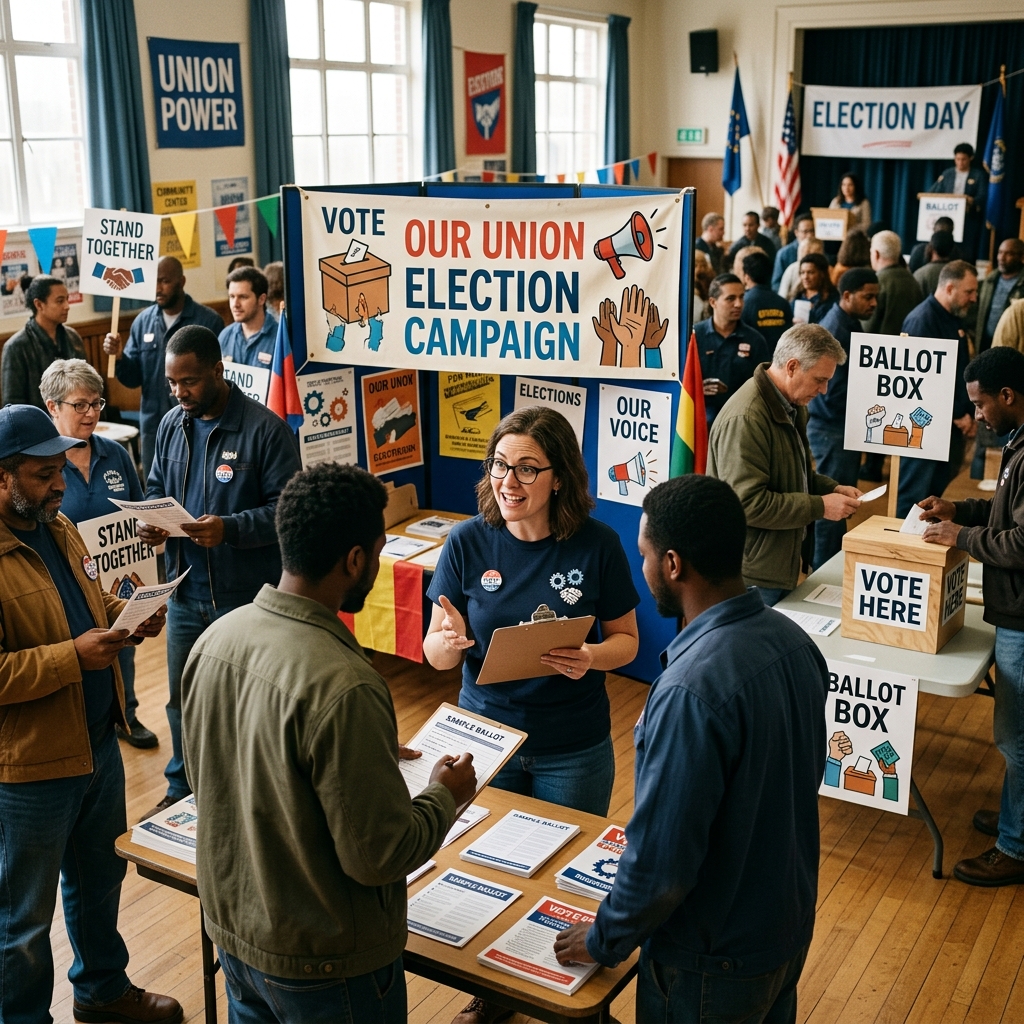
Union officer elections are central to democratic governance inside unions. They determine who negotiates contracts, administer grievance procedures, and speaks for members in dealings with employers and government agencies. Because these positions carry significant authority, federal law and union constitutions impose detailed rules on how campaigns and elections must be conducted to ensure fairness and transparency.
This article explains the key elements of union election campaigns, including legal foundations, common campaign practices, frequent violations, and options for candidates or members who believe an election was unfair. It focuses on internal union officer elections, and briefly notes how these differ from government-supervised representation elections under the National Labor Relations Board (NLRB).
Legal Foundations for Union Election Campaigns
Internal union officer elections in the United States are primarily governed by the Labor-Management Reporting and Disclosure Act (LMRDA) for most private-sector unions, along with union constitutions and bylaws. The LMRDA sets minimum standards for democratic procedures, including secret ballots, reasonable opportunities to vote, and equal treatment of candidates.
In addition, the NLRB oversees elections to determine whether employees want a union to represent them for collective bargaining. These representation elections follow a separate petition and voting process but share similar concerns about coercion, retaliation, and misinformation.
- LMRDA requirements typically apply to internal officer elections and focus on individual member rights and internal union democracy.
- NLRB rules govern representation elections where workers vote to form, join, or decertify a union, and address employer and union conduct during campaigns.
Key Differences: Internal Officer Elections vs. Representation Elections
| Feature | Internal Union Officer Elections | NLRB Representation Elections |
|---|---|---|
| Primary purpose | Choose union leaders (officers and sometimes executive board members). | Determine whether employees want union representation and which union will represent them. |
| Main legal framework | LMRDA, union constitutions, and bylaws. | National Labor Relations Act (NLRA), NLRB regulations. |
| Oversight authority | U.S. Department of Labor (Office of Labor-Management Standards) for most private-sector unions. | NLRB regional offices and Board decisions. |
| Typical voters | Union members in good standing. | Employees in an appropriate bargaining unit determined by the NLRB. |
| Common campaign issues | Use of union resources, equal access to member lists, internal politics, and eligibility rules. | Employer and union communications, threats or promises, and access to the workplace. |
Core Steps in an Internal Union Election Campaign
While each union has its own constitution and bylaws, most internal campaigns follow a similar sequence: notice, nominations, campaigning, voting, and tallying. Election committees or designated officers are responsible for administering these steps and ensuring compliance with both union rules and applicable law.
1. Election Notice and Timelines
Members must receive adequate notice of nominations and elections, including the offices to be filled, eligibility requirements, and key dates. Many union rules require that notices be mailed to members’ home addresses a certain number of days before the nomination meeting or election date, and posting only at the workplace often does not satisfy legal requirements.
- Notice must typically include date, time, and location (or method) of nominations and voting.
- Written notice is usually required; some unions explicitly mandate mailed notices rather than electronic-only communication.
- Election committees should build a clear timetable covering notice, nominations, ballot preparation, and the tally to avoid rushed or inconsistent procedures.
2. Nominations and Candidate Eligibility
During the nomination phase, members may nominate themselves or others for specific offices. The union’s constitution and bylaws typically detail eligibility criteria, such as continuous good standing, minimum membership duration, or compliance with dues obligations.
Once nominations close, the election committee must verify that each nominee meets the eligibility rules and inform candidates of their status. Any disqualification should be explained in writing to minimize disputes and potential challenges.
3. Campaign Period and Equal Access
The campaign period begins after nominations are final. Candidates are generally free to advocate for their election, but unions must treat them equally regarding access to members and use of union resources. Federal law for many unions requires compliance with all reasonable candidate requests to distribute campaign materials to the membership at the candidate’s expense.
Common provisions to ensure fairness include:
- Equal mailing opportunities, allowing each candidate to send campaign literature through the union mailing system if they cover the cost.
- Access to membership lists for inspection, often limited to viewing rather than copying, to prevent misuse while still permitting truthful outreach.
- Prohibition on using union funds or employer resources to support one candidate over another, except for neutral voter education.
4. Ballots, Voting Procedures, and Secrecy
Ballots must be designed and administered to protect the secrecy of votes and provide equal opportunity to participate. Unions may use in-person polling places, mail ballots, or a combination, but in all cases must ensure that members can vote without intimidation or improper influence.
Election officials are typically responsible for:
- Printing accurate ballots and maintaining tight control over surplus and unused ballots.
- Preparing voter eligibility lists and verifying each member’s status at the polls.
- Providing private voting booths or equivalent arrangements to protect ballot secrecy.
- Enforcing rules against campaigning in or near the polling area on election day.
5. Tallying Votes and Certifying Results
After voting closes, the union must tally ballots using procedures that are transparent, consistent, and documented. Many unions permit candidates to appoint observers to watch the counting process, and some require signed tally sheets and reports.
Key practices for a credible tally include:
- Counting all ballots in a single, continuous session where observers can attend.
- Establishing clear rules on void or challenged ballots before counting begins.
- Recording total ballots issued, returned, and counted, to detect discrepancies.
- Formally certifying the results and promptly notifying candidates and members.
Common Campaign Rules and Restrictions
Although unions can tailor their rules, certain principles recur across most constitutions and manuals. These principles aim to balance robust campaigning with protection against coercion, misuse of funds, or discriminatory practices.
Use of Union and Employer Resources
Union funds, staff time, and facilities must not be used to promote or oppose individual candidates, except in strictly neutral ways such as publishing objective candidate statements or voting instructions. Similarly, employers should not provide preferential access, equipment, or paid time that gives one candidate an advantage.
- Allowed neutral announcements of election dates and rules.
- Prohibited use of union dues to print partisan campaign flyers or pay staff to campaign for specific candidates.
- Prohibited employer assistance, such as allowing one candidate to hold on-site meetings while refusing similar access to others.
Equal Treatment of Candidates
Unions must avoid favoritism that materially affects the outcome. Unequal access to mailing services, meeting rooms, or membership lists can be grounds for challenging an election. Election committees should develop written rules that apply uniformly to all candidates and communicate them at the outset.
Member Rights During Campaigns
Individual members retain rights to support the candidate of their choice, wear buttons or distribute literature (subject to reasonable workplace rules), and attend campaign meetings. Retaliation for supporting a particular candidate, such as disciplinary actions or exclusion from union activities, may violate federal law or union policies.
Unfair Campaign Practices and Potential Violations
Despite detailed rules, disputes over campaign conduct are common. The seriousness of a violation usually depends on whether it affected the result or undermined members’ ability to vote freely. Below are frequent problem areas.
Misuse of Union Funds or Employer Support
Using union funds, staff, or employer-provided assets for partisan campaigning is a recurring basis for legal challenges. Examples include printing campaign materials at union expense, using official union newsletters to promote one slate, or allowing candidates to campaign on paid employer time without equal access.
Coercion, Threats, or Promises
Direct threats or promises tied to voting choices are generally prohibited. In representation elections overseen by the NLRB, both employers and unions may not threaten job loss, plant closure, or retaliation depending on how workers vote, nor may they promise improper benefits for supporting or rejecting union representation.
Similar principles apply in internal elections: promising positions, favors, or financial benefits in exchange for votes can be unlawful or violate union ethics rules.
Discrimination in Access or Eligibility
Selective enforcement of eligibility criteria or targeted changes to membership status to favor or disqualify specific candidates can invalidate an election. For example, applying dues rules strictly to opponents while overlooking similar issues for favored candidates may constitute discriminatory conduct.
Procedural Irregularities
Irregularities in notice, ballot distribution, or tallying can give rise to challenges, especially if they potentially altered the outcome. Examples include failing to send required notices, losing or miscounting ballots, or materially restricting the opportunity to vote for particular groups of members.
Challenging Questionable Union Elections
Members and candidates who believe a union election was unfair have several possible avenues for challenge, depending on whether the dispute involves internal rules or federal law.
Internal Union Remedies
Most union constitutions provide procedures for protesting elections, often requiring a written complaint within a short period after the tally. The complaint typically goes to the local election committee, a higher-level union body, or a designated officer.
- Review the union’s constitution and bylaws for specific timelines and filing requirements.
- Gather documentation, such as notices, ballots, emails, and witness statements.
- Request a written decision explaining whether the election will be upheld, rerun, or modified.
Government Oversight and Legal Options
For private-sector unions covered by the LMRDA, members may be able to file complaints with the U.S. Department of Labor’s Office of Labor-Management Standards if internal remedies do not resolve serious violations. In representation elections, parties may file objections with the NLRB, which can set aside results and order new elections if it finds that unlawful conduct materially affected the vote.
Because the standards and deadlines can be strict, candidates who suspect significant violations often consult attorneys experienced in labor and employment law to evaluate evidence and determine the appropriate forum for challenge.
Best Practices for Fair and Effective Union Election Campaigns
Unions, candidates, and members can all contribute to more effective and credible campaigns by following practical best practices in communication, documentation, and conflict resolution.
For Election Committees
- Develop a detailed written election plan, including notices, nominations, ballot handling, and tally procedures.
- Publish clear, neutral campaign rules and provide them to all candidates at the same time.
- Maintain accurate voter lists and track all ballots issued, returned, and counted.
- Document all major decisions and communications in writing to support transparency.
For Candidates
- Understand eligibility requirements and submit nominations on time with any required documentation.
- Request access to member lists and mailing opportunities in a manner consistent with union rules.
- Keep records of campaign spending and contributions to avoid allegations of improper funding.
- Focus messaging on issues that matter to members, such as contract enforcement, health and safety, and representation quality.
For Union Members
- Read notices carefully and verify important dates for nominations and voting.
- Ask questions about procedures if something seems unclear or inconsistent.
- Report apparent irregularities to the election committee promptly, ideally in writing.
- Participate in voting to ensure leadership reflects the membership’s priorities.
Frequently Asked Questions About Union Election Campaigns
Do union members always vote by secret ballot?
For most private-sector unions covered by federal law, local union officers must be elected by secret ballot, meaning that members mark their choices in a way that cannot be linked to their identity by union officials or other members. Unions may use mail ballots or in-person voting, but secrecy must be preserved in either method.
Can union officers use union newsletters to promote their candidacy?
Generally, official union publications should remain neutral and cannot be used to support or oppose specific candidates, except in limited ways that treat all candidates equally (such as publishing equal-length candidate statements). Using union funds to favor particular candidates can be grounds for challenging an election.
Are employers allowed to campaign in internal union elections?
Internal union officer elections are primarily internal matters, and employers typically have limited legitimate reasons to be involved. Providing unequal access, facilities, or paid time to particular candidates could raise legal concerns under labor law, particularly if the employer’s actions influence the outcome.
What if a member did not receive an election notice?
Failure to receive a notice does not automatically invalidate an election, but widespread notice problems may indicate that the union did not meet legal requirements. Members who missed voting because they did not receive notice should inform the election committee and, if necessary, consult legal counsel about potential remedies.
When should a candidate seek legal advice?
Candidates should consider consulting a labor and employment attorney if they observe serious issues such as systematic misuse of union funds, threats or retaliation, significant notice failures, or clear discrimination in access to members or resources. Early advice can help preserve evidence and meet deadlines for internal and external challenges.
References
- Conduct Elections — National Labor Relations Board. 2024-03-01. https://www.nlrb.gov/about-nlrb/what-we-do/conduct-elections
- Checklist for Conducting Local Union Officer Elections — U.S. Department of Labor, Office of Labor-Management Standards. 2023-06-15. https://www.dol.gov/agencies/olms/compliance-assistance/elections/checklist
- Local Union Election Manual — AFSCME. 2022-01-10. https://www.afscme.org/about/governance/document/AFSCME-local-union-election-manual.pdf
- Guide for Local Union Election Committees — UAW. 2024-03-01. https://uaw.org/wp-content/uploads/2024/03/Guide-Local-Union-Elections.pdf
- Checklist for Conducting Local Union Officer Elections — U.S. Department of Labor, Office of Labor-Management Standards. 2023-06-15. https://www.dol.gov/agencies/olms/compliance-assistance/elections/checklist
- What Is the Process for a Union Election, and How Does It Affect Employers? — Labor Advisors. 2023-09-20. https://laboradvisors.com/what-is-the-process-for-a-union-election-and-how-does-it-affect-employers/
Similar Articles








Read full bio of Sneha Tete




