
Supreme Court and Domestic Violence Gun Law
How the Supreme Court reshaped the constitutional analysis of firearm restrictions tied to domestic violence orders.
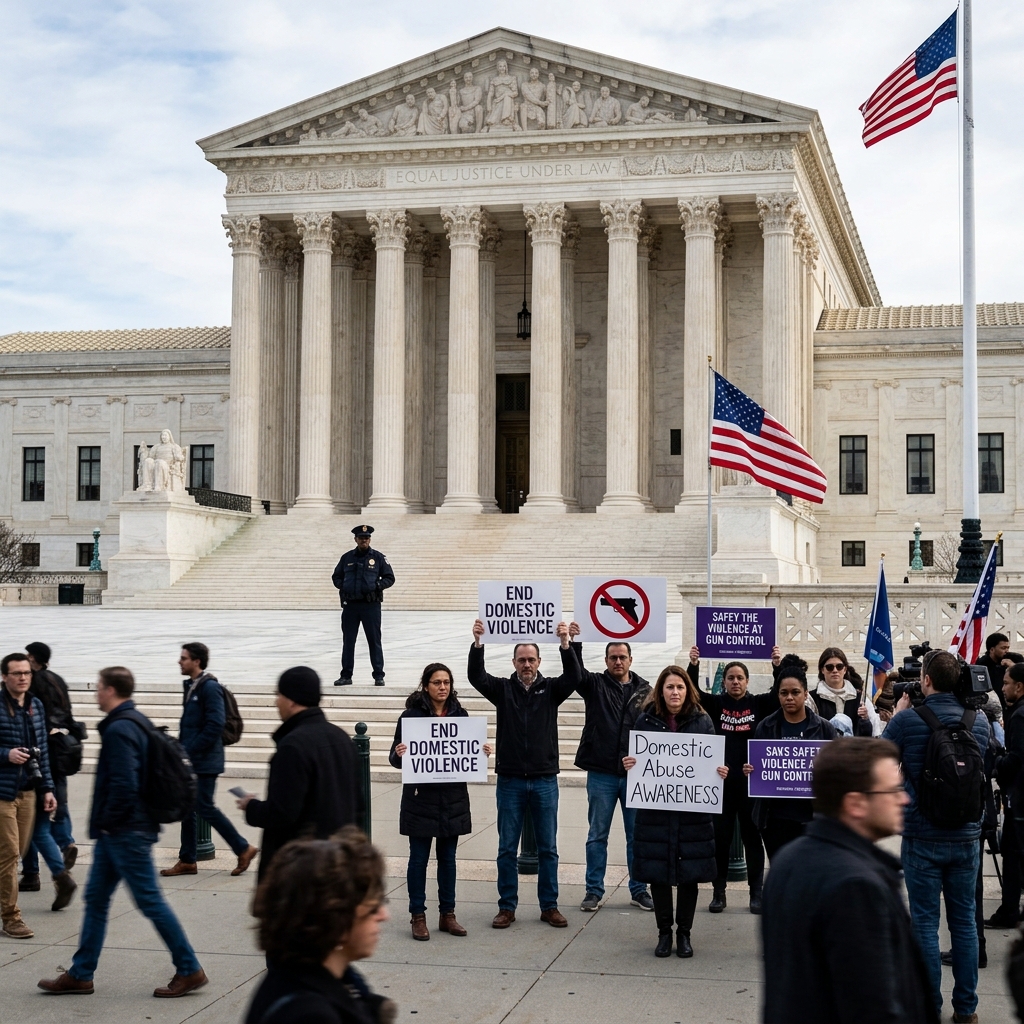
The Supreme Court’s decision in United States v. Rahimi marked a major clarification of how the Second Amendment applies when a court has found that a person poses a credible threat of violence. The ruling upheld the federal law barring certain individuals subject to domestic violence restraining orders from possessing firearms, and it confirmed that public safety can justify temporary disarmament in legally defined circumstances.
Why the case mattered
The dispute centered on a federal statute, 18 U.S.C. § 922(g)(8), which makes it unlawful for a person under a qualifying domestic violence protective order to possess a gun. The Supreme Court’s ruling was significant because it addressed a core question left unsettled after recent Second Amendment decisions: whether modern firearm restrictions can stand when they are not identical to laws from the founding era.
Before this decision, lower courts had struggled to reconcile public-safety laws with the Court’s 2022 firearms framework. That earlier approach required judges to compare modern gun regulations with historical traditions, a method that triggered uncertainty for laws aimed at preventing violence rather than regulating ordinary gun ownership.
What the Court decided
In an 8-1 ruling, the Court held that the Constitution allows the government to disarm an individual whom a court has found to pose a credible threat to another person’s physical safety.[10]
Chief Justice John Roberts wrote for the majority that the nation’s history of firearm regulation supports temporary disarmament in situations involving demonstrable danger. The Court explained that its earlier Second Amendment cases were never meant to freeze the law in time or require a one-to-one historical duplicate before a safety measure could be upheld.
The decision reversed the Fifth Circuit’s ruling that had invalidated the law. That lower court had concluded that the federal restriction could not survive the historical test announced in New York State Rifle & Pistol Association v. Bruen. The Supreme Court disagreed and restored the law’s nationwide force.[10]
The legal test the Court used
The majority emphasized that constitutional analysis should focus on whether a modern law is “relevantly similar” to historical firearm restrictions, not whether it is an exact replica. That distinction mattered because many contemporary safety laws address present-day forms of risk that the founding generation did not regulate in the same way.
Instead of requiring perfect historical twins, the Court looked for a broader pattern: when the law of the past permitted disarming people who posed a serious threat, that tradition could support similar restrictions today. In the majority’s view, the domestic violence gun ban fit within that tradition.
How the ruling changes the practical landscape
The immediate effect is that the federal prohibition remains enforceable against people covered by qualifying domestic violence protective orders. For survivors, that means a key layer of legal protection remains in place when a court has already concluded that a defendant presents a credible risk of harm.[10]
The broader impact is constitutional. Advocates and scholars expect the reasoning to influence other restrictions that apply to dangerous individuals, including some state domestic violence firearm laws, extreme risk protection orders, and related disarmament rules. While each law still must be assessed on its own terms, the decision provides stronger support for regulations tied to demonstrable danger.
Why domestic violence gun laws are treated differently
Domestic violence cases are distinct because they often involve repeated threats, coercion, and escalating conduct. A protective order is not a casual administrative label; it generally follows a judicial process in which a court has evaluated the facts and determined that restrictions are necessary.
The Supreme Court’s ruling reflects the idea that the government may act before violence occurs, rather than waiting until a weapon is used. That preventive logic is central to domestic violence policy, where the risk of serious injury or death can increase when firearms are present.[10]
What happened to the Fifth Circuit approach
The Fifth Circuit had adopted a stricter reading of the post-Bruen framework and found no historical analogue close enough to justify § 922(g)(8). The Supreme Court rejected that approach as too rigid, warning that constitutional doctrine should not become a search for antiquarian matchups that ignore modern public safety problems.
By restoring the statute, the Court signaled that the Second Amendment does not prevent all firearm restrictions; it requires courts to examine whether the law fits within a historically grounded tradition of regulation. That is a narrower and more contextual inquiry than the one the Fifth Circuit applied.
Key takeaways for lawyers, judges, and the public
- The federal domestic violence firearm ban remains constitutional when applied to individuals covered by qualifying restraining orders.
- Courts may look to historical traditions of disarming dangerous persons without demanding identical laws from the 1700s.
- The ruling strengthens the government’s ability to use firearm restrictions as a preventive tool in high-risk domestic violence situations.[10]
- The decision likely supports other dangerous-person disarmament laws, though future cases may still test the limits of that reasoning.
Comparison of the main legal positions
| Issue | Fifth Circuit | Supreme Court |
|---|---|---|
| Historical analysis | Required a very close founding-era analogue | Allowed laws that are relevantly similar in purpose and burden |
| Firearm restriction | Invalidated the domestic violence gun ban | Upheld the ban as constitutional |
| Core principle | Strict historical matching | Tradition-based but flexible constitutional review |
| Public safety effect | Would have weakened enforcement | Preserved a tool for preventing armed abuse |
What this means for future Second Amendment cases
The ruling does not end Second Amendment litigation, but it does give courts clearer guidance. Laws directed at people who have been found to present a credible threat are on firmer ground than rules that broadly burden ordinary lawful possession without a demonstrated safety justification.
Future cases will likely focus on how closely a modern regulation must resemble historical practice, how courts define “relevantly similar,” and whether the government can show a well-supported public safety rationale. The decision suggests that context, rather than rigid formalism, will matter more in those disputes.
Frequently asked questions
Did the Supreme Court create a new gun regulation?
No. The Court upheld an existing federal law and explained why it fits within the Second Amendment’s historical tradition.
Does the ruling apply only to one defendant?
No. Although the case involved one person, the decision validates the federal statute itself, which applies to similarly situated individuals nationwide.[10]
Does this mean all gun restrictions are constitutional?
No. The Court addressed a law aimed at people found by a court to pose a credible threat. Other gun laws will still be judged on their own facts and history.
Why is a restraining order important in this context?
A qualifying restraining order means a court has already made findings about risk or abusive conduct, which is part of why the law allows temporary disarmament.
Could this influence state laws too?
Yes. The reasoning is likely to affect state domestic violence firearm restrictions and other laws focused on individuals who present a serious danger.
References
- United States v. Rahimi — Supreme Court of the United States. 2024-06-21. https://www.supremecourt.gov/opinions/23pdf/22-915_2co3.pdf
- Supreme Court upholds federal ban on guns for domestic abusers — NPR. 2024-06-21. https://www.npr.org/2024/05/23/1252764853/supreme-court-guns
- Supreme Court upholds bar on guns with domestic-violence restraining orders — SCOTUSblog. 2024-06-21. https://www.scotusblog.com/2024/06/supreme-court-upholds-bar-on-guns-with-domestic-violence-restraining-orders/
- Supreme Court upholds gun law to protect domestic violence victims — Associated Press. 2024-06-21. https://apnews.com/article/supreme-court-guns-domestic-violence-d63ee828e51911cc5e5a01780820f224
- United States v. Rahimi — Everytown for Gun Safety. 2024-06-21. https://www.everytown.org/rahimi-scotus/
Similar Articles








Read full bio of Sneha Tete


