
Supreme Court DNA Swabs and the Fourth Amendment
Exploring how a landmark Supreme Court ruling reshaped police DNA collection and Fourth Amendment privacy protections.
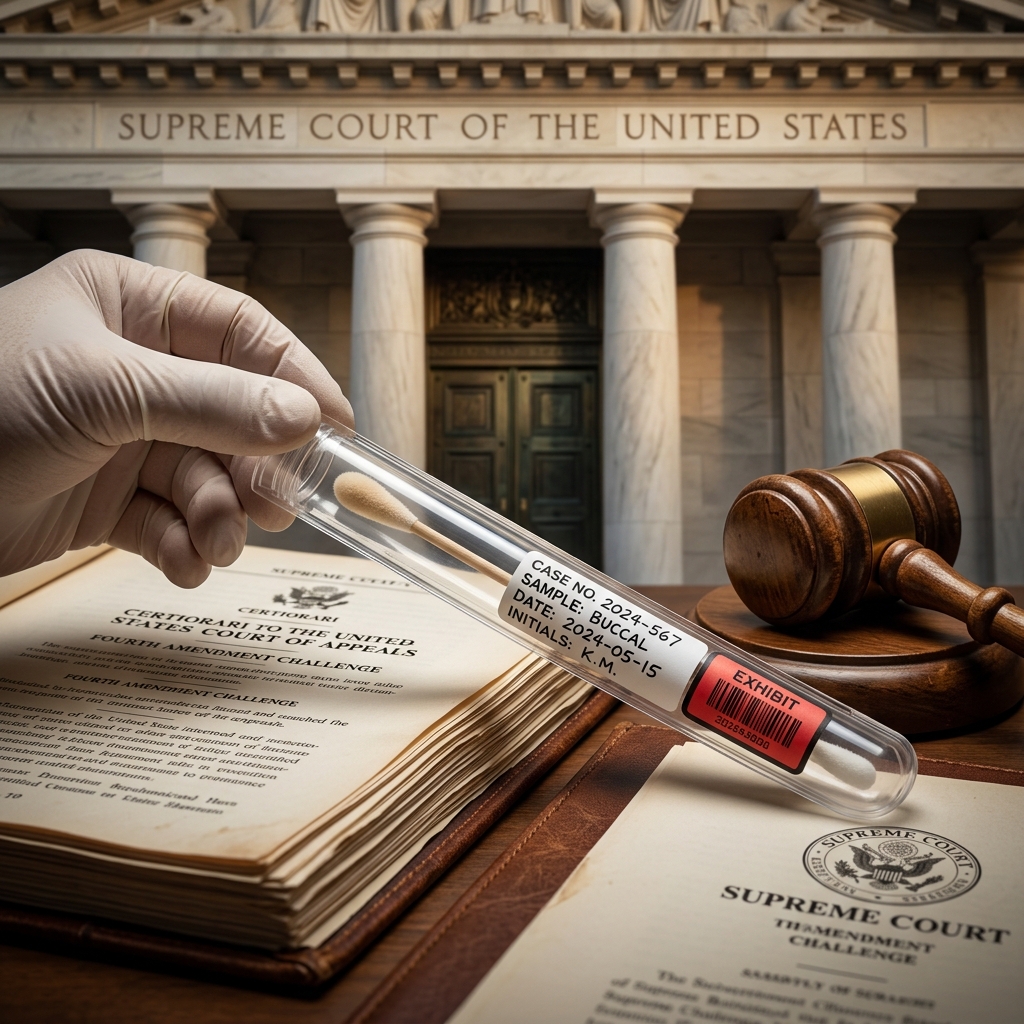
The question of whether police may collect DNA samples without a warrant from people who have been arrested sits at the intersection of modern technology and long-standing constitutional protections. In Maryland v. King (2013), the United States Supreme Court held that, in many circumstances, officers may lawfully swab an arrestee’s cheek for DNA as part of the routine booking process, even before any conviction, without violating the Fourth Amendment. This ruling has reshaped debates over privacy, identification, and the permissible scope of criminal investigations.
From Cheek Swab to Supreme Court: The Background
The case that brought this issue to national prominence began in Maryland, where state law allowed police to collect DNA from individuals charged with certain serious offenses. After an arrest supported by probable cause, officers were authorized to take a buccal swab—a quick, gentle wipe of the inside of a person’s cheek to collect cells for DNA analysis. That sample was then run through national databases to see if it matched DNA from unsolved crimes.
Alonzo King was arrested in 2009 on an assault charge. During booking, officers collected his DNA under Maryland’s statute. Months later, the sample matched DNA from an unsolved 2003 rape, leading to King’s conviction in that case. King challenged the law, arguing that the warrantless DNA collection at the time of arrest was an unreasonable search under the Fourth Amendment.
Maryland’s highest court agreed with King and invalidated portions of the law, holding that his privacy interests outweighed the state’s claimed need for DNA at booking. The state appealed, and the U.S. Supreme Court ultimately reversed, concluding that the DNA swab was a reasonable search.
How the Court Viewed DNA Swabs As a Search
The Fourth Amendment protects people against unreasonable searches and seizures, and any physical intrusion to collect biological material is considered a “search.” The Supreme Court openly acknowledged that using a buccal swab to obtain DNA from the inside of a person’s cheek is a search within the meaning of the Fourth Amendment.
However, the majority emphasized the very limited physical intrusion associated with a buccal swab compared to more invasive procedures, such as drawing blood. The process is typically described as:
- Quick—taking only a few seconds.
- Painless—no needles or penetration beneath the skin.
- Routine—performed in a controlled booking environment by trained personnel.
According to the Court, this minimal bodily intrusion was a critical part of the constitutional analysis. The justices also noted that arrestees already experience a range of booking procedures, including fingerprinting, photographing, and inventory searches of personal items, all of which involve some invasion of privacy.
Balancing Government Interests and Individual Privacy
Central to the Court’s reasoning was the classic Fourth Amendment balancing test: weighing the government’s interests against the degree of intrusion on the individual’s privacy. The majority identified several important government interests served by DNA collection at arrest:
- Reliable identification of arrestees, including verifying identity and discovering criminal history.
- Linking suspects to unsolved crimes by matching DNA with evidence from past investigations.
- Protecting public safety by more accurately assessing the risk posed by detainees in custody.
The Court characterized DNA analysis used in these contexts as a powerful form of identification, analogous to but more precise than fingerprinting. DNA profiles used for law enforcement purposes typically rely on specific genetic markers—known as CODIS loci—that are designed to identify individuals without revealing sensitive medical or familial information. The majority concluded that, when properly limited to identification, the state’s interests were substantial.
On the other side of the balance, the Court recognized that arrestees retain privacy interests, but noted they are diminished once a person has been lawfully taken into custody for a serious offense. Because arrestees are already subject to significant restrictions—such as searches of their person and belongings—the additional privacy impact of a cheek swab was viewed as modest.
Key Holding: DNA Swabs as Routine Booking for Serious Offenses
The Supreme Court’s core holding in Maryland v. King can be summarized as follows:
- When police make an arrest supported by probable cause for a serious offense and bring the suspect to the station for detention, taking and analyzing a cheek swab of the arrestee’s DNA is a legitimate booking procedure under the Fourth Amendment.
- A warrant is not required for this DNA collection, because the individual is already in valid custody based on probable cause.
- The procedure is reasonable when used for identification purposes and carried out under statutory safeguards.
In other words, for qualifying serious crimes, DNA collection is treated much like fingerprinting or photographing: a routine step that helps authorities confirm who they have in custody and link that person to prior criminal activity.
| Booking Procedure | Purpose | Intrusiveness |
|---|---|---|
| Fingerprinting | Identify suspect; check prior record | Minimal physical contact with fingers |
| Photographing | Create visual record of suspect | Non-contact, visual capture |
| Buccal DNA swab | Identify suspect; match to DNA evidence | Quick, painless swab inside cheek |
Statutory Safeguards and Data Handling
Maryland’s statute, and similar laws in other jurisdictions, typically include procedural safeguards intended to limit the risk of misuse of DNA information. For example, the Maryland law contained provisions specifying when DNA could be collected, how it could be used, and when it must be destroyed.
Important safeguards discussed in legal analyses include:
- Limiting DNA testing to loci used for identification, rather than revealing medical or genetic traits.
- Requiring destruction of samples if charges are dismissed or probable cause is not established at arraignment.
- Prohibiting testing for purposes unrelated to identification, such as health information or familial profiling beyond what is authorized by law.
These safeguards are central to the Court’s assumption that DNA collection is used narrowly for identification rather than broad surveillance of genetic information. As technology advances, the adequacy and enforcement of such limits remain crucial policy questions.
Dissenting Views: Suspicionless Searches and Evidence Gathering
The Court’s decision was sharply divided, with a four-justice dissent arguing that the practice violated the Fourth Amendment. The dissent focused on a different understanding of what the state was doing when it collected DNA at arrest.
Where the majority emphasized identification, the dissent argued that the true purpose was to search for evidence of other crimes, not to confirm who the suspect was. In their view, the Fourth Amendment generally forbids searching a person for evidence of a crime when there is no particular basis to believe that person is connected to that crime.
The dissent underscored several points:
- DNA collection at arrest is suspicionless with respect to unsolved crimes; it seeks evidence based solely on the fact of arrest.
- The historical rule of the Fourth Amendment requires a warrant and individualized suspicion before searching for evidence.
- Allowing routine DNA collection risks eroding the categorical protections against broad, evidence-gathering searches without cause.
From this perspective, the relative physical comfort of the cheek swab was not the decisive issue. Instead, the dissent highlighted the powerful informational potential of DNA databases and warned that normalizing suspicionless collection could lead to expansive government monitoring.
Practical Impact on Police and Arrestees
Following Maryland v. King, many states and the federal government either confirmed or expanded policies allowing DNA collection from arrestees, particularly in felony cases. News reports and commentary noted that, under such laws, a person’s DNA could be taken even if they were never ultimately convicted, so long as the arrest was supported by probable cause.
For arrestees, the ruling means that being booked for a qualifying offense may result in placement of their DNA profile in a national database—sometimes temporarily, sometimes longer, depending on the outcome of the case and applicable state rules. While safeguards require removal when charges are dropped or probable cause fails, the process raises practical questions:
- How quickly are profiles removed when required by law?
- What remedies exist if DNA is misused or retained contrary to statute?
- How transparent are database operations and oversight mechanisms?
Law enforcement agencies, on the other hand, view DNA databases as powerful tools that can connect seemingly unrelated crimes and close cases that might otherwise remain unsolved. The ruling affirmed that, at least for serious offenses and under appropriate safeguards, they may continue to rely on DNA as part of routine booking.
Ongoing Debates About Privacy and Technology
Although the Supreme Court settled the constitutional question for the specific facts in Maryland v. King, broader debates continue. Legal scholars, privacy advocates, and policymakers regularly discuss how rapidly developing genetic technologies should be regulated to protect civil liberties while enabling legitimate law enforcement uses.
Several themes recur in this discussion:
- Scope of qualifying offenses: Whether DNA should be collected only for violent felonies, or also for lesser crimes.
- Data retention and destruction: How long profiles should remain in databases and under what conditions they must be purged.
- Informational privacy: Ensuring that the loci used for law enforcement do not reveal sensitive health or familial information.
- Oversight and accountability: Implementing clear rules, independent audits, and remedies for misuse.
The line between identification and investigation is particularly important. The Supreme Court’s reasoning rests heavily on the idea that DNA is being collected to identify arrestees, but critics worry that, in practice, the distinction between identification and evidence-gathering may blur.
Frequently Asked Questions
Is a cheek swab for DNA really considered a search?
Yes. Both the Supreme Court and legal commentators recognize that using a buccal swab to obtain DNA from inside a person’s cheek constitutes a search under the Fourth Amendment, because it involves a physical intrusion to collect biological material.
Do police need a warrant to take DNA from someone who has just been arrested?
Under Maryland v. King, when officers make an arrest supported by probable cause for a serious offense and bring the suspect to the station to be detained, they may take a cheek swab for DNA as part of routine booking without a warrant, provided statutory safeguards are followed.
What kinds of crimes allow DNA collection at the time of arrest?
The exact list depends on state law, but the Supreme Court’s decision focused on serious offenses, often including crimes of violence, burglary, and certain qualifying felonies. Many jurisdictions limit warrantless DNA collection to these more serious categories.
Can the DNA collected at arrest be used to look for genetic health information?
No, not lawfully. Statutes such as Maryland’s restrict testing to markers used for identification and explicitly prohibit analyzing samples for unrelated genetic information, such as health conditions or traits. Misusing DNA beyond these limits would violate both law and constitutional assumptions underlying the Supreme Court’s decision.
What happens to my DNA profile if charges are dropped or there is no probable cause?
Under laws like Maryland’s, if a judicial officer determines there is no probable cause to detain an individual for a qualifying offense, the DNA sample is supposed to be destroyed and the profile removed from the database. How promptly and accurately this occurs depends on enforcement of statutory procedures.
References
- Maryland v. King, 569 U.S. 435 (2013) — U.S. Supreme Court via Justia. 2013-06-03. https://supreme.justia.com/cases/federal/us/569/435/
- Supreme Court Rules Police Can Swab for DNA Upon Arrest — PBS NewsHour. 2013-06-03. https://www.pbs.org/newshour/politics/supreme-court-rules-police-can-swab-for-dna-upon-arrest
- U.S. Supreme Court Says Warrantless Cheek Swab for DNA of Arrestee is Constitutional — Riddell Law. 2013-06-04. https://www.riddelllaw.com/cheek-swab-dna-constitutiona/
- Maryland v. King: The Use of a Buccal Swab to Obtain a Defendant’s DNA — University of Baltimore Law Forum. 2013. https://scholarworks.law.ubalt.edu/cgi/viewcontent.cgi?article=2400&context=lf
- Maryland v. King — Electronic Privacy Information Center (EPIC). 2013. https://epic.org/documents/maryland-v-king-2/
- What the Supreme Court Hasn’t Told You About DNA Databases — Promega Corporation. 2013-07-10. https://www.promega.com/resources/profiles-in-dna/2013/what-the-supreme-court-hasnt-told-you-about-dna-databases/
Similar Articles








Read full bio of Sneha Tete




