
State Minimum Wage Laws: Employer Compliance Guide For 2025.
A practical guide to how state minimum wage rules work, where federal law still matters, and what employers must watch.
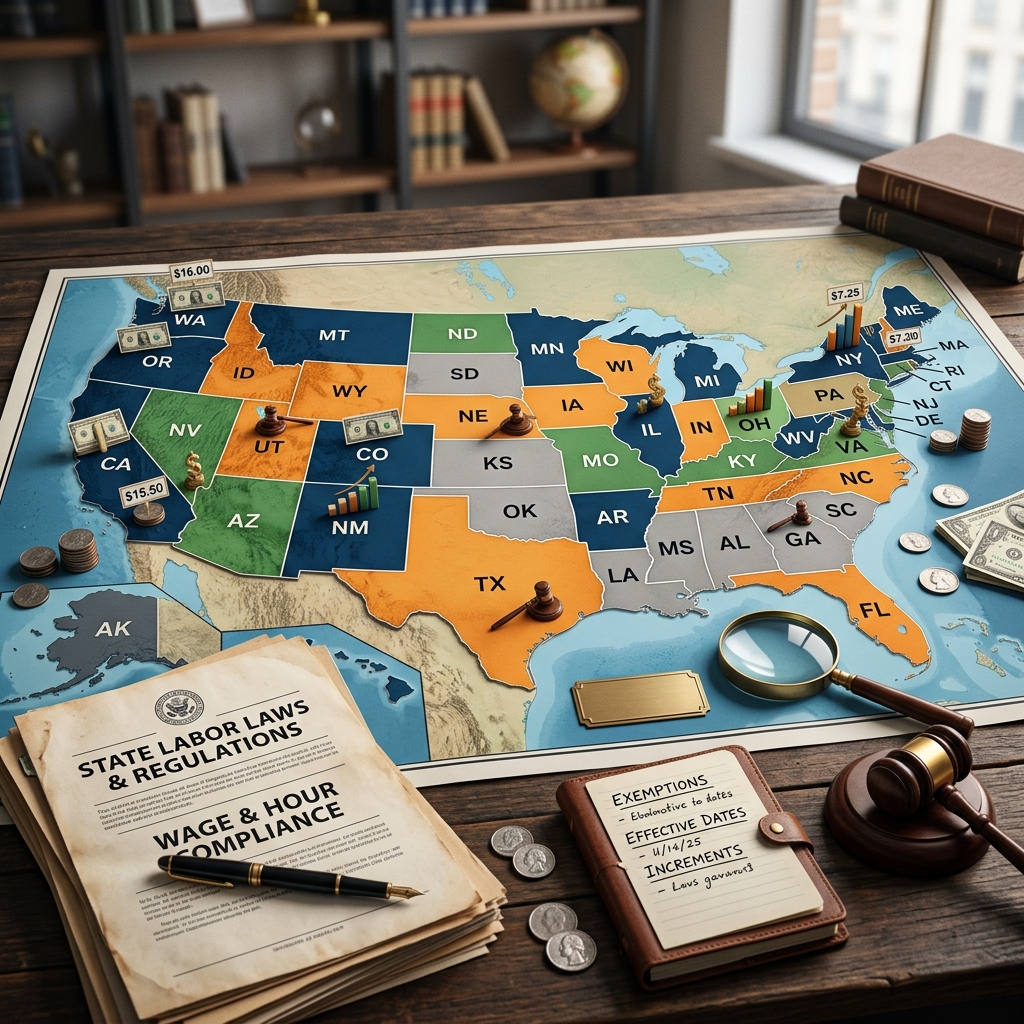
Understanding State Minimum Wage Laws
Minimum wage laws set the lowest hourly rate an employer can legally pay most workers. In the United States, that floor is shaped by both federal law and state law, and in some places local ordinances add another layer of rules. The practical result is simple: employers usually must pay the highest rate that applies to the employee’s work location and job classification.
The federal minimum wage remains $7.25 per hour under the Fair Labor Standards Act, but many states have adopted higher rates. Some states also update their wage floors automatically through inflation indexing or scheduled increases. That means the number on the calendar can change without a new legislature vote each time. For workers and employers, the key question is not just what the federal minimum wage is, but which wage law controls in the specific workplace.
- Federal law sets a national baseline.
- State law may require a higher rate.
- Local law may also impose a higher wage in some cities or counties.
- Employers must generally follow the rule most favorable to the employee.
How Federal and State Rules Interact
Federal wage law does not replace state wage law. Instead, it acts as a floor. If a state sets a wage above the federal amount, employers covered by both laws must pay the higher state rate. If a state has no minimum wage law or sets a rate below the federal standard, the federal rate applies to covered workers. The U.S. Department of Labor explains that employers subject to the FLSA must pay at least the federal minimum wage, while many states require more.
This overlap matters because states are not uniform. Some states have no separate minimum wage law. Others have statutory rates that are effectively superseded by federal law when the state amount falls below $7.25. Still others maintain a higher state wage and may also regulate overtime triggers, tip credits, or special rules for certain industries. The employer’s compliance obligation depends on the law that gives the worker the better protection.
| Rule Type | General Effect |
|---|---|
| Federal minimum wage | Applies nationwide to covered nonexempt workers |
| Higher state minimum wage | Overrides the federal floor for covered workers in that state |
| Lower or absent state law | Federal wage controls for covered workers |
| Local minimum wage | May apply if city or county law is higher than state and federal law |
Why State Minimum Wages Vary So Much
State legislatures choose different wage levels for different policy reasons. Some states tie minimum wage increases to inflation so the rate rises over time without repeated legislative action. Other states use phased increases that climb over several years. A few states keep wages aligned with the federal minimum, while others allow the wage to rise substantially above it.
According to the National Conference of State Legislatures, many states now have minimum wages above the federal rate, and several have automatic annual adjustments. That means a nationwide business cannot rely on a single payroll number for every location. A company with stores in multiple states may need different pay rates for employees doing similar work depending on where they are stationed.
Because wage laws can change through ballot measures, legislation, or indexing, employers should not assume last year’s rate still applies. Payroll teams often review state wage schedules at the start of each year, and in some states, again midyear when a scheduled increase takes effect.
States Without a Separate Minimum Wage Law
In some states, there is no separate state minimum wage statute. In those places, the federal minimum wage generally fills the gap for covered workers. The Economic Policy Institute and the U.S. Department of Labor both identify states where federal law functions as the operative wage floor.
For workers, the absence of a state wage law does not mean an employer can pay any amount it wants. If the employee is covered by the FLSA, the employer still owes at least the federal minimum wage. For employers, the key issue is determining coverage under federal wage law and then applying any higher local rule that may exist.
When State Law Sets a Lower Wage Than Federal Law
Some states have wage rates below $7.25 on the books, but that lower amount does not control for employees covered by the FLSA. Georgia and Wyoming are often used as examples because their state minimums are below the federal floor, yet covered employees still receive the federal rate.
This arrangement can be confusing because a state statute may list a lower number, but employers are not free to pay that lower number to covered workers if federal law applies. In practice, the federal minimum wage preempts the lower state rate for those workers. The lower state figure may still matter for limited categories of workers not covered by federal wage law, but that is a narrower exception rather than the norm.
Higher State Minimum Wages and Automatic Increases
Many states have gone beyond the federal floor. Some of the highest statewide minimum wages are now well above $15 per hour, and others continue to rise through scheduled annual increases. States such as California, Colorado, and Arizona illustrate how state wage laws can be set above the federal baseline and then adjusted over time.
Automatic indexing is especially important. When a state links the minimum wage to inflation or another formula, the wage can change each year without a new public debate. That creates stability for workers but requires ongoing attention from employers. A business that fails to update its payroll system could underpay employees even if it originally complied the prior year.
- Some states increase wages on a fixed schedule.
- Some states use inflation indexing.
- Some states rely on ballot measures to trigger future increases.
- Annual compliance reviews are essential in all three models.
Special Rules for Tipped Employees
Tipped workers are a major exception in minimum wage law. Under federal law, employers may use a tip credit in some circumstances, paying a direct cash wage of $2.13 per hour so long as tips make up the difference and total earnings reach at least $7.25 per hour. If tips do not make up the gap, the employer must cover the shortfall.
But state law can narrow or eliminate the tip credit. Several states require tipped workers to receive the full state minimum wage before tips are added. Others allow a tip credit but set different thresholds or recordkeeping requirements. The result is that an employer must check the specific state rule before using a federal-style tipped wage.
For tipped staff, the practical question is not simply how much the employer pays in cash, but whether the full compensation structure satisfies the law after tips are included. That makes payroll records and tip reporting especially important in restaurants, bars, hotels, and other service industries.
Common Compliance Issues for Employers
Minimum wage compliance is not only about the posted hourly rate. Employers also need to consider job classification, exemptions, credits, overtime triggers, and local wage laws. A worker may be covered by a state minimum wage even if the employer assumes federal law alone applies. In multi-state operations, this problem becomes more complex because each location can have a different wage floor.
Some of the most common mistakes include misclassifying tipped employees, using an outdated wage table, ignoring a city minimum wage ordinance, or failing to raise pay after a scheduled state increase. Employers also need to remember that wage obligations can differ by employee category, such as minors, learners, or certain seasonal workers, depending on state law. When in doubt, payroll compliance should be based on the most protective rule that actually applies.
| Compliance Risk | Why It Matters |
|---|---|
| Outdated wage rates | Can lead to back pay liability |
| Ignoring local ordinances | City or county rates may exceed state law |
| Improper tip credit use | May violate state or federal wage rules |
| Misclassification | Can affect whether minimum wage protections apply |
How Workers Can Check Their Pay Rights
Workers who want to verify whether they are being paid correctly should start by identifying three things: the state where the work is performed, whether any local minimum wage applies, and whether the employee is covered by the FLSA. The U.S. Department of Labor provides state-by-state minimum wage information, and state labor agencies often publish their own current wage charts.
Employees in tipped positions should also review whether their pay stubs show a direct wage, tips received, and any employer credit taken against the minimum wage. If total compensation drops below the legally required threshold, the employer may owe make-up pay. In addition, workers should keep their own records of hours worked, because time records are often central in a wage dispute.
Where Minimum Wage Law Is Heading
Minimum wage policy continues to move upward in many jurisdictions. NCSL data shows that numerous states and territories have wages above the federal floor, with scheduled increases already enacted in several places. That trend suggests that federal law is no longer the only meaningful benchmark in wage compliance. Instead, employers increasingly operate in a patchwork system where state and local governments set the pace.
For workers, that may mean higher pay protections depending on where they live or work. For employers, it means wage compliance is no longer a once-a-year task. It is an ongoing process of tracking legislative changes, preparing for new rates, and making sure payroll systems are updated before the effective date arrives.
Frequently Asked Questions
Does the federal minimum wage apply everywhere?
The federal minimum wage applies to covered nonexempt workers under the Fair Labor Standards Act. If a state or local law requires more, the higher rate generally controls.
Can a state minimum wage be lower than the federal minimum wage?
A state can list a lower wage on its books, but covered employees still receive the federal minimum wage when federal law applies. In practice, the federal rule sets the pay floor for those workers.
Do all tipped workers have to be paid the same way?
No. Federal law allows a tip credit in some cases, but many states require a higher direct cash wage or prohibit the tip credit altogether. Employers must follow the rule that offers the greater protection.
What happens if a city wage is higher than the state wage?
The employer generally must follow the higher local rate if that ordinance applies to the workplace. The governing principle is to pay the highest legally required wage.
How often do minimum wage rates change?
It depends on the state. Some rates stay fixed until lawmakers change them, while others rise automatically through indexing or scheduled increases.
References
- State Minimum Wages — National Conference of State Legislatures. 2026-06-01. https://www.ncsl.org/labor-and-employment/state-minimum-wages
- State Minimum Wage Laws — U.S. Department of Labor. 2026-06-01. https://www.dol.gov/agencies/whd/minimum-wage/state
- Federal vs. State Minimum Wage: 2026 Guide — APS Payroll. 2026-01-01. https://apspayroll.com/blog/federal-state-min-wage/
- Minimum Wage Rate in the US by State (2026) — Paycom. 2026-01-01. https://www.paycom.com/resources/blog/minimum-wage-rate-by-state/
- Minimum Wage — U.S. Department of Labor. 2026-06-01. https://www.dol.gov/agencies/whd/minimum-wage
- Minimum wage — USA.gov. 2026-06-01. https://www.usa.gov/minimum-wage
- Minimum Wage Tracker — Economic Policy Institute. 2026-06-01. https://www.epi.org/minimum-wage-tracker/
Similar Articles








Read full bio of Sneha Tete




